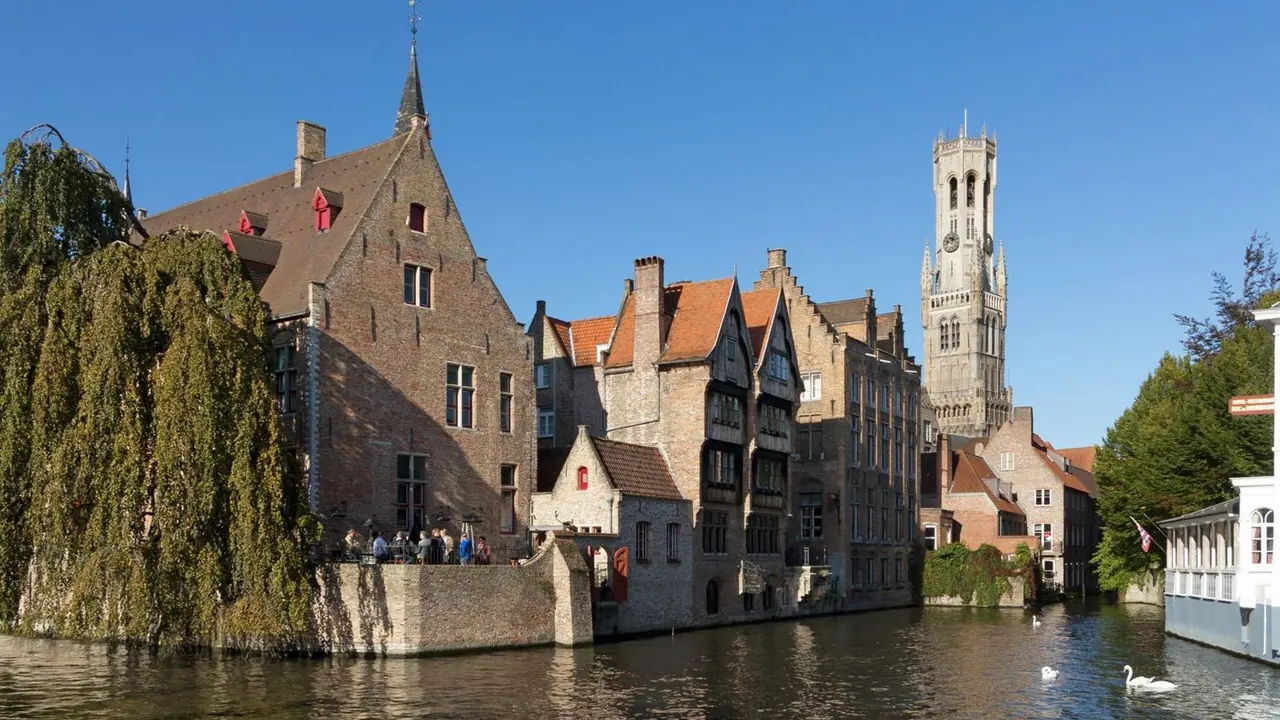
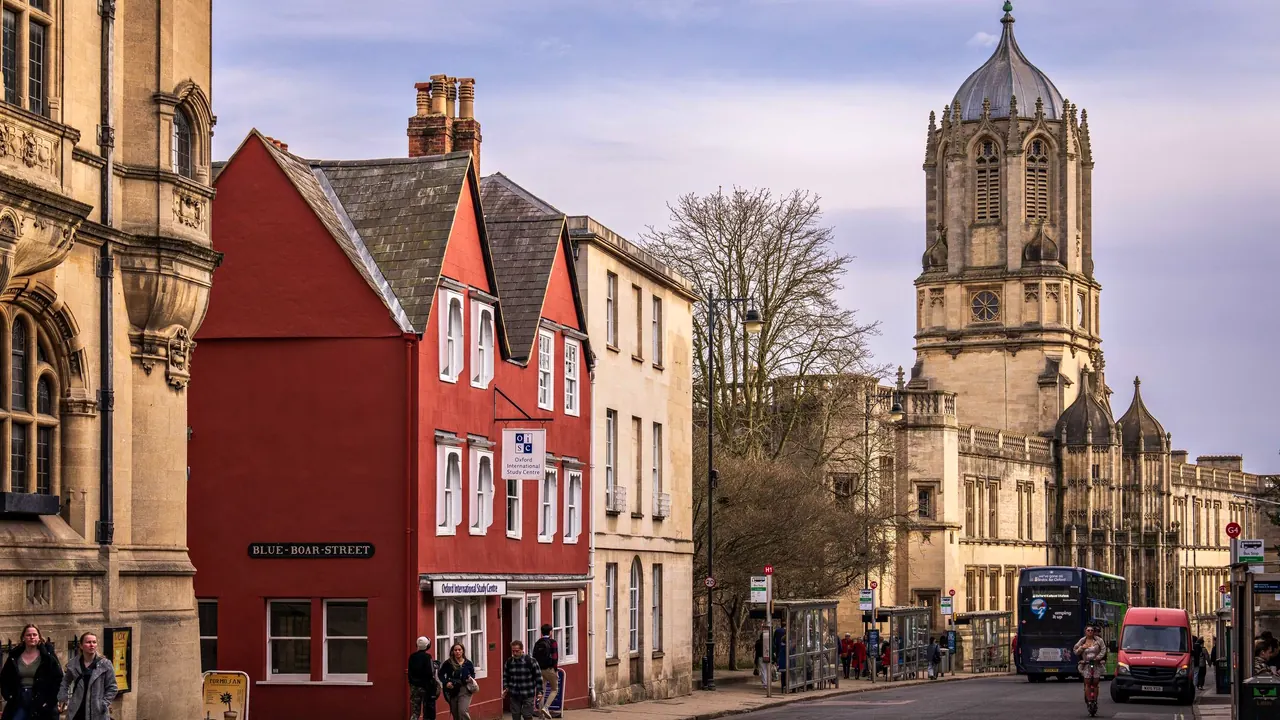
Photos: Bruges by Michielverbeek, CC BY-SA 4.0, cropped; Oxford by Mark Stebnicki, Pexels License.
Bruges or Oxford?
Our verdict in twelve categories, each scored against the same fixed benchmark cities, and the climate month by month, so you can choose for your trip.
Choose Bruges for
- beaches
- food and drink
- wellness
Bruges suits a slow, romantic trip built around canals, Flemish painting and Belgian beer. Its whole centre is a medieval townscape you can walk in a morning, its beer cafés and chocolate shops give the stay its flavour, and the quiet east-side streets stay calm all day. Fast, frequent trains to Ghent, Brussels, Antwerp and the coast mean you can use it as a base for Flanders without ever needing a car.
Choose Oxford for
- live music and the arts
- nature and the outdoors
- nightlife
Oxford is the better pick if you want a living university town with more to do in the evenings and better walking country close by. Choral Evensong in the college chapels, concerts at the Sheldonian and a wider range of pubs and bars give the nights more variety. Its free museums are broad, and the Cotswolds, the Chilterns, Blenheim and London are all within reach for day trips.
Scoreboard
Twelve categories on one fixed scale from 0 to 100. The shaded stretch is the gap between the two.
Your match
Pick a travel style or drag the sliders, and both match scores follow your weighting.
Too close to call, 1 point apart
Wins on beaches and food and drink with your weighting.
Wins on live music and the arts and nature and the outdoors with your weighting.
What matters to you?
Category by category
What the scores mean for a trip.
Beaches & swimming
Neither city is a beach destination, but Bruges at least has the sea close by. A short train ride to Blankenberge and the coast tram give you a long line of wide, flat sand with promenades, from the dunes near France up to Knokke. The North Sea stays cool and often windy, so expect paddling and a bracing dip rather than proper swimming.
Oxford is about as far from the coast as England gets. Swimming there means the Thames at Port Meadow, the Cherwell or the open-air pool at Hinksey, with grassy banks instead of sand. It's fine on a hot afternoon, but it doesn't replace a beach.
Food & drink
Bruges gives you more to eat and drink for its own sake. Its beer cafés pour long lists of Trappist and abbey ales, each in its own glass, and there are mussels with frites, beef stewed in beer, waterzooi and chocolate in every street. Avoid the set menus on the main squares and eat on the side streets and canalsides.
Oxford's strength is the pub: low-beamed taverns, riverside Sunday roasts and the old Covered Market for lunch. For variety you go out to Cowley Road's Middle Eastern, South Asian and Caribbean kitchens or to the bistros of Jericho. You'll eat well, but there is no local cuisine to seek out.
Culture & sights
Both are outstanding historic cities, but they offer different kinds of experience. Bruges is a whole medieval townscape of canals, stepped gables, almshouses and the Belfry over the Markt. Its art is concentrated and superb: the Flemish Primitives in the Groeninge Museum, Memling in St John's Hospital and Michelangelo's Madonna in the Church of Our Lady.
Oxford is a working university, with honey-stone quadrangles, chapels and libraries clustered around the Radcliffe Camera and the Bodleian. Its museums cover more ground: antiquities and old masters at the Ashmolean, ethnography at the Pitt Rivers, and the Gothic glass hall of the Natural History Museum. That is enough for a day or so more than Bruges needs.
Nightlife
Oxford gives you somewhat more choice after dark. In term the historic taverns fill with students. On summer evenings the riverside pubs along the Thames are the place to be. Cowley Road adds late bars and a couple of small clubs, and Jericho has relaxed wine and cocktail bars. It all goes quieter during the university's long summer break.
Bruges is built for one kind of evening: a long session over strong ales in a brown café or vaulted cellar, perhaps around the Eiermarkt or 't Zand. After that comes a walk by the lit canals. Clubs are few and mostly busy at weekends, and the centre is largely asleep by midnight.
Nature & outdoors
Oxford has the better countryside, and it starts in the centre, with Christ Church Meadow, the University Parks and the open commons of Port Meadow. Within an hour you reach the Cotswold hills, the Chiltern beech woods and the ancient Ridgeway, real country for long walks, and you can punt on the rivers.
Bruges sits in flat polder land with wide skies and poplar-lined canals. It's made for easy cycling, above all the towpath ride to Damme. The Zwin salt marsh near Knokke adds birdlife and the dunes give you windy walks, but there are no hills or forests.
Day trips
From Bruges the day trips are mostly city to city by train, while Oxford's lean towards country houses and stone villages. Ghent is under half an hour away, with a medieval centre to rival Bruges's own and the Van Eyck altarpiece in its cathedral. Brussels and Antwerp make easy days out. Closer in, Damme is a bike ride along the canal, and the First World War cemeteries and memorials around Ypres are about an hour away by bus or car.
Oxford's best outings are close and rural. Blenheim Palace at Woodstock is about twenty minutes away, and the Cotswold villages such as Burford, Bibury and Chipping Campden are within an hour. Stratford-upon-Avon, Warwick Castle, Windsor and Georgian Bath add to the list, and London is an hour away by train. Some of the Cotswold trips are much easier with a car or a tour.
Good for families
With children, the two are about equal: small, safe and walkable, with only a few days of child-friendly outings. Bruges has canal boats, horse-drawn carriages, the chocolate and frites museums, swans on the Minnewater and Boudewijn Seapark. Sandcastles on the coast are a short train ride away. The cobbles are hard work with a pushchair.
Oxford's winners are free: dinosaur skeletons at the Natural History Museum and the curiosities of the Pitt Rivers. Add punting on the Cherwell and Harry Potter scenes at Christ Church. Wildlife parks and the studio tour mean a trip out of town.
Getting around
Both centres are small, flat and best on foot or by bike. In Bruges everything sits inside the egg-shaped canal ring, largely car-free, and cycling is how locals get about. The station is just outside the ring, a fair walk or a short bus ride from the Markt, and the cobbles are hard on ankles and suitcases.
Oxford's core takes about twenty minutes to cross, and the station is a short walk away. Buses reach suburbs such as Headington and Summertown. Drivers leave the car at the park-and-ride sites on the edge of town.
Shopping & style
Oxford has more to browse. Beyond the chains on Cornmarket there are the Covered Market's small traders, independents on Little Clarendon Street and in Jericho, and antique map and print sellers. Blackwell's on Broad Street is the famous bookshop. Luxury-label hunters head to the outlet village near Bicester.
Bruges shopping is mostly about things to eat and drink: pralines from countless chocolate makers and bottles and glasses from specialist beer shops. Much of the lace in the shop windows is imported, the high street is chains, and the Saturday market on 't Zand and the Dijver flea market are pleasant browsing, not a reason to go.
Affordability
Neither is cheap, but Bruges is a little easier on the budget. Beds inside the canal ring cost more at weekends and in summer, so staying midweek or near the station helps. Good beer is fair value, and day-trip trains are reasonable.
Oxford has few central hotel rooms, and graduations and conferences keep them expensive, so many visitors stay out by the ring road. Day to day, the free museums and pub meals help, though college entry and library tours add up.
Live music & performing arts
Oxford has the richer live programme, and its highlight is unusual. On most term evenings you can sit in on Evensong sung by the world-famous choirs of Christ Church, Magdalen and New College. There are concerts at the Sheldonian and chamber music and jazz at the historic Holywell Music Room. The Playhouse and New Theatre stage touring shows, and Cowley Road has rock gigs.
Bruges punches above its size in one area: early music and contemporary dance at the Concertgebouw, plus a long-running summer early-music festival. Otherwise there is touring theatre at the Stadsschouwburg and the carillon over the rooftops. For a wider choice you go to Ghent or Brussels.
Wellness & relaxation
Neither city has a spa tradition, and in both it comes down to a few hotel and day spas. Bruges is a little better for unwinding because some of it stays calm all day: the Sint-Anna and Langestraat streets on the east side are calm even at midday. The Begijnhof and Minnewater are peaceful once the groups have left.
Oxford's calm is in its gardens: the Botanic Garden, the walled college gardens, Magdalen's deer park and Addison's Walk. A slow afternoon in a punt does the same job. These spots are at their quietest early in the morning, before the tour groups arrive.
When should you go?
Pick your month. The climate figures are measured averages, not a forecast.
Bruges in July
Oxford in July
Daytime high, °C
Rainfall in the month, mm
Where the figures come from
Bruges has no rain gauge within 25 km of the centre, so its rainfall comes from a gridded climate dataset read at the city rather than from a gauge further away.
Bruges's sunshine is measured 37 km from the centre, at Vlissingen.
Oxford's temperatures are measured 37 km from the centre, at Fairford Royal Air Force Base.
Oxford has no rain gauge within 25 km of the centre, so its rainfall comes from a gridded climate dataset read at the city rather than from a gauge further away.
Oxford's sunshine is measured 57 km from the centre, at Lyneham.
Temperature and rainfall are climate normals, averaged over the years shown. Bruges: 2009-2025 (sunshine 1991-2020, rainfall 1991-2020) normals, Zeebrugge / Zeemanshaard (15.8 km from centre). Oxford: 1961-1990 (sunshine 1991-2020, rainfall 1991-2020) normals, Fairford Royal Air Force Base (37 km from centre).
The two climates are close, with mild summers and cool, grey winters. Both are at their best from late May to September, when highs reach about 21°C in Bruges and 22°C in Oxford. That is comfortable for walking all day, and neither city gets too hot for the streets. Bruges gets noticeably more sunshine through late spring and summer. Its North Sea warms to about 19°C in August, which is enough for a paddle and a quick dip but not for long swims.
The bigger difference is rain. Bruges turns wet from late summer, and October to December bring around 89mm a month, so autumn there means more showers than in Oxford, which is drier all year. Oxford's winters are a little colder, with January highs near 5°C. Both are pleasant for museums and cafés in winter but bleak for long walks.
Which traveller are you?
For a beach and sun trip, Bruges is the only real option. Fifteen minutes by train puts you on the wide sands of the Belgian coast, with the coast tram running along it. Oxford's swimming is limited to river meadows and an open-air pool.
On an outdoors trip, Oxford wins. Port Meadow and the Thames Path start in town, and the Cotswold footpaths, the Chiltern beech woods and the Ridgeway are within an hour. Bruges offers flat polder cycling and coastal birdwatching, pleasant but never challenging.
For a relaxing and wellness trip, Bruges has the edge. Neither city has a spa tradition, but the Sint-Anna and Langestraat districts stay peaceful even at midday, and the canals and Begijnhof are calm in the evenings. Oxford's quiet mostly comes before the tour groups arrive.
Before you go
| Measure | Bruges | Oxford |
|---|---|---|
| Official language | French, German, Dutch | English |
| Currency | Euro (EUR) | Pound Sterling (GBP) |
| Sockets | CE230 V, 50 Hz | G230 V, 50 Hz |
| Driving side | Right | Left |
| Time zone | UTC+1, UTC+2 in summer | UTC, UTC+1 in summer |
| Emergency number | 112 | 112 or 999 |
| Elevation | 2 m | 73 m |
| Main airport | Brussels Airport (BRU)94 km from centre191 non-stop destinations | London Heathrow Airport (LHR)63 km from centre224 non-stop destinations |
| Public holidays this year | 14 days | 8 days |
By the numbers
| Measure | Bruges | Oxford |
|---|---|---|
| City population | 118,509 | 147,500 |
| People per km² | 840 | 3,235 |
| Museums within 10 km | 38 | 11 |
| UNESCO World Heritage sites within 50 km | 4 | 1 |
| Swim season, months above 21 °C | None | - |
Where else could you go?
Every comparison below shares a destination with this one, so you can follow Bruges or Oxford somewhere new.