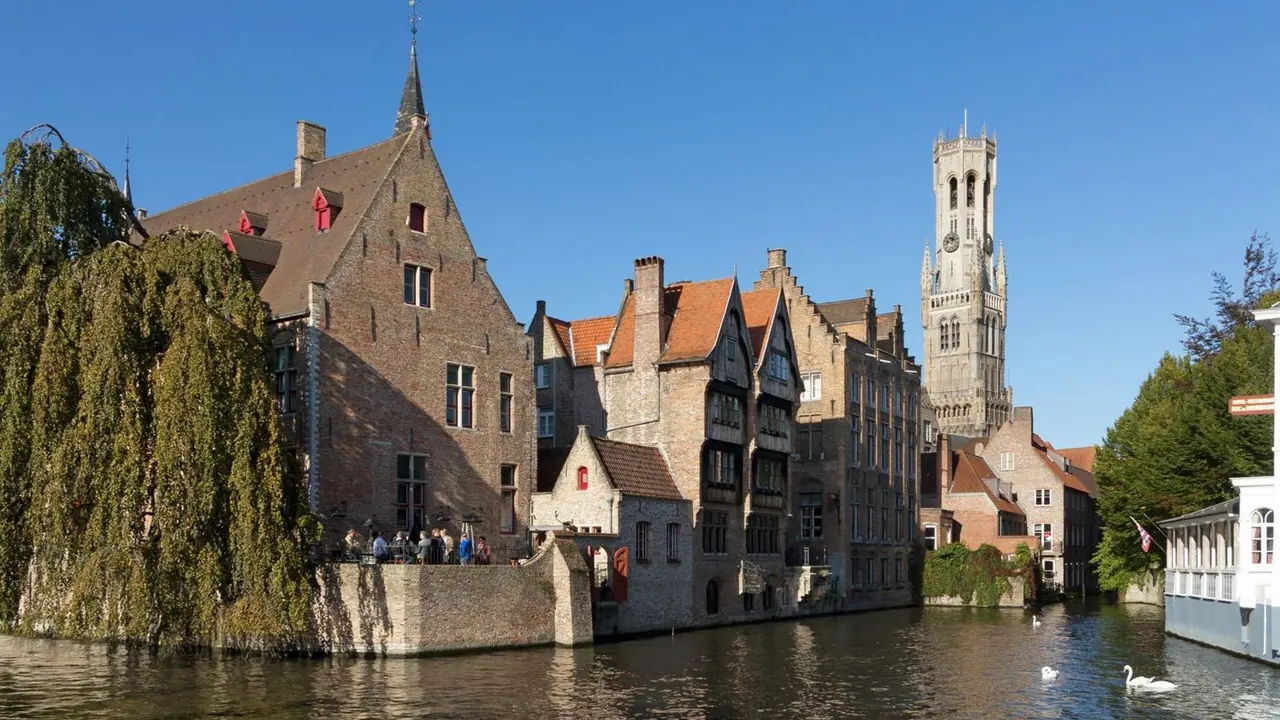
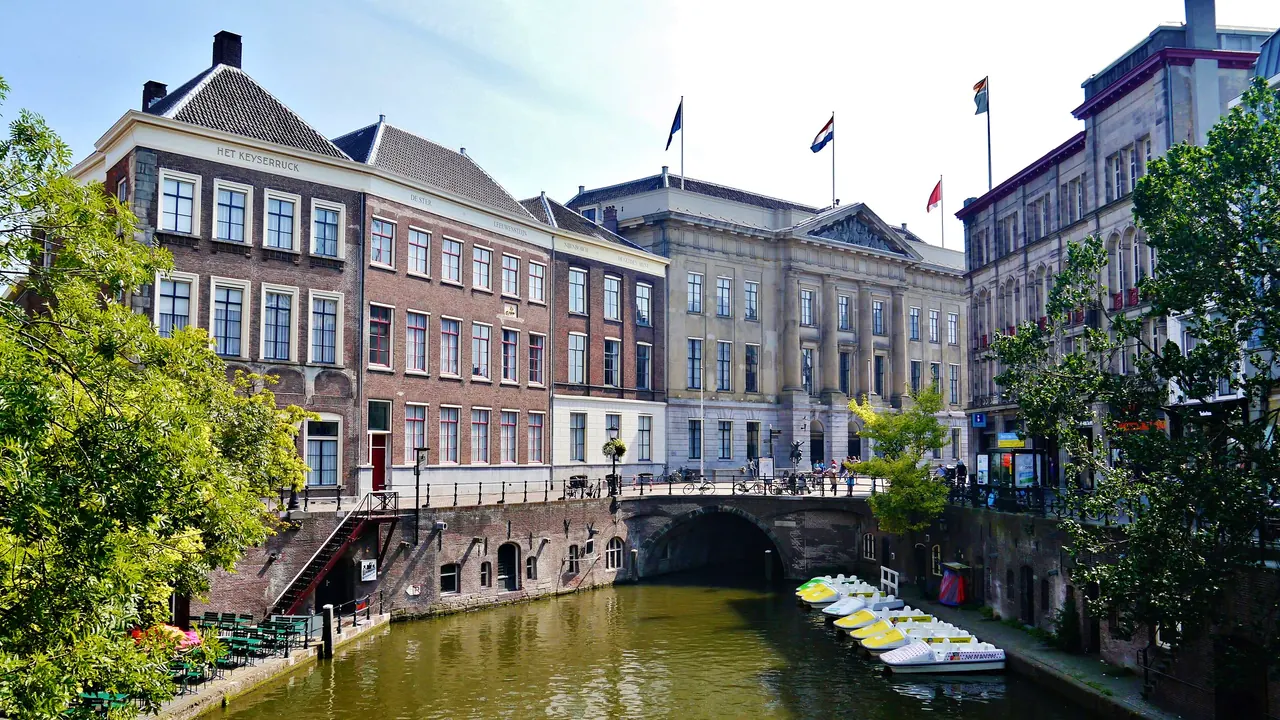
Photos: Bruges by Michielverbeek, CC BY-SA 4.0, cropped; Utrecht by Zairon, CC BY-SA 4.0, cropped.
Bruges or Utrecht?
Our verdict in twelve categories, each scored against the same fixed benchmark cities, and the climate month by month, so you can choose for your trip.
Choose Bruges for
- culture and sights
- food and drink
- beaches
Bruges suits a traveller who wants a medieval town at its most complete and concentrated: the canal ring, the Belfry and the Flemish Primitives in the Groeninge by day, then long evenings over Trappist ales. It is the better pick for art lovers, couples and anyone who cares about Belgian beer and cooking. The coast is also close enough for a sunny afternoon on the sand.
Choose Utrecht for
- nightlife
- live music and the arts
- families
Choose Utrecht if you want a livelier, more lived-in base. Its students keep the canal-side bars full on weeknights, TivoliVredenburg gives it a much deeper concert programme, and the Railway Museum and Miffy make it easier with children. The shops are more independent, and the whole of the Netherlands is a short train ride away.
Scoreboard
Twelve categories on one fixed scale from 0 to 100. The shaded stretch is the gap between the two.
Your match
Pick a travel style or drag the sliders, and both match scores follow your weighting.
Wins on culture and sights and food and drink with your weighting.
Wins on nightlife and live music and the arts with your weighting.
What matters to you?
Category by category
What the scores mean for a trip.
Beaches & swimming
Neither is a beach destination, but Bruges is much closer to one. Blankenberge is about fifteen minutes away by train, and the coast tram links a long line of wide sandy beaches. A sunny August afternoon on the sand is easy to fit in, even if the water is the cold North Sea.
From Utrecht, the sea at Zandvoort or Scheveningen is an hour or more away. Summer swimming there means the recreation lakes on the edge of town or at Loosdrecht. They are pleasant for cooling off but are no substitute for a coastline.
Food & drink
Bruges has the stronger table, and the reason is beer: Trappist and abbey ales, each in its own glass, poured in panelled cafés. Alongside come mussels and frites, beef stewed in beer, waterzooi and serious chocolate. The catch is the set-menu restaurants on the main squares, so it pays to eat a few streets away.
Utrecht has no cuisine of its own to match that. Its strengths are the setting, with tables at the water's edge on the Oudegracht wharves, and the casual variety a student city brings. That means Indonesian and Surinamese kitchens and modern bistros around the Twijnstraat and Lombok.
Culture & sights
Both have well-kept medieval centres, but Bruges has more of one in a single place. The entire canal ring is a UNESCO site of guildhalls, stepped gables and almshouses, and the art inside matches it, from van Eyck and Memling to a Michelangelo marble.
Utrecht's highlights are unusual rather than grand: the Dom Tower standing apart from its surviving choir, the two-level Oudegracht wharves, and the Rietveld Schröder House, with De Stijl work in the Centraal Museum. Its museums are good but smaller in reach.
Nightlife
Utrecht has the livelier evenings. Its students fill the bars around the Neude, the Janskerkhof and along the Oudegracht on weeknights as well as weekends, and drinking at the canal edge is a summer ritual. There are few clubs, but Amsterdam is close for a bigger night.
Bruges is quieter and goes to bed earlier. An evening there is a long session over strong ales in a brown café or vaulted cellar, with a little late life around the Eiermarkt and 't Zand. Most of the centre is asleep by midnight on weeknights.
Nature & outdoors
Both are surrounded by the same flat, watery countryside, but Utrecht has more variety close by. Beyond the river Vecht, with its estates and windmills, the Utrechtse Heuvelrug adds wooded ridges, heath and forest trails, and the Loosdrecht lakes have sailing and canoeing.
Around Bruges it is all polder, poplar-lined canals and dykes. That is ideal for the easy ride to Damme, and the Zwin salt marsh and coastal dunes are good for birdwatching and windy walks.
Day trips
Both make outstanding bases, so the real question is which country you want to see. From Bruges it is Flanders: Ghent in under half an hour, Brussels and Antwerp a little further, plus the coast, Damme by bike and the First World War sites around Ypres.
From Utrecht it is the Netherlands. Amsterdam is under half an hour away, Rotterdam, The Hague, Delft, Leiden and Gouda are all easy, and Kasteel de Haar, the Kinderdijk windmills and the Kröller-Müller Museum are within reach.
Good for families
Utrecht is better with children. The Railway Museum in its old station and the Miffy museum are made for them, the barrel organs at the Speelklok museum appeal to all ages, and Kasteel de Haar makes a fairy-tale outing.
Bruges works for short outings: canal boats, horse-drawn carriages, climbing the Belfry and the swans on the Minnewater, with Boudewijn Seapark and the beaches nearby. Its main sights are paintings and churches, though, and the cobbles make pushchairs hard work.
Getting around
Both centres are flat and compact, best seen on foot or by bike, and a car is a nuisance in either. Utrecht is a little easier, because Utrecht Centraal is right on the edge of the old town, and trams and buses use the same tap-in card as the trains.
In Bruges the station is outside the canal ring, a fair walk or short bus ride from the Markt. The cobbles that give the town its look are also hard going with a suitcase.
Shopping & style
Utrecht gives a shopper more to do. Independent fashion, design, book and homeware shops fill the small streets around the Oudegracht and the Twijnstraat, Hoog Catharijne has the chains, and the flower and textile markets add colour.
Bruges is strongest on things to eat and drink: chocolate makers on every street and beer shops selling bottles and glasses from all over Belgium. Lace is the traditional craft, but much of what is on sale is imported, and the main high street is mostly chains.
Affordability
Neither is cheap, and in both the main cost is the bed. In Bruges, the hotels inside the canal ring and the restaurants on the main squares are priced for visitors, so it pays to stay midweek or near the station and to eat on the side streets.
In Utrecht, the few hotels in the old centre keep room rates high. On the other hand, student cafés and snack bars keep lunch cheap, and in such a compact city local transport costs almost nothing.
Live music & performing arts
Utrecht has the fuller programme. TivoliVredenburg stacks several halls under one roof and can have the Radio Philharmonic, jazz and pop on the same evening, and the calendar adds an adventurous autumn music festival and the national film festival. Theatre is mostly in Dutch.
Bruges offers less but has real quality. Its Concertgebouw is strong on early music, chamber music and contemporary dance, the Belfry carillon plays over the town, and summer brings concerts in churches. Both cities hold well-known early-music festivals, so lovers of that music are well served in either.
Wellness & relaxation
Neither has a bathing tradition, so the calm comes more from the setting than from spas. Bruges has a handful of hotel and day spas. Its quiet is found early and late at the Begijnhof and the Minnewater, or at any hour in the Sint-Anna quarter.
In Utrecht, wellness means the large Dutch sauna complexes in the green belt, a short ride out. In town, the Pandhof cloister garden beside the Dom and slow evenings on the canal wharves are the places to unwind.
When should you go?
Pick your month. The climate figures are measured averages, not a forecast.
Bruges in July
Utrecht in July
Daytime high, °C
Rainfall in the month, mm
Where the figures come from
Bruges has no rain gauge within 25 km of the centre, so its rainfall comes from a gridded climate dataset read at the city rather than from a gauge further away.
Bruges's sunshine is measured 37 km from the centre, at Vlissingen.
Temperature and rainfall are climate normals, averaged over the years shown. Bruges: 2009-2025 (sunshine 1991-2020, rainfall 1991-2020) normals, Zeebrugge / Zeemanshaard (15.8 km from centre). Utrecht: 1991-2020 normals, De Bilt (4.3 km from centre).
Both cities have the same mild, damp North Sea climate, and late spring to early autumn is the time to go. Utrecht warms up faster and is a couple of degrees warmer at the height of summer, reaching about 23°C in July and August against 21°C in Bruges. Bruges gets noticeably more sunshine from spring through summer. April is the driest month in both, which makes it a good time for long walks through the old streets.
Only Bruges has the sea close by, and even there the North Sea only reaches about 19°C in August, so July and August are the only months for a quick dip. Rain picks up in late summer and stays high through autumn and winter. From November to February the days are short and grey and highs sit around 7°C. That is cold for long walks, but fine for museums and brown cafés.
Which traveller are you?
For a culture and arts trip, choose Bruges. The old town is the attraction in itself, and its great Flemish paintings hang a short walk apart, so two unhurried days give a complete picture. Utrecht rewards curiosity, but its sights are fewer.
On a family trip with young children, Bruges is fine for a weekend of boat rides and treats, but Utrecht keeps children busy for longer. Several of its museums are made with them in mind, and Dutch habits make room for children wherever you go.
On a shopping trip, Utrecht deserves the extra day. Bruges is ideal for a bag of edible gifts on the last afternoon. Utrecht suits a slow day of browsing small independent shops and markets, though anyone after luxury labels will still need Amsterdam.
Before you go
| Measure | Bruges | Utrecht |
|---|---|---|
| Official language | French, German, Dutch | Dutch |
| Currency | Euro (EUR) | Euro (EUR) |
| Sockets | CE230 V, 50 Hz | CF230 V, 50 Hz |
| Driving side | Right | Right |
| Time zone | UTC+1, UTC+2 in summer | UTC+1, UTC+2 in summer |
| Emergency number | 112 | 112 |
| Elevation | 2 m | 5 m |
| Main airport | Brussels Airport (BRU)94 km from centre191 non-stop destinations | Amsterdam Airport Schiphol (AMS)34 km from centre287 non-stop destinations |
| Public holidays this year | 14 days | 11 days |
By the numbers
| Measure | Bruges | Utrecht |
|---|---|---|
| City population | 118,509 | 359,370 |
| People per km² | 840 | 3,619 |
| Museums within 10 km | 38 | 28 |
| UNESCO World Heritage sites within 50 km | 3 | 5 |
| Swim season, months above 21 °C | None | None |
Where else could you go?
Every comparison below shares a destination with this one, so you can follow Bruges or Utrecht somewhere new.