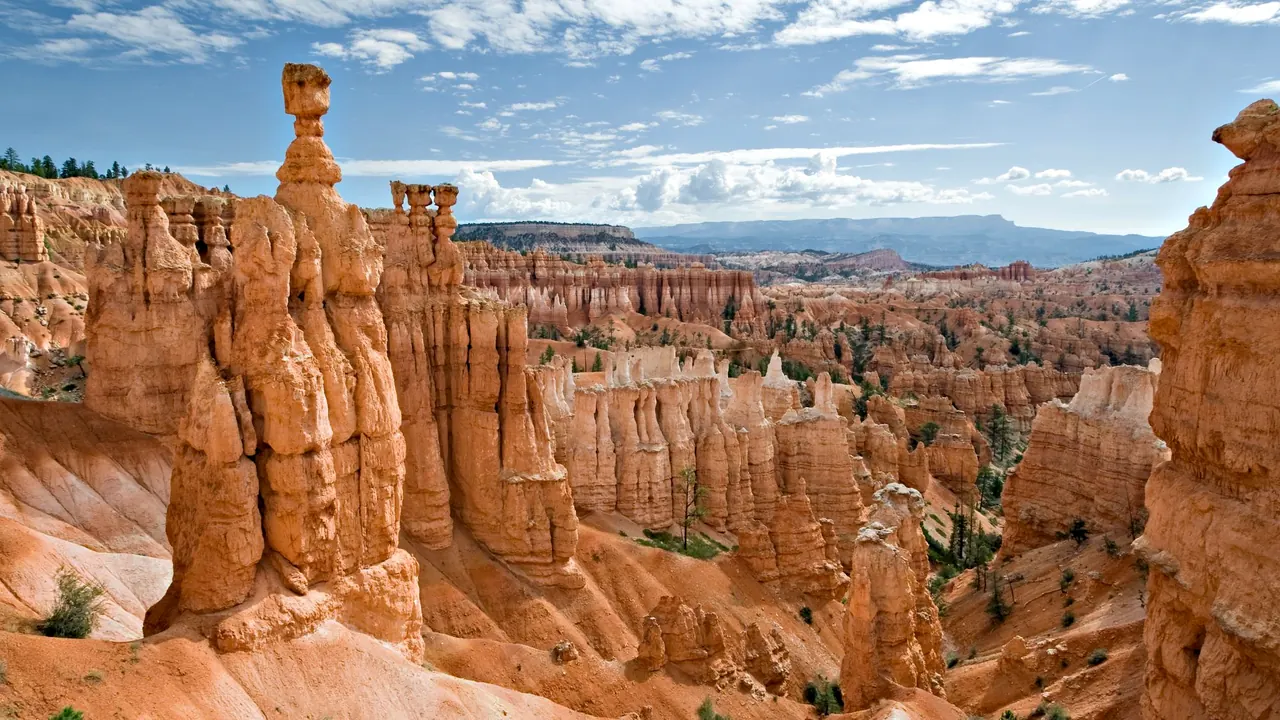
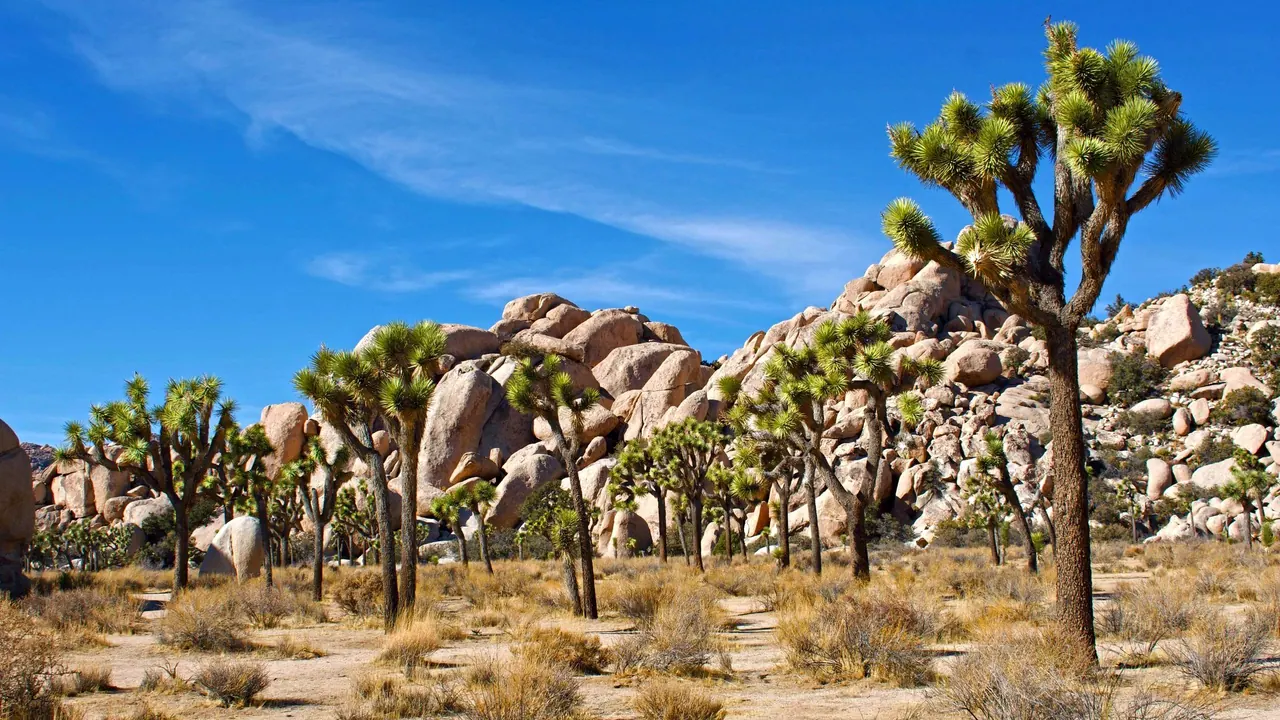
Photos: Bryce Canyon by Luca Galuzzi (Lucag), CC BY-SA 2.5, cropped; Joshua Tree by Mr. Location Scout, Pexels License.
Bryce Canyon or Joshua Tree?
Our verdict in twelve categories, each scored against the same fixed benchmark cities, and the climate month by month, so you can choose for your trip.
Choose Bryce Canyon for
- nature and the outdoors
- families
- getting around
Bryce Canyon is the pick for walkers and photographers who want the landscape at its most extraordinary and little else. The trip is about getting up for sunrise on the rim, dropping among the hoodoos on the Navajo Loop and Queen's Garden, and adding Red Canyon, Kodachrome Basin and the slot canyons off Scenic Byway 12. It runs best from late spring to autumn, and in winter it turns into a snowy plateau for snowshoeing. Be ready for plain food, very quiet evenings and almost nothing to do once the hiking is done.
Choose Joshua Tree for
- wellness
- shopping
- day trips
Joshua Tree is a slower, softer trip. It suits climbers and boulderers, couples looking for a desert retreat in a rental house with a pool and a hot tub, and anyone who wants yoga, sound baths or a soak in the mineral pools of Desert Hot Springs between hikes. It also has a bit more around the park: the odd art sites, a famous roadhouse in Pioneertown, and Palm Springs an hour downhill. The scenery is less startling than Bryce's, and summer is too hot for most of what it offers.
Scoreboard
Twelve categories on one fixed scale from 0 to 100. The shaded stretch is the gap between the two.
Your match
Pick a travel style or drag the sliders, and both match scores follow your weighting.
Wins on nature and the outdoors and families with your weighting.
Wins on wellness and shopping with your weighting.
What matters to you?
Category by category
What the scores mean for a trip.
Beaches & swimming
Neither has any swimming worth travelling for, and in both a pool at your lodging is the realistic way to cool off. What differs is the water nearby. Around Bryce, Tropic Reservoir and Panguitch Lake are cold mountain lakes for fishing or paddling a canoe. Joshua Tree has no open water at all, but plenty of its rental houses come with a private pool or plunge pool.
Food & drink
Joshua Tree eats a little better. Highway 62 has proper coffee shops, health-food cafés for the climbing crowd, Mexican places and the smoky barbecue up in Pioneertown, and the restaurants of Palm Springs are an hour's drive away. Many visitors also cook in their rental, which suits the region well.
Bryce Canyon is fuel between hikes: ranch breakfasts, steaks, Navajo tacos and pie in Tropic and Panguitch, and the dining room of the old lodge. The exceptions are a few serious kitchens out along Byway 12 in Escalante and Boulder, which are worth a dinner drive. Utah's licensing rules also make a glass of wine harder to come by.
Culture & sights
Neither is a place for museums, but Joshua Tree has more sights with real character. Noah Purifoy's junk-sculpture field, the Integratron dome and Pioneertown's film-set main street are odd enough to fill a curious afternoon, and the park adds Keys Ranch, petroglyphs and old mine workings.
Bryce Canyon's heritage is quieter and more conventional: the 1920s timber-and-stone lodge, the red-brick pioneer houses of Panguitch, the Mormon farming towns of the valley and the Puebloan village at Boulder. It is mainly about settlement history, and a single afternoon covers it.
Nightlife
Joshua Tree has a little going on after dark, with a couple of saloons in the towns and Pioneertown's roadhouse filling up at weekends. In the gateway towns around Bryce there is almost nothing open late, and most people are asleep early so they can catch sunrise at the rim. In both, the real evening entertainment is the night sky.
Nature & outdoors
Bryce Canyon has the more astonishing landscape. Thousands of coloured hoodoos fill bowls cut into a plateau edge, and trails run both along the rim and down among the spires. Red Canyon, Kodachrome Basin, the slot canyons of Grand Staircase-Escalante and Zion are all within reach. Because it sits at altitude, the hiking season runs through summer and the snow brings skiing and snowshoeing in winter.
Joshua Tree is just as wild but quite different: two deserts meeting, Joshua tree forests among granite boulder piles, and palm oases at the end of longer hikes. Its standout is rock climbing on thousands of routes. Both are dark-sky places, so the stargazing is excellent either way.
Day trips
Joshua Tree has the more useful day out. Palm Springs is an hour downhill, with its mid-century houses and walkable downtown, and Idyllwild in the pines, the old stops along Route 66 and the strange shoreline of the Salton Sea give you more options.
From Bryce, almost every outing is to more scenery. The places with people in them are small: Panguitch's main street, the Puebloan museum at Boulder, Kanab's film-Western past and the college town of Cedar City. They are pleasant to stop at on a drive, but none of them is worth a whole day.
Good for families
Both suit older children better than toddlers, but they keep children busy in different ways. Bryce works for walkers: the flat paved rim path, Queen's Garden as a first descent and horse rides into the formations. Against that, the air is thin, the climbs back out are steep and some drop-offs have no fence.
Joshua Tree works for scramblers, with the boulder piles at Hidden Valley, Skull Rock and Jumbo Rocks acting as a giant playground and a rental house with a yard as the base. Its main danger is heat and lack of shade, so families should come in winter or early spring.
Getting around
In both you need a car, and the driving is easy on quiet roads. Bryce has the edge inside the park: one scenic road with viewpoints all the way along, a summer shuttle to the busiest overlooks, and the Rim Trail linking the main viewpoints on foot. Getting there takes hours from any big airport, though, and winter snow can close the far end of the road.
Joshua Tree's towns are strung out along Highway 62, and it takes a long drive to cross the park from west to south. On spring weekends the entrances queue, and much of the park has no mobile signal.
Shopping & style
Joshua Tree is the one with shopping worth browsing. Yucca Valley's old town has vintage Western wear and mid-century furniture, the village has galleries and crystal shops, and there are artists' markets at weekends. Bryce offers a general store, park books and roadside rock shops selling fossils and geodes, which is fine for a souvenir but nothing more.
Affordability
Both cost about the same, and in both the cost of a bed matters most. At Bryce, rooms are scarce and expensive from late spring to early autumn, and winter is cheaper but many places close. At Joshua Tree the pricey stretch is the cool season, when stylish rental houses fill at weekends and in spring, so midweek in winter is easier on the budget. In either region, camping or an older motel in Panguitch or Twentynine Palms brings the cost right down.
Live music & performing arts
Joshua Tree has more live music as part of everyday life. Pioneertown's old roadhouse books well-known indie, rock and country acts, music festival weekends come in spring and autumn, and small shows turn up in the town bars.
Bryce has almost nothing on locally beyond a summer cowboy dinner show. Its one serious draw is the Utah Shakespeare Festival in Cedar City, an hour and a half away, which is worth planning one theatre evening around in summer or autumn.
Wellness & relaxation
For winding down, Joshua Tree is the clear choice. Yoga and meditation retreats and sound baths are found all around the village, the Integratron's dome is known for its acoustics, and Desert Hot Springs has spa motels with pools fed by hot mineral springs. Many rentals add a hot tub under the stars.
Bryce gives you calm without any treatments: cool air, empty roads and an evening on a lodge porch under a dark sky. The days themselves are tiring, spent climbing in and out of the canyon at altitude.
When should you go?
Pick your month. The climate figures are measured averages, not a forecast.
Bryce Canyon in July
Joshua Tree in July
Daytime high, °C
Rainfall in the month, mm
Where the figures come from
Bryce Canyon has no rain gauge within 25 km of the centre, so its rainfall comes from a gridded climate dataset read at the destination rather than from a gauge further away.
Joshua Tree has no rain gauge within 25 km of the centre, so its rainfall comes from a gridded climate dataset read at the destination rather than from a gauge further away.
Temperature and rainfall are climate normals, averaged over the years shown. Bryce Canyon: 2004-2020 (rainfall 1991-2020) normals, Bryce Canyon / Bryce Canyon City (3.9 km from centre). Joshua Tree: 1992-2020 (rainfall 1991-2020) normals, Twentynine Palms / Sunfair Heights (20.4 km from centre).
These two have opposite seasons. Bryce sits high on a plateau, so its good months are the warm ones. From June to September the days are pleasant for hiking, with highs around 27°C in July, but summer storms make August the wettest month at about 42mm. October is crisp and clear. From November to March the rim is cold, with highs near 1°C in midwinter and snow on the hoodoos, which is lovely for snowshoeing but not for long days on the trails.
Joshua Tree is the reverse. Winter is mild, with highs around 17°C in January, and spring and autumn are its best seasons for climbing and walking. From June to September it is fierce, with highs near 39°C and almost no rain, so outdoor time shrinks to early morning and dusk. Roughly speaking, summer belongs to Bryce and the months from October to May belong to Joshua Tree.
Which traveller are you?
On an outdoors trip, Bryce Canyon has the more spectacular ground. The amphitheatre of hoodoos, the rim and canyon-floor loops, horse trails and winter snowshoeing beat the desert walks, though climbers will still choose Joshua Tree's granite boulders.
For a relaxing and wellness trip, Joshua Tree is far ahead. Retreats and sound baths gather around the village, the Integratron dome is close by, and Desert Hot Springs has mineral pools. Bryce offers quiet and dark skies but no real way to pamper yourself.
On a food and nightlife trip, neither is a natural fit, but Joshua Tree does better. It has good coffee, Mexican food, Pioneertown barbecue and a roadhouse with live bands, and Palm Springs is an hour away. Bryce's towns serve diner food and are asleep early.
Before you go
| Measure | Bryce Canyon | Joshua Tree |
|---|---|---|
| Currency | US Dollar (USD) | US Dollar (USD) |
| Sockets | AB120 V, 60 Hz | AB120 V, 60 Hz |
| Driving side | Right | Right |
| Time zone | UTC-7, UTC-6 in summer | UTC-8, UTC-7 in summer |
| Emergency number | 911 | 911 |
| Main airport | Harry Reid International Airport (LAS)160 non-stop destinations | Palm Springs International Airport (PSP)29 non-stop destinations |
| Public holidays this year | 12 days | 13 days |
Where else could you go?
Every comparison below shares a destination with this one, so you can follow Bryce Canyon or Joshua Tree somewhere new.
- Zionvs Bryce Canyon
- Grand Canyonvs Bryce Canyon
- Canyonlandsvs Bryce Canyon
- Archesvs Bryce Canyon
- Death Valleyvs Joshua Tree
- Sequoiavs Joshua Tree