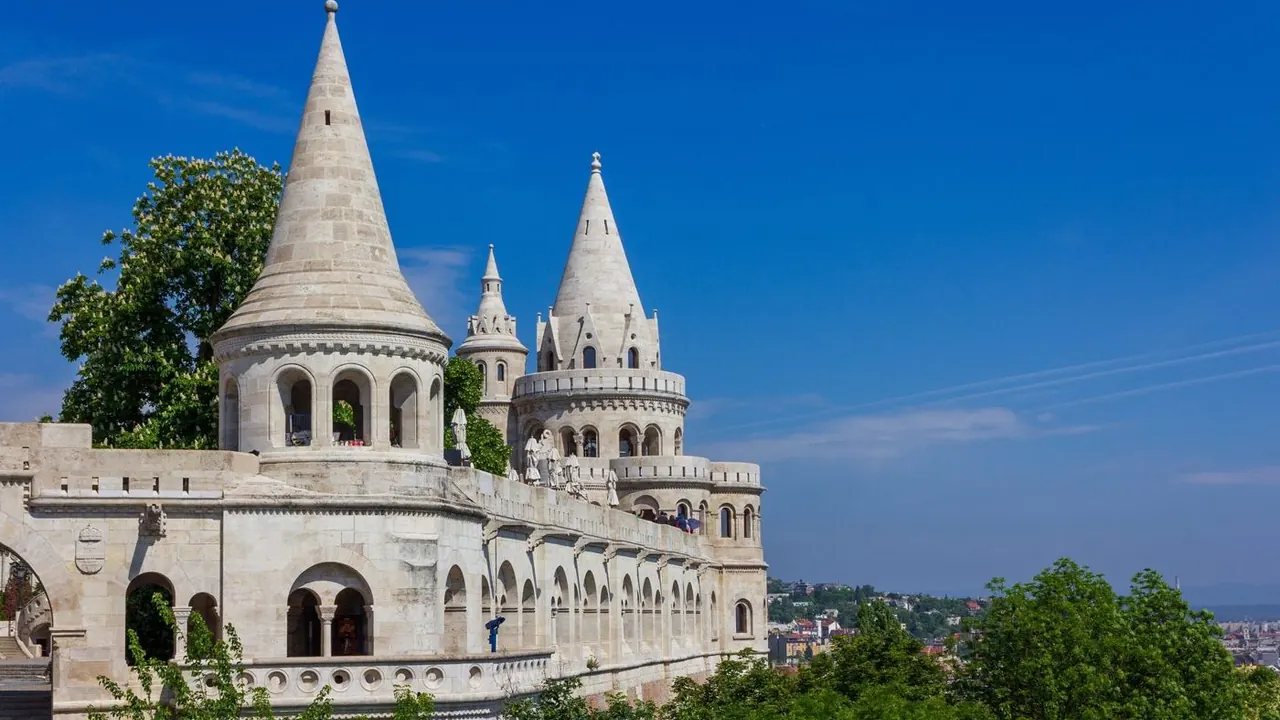
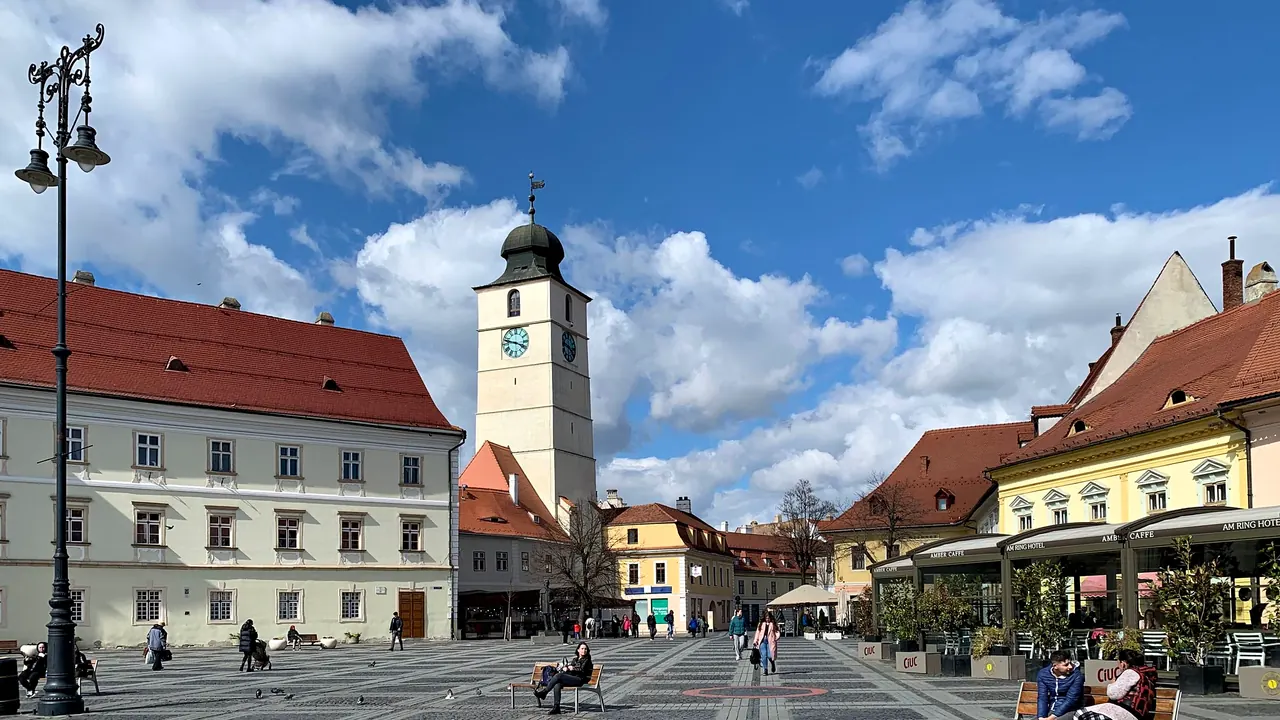
Photos: Budapest by Perituss, CC0; Sibiu by Chainwit., CC BY 4.0, cropped.
Budapest or Sibiu?
Our verdict in twelve categories, each scored against the same fixed benchmark cities, and the climate month by month, so you can choose for your trip.
Choose Budapest for
- wellness
- nightlife
- live music and the arts
Budapest suits the traveller who wants a capital with something to fill every day and evening: the Danube panorama, great museums, opera and concert halls, the ruin bars of District VII and, above all, thermal baths that Sibiu cannot match. You can see all of it without a car, and it works as well for a long weekend as for a full week.
Choose Sibiu for
- nature and the outdoors
- prices
- day trips
Pick Sibiu for a slower, cheaper trip built around landscape and old Transylvania. The Saxon old town takes two or three days, and the real draw lies beyond it, in the Fagaras and Cindrel mountains, the fortified churches and the shepherd villages, which are best reached with a car. Evenings are quiet, so this is the place for travellers who would rather have mountains and villages than nightlife and spas.
Scoreboard
Twelve categories on one fixed scale from 0 to 100. The shaded stretch is the gap between the two.
Your match
Pick a travel style or drag the sliders, and both match scores follow your weighting.
Wins on wellness and nightlife with your weighting.
Wins on nature and the outdoors and prices with your weighting.
What matters to you?
Category by category
What the scores mean for a trip.
Beaches & swimming
Neither city has a beach, but Budapest gives a summer swimmer more to do. Its open-air lidos, led by Palatinus on Margaret Island, make a full day out, with lawns and several pools. Lake Velence is under an hour away by train, and Lake Balaton makes a longer outing.
Sibiu's best swim is in the salt lakes of Ocna Sibiului, about 20km out, where the water is dense enough to float in. It is a curiosity worth an afternoon in July or August, not a reason to choose the city.
Food & drink
Budapest has the broader and better-stocked table. Beyond goulash and lángos there is the Great Market Hall, the Austro-Hungarian coffee houses with their layered cakes, a serious modern restaurant scene, and wine bars pouring Tokaji, Eger reds and Balaton whites.
Sibiu serves hearty Transylvanian food in vaulted cellars, such as sarmale with polenta and bean soup in a bread bowl, and the shepherd villages to the south supply sheep's cheese and smoked meats. It is satisfying for a few days, but there is little street food and few kitchens cooking anything beyond traditional dishes.
Culture & sights
Budapest has a capital's worth of sights. The river front runs from Parliament across to the Castle District, Andrássy Avenue leads out to Heroes' Square, the Museum of Fine Arts holds old masters, and the Dohány Street Synagogue anchors the centre. The city's history runs from Ottoman tombs to the statues of Memento Park, and it needs several days.
Sibiu gives a smaller but complete picture of one past: a Saxon town of linked squares, guild towers and attic windows. The Brukenthal Museum stands on the main square and the ASTRA open-air museum spreads through the forest. Two or three days cover it well.
Nightlife
This is one of the widest gaps between the two. Budapest's District VII has ruin bars in crumbling tenement courtyards, plus cocktail bars and clubs that run well past 2am. In summer there are garden bars and Danube terraces as well. The cost is rowdy stag and student crowds at weekends.
In Sibiu, an evening out means student pubs, cellar bars and craft beer around the squares, with a few clubs that come alive in term time. It suits a drink after dinner, not a big night.
Nature & outdoors
Sibiu is far ahead here. The Southern Carpathians fill the skyline to the south. There is easy walking around Paltinis, ridges and glacial lakes in the Fagaras above 2,500m, and the hairpin bends of the Transfagarasan climbing to Balea Lake. Brown bears live in the forests, and most of this needs a car or a tour.
Budapest's outdoors is gentler and closer to hand. The oak and beech forests of the Buda Hills are reached by cogwheel railway and chairlift, there are caves beneath them, and the Danube Bend offers hiking and cycling an hour to the north. It is pleasant country, but it has no mountains.
Day trips
Both cities make good bases, and the difference lies in how you travel. From Budapest, the Danube Bend towns of Szentendre, Visegrád and Esztergom and the palace at Gödöllő are easy by suburban train. Eger, Hollókő and Pannonhalma are around two hours away.
Sibiu's outings lead into castle and village Transylvania: Sighisoara, the fortified churches of Biertan and Valea Viilor, Alba Iulia's citadel and Corvin Castle. Slow trains mean a car or a tour is needed to make them work.
Good for families
Children get far more to do in Budapest. The City Park zoo, one of Europe's oldest, sits beside a boating lake. Schoolchildren in uniform run the Children's Railway through the Buda Hills, and the Palace of Wonders is a hands-on science centre. In summer the lidos add wave pools and slides, though metro stairs and loud weekend nights in District VII need some planning.
Sibiu is smaller and calmer, and the streets around its squares are mostly free of traffic. The ASTRA open-air museum, next to the Dumbrava zoo and playgrounds, makes the best day out. Beyond that, little is designed for children, and the stairways down to the Lower Town are hard going with a pushchair.
Getting around
Getting about Budapest takes nothing more than trams, the metro and your own feet, while Sibiu is easy only until you leave town. Central Pest is flat. One tram line runs along the embankment past Parliament and makes a sightseeing ride of its own, others circle the Grand Boulevard through the night, and the oldest metro line on the continent still runs its little yellow carriages under Andrássy Avenue. Ferries, buses and the funicular cover the river and the climb to the Castle District.
Sibiu's centre is compact and largely pedestrianised, and the steep lanes between the Upper and Lower Town are the only real effort. Local buses reach the ASTRA museum and the airport is close by. Beyond the city, though, the trains are slow and infrequent, so the mountains and Saxon villages are much easier with your own wheels.
Shopping & style
Budapest gives you more reasons to browse. There is Herend and Zsolnay porcelain, Hungarian design boutiques in Districts V and VII, a short run of luxury labels on Andrássy Avenue, and the Ecseri flea market for communist-era finds. Váci utca itself is mostly chain stores.
Shopping in Sibiu is about crafts: painted ceramics, embroidered blouses and icons on glass along Nicolae Balcescu Street. The Christmas market is the high point of the year, and there is no fashion shopping to speak of.
Affordability
Sibiu is the cheaper stay. Old-town guesthouses, hearty meals with local wine, buses, taxis and museum entry all cost little, though rooms cost more during the June theatre festival and the Christmas market.
Budapest is good value compared with Western European capitals, with cheap transport and wine and plenty of mid-range rooms near the centre. Costs build up quickly in the tourist core around Váci utca and the Basilica, and lunch menus in residential districts are the way to keep them down.
Live music & performing arts
Budapest is one of Europe's great cities for music. With the State Opera House, the Art Nouveau hall of the Liszt Academy, Müpa and the Budapest Festival Orchestra, there is something worth hearing most nights, with operetta and folk dance as well.
Sibiu's strength is theatre. It is led by the Radu Stanca National Theatre and by the International Theatre Festival, which fills halls, churches and squares each June. Outside those weeks the choice is thin, and most plays are in Romanian.
Wellness & relaxation
Nothing in Sibiu comes close to Budapest here. More than a hundred thermal springs feed the neo-Baroque Széchenyi, the Art Nouveau Gellért and the Ottoman domes of Rudas and Király, and soaking in them is part of local daily life.
In Sibiu, the restful side is the slow pace of the old town and the clean mountain air of Paltinis. For bathing, the salt lakes and mud cures of Ocna Sibiului are a short trip out of town, as the city itself has only hotel spas.
When should you go?
Pick your month. The climate figures are measured averages, not a forecast.
Budapest in July
Sibiu in July
Daytime high, °C
Rainfall in the month, mm
Temperature and rainfall are climate normals, averaged over the years shown. Budapest: 1991-2020 (sunshine 1981-2010, rainfall 1981-2010) normals, Budapest Met Center (2.1 km from centre). Sibiu: 1991-2020 normals, Sibiu (0 km from centre).
Both cities have the same continental pattern of warm summers and cold winters. In each, the swimming season runs from June to August, when Budapest's lidos and the lakes near both cities are at their best and Budapest reaches about 28°C. May and September, with highs in the low twenties, are the most comfortable months for walking the streets of either city. Winter is cold in both and a little colder in Sibiu, where January highs are close to 2°C.
The real difference is summer rain. Sibiu's wettest months are June and July, with close to 97mm each, and that matters if you plan days in the mountains. Budapest is drier and sunnier through July and August, so its high summer is more reliable for long days outdoors. In Sibiu, early autumn is the better time for the hills, with October still around 17°C.
Which traveller are you?
For a relaxing and wellness trip, Budapest is the clear choice. Its thermal baths, from the steaming outdoor pools of the Széchenyi to the Ottoman domes of Rudas, are part of everyday life there, and the coffee houses fill the slow hours afterwards. Sibiu offers calm streets but only hotel spas.
On a food and nightlife trip, Budapest offers far more. You get paprika-rich cooking, wine bars pouring Tokaji and Eger reds and coffee house cakes, and after dinner the ruin bars and late clubs of District VII. Sibiu's cellar restaurants and student pubs make for a pleasant evening but little more.
On an outdoors trip, Sibiu is the better base. The ridges and glacial lakes of the Fagaras, the Transfagarasan road and the easy trails around Paltinis are all within driving distance, and bears live in the forests. Budapest's Buda Hills and Danube Bend are lovely for walking but low and gentle.
Before you go
| Measure | Budapest | Sibiu |
|---|---|---|
| Official language | Hungarian | Romanian |
| Currency | Forint (HUF) | Romanian Leu (RON) |
| Sockets | CF230 V, 50 Hz | CF230 V, 50 Hz |
| Driving side | Right | Right |
| Time zone | UTC+1, UTC+2 in summer | UTC+2, UTC+3 in summer |
| Emergency number | 112 | 112 |
| Elevation | 117 m | 415 m |
| Main airport | Budapest Liszt Ferenc International Airport (BUD)18 km from centre157 non-stop destinations | Sibiu International Airport (SBZ)5 km from centre11 non-stop destinations |
| Public holidays this year | 13 days | 17 days |
By the numbers
| Measure | Budapest | Sibiu |
|---|---|---|
| City population | 1,675,777 | 134,308 |
| People per km² | 3,191 | 1,110 |
| Museums within 10 km | 81 | 12 |
| UNESCO World Heritage sites within 50 km | 1 | 2 |
Where else could you go?
Every comparison below shares a destination with this one, so you can follow Budapest or Sibiu somewhere new.
- Brasovvs Sibiu
- Cluj-Napocavs Sibiu
- Bratislavavs Budapest
- Viennavs Budapest
- Bucharestvs Sibiu
- Brnovs Budapest