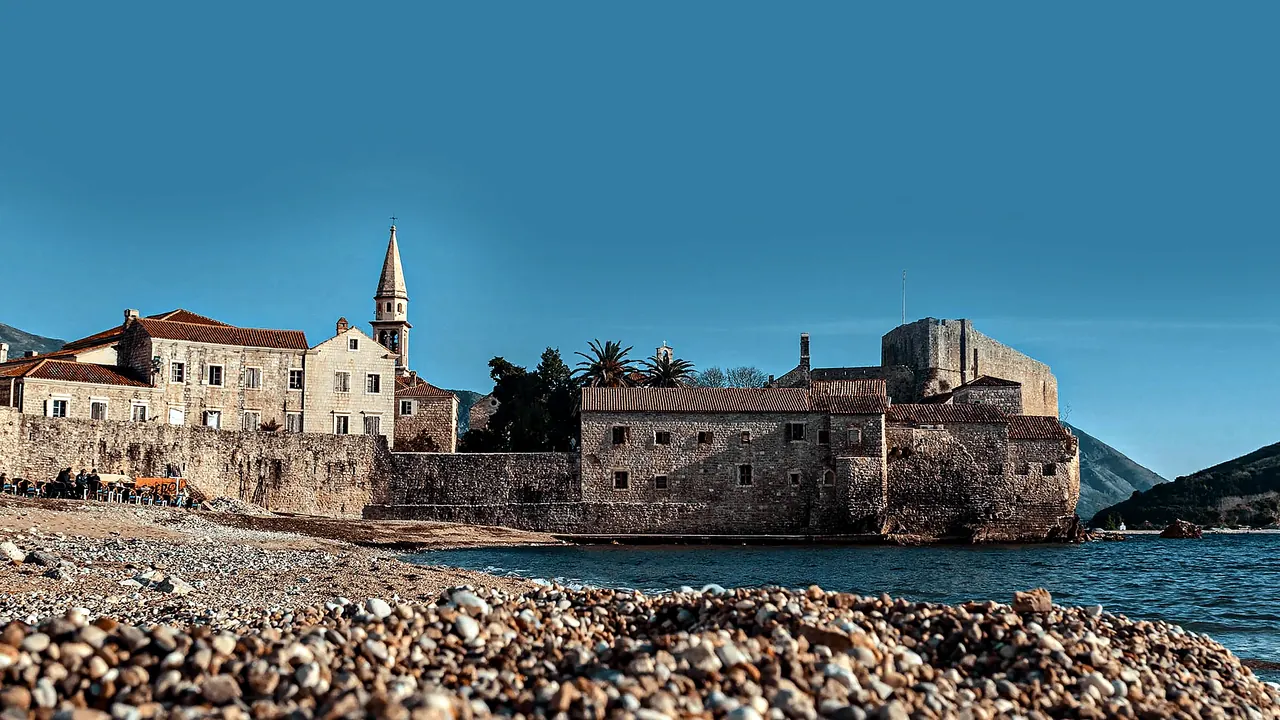
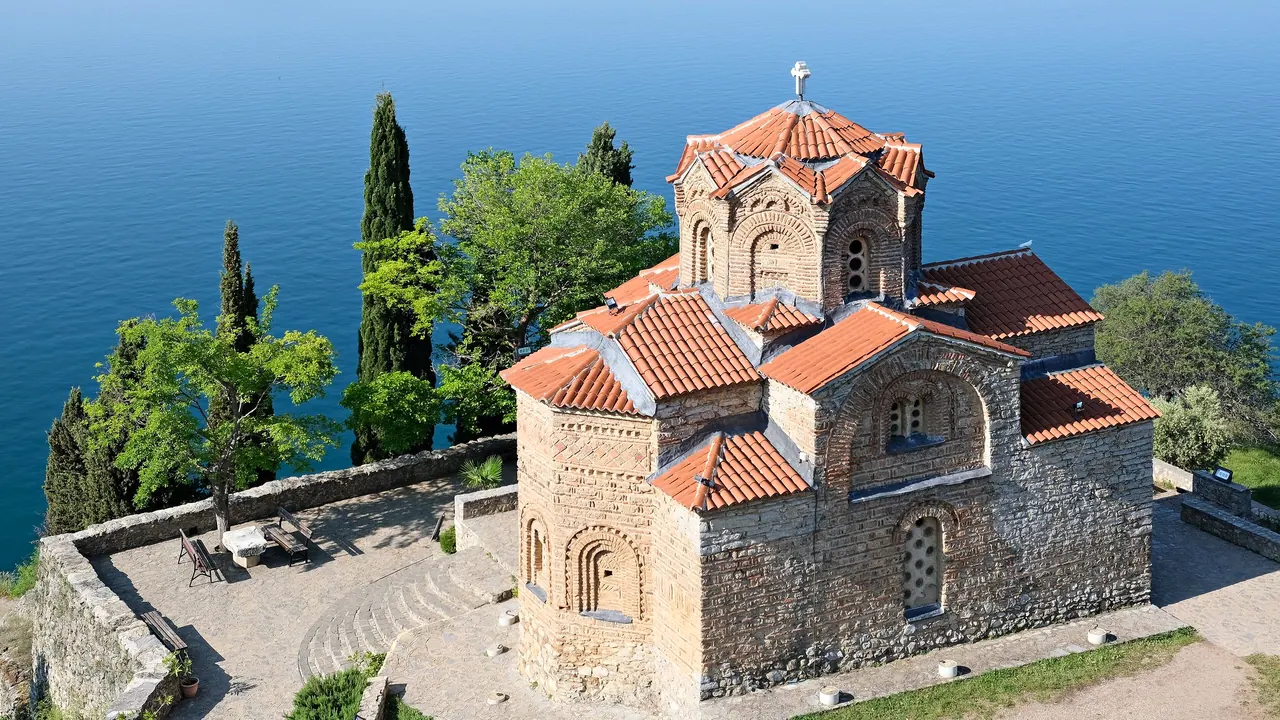
Photos: Budva by Ender Vatan, Pexels License; Ohrid by kallerna, CC BY-SA 4.0, cropped.
Budva or Ohrid?
Our verdict in twelve categories, each scored against the same fixed benchmark cities, and the climate month by month, so you can choose for your trip.
Choose Budva for
- beaches
- nightlife
- day trips
Budva is the pick for a sea-and-sun vacation with a lively evening side. The Adriatic beaches run from Slovenska Plaza and the Mogren coves to Becici and Sveti Stefan, summer nights are long and loud, and Kotor, Perast and Cetinje are all close enough to fill the days you spend off the sand.
Choose Ohrid for
- culture and sights
- prices
- getting around
Travellers who care more about what they see than where they swim will get more from Ohrid. Its hillside old town of frescoed churches, Samuel's Fortress and the Plaošnik site goes far beyond Budva's single walled peninsula, the lake is clean and calm for midsummer swimming, and rooms, meals and taxis cost noticeably less. It suits a slower, quieter trip, best in late spring or early autumn.
Scoreboard
Twelve categories on one fixed scale from 0 to 100. The shaded stretch is the gap between the two.
Your match
Pick a travel style or drag the sliders, and both match scores follow your weighting.
Too close to call, 2 points apart
Wins on beaches and nightlife with your weighting.
Wins on culture and sights and prices with your weighting.
What matters to you?
Category by category
What the scores mean for a trip.
Beaches & swimming
Budva is the stronger place for a beach vacation. It has a real sea that stays swimmable from June into October and a string of beaches: Slovenska Plaza and the Mogren coves in town, then Becici, Jaz and the sand facing Sveti Stefan further along. Expect fine pebble and coarse sand, with packed rows of sunbeds in high summer.
In Ohrid you swim in fresh water, off jetties, concrete platforms and short pebble strips at Potpeš, below Kaneo or further south at Lagadin and Gradište. The lake is very clear and calm, but the swimming season is a couple of months shorter and the beaches are small.
Food & drink
Neither town is worth travelling to for the food, and in both the best meals are in family-run places away from the waterfront. What differs is what's on the plate. Budva leans on the sea, with grilled squid, the day's catch and black risotto, plus Njegusi ham and Vranac red from inland. Ohrid serves Macedonian home cooking such as tavče gravče, stuffed peppers and ajvar, with belvica from the lake and Tikveš wine.
Culture & sights
Ohrid is in a different league for sightseeing. St Sophia's medieval frescoes, St John at Kaneo above the water, Samuel's Fortress and the Plaošnik complex, with its Hellenistic theatre and mosaics, belong to a town and lake that UNESCO lists together. They repay a day or two of slow walking.
Budva has Stari Grad, a compact walled peninsula of marble lanes, small churches and the Citadel, much of it rebuilt after the 1979 earthquake. You can see it in an hour or two. For serious heritage on that coast you go out to Kotor or Cetinje.
Nightlife
Budva is the clear winner for summer nights out. Beach bars and terrace clubs along Slovenska Plaza play pop and house until late, and the open-air club on the hill keeps going until dawn. It suits groups of friends who want noise and long nights.
Ohrid's summer evenings revolve around the stroll along the promenade and the café-bars near the old bazaar, with a few beach clubs on the southern shore. Out of season both towns go quiet, and in Ohrid most evenings end over wine at dinner.
Nature & outdoors
Both towns have mountains rising right behind them and both are best for walking in spring and autumn, so the real difference is the water. Budva's outdoors is coastal: cliff paths between the bays, sea kayaking, boat trips and paragliding above Becici, with Lovcen's beech forest and the reed beds of Lake Skadar about an hour inland.
Ohrid's outdoors centres on the lake and on Galičica National Park behind it, where trails climb to summits above 2,000m and one viewpoint looks over both Lake Ohrid and Lake Prespa. The spring-fed pool at the southern end of the lake makes a gentler outing by rowing boat.
Day trips
Budva sits in the middle of the Montenegrin coast. Kotor's walled town is half an hour away, Perast, Cetinje, the wine villages on Lake Skadar, Stari Bar and Ulcinj all make easy days out, and Dubrovnik works as a long one.
Ohrid has fewer options, and they are further apart: St Naum by boat or road, Struga next door, Bitola with the ruins of Heraclea Lynkestis, and cross-border days to Pogradec and Korçë. Public transport is thin, so you will rely on a car or a driver more often here.
Good for families
Budva is slightly better for families, thanks to sea beaches that shelve gently, the calmer bays at Becici and the water park above town. The drawback is noise, and in July and August families do better staying just outside the centre.
Ohrid offers safe lake swimming, boat rides and the prehistoric pile village at the Bay of Bones in a quieter town, but the steep, cobbled old town is hard work with a pushchair. Neither town has a zoo or an aquarium.
Getting around
Ohrid is the easier of the two to get around. The promenade, the bazaar and the old town sights are a short walk apart, though the old town's stairs are tiring, and cheap taxis cover short hops.
Budva's centre is walkable too, from the old town to Slovenska Plaza and along the shore to Becici. Beyond it, though, there is no railway and everything depends on one coast road that jams in summer. Boat taxis from the marina are the easy way to reach nearby coves.
Shopping & style
Neither town is a shopping destination, but Ohrid has a craft worth buying: the Ohrid pearl, made by a few families in workshops in the old bazaar, along with carved wood, icons and filigree silver. Budva's old town lanes and promenade stalls sell mostly beachwear, souvenirs, silver jewellery, olive oil and rakija, and a modest shopping centre by the marina covers the basics.
Affordability
Ohrid is clearly the cheaper place to stay. Guesthouses, meals with wine, taxis and church entry fees all cost little, and only lakefront rooms in July and August get noticeably dearer.
Budva is the most expensive resort in Montenegro, and you feel it in summer in the cost of seafront rooms, sunbeds and promenade restaurants. It is still cheaper than most Western European coasts if you eat at bakeries and grill houses and stay a few streets back from the sea.
Live music & performing arts
In both towns the performances happen only in summer, but Ohrid's programme is the richer one. The Ohrid Summer Festival stages classical concerts, opera and theatre inside St Sophia and in the ancient theatre, and a choral festival adds sacred and folk singing. Budva's Grad Teatar brings theatre, concerts and readings to the old town squares, and outside the festival you will mostly hear cover bands on the seafront.
Wellness & relaxation
Neither town has a bathing tradition, and both are at their most restful in May, June and September, before or after the summer crowds. The difference is in the way you unwind. In Budva, relaxing means pampering at the big resort hotels in Becici and near Sveti Stefan, or a massage between swims. In high summer, music from the seafront carries late into the night, so the hotel spa is an escape from the town rather than part of it.
Ohrid also has hotel spas with pools and saunas, but its real strength is pace. The lake lies still, coffee by the water takes as long as you like, and evenings on the promenade stay calm everywhere except August. Instead of treatments, the quiet of the place itself does the work.
When should you go?
Pick your month. The climate figures are measured averages, not a forecast.
Budva in July
Ohrid in July
Daytime high, °C
Rainfall in the month, mm
Where the figures come from
Budva has no rain gauge within 25 km of the centre, so its rainfall comes from a gridded climate dataset read at the city rather than from a gauge further away.
Budva's sunshine is measured 40 km from the centre, at Podgorica-Grad.
Ohrid has no rain gauge within 25 km of the centre, so its rainfall comes from a gridded climate dataset read at the city rather than from a gauge further away.
Temperature and rainfall are climate normals, averaged over the years shown. Budva: 1991-2020 normals, Tivat (15.8 km from centre). Ohrid: 1999-2017 (rainfall 1991-2020) normals, Ohrid (0.2 km from centre).
Budva has the longer warm season. The sea is warm enough to swim from June, peaks at about 26°C in August and is still pleasant in September. July and August are hot, with highs near 32°C, so walking the old town is best done in the morning or evening. Heavy rain sets in from September, and November is the wettest month at about 212mm. May, June and September are the best months to combine the beach with walking.
Ohrid lies inland and higher up, so it is milder in summer and much colder in winter. August highs of around 29°C make July and August the months for swimming in the lake, while May, June and September suit the old town and the mountain trails better. Winters are grey, with January highs near 6°C, though the rain is spread more evenly across the year than on the coast.
Which traveller are you?
On a beach and sun trip, Budva is the clear choice. You can swim in the sea from June into October, the beaches run from town to Becici and Sveti Stefan, and boats reach quieter coves. Ohrid's lake is only warm enough in high summer.
For a culture and arts trip, Ohrid is far richer. The medieval frescoes in St Sophia, the church at Kaneo on its rock, Samuel's Fortress and a summer festival held in historic settings easily fill two days. Budva's old town takes one afternoon.
On a trip on a tight budget, Ohrid makes your money go further. Guesthouses, home-cooked meals with local wine and taxis all cost little outside July and August. Budva is Montenegro's most expensive resort and charges resort prices along its summer seafront.
Before you go
| Measure | Budva | Ohrid |
|---|---|---|
| Official language | Montenegrin | Albanian, Macedonian |
| Currency | Euro (EUR) | Denar (MKD) |
| Sockets | CF230 V, 50 Hz | CF230 V, 50 Hz |
| Driving side | Right | Right |
| Time zone | UTC+1, UTC+2 in summer | UTC+1, UTC+2 in summer |
| Emergency number | 112 | 112 |
| Elevation | 3 m | 695 m |
| Main airport | Tivat Airport (TIV)17 km from centre42 non-stop destinations | Ohrid St. Paul the Apostle Airport (OHD)9 km from centre14 non-stop destinations |
| Public holidays this year | - | 12 days |
By the numbers
| Measure | Budva | Ohrid |
|---|---|---|
| City population | 13,338 | 38,818 |
| People per km² | 109 | 100 |
| Museums within 10 km | 0 | 11 |
| UNESCO World Heritage sites within 50 km | 3 | 2 |
| Swim season, months above 21 °C | 5 months | - |
Where else could you go?
Every comparison below shares a destination with this one, so you can follow Budva or Ohrid somewhere new.