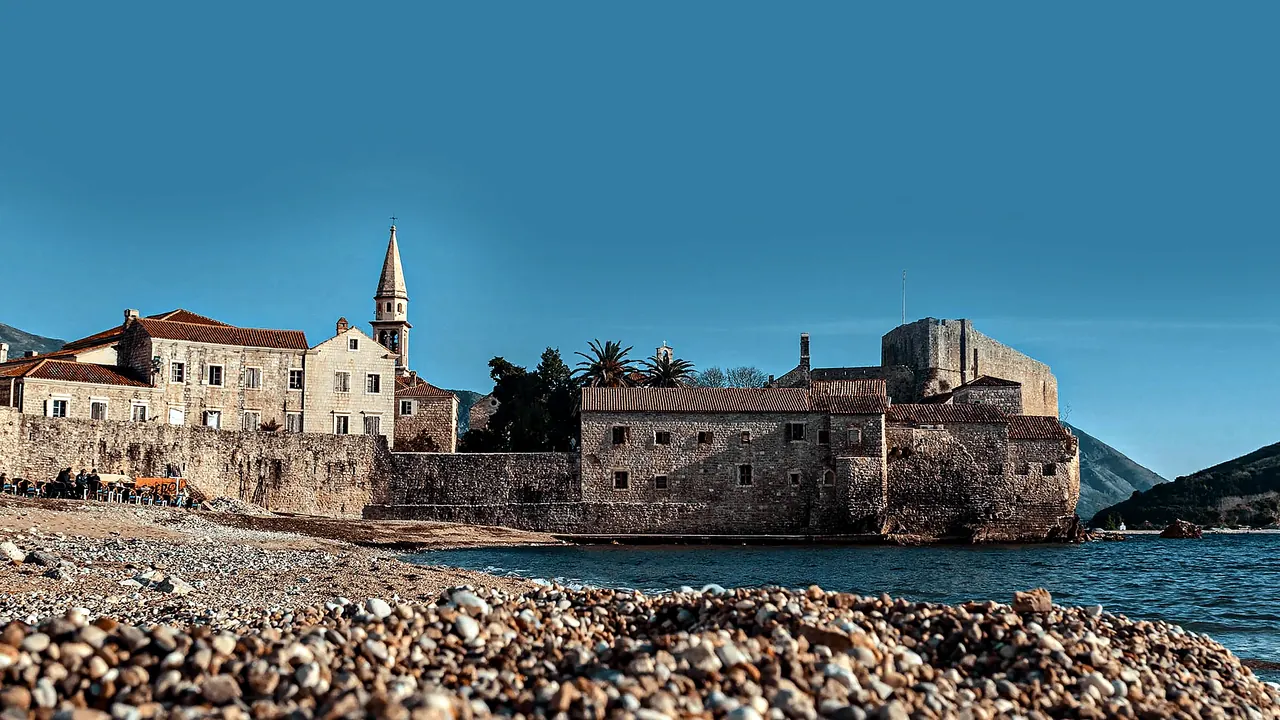
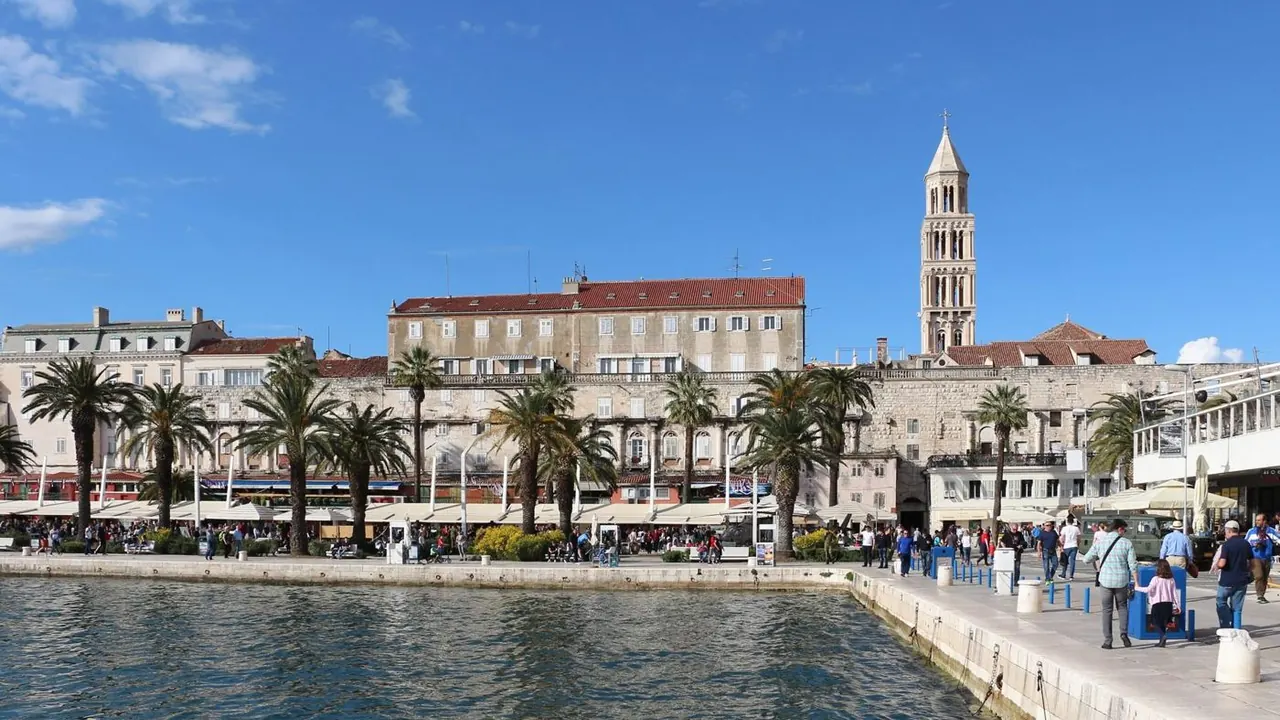
Photos: Budva by Ender Vatan, Pexels License; Split by Bernard Gagnon, CC BY-SA 4.0, cropped.
Budva or Split?
Our verdict in twelve categories, each scored against the same fixed benchmark cities, and the climate month by month, so you can choose for your trip.
Choose Budva for
- prices
- beaches
- nightlife
Budva suits a summer beach trip with a bit of a party in it. The town beaches are on the doorstep, a string of bays runs down the coast to Sveti Stefan and Petrovac, and the seafront clubs keep going until dawn. It costs less day to day than Split, and Kotor, Perast and the mountains of Lovcen are close enough to fill the days you don't spend lying in the sun. It fits groups of friends and anyone who wants sea first and sights second.
Choose Split for
- culture and sights
- food and drink
- getting around
Split is the better choice for a city vacation that also includes a swim. You stay inside a Roman emperor's palace, eat proper Dalmatian cooking in the konobas of Varoš, and walk to Marjan's pine woods or to Bačvice. Ferries, buses and trains all leave from the same harbour, so the islands, Trogir and Krka are easy to reach without a car. It also has a theatre that stays open after the summer crowds have gone.
Scoreboard
Twelve categories on one fixed scale from 0 to 100. The shaded stretch is the gap between the two.
Your match
Pick a travel style or drag the sliders, and both match scores follow your weighting.
Wins on prices and beaches with your weighting.
Wins on culture and sights and food and drink with your weighting.
What matters to you?
Category by category
What the scores mean for a trip.
Beaches & swimming
The beaches are about equally good. In Budva the town beach, Slovenska Plaza, runs the length of the seafront, the two Mogren coves sit under the cliffs, and Becici, Jaz and the sand facing Sveti Stefan are a short ride away. Most of it is fine pebble or coarse sand, with rows of sunbeds and loud music in high summer.
Split's swimming is more urban. Bačvice is a shallow sandy bay where locals play picigin in knee-deep water, and the coves around Marjan offer pine shade and deeper water off rocks and concrete platforms. For longer beaches you take a ferry to Brač, Šolta or Hvar.
Food & drink
Split eats noticeably better. Its Dalmatian kitchen includes pašticada with gnocchi and peka baked under an iron bell. You can see what is in season at the fish market and the Pazar green market, and the konobas in Varoš serve it with local Plavac Mali or Pošip.
Budva's best food comes from the hills and from family konobas: smoked Njegusi ham, mountain cheese, grilled squid and dark Vranac wine. The promenade restaurants, though, are uneven and cater to the resort crowd. Neither city has much fine dining.
Culture & sights
This is where the two differ most. In Split, Diocletian's Palace is still a working neighbourhood. You can walk from the Peristyle into a cathedral that was once the emperor's mausoleum, explore the vaulted halls beneath it, and then visit the Meštrović Gallery. That fills two full days.
Budva's walled Stari Grad is attractive but much of it was rebuilt after the 1979 earthquake, and you can see it, the Citadel and the small archaeological museum in a morning. For heritage on that side of the border, you go to Kotor or Cetinje.
Nightlife
Both cities are lively on summer nights, but the style differs. Budva is the louder of the two, with terrace clubs along Slovenska Plaza and a big open-air club on the hill that runs until dawn, which explains its party reputation across the Balkans. Split's nights are spent in small bars in the palace alleys and on its stone stairways, with beach bars and a few clubs around Bačvice. Its serious party crowd often heads to Hvar. Both cities go quiet from October to May.
Nature & outdoors
Split has the edge, mainly because its outdoors starts at the edge of town. Marjan's trails, cliffs and hermitage chapels are a walk from the old town. Mosor and Kozjak offer ridge hikes, the Cetina canyon at Omiš has rafting and canyoning, and Krka's waterfalls and the islands for sailing are within an hour.
Budva's scenery is just as dramatic, with bare mountains rising straight out of the sea. However, Lovcen and Lake Skadar are each about an hour away on winding roads. Close to town you have coastal paths between the bays, sea kayaking and paragliding from the hills above Becici.
Day trips
Both are good bases, and Split is a little better. Trogir is half an hour away, Šibenik's cathedral about an hour, and the ruins of Salona and the fortress at Klis are close by. Regular ferries put Hvar, Brač and Vis within easy reach in summer.
Budva's best trip is just as easy: Kotor is about half an hour away, with Perast further round the bay and Cetinje inland. Stari Bar and Ulcinj lie down the coast. Dubrovnik is a long day out with a border crossing that can be slow.
Good for families
For families the two cities are much the same. Neither has a zoo or an aquarium, and both are hot and crowded in July and August. Budva works as a simple beach vacation, with gently shelving beaches, calmer water at Becici and a water park on the hill. Split offers shallow paddling at Bačvice, shade in the Marjan woods and a ferry ride that children tend to remember, though the steep stone streets of the palace are hard work with a pushchair.
Getting around
Split is much easier to get around. The palace, the Riva, the markets and Bačvice are all within about fifteen minutes' walk, and the ferry port, bus station and railway station sit together at the harbour. You can manage the whole trip without a car.
In Budva you can walk from the old town to the marina and along to Becici, but there is no railway, and the single coast road jams in summer. Boat taxis help you reach nearby coves, but Lovcen and Cetinje really need a car or an organised tour.
Shopping & style
Neither city is a shopping destination, but Split offers a bit more. The fashion chains are on Marmontova street, and the Pazar market sells dried figs, honey and brandies. Budva's old town lanes and promenade stalls mostly sell beachwear and souvenirs, and the silver filigree jewellery and rakija are the most worthwhile buys.
Affordability
Budva is the cheaper of the two, even though it is the most expensive place in Montenegro. Its bakeries, grill houses, local buses and back-street apartments cost less than most of the Western European coast.
Split in July and August charges big-city room rates near the old town, sells fish by weight at high prices on the waterfront, and the ferry fares add up quickly for a family. In both cities, coming in June or September makes a clear difference.
Live music & performing arts
Split is clearly ahead. The Croatian National Theatre puts on opera, ballet and drama through the season, the Summer Festival stages opera in the Peristyle, and you can often hear klapa singers in the domed vestibule of the palace.
Budva has one fixture, the Grad Teatar summer festival, which brings theatre and concerts to the old town squares. Outside the festival there is little beyond cover bands.
Wellness & relaxation
Neither city has a bathing tradition, but Split is the easier place to slow down. The Dalmatian habit of fjaka shows in hour-long coffees on the Riva, and the pine woods of Marjan are always close by.
Rest in Budva usually means a resort spa at Becici or Sveti Stefan. In high summer the music from the seafront carries late into the night, so it is calmer in May, June or late September, or in a quieter village down the coast.
When should you go?
Pick your month. The climate figures are measured averages, not a forecast.
Budva in July
Split in July
Daytime high, °C
Rainfall in the month, mm
Where the figures come from
Budva has no rain gauge within 25 km of the centre, so its rainfall comes from a gridded climate dataset read at the city rather than from a gauge further away.
Budva's sunshine is measured 40 km from the centre, at Podgorica-Grad.
Temperature and rainfall are climate normals, averaged over the years shown. Budva: 1991-2020 normals, Tivat (15.8 km from centre). Split: 1991-2020 (sunshine 1971-2000, rainfall 1981-2010) normals, Split / Marjan (0.9 km from centre).
Through the summer the two are almost the same. Both are warm enough for the beach from June to September, both reach about 31°C in July and August, which is hot for walking around the old towns at midday, and Budva's sea is a degree or so warmer at about 26°C in August. May and late September are the best months for sightseeing and walking in either city.
The difference comes in autumn and winter. Budva gets much more rain. The wet weather starts in September and peaks at about 212mm in November, when it is one of the wettest corners of the coast. Split stays drier and sunnier through the cooler months, with its wettest month at about 100mm. That makes Split the safer choice for an autumn or winter city break.
Which traveller are you?
For a culture and arts trip, choose Split. Budva's old town fills a morning, and after that you have to drive to Kotor for more. In Split you can live among the history for days, with an evening at the opera or ballet a short walk away.
On a trip on a tight budget, Budva is the better bet. Day-to-day costs stay lower, so a week by the sea goes further, especially if you sleep and eat away from the front. In high summer, Split uses up a small budget much faster.
For a short city break, Split is the clear pick. Budva is a resort that lives for its beach season and has little to fill a weekend once summer ends. Split's car-free centre needs no transport at all, and its drier winters make it worth visiting out of season too.
Before you go
| Measure | Budva | Split |
|---|---|---|
| Official language | Montenegrin | Croatian |
| Currency | Euro (EUR) | Euro (EUR) |
| Sockets | CF230 V, 50 Hz | CF230 V, 50 Hz |
| Driving side | Right | Right |
| Time zone | UTC+1, UTC+2 in summer | UTC+1, UTC+2 in summer |
| Emergency number | 112 | 112 |
| Elevation | 3 m | 0 m |
| Main airport | Tivat Airport (TIV)17 km from centre42 non-stop destinations | Split Saint Jerome Airport (SPU)12 km from centre69 non-stop destinations |
| Public holidays this year | - | 14 days |
By the numbers
| Measure | Budva | Split |
|---|---|---|
| City population | 13,338 | 160,577 |
| People per km² | 109 | - |
| Museums within 10 km | 0 | 11 |
| UNESCO World Heritage sites within 50 km | 3 | 4 |
| Swim season, months above 21 °C | 5 months | 4 months |
Where else could you go?
Every comparison below shares a destination with this one, so you can follow Budva or Split somewhere new.