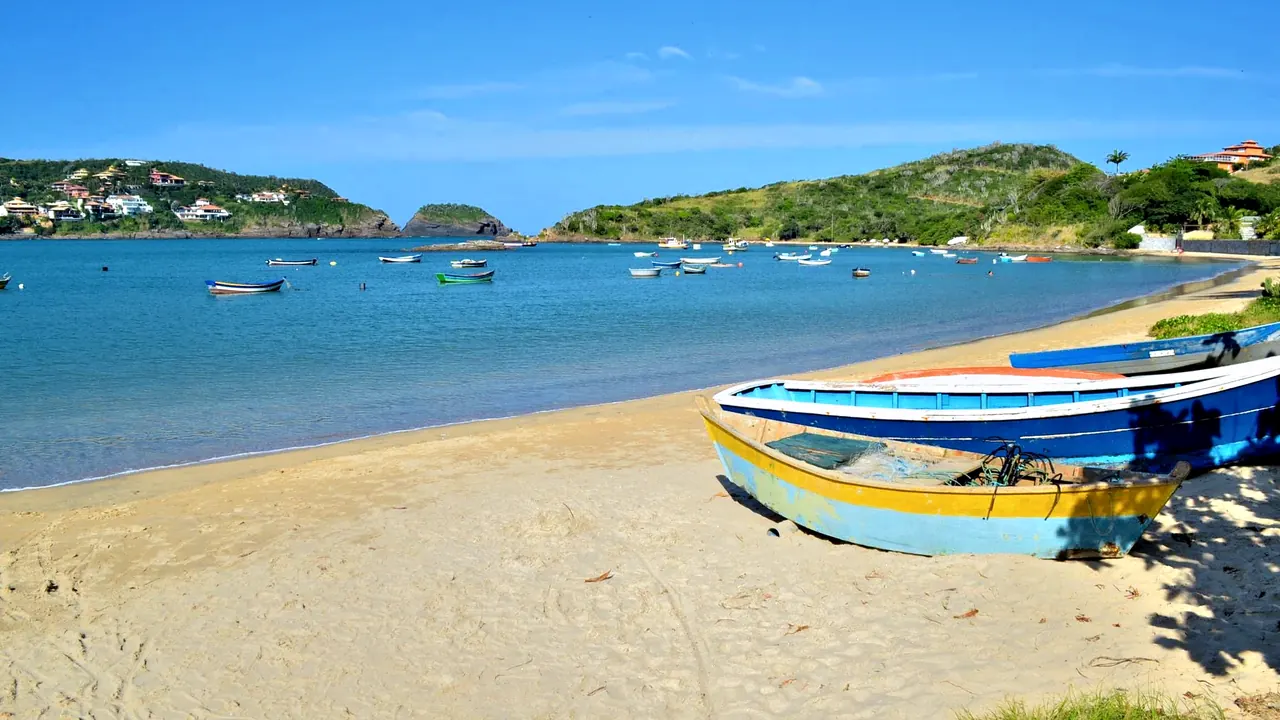
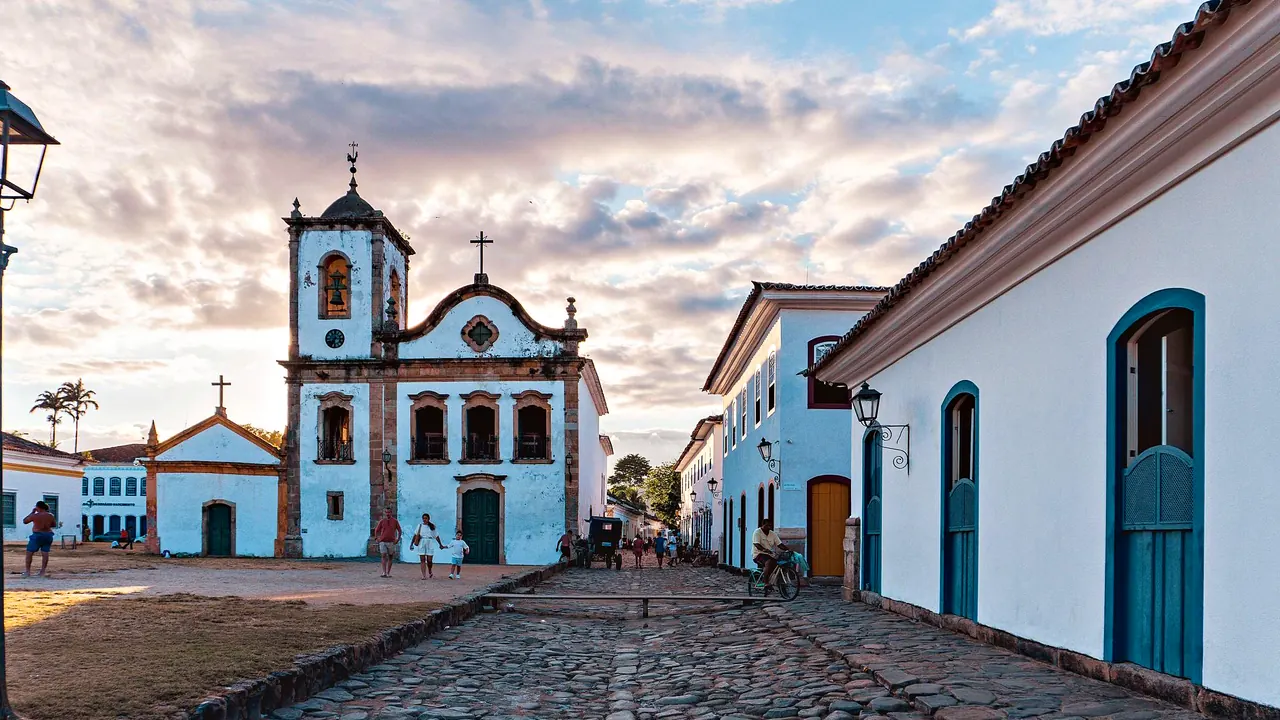
Photos: Buzios by Alberto1939, CC BY-SA 4.0, cropped; Paraty by Gabriel Zachi, Pexels License.
Buzios or Paraty?
Our verdict in twelve categories, each scored against the same fixed benchmark cities, and the climate month by month, so you can choose for your trip.
Choose Buzios for
- nightlife
- beaches
- families
Buzios is the choice for a beach-first trip with some evening life to go with it. Its peninsula gives you calm bay coves and open surf beaches within a short taxi or water-taxi ride, the rain is far lighter through the year, and in summer Rua das Pedras keeps going late with bars and small clubs. It suits couples and groups who want sand, boats and sunset dinners, and who don't mind that there is almost nothing to visit beyond the shore.
Choose Paraty for
- culture and sights
- nature and the outdoors
- day trips
Paraty rewards travellers who want more than a beach. The colonial centre is a place to walk for its own sake, and behind it the rainforest of the Serra da Bocaina has waterfalls, old gold-trail paths and the inlet of Mamanguá. Its swimming happens mostly from boats among the islands rather than on the town's own edge, the summers are very wet, and the nights are quieter. For history, scenery and an unhurried pace, it is the better pick, and it costs a little less.
Scoreboard
Twelve categories on one fixed scale from 0 to 100. The shaded stretch is the gap between the two.
Your match
Pick a travel style or drag the sliders, and both match scores follow your weighting.
Wins on nightlife and beaches with your weighting.
Wins on culture and sights and nature and the outdoors with your weighting.
What matters to you?
Category by category
What the scores mean for a trip.
Beaches & swimming
Buzios has the stronger beach offer, mainly because of its range and how easy it is to reach. Calm, clear coves such as Ferradura and Tartaruga on the bay side and long surf beaches like Geriba on the Atlantic side are all on the same small peninsula, so you can pick by mood each morning.
Paraty's own town beaches are murky and mostly for sitting at a kiosk. Its best swimming is from schooners among the forested islands, or forty minutes away at Trindade, but the bay water there is noticeably warmer than Buzios's upwelling-chilled sea.
Food & drink
The two eat about equally well, and both lean on grilled fish and shrimp aimed largely at visitors. What differs is the setting. In Buzios the pull is a table on the Orla Bardot watching the sun go down over the bay, with menus that lean Mediterranean.
Paraty dines by candlelight in old townhouses and has a dish of its own, the blue-green azul marinho fish stew. It also has the cachaça distilleries in the hills, which make a better excursion for anyone curious about Brazilian drink.
Culture & sights
Here Paraty is far ahead. Its whole centre of whitewashed eighteenth and nineteenth century houses on great uneven stones is the attraction, with baroque churches, a fort above town and the story of the gold route from Minas Gerais behind it.
Buzios has a few streets of the old fishing village, the chapel of Sant'Ana, the boats on Ossos beach and the Bardot statue. That is an hour's stroll, not a reason to go.
Nightlife
Buzios has the livelier nights. In summer Rua das Pedras fills with a dressed-up crowd from Rio, São Paulo and Argentina, moving from late dinners to lounge bars and small clubs, with beach parties at New Year and Carnival.
Paraty has no clubs to speak of. Its evenings are long dinners and live guitar in old-town bars, with Trindade's beach parties for a younger crowd. Both towns go quiet out of season, Paraty more so.
Nature & outdoors
Paraty's setting is much grander. The Serra do Mar drops straight into a bay of green islands, and behind the town the Serra da Bocaina rainforest holds waterfalls, swimming holes and paved stretches of the Gold Trail. Boats reach the fjord-like Saco do Mamanguá, and there is a steep climb to its viewpoint.
Buzios is a dry, scrubby peninsula best seen from the water. Its strengths are particular rather than broad: steady wind for kitesurfing at Rasa and Manguinhos, turtles in the bay coves, and first-rate diving at nearby Arraial do Cabo.
Day trips
Neither town is a touring base, but Paraty gives you more to do. Trindade's wild beaches are close, the pottery town of Cunha lies over the mountains and Ubatuba is along the coast, with Ilha Grande worth a night of its own.
From Buzios the options amount to Cabo Frio and its seventeenth-century fort, and Arraial do Cabo for boat trips and diving.
Good for families
Both work about equally well for families, with calm water and no attractions built for children. Buzios has the easier swimming, in shallow bay coves where small children can dig and paddle, and plenty of pousadas with pools, but getting between beaches means hills and taxis.
Paraty offers more adventure, with boat days, the rock pools at Trindade and the waterfall slide, though its paving stones defeat pushchairs and the summer rain needs planning round.
Getting around
Buzios is harder to get around once you leave its small walkable centre around Rua das Pedras, the Orla Bardot and Armacao beach. The rest of the hilly peninsula means taxis, hired buggies or quad bikes, or water taxis between the bay coves, because the local buses are of little use to visitors and some roads have no pavements.
Paraty is the easier town on the ground. Its car-free centre takes ten minutes to cross, if slowly over the big rounded stones, boats leave the quay for the bay beaches and local buses run to Trindade, though the waterfalls and Mamanguá still need a taxi, a hired car or a tour. Getting there takes longer, though: about four or five hours from Rio or São Paulo, against roughly three hours by road from Rio's airport to Buzios.
Shopping & style
Both offer a pleasant after-dinner browse rather than real shopping. Buzios leans towards fashion, with Brazilian swimwear and beachwear labels, linen and an evening craft fair along late-opening lanes.
Paraty is more about craft and galleries in colonial shopfronts. The things to bring home are local cachaça, indigenous basketry and painted wooden boats.
Affordability
Paraty is the somewhat cheaper stay, though neither is a bargain by Brazilian standards and both charge far more over New Year and Carnival. In Buzios the spread-out layout adds a steady run of taxi and boat fares on top of resort-priced pousadas and restaurants.
Paraty's shared schooner trips, local buses and simple fish places keep daily costs down, and rooms just outside the old town cost noticeably less than those inside it.
Live music & performing arts
Paraty has a little more to offer, though neither is a place to plan evenings around performance. Besides informal samba and bossa nova in old-town bars, it has a long puppet-theatre tradition and a festival calendar that brings concerts and street performance.
In Buzios live music means musicians in waterfront restaurants on summer evenings, and nothing more.
Wellness & relaxation
Both rely on pousadas rather than any bathing tradition, and both are restful mainly for their pace. Buzios's version is a hillside pousada with a small spa and a pool facing the sea, as long as you stay away from the noise of Rua das Pedras in high season.
Paraty's is a garden house with hammocks in the quiet old town out of season, with yoga studios and secluded forest or bayside retreats for a complete switch-off.
When should you go?
Pick your month. The climate figures are measured averages, not a forecast.
Buzios in July
Paraty in July
Daytime high, °C
Rainfall in the month, mm
Where the figures come from
Buzios's temperatures are measured 46 km from the centre, at Macae / Barra.
Buzios has no rain gauge within 25 km of the centre, so its rainfall comes from a gridded climate dataset read at the city rather than from a gauge further away.
Paraty has no weather station within reach, so its figures come from a gridded climate model rather than a measured record, and read a broad area rather than the city itself.
Temperature and rainfall are climate normals, averaged over the years shown. Buzios: 2007-2020 (rainfall 1991-2020) normals, Macae / Barra (45.7 km from centre). Paraty: 1991-2020 normals, TerraClimate 4 km grid at the town, no weather station within 90 km.
Both towns are warm all year, and the real difference is rain. Buzios is much the drier: even its wettest summer months get about half of what Paraty receives, where January brings around 324mm and the afternoons often end in downpours. Summer in Buzios is hot, up to about 33°C in February, which is fine on the sand but tiring for walking at midday. From June to September it is almost dry and still around 27°C, pleasant enough for the beach, though the sea there cools to about 21°C.
Paraty's sea is warmest in summer, around 27°C from January to March, so the island swims are at their best just when the rain is heaviest. The cooler months from May to September bring far less rain and milder days, which suit the cobbled streets and forest trails best, though the water is a few degrees cooler by then. In both towns April and May are a good middle ground: still warm water, less rain than in summer.
Which traveller are you?
On a culture and arts trip, Paraty is the clear choice. Its UNESCO-listed colonial centre, the churches around Santa Rita and the hilltop fort fill an unhurried day, while Buzios has only a chapel, a statue and an hour of wandering.
For an outdoors trip, Paraty again comes out ahead. Rainforest trails in the Serra da Bocaina, waterfalls, kayaking among the bay's islands and the hike above Mamanguá offer far more than Buzios's coastal paths, unless your sport is kitesurfing or diving.
On a food and nightlife trip, Buzios suits you better. Both towns cook similar seafood about equally well, but after dinner Rua das Pedras moves on to lounge bars and small clubs into the early hours in summer, where Paraty mostly ends with a caipirinha and a guitarist.
Before you go
| Measure | Buzios | Paraty |
|---|---|---|
| Official language | Portuguese | Portuguese |
| Currency | Brazilian Real (BRL) | Brazilian Real (BRL) |
| Sockets | CN60 Hz | CN60 Hz |
| Driving side | Right | Right |
| Time zone | UTC-3 | UTC-3 |
| Emergency number | Police 190, ambulance 192, fire 193 | Police 190, ambulance 192, fire 193 |
| Elevation | 5 m | 5 m |
| Main airport | Rio de Janeiro Galeão – Tom Jobim International Airport (GIG)140 km from centre54 non-stop destinations | Rio de Janeiro Galeão – Tom Jobim International Airport (GIG)157 km from centre54 non-stop destinations |
| Public holidays this year | 14 days | 14 days |
By the numbers
| Measure | Buzios | Paraty |
|---|---|---|
| City population | 40,006 | 47,668 |
| People per km² | 577 | 51 |
| Museums within 10 km | 0 | 2 |
| UNESCO World Heritage sites within 50 km | 0 | 1 |
| Swim season, months above 21 °C | 12 months | 12 months |
Where else could you go?
Every comparison below shares a destination with this one, so you can follow Buzios or Paraty somewhere new.
- Rio de Janeirovs Buzios
- Rio de Janeirovs Paraty
- Sao Paulovs Paraty
- Sao Paulovs Buzios
- Florianopolisvs Paraty
- Florianopolisvs Buzios