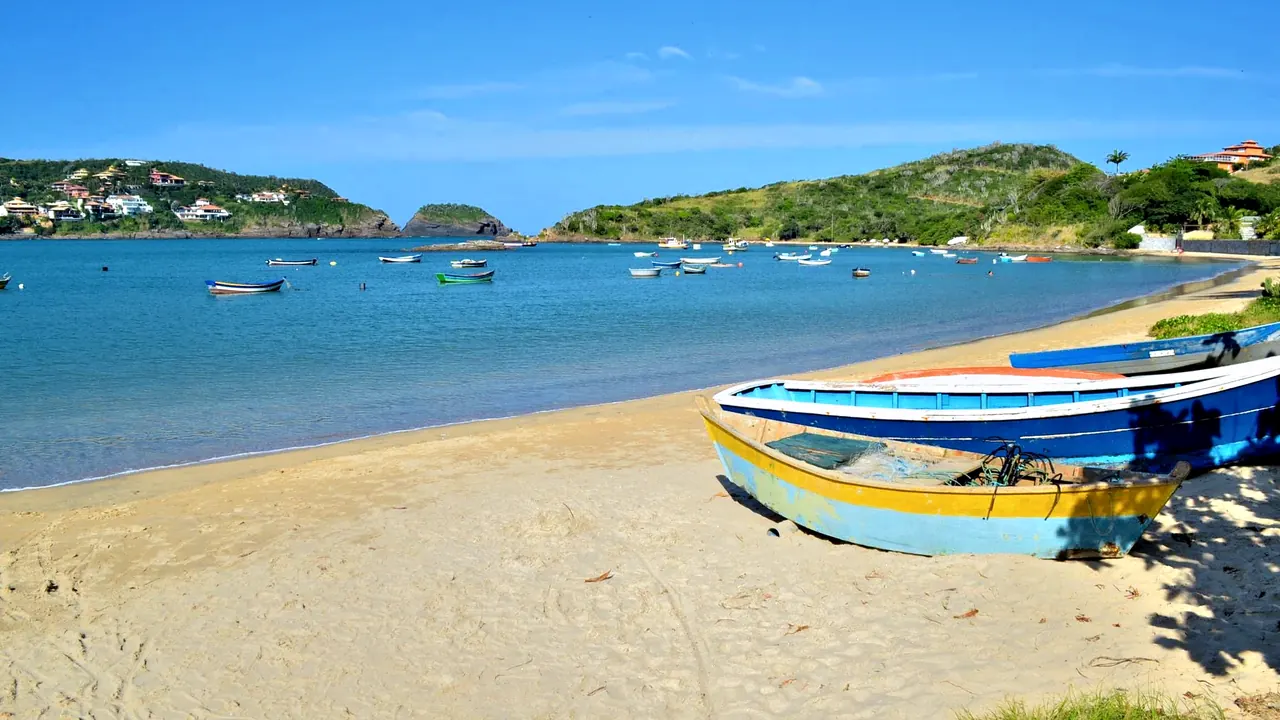
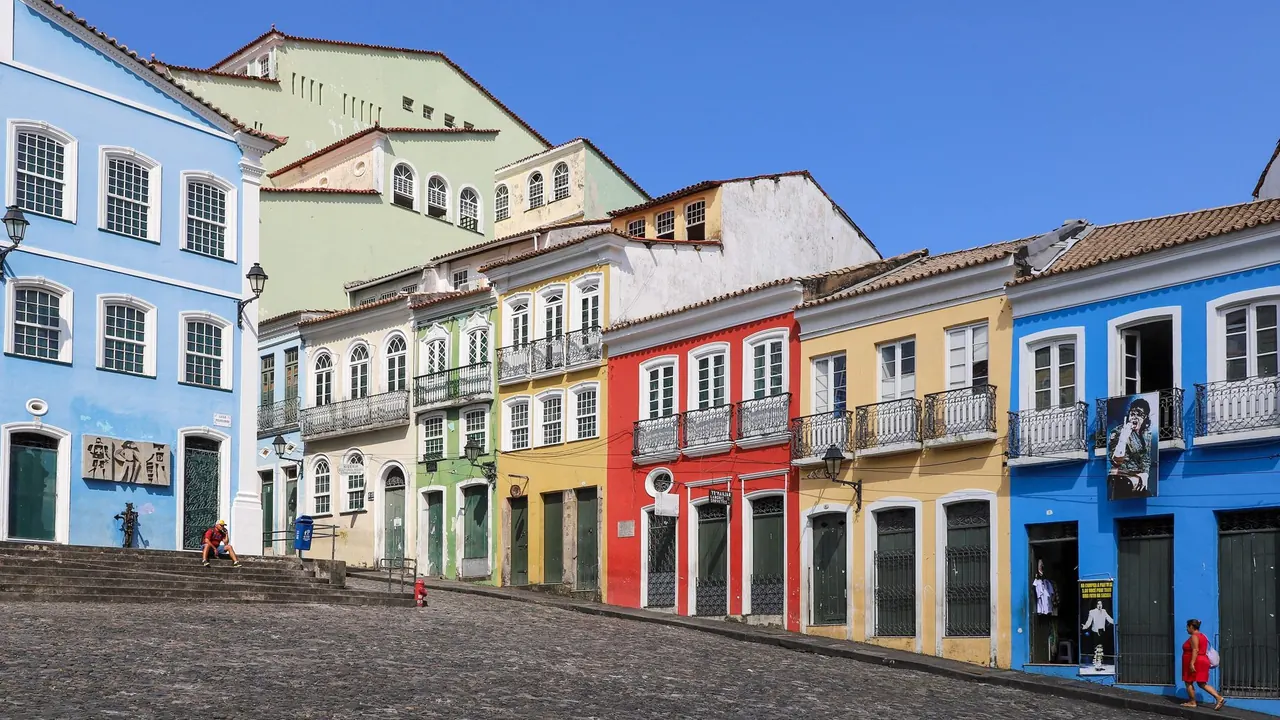
Photos: Buzios by Alberto1939, CC BY-SA 4.0, cropped; Salvador by Paul R. Burley, CC BY-SA 4.0, cropped.
Buzios or Salvador?
Our verdict in twelve categories, each scored against the same fixed benchmark cities, and the climate month by month, so you can choose for your trip.
Choose Buzios for
- nature and the outdoors
- wellness
- families
Buzios suits a slow beach vacation where the main decision each day is which cove to pick. On one side of the peninsula there are calm, clear bays for snorkelling and small children, and on the other there are surf beaches. In the evening you have dinner and a drink along Rua das Pedras. There is almost nothing to sightsee, so it works best for couples and families who are happy to stay by the water and want a quieter, more polished stay.
Choose Salvador for
- culture and sights
- live music and the arts
- day trips
Salvador is the choice if you want your beach inside a real city with a culture of its own. The Pelourinho's baroque churches, the Afro-Brazilian heritage, the bloco drum rehearsals and acarajé on the squares give it a depth Buzios cannot match, and it costs less day to day. The trade-off is a hotter, noisier and more demanding stay, and you will take taxis after dark.
Scoreboard
Twelve categories on one fixed scale from 0 to 100. The shaded stretch is the gap between the two.
Your match
Pick a travel style or drag the sliders, and both match scores follow your weighting.
Wins on nature and the outdoors and wellness with your weighting.
Wins on culture and sights and live music and the arts with your weighting.
What matters to you?
Category by category
What the scores mean for a trip.
Beaches & swimming
Both towns sit on peninsulas with a calm bay side and an open Atlantic side, and in both the beach is the centre of the day. The difference is in the water and the setting. Buzios has more than twenty separate coves, linked by water taxis and clear enough for snorkelling at Ferradura or Tartaruga. On some days, though, cold upwelling makes the sea surprisingly cool.
Salvador's sea is warm all year, and its beaches are city beaches. Porto da Barra is where the neighbourhood swims and watches the sunset. The cleaner, wilder sand lies further north towards Stella Maris, or an hour away at Praia do Forte, and the water near the centre can turn murky after rain.
Food & drink
Buzios has the smarter table, with grilled fish, shrimp and Mediterranean-leaning plates at waterfront restaurants on the Orla Bardot, eaten as the sun goes down over the bay. The cooking is made for visitors, though. Once you have had the seafood, there is no market or regional kitchen to explore, so it suits evenings out more than discovery. Salvador is the opposite: less polish and far more to taste.
Salvador's Bahian cooking has West African roots and is built on dendê oil, coconut milk and dried shrimp. You find it in the street as much as at a table, in fritters from the baianas' stalls, per-kilo lunch counters and the São Joaquim market, with a clay-pot moqueca baiana for a proper sit-down meal. Travellers who plan their days around eating will be happier here. If you want a stylish dinner with a view, Buzios is easier, because Salvador has little high-end or international dining.
Culture & sights
This is where the two differ most. Buzios has the whitewashed lanes of its old fishing village, the chapel of Sant'Ana and the Bardot statue on the waterfront, and an hour covers it all.
Salvador was Brazil's first capital, and its UNESCO-listed Pelourinho has dozens of baroque churches, led by the gilded interior of São Francisco. From there the Lacerda Elevator drops to the Mercado Modelo, and the Bonfim church stands on its own hill. The Afro-Brazilian heritage running through all of it gives several days of sightseeing a character no beach resort can offer.
Nightlife
Buzios has one street for going out. On Rua das Pedras, late dinners lead on to lounge bars and small clubs full of a well-dressed crowd in summer, and the rest of the year is much quieter. Salvador's evenings are looser and more local, with plastic tables across Rio Vermelho's pavements, a younger beachfront crowd in Barra and the Pelourinho squares busy on Tuesday and weekend nights.
Both peak at Carnival, but Salvador's street parties behind the music trucks are on another scale entirely. Neither is much of a clubbing destination.
Nature & outdoors
Buzios is the better choice for time outdoors, and almost all of it is on the water. You can snorkel with turtles in the bay coves, take schooner trips round the headlands, kitesurf in the steady wind at Rasa and Manguinhos, and dive at Arraial do Cabo, under an hour away.
Salvador's nature is more varied but less close at hand. It offers boat trips on the Bay of All Saints, the white dunes and dark lagoon of Abaeté, surf at Stella Maris and humpback whales offshore from about July to October. Neither has mountains for hiking nearby.
Day trips
Salvador has far more to fill a day away. Cachoeira is a colonial river town in the Recôncavo, Praia do Forte has its castle ruins, and the ferry runs to Itaparica's old town. The car-free village of Morro de São Paulo is a catamaran ride away.
From Buzios the choice is mostly Cabo Frio, with its seventeenth-century fort, and the boat trips at Arraial do Cabo. Rio is about three hours away and better treated as a separate stay.
Good for families
Neither has a zoo, aquarium or theme park worth planning around, so in both a family vacation is a beach vacation, and Buzios has the edge for small children. Its bay coves at Ferradura, Joao Fernandes and Tartaruga give several calm, shallow options, and pousadas with pools are easy to find, although hills and taxis separate the beaches.
Salvador has one comparable cove in Porto da Barra, and older children enjoy the Pelourinho's capoeira and the turtle centre at Praia do Forte. Steep cobbles, strong sun and the need to watch your belongings make it harder work with children.
Getting around
Neither is easy without taxis, but Salvador is a little more manageable. Buzios has a small walkable centre around Rua das Pedras and the Orla Bardot. Beyond that lies a hilly peninsula with infrequent buses and roads without pavements, so people reach the beaches by water taxi or hired buggy.
Salvador is far larger, yet cheap ride-hailing, the metro to the airport and bus station, and the Lacerda Elevator between the upper and lower town cover most needs. It also has its own airport, whereas Buzios means a three-hour road transfer from Rio.
Shopping & style
The two offer different kinds of shopping. Buzios sells style: Brazilian swimwear and beachwear labels, linen and jewellery along Rua das Pedras, with shops open late after dinner, plus an evening craft fair.
Salvador sells Bahian craft, such as carved wood, lace, berimbaus and Bonfim ribbons, at the Mercado Modelo and in the Pelourinho. It also has the São Joaquim market to wander and malls for everyday needs, which gives it more range overall.
Affordability
Salvador is noticeably cheaper. Street food, beach-shack lunches, ride-hailing and simple guesthouses in Barra or the Pelourinho keep costs low, and many churches and museums cost little or nothing to enter.
Buzios charges resort rates for pousadas and waterfront dining, much like a mid-range trip to Southern Europe, and taxis and boat trips add up. Carnival pushes room rates up sharply in both places, and Buzios is far easier on the budget from April to November.
Live music & performing arts
Salvador wins easily here. It is the home of samba-reggae and axé, and open bloco rehearsals in the Pelourinho and Liberdade, the Balé Folclórico da Bahia and impromptu capoeira rodas make live rhythm part of most evenings. The Teatro Castro Alves adds orchestral concerts and touring shows.
In Buzios, live performance means bossa nova and samba at waterfront restaurants on summer nights. It is pleasant with dinner, but there is no programme to plan an evening around.
Wellness & relaxation
Buzios is the better place to unwind. Its hillside pousadas and resorts often have small spas and pools looking out to sea, and a day of cove, long lunch and sunset is restful, particularly outside the December to March season, as long as you sleep away from Rua das Pedras.
Salvador has no spa culture beyond its hotels, and the centre is hot and noisy. Its calm lies in the unhurried Bahian manner, a quiet guesthouse in Santo Antônio or a resort up the coast.
When should you go?
Pick your month. The climate figures are measured averages, not a forecast.
Buzios in July
Salvador in July
Daytime high, °C
Rainfall in the month, mm
Where the figures come from
Buzios's temperatures are measured 46 km from the centre, at Macae / Barra.
Buzios has no rain gauge within 25 km of the centre, so its rainfall comes from a gridded climate dataset read at the city rather than from a gauge further away.
Temperature and rainfall are climate normals, averaged over the years shown. Buzios: 2007-2020 (rainfall 1991-2020) normals, Macae / Barra (45.7 km from centre). Salvador: 1991-2020 normals, Salvador (4.5 km from centre).
Buzios gets its rain in summer. December to March are the wettest and hottest months, with highs of up to 33°C in February, but this is also when the bay coves are warmest for swimming. From June to September the rain drops below 50mm a month and the days stay pleasantly warm for walking. The sea cools to around 21°C, though, so swimming takes some resolve. April, May, October and November fall in between and are a good compromise.
Salvador's year runs the other way. Its rain comes in autumn and winter, peaking at nearly 290mm in each of April and May, and there is noticeably less sunshine through June. December and January are the driest and sunniest months. The sea stays at 28°C from January to May and barely cools after that, so Salvador gives the warmer swim in any season. October is a fair middle ground if you are weighing up both.
Which traveller are you?
For a culture and arts trip, Salvador is the clear choice. The Pelourinho's gilded churches, the Afro-Brazilian Museum, the Balé Folclórico and the open bloco rehearsals fill both days and evenings, while Buzios offers a chapel, a statue and an hour's wander.
On a relaxing and wellness trip, Buzios suits you better. Hillside pousadas with sea-view pools and small spas, calm coves and sunset dinners make for an easy rhythm, especially outside high season. In Salvador the centre is hot and noisy, and finding calm usually means leaving town.
On a tight budget, your money goes further in Salvador. Acarajé, beach-shack meals, cheap ride-hailing and churches that are free or cheap to enter keep daily spending down. Buzios charges resort rates, and its spread-out layout adds taxi and boat fares.
Before you go
| Measure | Buzios | Salvador |
|---|---|---|
| Official language | Portuguese | Portuguese |
| Currency | Brazilian Real (BRL) | Brazilian Real (BRL) |
| Sockets | CN60 Hz | CN60 Hz |
| Driving side | Right | Right |
| Time zone | UTC-3 | UTC-3 |
| Emergency number | Police 190, ambulance 192, fire 193 | Police 190, ambulance 192, fire 193 |
| Elevation | 5 m | 8 m |
| Main airport | Rio de Janeiro Galeão – Tom Jobim International Airport (GIG)140 km from centre54 non-stop destinations | Deputado Luiz Eduardo Magalhães International Airport (SSA)20 km from centre31 non-stop destinations |
| Public holidays this year | 14 days | 14 days |
By the numbers
| Measure | Buzios | Salvador |
|---|---|---|
| City population | 40,006 | 2,417,678 |
| People per km² | 577 | 3,489 |
| Museums within 10 km | 0 | 49 |
| UNESCO World Heritage sites within 50 km | 0 | 1 |
| Swim season, months above 21 °C | 12 months | 12 months |
Where else could you go?
Every comparison below shares a destination with this one, so you can follow Buzios or Salvador somewhere new.
- Rio de Janeirovs Buzios
- Paratyvs Buzios
- Sao Paulovs Buzios
- Recifevs Salvador
- Florianopolisvs Buzios
- Rio de Janeirovs Salvador