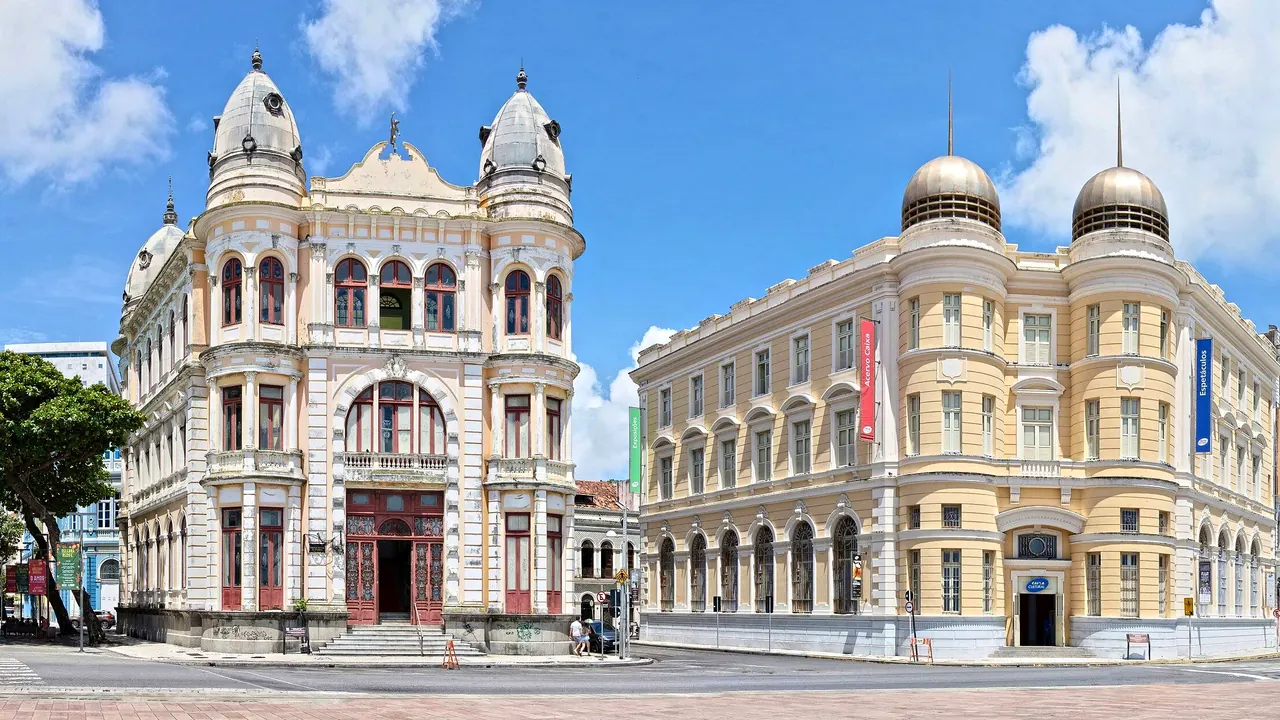
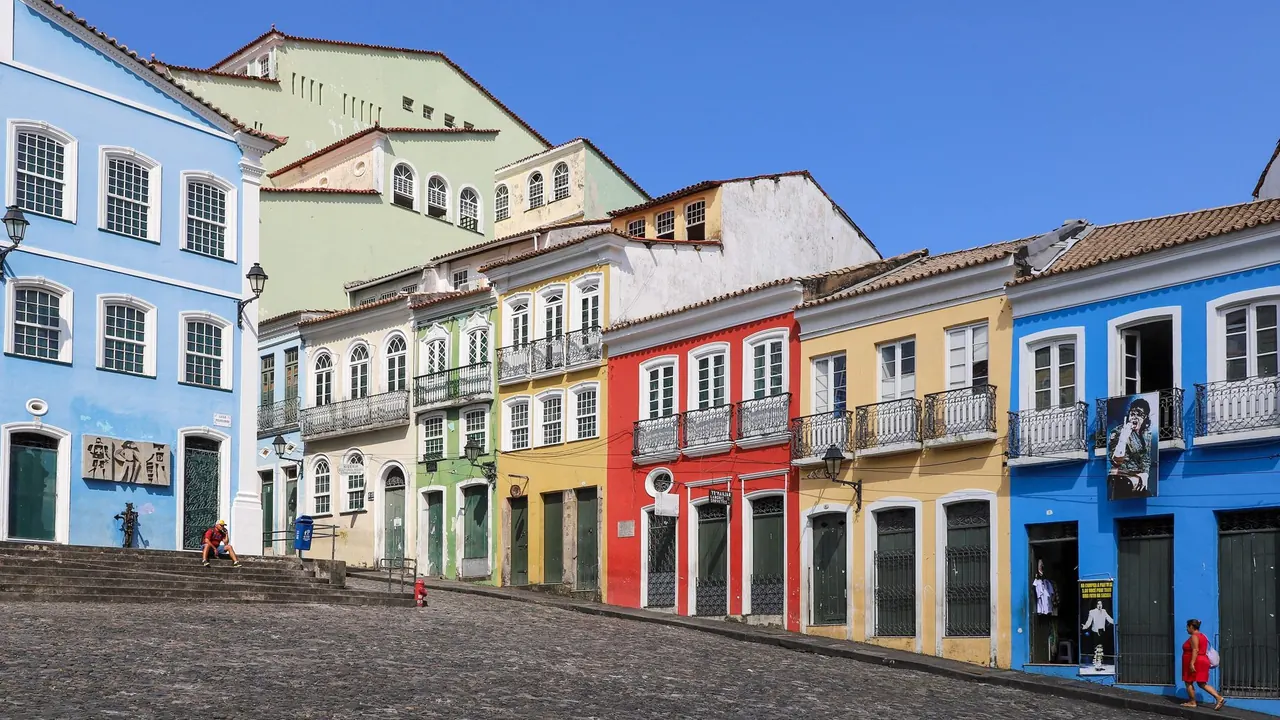
Photos: Recife by Wilfredor, CC0; Salvador by Paul R. Burley, CC BY-SA 4.0, cropped.
Recife or Salvador?
Our verdict in twelve categories, each scored against the same fixed benchmark cities, and the climate month by month, so you can choose for your trip.
Choose Recife for
- shopping
- prices
- day trips
Recife suits travellers who are drawn to Pernambuco's own culture: the frevo and maracatu that drive its Carnival, the colonial streets of Olinda a short ride away, and crafts worth carrying home from the Casa da Cultura and the potters of Caruaru. It works best as a base for music and outings, with the proper beach time spent down the coast at Porto de Galinhas, since sharks keep swimmers inside the reef off the city shore.
Choose Salvador for
- beaches
- culture and sights
- nature and the outdoors
Choose Salvador if you want the beach and the history in the same place. You can swim in calm water at Porto da Barra in the morning and walk the cobbled lanes of the Pelourinho, Brazil's first capital, in the afternoon. The Afro-Brazilian heritage runs through its food, drumming and churches, and the city is the more complete trip of the two without having to move to a resort.
Scoreboard
Twelve categories on one fixed scale from 0 to 100. The shaded stretch is the gap between the two.
Your match
Pick a travel style or drag the sliders, and both match scores follow your weighting.
Wins on shopping and prices with your weighting.
Wins on beaches and culture and sights with your weighting.
What matters to you?
Category by category
What the scores mean for a trip.
Beaches & swimming
Off Boa Viagem, Recife's long city beach, sharks are a lasting hazard, and bathers are told to stay inside the reef. That makes the beach good for kiosks, football and wading in the low-tide pools, but not for real swimming. For clear water you have to drive an hour or more south to the raft-reached pools of Porto de Galinhas, the lagoon at Muro Alto or the river mouth at Carneiros.
Salvador gives you swimmable sea within the city. Porto da Barra is a calm, sheltered cove on the bay, and the ocean beaches get wider and cleaner as they run north to Stella Maris and Flamengo. Praia do Forte and the bay islands add full beach days, so you don't need to change your base to spend time by the sea.
Food & drink
These are two equally strong regional kitchens, and both are best eaten casually, but they taste very different. Recife's table is Pernambucan: carne de sol with macaxeira, sururu broths, crab cracked with a mallet at the kiosks, and sweets such as bolo de rolo and cartola.
Salvador cooks with dendê palm oil and coconut milk, and its cooking has West African roots. Acarajé from the lace-clad baianas and moqueca baiana in a clay pot are the dishes to try. In neither city will you find much international or high-end range.
Culture & sights
Recife's history comes in strong fragments. There is the rebuilt Kahal Zur Israel on Rua do Bom Jesus, the gilded Capela Dourada, and the two Brennand institutions, an odd castle of arms and Dutch-period art and a ceramic sculpture garden. Between these highlights the old centre is faded, and much of the colonial atmosphere is found in Olinda next door.
Salvador has the more complete ensemble. The Pelourinho is an intact upper town of cobbled streets and dozens of baroque churches, led by the gold-covered São Francisco. With the Lacerda Elevator, the Afro-Brazilian Museum and the Bonfim church, it fills several days with a character of its own.
Nightlife
Salvador has the easier night out because it has an obvious centre. In Rio Vermelho, the bohemian seafront district, pavement tables and acarajé stalls stay busy past midnight, and Barra and the Pelourinho squares add to it. Recife's evenings are just as informal, with forró from the next bar and cold beer, but they are spread across Recife Antigo, Boa Viagem and Casa Forte, so you spend more time in taxis.
Both cities hold one of Brazil's great Carnivals. Recife's opens with the vast Galo da Madrugada parade and continues through the streets of Olinda. Salvador's follows music trucks along the Barra seafront for a whole week.
Nature & outdoors
Recife is a flat city of rivers and mangroves. Its outdoors means boat trips on the Capibaribe, the patch of forest at Dois Irmãos, and snorkelling, paddleboarding and kitesurfing on the coast to the south. Fernando de Noronha is a flight away, not a day out.
Salvador has more to do close at hand. You can sail among the islands of the Bay of All Saints, surf at Stella Maris, and walk the white dunes and dark lagoon of Abaeté inside the city. Between July and October, humpback whales pass along the coast, and the turtle project at Praia do Forte is about an hour north.
Day trips
The two cities are evenly matched for outings, but the shape differs. Recife's best excursion, Olinda, is barely an excursion at all: it is a short taxi ride away and easy to fit into an evening. After that the choices thin out to Igarassu and Itamaracá, plus long days to the Caruaru market or João Pessoa.
Salvador has no single neighbour as close as Olinda, but its outings are more varied. Cachoeira's baroque river town is two hours inland, ferries cross the bay to Itaparica, and Morro de São Paulo, a car-free island village, is reached by catamaran.
Good for families
Neither city is built around children, and families in both often end up at a resort down or up the coast. The difference is where the easy wins are. In Salvador, the calm water at Porto da Barra lets young children swim without leaving town, and the drumming and capoeira in the Pelourinho hold older ones.
In Recife, the best moments come at low tide, when children can stand in the reef pools of Porto de Galinhas and watch fish. The Dois Irmãos forest zoo and the Brennand castle are other good outings. The heat, traffic and broken pavements make the city itself harder going.
Getting around
Salvador is a little easier to manage. Barra is walkable along the seafront, and the Pelourinho is only a lift or funicular ride above the port, although its streets are steep and cobbled. Recife's usual base, Boa Viagem, is a long way from the old centre and Olinda, so most sightseeing starts with a taxi.
In both cities the metro is mainly useful for the airport, the buses are hard for visitors to work out, and ride-hailing is the cheap, sensible choice after dark.
Shopping & style
Both cities are about regional crafts, not fashion. Recife has the better sources. The Casa da Cultura sells lace, leatherwork and cordel woodcuts from former prison cells, Olinda has artists' studios and Carnival puppet makers, and the Alto do Moura potters in Caruaru make the finest ceramics.
Salvador's Mercado Modelo and the Pelourinho shops lean more towards visitors, with berimbaus, drums, carved wood and Bonfim ribbons. The São Joaquim market is better for wandering than for buying. Both cities have malls, and neither has a luxury street.
Affordability
Both cities are cheap, and the costs are similar. Recife is a touch easier on the wallet: kiosk meals, per-kilo lunches and ride-hailing cost little, and seafront rooms in Boa Viagem are fairly priced. Salvador's simple guesthouses in Barra and the Pelourinho are just as kind to a budget.
Prices rise in the same places in both cities. Carnival sends room rates soaring, and the coastal resorts, Porto de Galinhas near Recife and Praia do Forte near Salvador, are priced for well-off travellers.
Live music & performing arts
Music is the main event in both cities, but the sounds are different. Recife has the brass and umbrella dance of frevo, the heavy maracatu drums, the manguebeat that mixed them with rock, and forró everywhere during the June festivals.
Salvador is the home of samba-reggae and axé. Its bloco drum rehearsals are open to anyone, the Balé Folclórico da Bahia performs most evenings, and the Teatro Castro Alves gives it a somewhat fuller formal stage than Recife's Teatro Santa Isabel.
Wellness & relaxation
Neither city has a spa or bathing tradition, and both are hot and noisy in the centre. Salvador relaxes a little more easily thanks to the slow Bahian pace and quiet guesthouses in Santo Antônio Além do Carmo, beside the old town. In Recife, real rest means moving out to the resort spas at Muro Alto and Porto de Galinhas.
When should you go?
Pick your month. The climate figures are measured averages, not a forecast.
Recife in July
Salvador in July
Daytime high, °C
Rainfall in the month, mm
Temperature and rainfall are climate normals, averaged over the years shown. Recife: 1991-2020 normals, Recife (4 km from centre). Salvador: 1991-2020 normals, Salvador (4.5 km from centre).
Both cities are hot all year, with daytime highs of about 31°C from November to March and only slightly cooler in midwinter, and the sea is warm enough for a swim in every month. Rain is what separates the months. Recife's wet season comes later and is heavier, building from April and peaking in June at around 388mm. It then dries out quickly, so September to February is its best stretch, with November the driest and sunniest month.
Salvador's rain arrives earlier, at its heaviest in April and May, and eases from August. Its clearest weather falls from December to February, when the days are sunny and the rain is light. If you are travelling between September and November, Recife is the drier choice. From late December into February the two are much alike, both at their best for the beach.
Which traveller are you?
For a beach and sun trip, Salvador lets you live by the sea for the whole stay. Ocean beaches at Ondina, Pituba and Itapuã are a short ride from most hotels, and Barra gathers on the sand every evening for sunset. Recife's Boa Viagem is better for a promenade stroll and coconut water.
On a culture and arts trip, Salvador gives you more days of sightseeing. You can go from the blue-tiled Rosário dos Pretos church and the Carmo district to the modern art at Solar do Unhão and the fort by the Barra lighthouse. Recife's Paço do Frevo and Marco Zero fill fewer days.
On a trip on a tight budget, Recife makes the money go a little further. Seafront hotels in Boa Viagem are fair value, while in Salvador a comfortable room by the beach costs more. Recife's best outing, Olinda, needs only a short taxi ride, where Salvador's best outings mean a ferry, a catamaran or two hours on the road.
Before you go
| Measure | Recife | Salvador |
|---|---|---|
| Official language | Portuguese | Portuguese |
| Currency | Brazilian Real (BRL) | Brazilian Real (BRL) |
| Sockets | CN60 Hz | CN60 Hz |
| Driving side | Right | Right |
| Time zone | UTC-3 | UTC-3 |
| Emergency number | Police 190, ambulance 192, fire 193 | Police 190, ambulance 192, fire 193 |
| Elevation | 6 m | 8 m |
| Main airport | Recife/Guararapes - Gilberto Freyre International Airport (REC)9 km from centre39 non-stop destinations | Deputado Luiz Eduardo Magalhães International Airport (SSA)20 km from centre31 non-stop destinations |
| Public holidays this year | 14 days | 14 days |
By the numbers
| Measure | Recife | Salvador |
|---|---|---|
| City population | 1,488,920 | 2,417,678 |
| People per km² | 6,805 | 3,489 |
| Museums within 10 km | 21 | 49 |
| UNESCO World Heritage sites within 50 km | 1 | 1 |
| Swim season, months above 21 °C | 12 months | 12 months |
Where else could you go?
Every comparison below shares a destination with this one, so you can follow Recife or Salvador somewhere new.
- Buziosvs Salvador
- Rio de Janeirovs Salvador
- Paratyvs Salvador
- Rio de Janeirovs Recife
- Florianopolisvs Salvador
- Sao Paulovs Recife