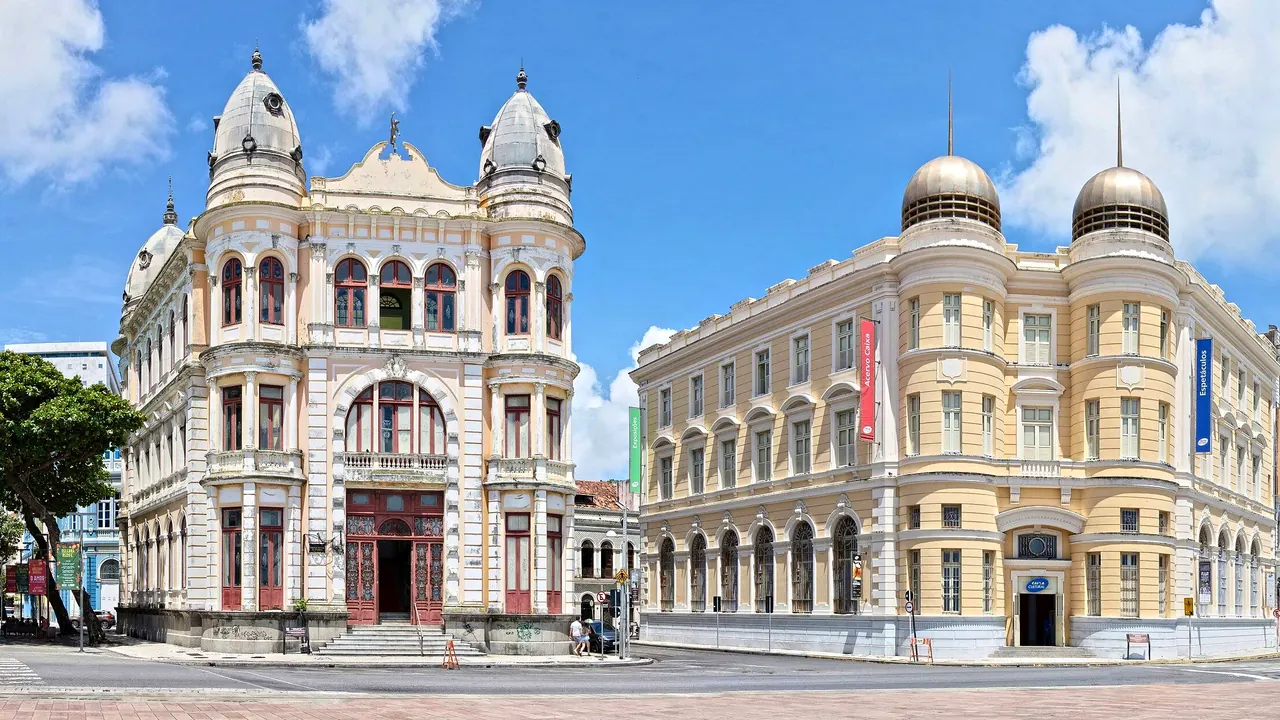

Photos: Recife by Wilfredor, CC0; Rio de Janeiro by Arne Müseler, CC BY-SA 3.0 DE, cropped.
Recife or Rio de Janeiro?
Our verdict in twelve categories, each scored against the same fixed benchmark cities, and the climate month by month, so you can choose for your trip.
Choose Recife for
- prices
- day trips
- food and drink
Recife suits a traveller more curious about Brazil's Northeast than about postcard views. It is a cheaper trip, built around frevo and maracatu, Pernambuco cooking, the colonial streets of Olinda next door and a few days by the calm reef pools at Porto de Galinhas. It works best if you are happy to stay by the sea and take taxis to the sights.
Choose Rio de Janeiro for
- nature and the outdoors
- beaches
- nightlife
Choose Rio de Janeiro if you want the beach to be the centre of city life, with dramatic landscape around it. Copacabana and Ipanema are real swimming beaches a short walk from the hotels. The Tijuca forest and the granite peaks give hiking and views that a flat delta city cannot match, and nights in Lapa and Botafogo run later and louder. It costs more, mostly for a room near the sand, but there is a great deal more to do.
Scoreboard
Twelve categories on one fixed scale from 0 to 100. The shaded stretch is the gap between the two.
Your match
Pick a travel style or drag the sliders, and both match scores follow your weighting.
Wins on prices and day trips with your weighting.
Wins on nature and the outdoors and beaches with your weighting.
What matters to you?
Category by category
What the scores mean for a trip.
Beaches & swimming
If you actually want to swim, Rio's beaches are much better. Copacabana, Ipanema and Leblon lie on the hotels' doorstep, with lifeguard posts along the sand. Further west, the wilder coves of Prainha and Grumari have surf and cleaner water. The cautions are strong waves on the open ocean and polluted water inside the bay.
Recife's Boa Viagem is pleasant for sitting and walking, but because of the sharks bathers stay inside the reef, so a real swim means going an hour or more south to the natural pools of Porto de Galinhas or the lagoon at Muro Alto. Recife's sea is warmer than Rio's, which matters most in the southern winter.
Food & drink
The two eat about equally well, but in different styles. Recife has a regional kitchen of its own: carne de sol with macaxeira, sururu broths, crab cracked open at beach kiosks, and sweets such as bolo de rolo. Rio's eating centres on the boteco, Saturday feijoada, rodízio grills and juice bars on every Zona Sul corner, and Leblon and Botafogo have more modern restaurants than anything in Recife.
Culture & sights
Each city fills a few good days, and Rio has the edge in famous landmarks. Its best-known sights are part of the scenery, Corcovado and Sugarloaf above all. The old centre adds the gilded São Bento monastery and the Real Gabinete reading room, and the port has its museums on Praça Mauá.
Recife's sights are more about history, and more unusual. There is the rebuilt Kahal Zur Israel synagogue from the Dutch period, the Capela Dourada, and the Brennand castle and ceramic sculpture garden, which have no equivalent in Rio. The centre is run-down in places between these highlights, but the colonial streets of Olinda are just over the city line.
Nightlife
Rio's nights are bigger and go on later. On weekends, crowds fill the streets under the Lapa Arches and clubs stay open until dawn. Pavement bars spread through Botafogo and Humaitá, Leblon has smarter cocktail bars, and baile funk parties are louder and rougher.
Recife's evenings mean plastic tables, cold beer and live forró around Rua da Moeda. They are relaxed and local, but on a smaller scale. At Carnival both cities turn into one long party, Rio with its street blocos and Recife with the Galo da Madrugada and the streets of Olinda.
Nature & outdoors
Rio has one of the most dramatic settings of any city. The Tijuca forest sits in the middle of town, there are steep hikes up the Dois Irmãos peak and Pedra da Gávea, hang-gliders land on São Conrado beach, and the surf is good at Arpoador. The Serra dos Órgãos, about two hours inland, offers serious hiking.
Recife is flat delta country. Nature there means boat trips on the Capibaribe, a patch of forest in its own Dois Irmãos park (no relation to Rio's peak) and, above all, the coast to the south: snorkelling over the Porto de Galinhas reefs, kitesurfing and mangrove kayaking near Carneiros. Hikers will find little.
Day trips
Recife has the better nearby outing in Olinda, a colonial hill town a short taxi ride away that fits into an afternoon and evening, with Igarassu and Itamaracá as quieter extras. Rio's classic day out, imperial Petrópolis, is an hour and a half up into the hills, and the ferry to Niterói is easy. But Rio's best neighbours, Paraty, Búzios and Ilha Grande, are three hours or more away and work better as overnight stays.
Good for families
Rio has a bit more to keep children busy: the cable car to Sugarloaf, the Corcovado train, AquaRio, the BioParque zoo and the cycle path round the lagoon. Small swimmers will find calmer water at Leme and Praia Vermelha.
In Recife, the highlight for children is standing in the warm reef pools at Porto de Galinhas and watching the fish, along with the zoo in the forest at Dois Irmãos park. The city itself has little for children, which is why many families stay at a resort down the coast. In both cities, parents need to cope with heat and traffic and keep an eye on belongings.
Getting around
Neither city is easy to get around, but Rio is easier. Its metro runs straight along the route visitors need, from the centre through Botafogo and Copacabana to Ipanema and Leblon, and the beach districts are flat and easy to walk.
Recife's metro serves the suburbs and the airport rather than the sights. If you stay in Boa Viagem, nearly every trip to Recife Antigo or Olinda is by taxi or ride-hailing, and reaching the coast further south takes a transfer or a hire car.
Shopping & style
Recife is the better place for handmade crafts to take home. Clay figurines, lace, hammocks and cordel woodcuts are sold from the old prison cells of the Casa da Cultura, Olinda's studios make Carnival puppets, and the best ceramics come from the potters of Alto do Moura in Caruaru.
Rio is better for clothes to wear on the beach. The boutiques of Ipanema and Leblon do Brazilian swimwear, linen and resort fashion well, and the Sunday hippie fair and the Saara market streets downtown are good for cheaper finds and Carnival costumes. Both cities have big air-conditioned malls, and neither has much in the way of luxury shopping.
Affordability
Recife is the cheaper trip, mainly because seafront hotels in Boa Viagem are fairly priced, while rooms near the sand in Copacabana, Ipanema and Leblon are expensive for what you get. Day-to-day costs are closer: kilo lunches, beer and ride-hailing are cheap in both, and Rio's beaches and forest trails cost nothing. Both get expensive at Carnival, and Rio at New Year as well.
Live music & performing arts
Both are great music cities, each with its own sound. Recife has frevo with its umbrella dancers, the heavy drums of maracatu, the manguebeat movement it gave rise to, and forró everywhere during the June festivals. Rio has samba most nights in Lapa and at neighbourhood rodas, samba school rehearsals before Carnival and small bossa nova venues. It also has more formal performance, with opera and ballet at the Theatro Municipal.
Wellness & relaxation
In Recife, calm is found outside the city: a few slow days at a resort spa around Porto de Galinhas or Muro Alto, beside the still water behind the reef. Rio has more within reach in town, with yoga on the sand, an evening walk round the lagoon or the cooler streets of Santa Teresa, but there are no thermal baths in either city and both are hot and loud.
When should you go?
Pick your month. The climate figures are measured averages, not a forecast.
Recife in July
Rio de Janeiro in July
Daytime high, °C
Rainfall in the month, mm
Where the figures come from
Rio de Janeiro has no weather station within reach, so its figures come from a gridded climate model rather than a measured record, and read a broad area rather than the city itself.
Temperature and rainfall are climate normals, averaged over the years shown. Recife: 1991-2020 normals, Recife (4 km from centre). Rio de Janeiro: 2001-2020 normals, NASA POWER reanalysis grid, no weather station within 90 km.
Recife is hot all year, with highs of around 28°C to 31°C, so rain decides when to go, not temperature. The wet season runs from March to August and peaks in June at about 390mm. Sunshine drops then too, so beach days are unreliable. September to February is the time to go, and October to December is the driest and sunniest part. The sea is warm enough for a dip in every month.
Rio's seasons run the other way. Its summer, from November to March, is both the hottest and the wettest time, with heavy downpours. June to August is dry and mild, which is good for walking the streets and hiking the hills, but the sea cools to about 21°C and swimming feels brisk. If you want to visit both cities on one trip, September and October suit both reasonably well.
Which traveller are you?
On a beach and sun trip, Rio is the stronger choice. Copacabana and Ipanema are proper swimming beaches right outside the hotels, with lifeguards and life on the sand all day. In Recife, sharks limit swimming at the city beach, and the best water is an hour south.
For an outdoors trip, Rio is far ahead. Inside the city you can hike through the Tijuca forest, climb Pedra da Gávea for the view, surf at Arpoador or hang-glide down onto the sand. Flat Recife mainly offers snorkelling and kayaking along the coast to the south.
On a trip on a tight budget, your money goes further in Recife. Beach kiosks, per-kilo lunches and cheap taxis come with fairly priced seafront rooms in Boa Viagem and museums that charge little. In Rio, hotels near the sand are where the costs climb.
Before you go
| Measure | Recife | Rio de Janeiro |
|---|---|---|
| Official language | Portuguese | Portuguese |
| Currency | Brazilian Real (BRL) | Brazilian Real (BRL) |
| Sockets | CN60 Hz | CN60 Hz |
| Driving side | Right | Right |
| Time zone | UTC-3 | UTC-3 |
| Emergency number | Police 190, ambulance 192, fire 193 | Police 190, ambulance 192, fire 193 |
| Elevation | 6 m | 31 m |
| Main airport | Recife/Guararapes - Gilberto Freyre International Airport (REC)9 km from centre39 non-stop destinations | Rio de Janeiro Galeão – Tom Jobim International Airport (GIG)12 km from centre54 non-stop destinations |
| Public holidays this year | 14 days | 14 days |
By the numbers
| Measure | Recife | Rio de Janeiro |
|---|---|---|
| City population | 1,488,920 | 6,211,223 |
| People per km² | 6,805 | 4,930 |
| Museums within 10 km | 21 | 69 |
| UNESCO World Heritage sites within 50 km | 1 | 3 |
| Swim season, months above 21 °C | 12 months | 12 months |
Where else could you go?
Every comparison below shares a destination with this one, so you can follow Recife or Rio de Janeiro somewhere new.
- Buziosvs Rio de Janeiro
- Paratyvs Rio de Janeiro
- Sao Paulovs Rio de Janeiro
- Salvadorvs Recife
- Florianopolisvs Rio de Janeiro
- Foz do Iguacuvs Rio de Janeiro