
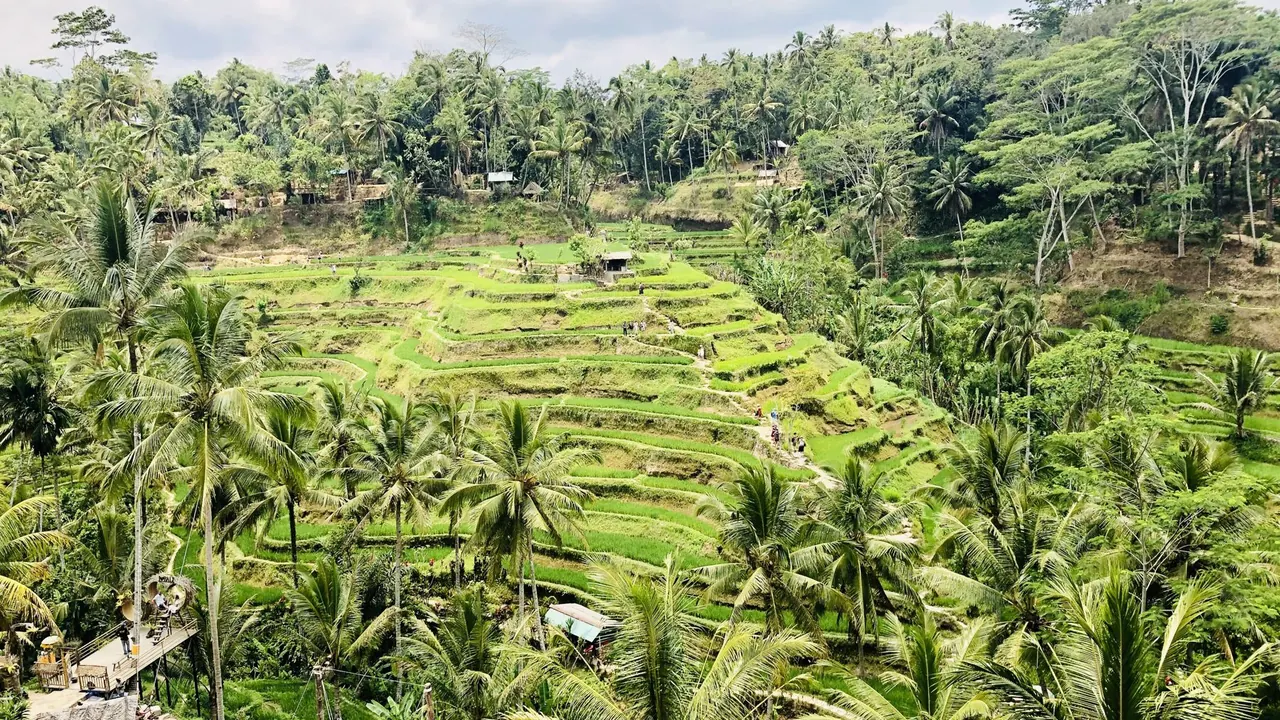
Photos: Byron Bay by Visions of Domino, CC BY 2.0, cropped; Ubud by Pinterpandai, CC BY-SA 3.0, cropped.
Byron Bay or Ubud?
Our verdict in twelve categories, each scored against the same fixed benchmark cities, and the climate month by month, so you can choose for your trip.
Choose Byron Bay for
- beaches
- getting around
- nightlife
Byron Bay is the choice when the sea is the point of the trip. A run of quite different beaches lies within walking distance, from the sheltered break at The Pass to the long empty sweep of Tallow, so the days are for surfing, swimming all year and watching for whales from the cape. The small, flat centre and its pubs make the evenings easy. It suits surfers, couples and families who have a car and a generous budget and don't need museums.
Choose Ubud for
- prices
- culture and sights
- day trips
Pick Ubud if you want somewhere that feels foreign and costs far less. Balinese ceremony, palace dance and the painting collections are part of everyday life, the temples and terraces of half the island are within a day's drive, and yoga and massage are built into the town's routine. The sea is an hour away and the streets are hard to walk, so it rewards slow travellers who are happy in a villa above the rice fields.
Scoreboard
Twelve categories on one fixed scale from 0 to 100. The shaded stretch is the gap between the two.
Your match
Pick a travel style or drag the sliders, and both match scores follow your weighting.
Wins on beaches and getting around with your weighting.
Wins on prices and culture and sights with your weighting.
What matters to you?
Category by category
What the scores mean for a trip.
Beaches & swimming
Byron Bay is built around its beaches. Main Beach and Clarkes are patrolled and close to the centre, The Pass has a sheltered point break, Wategos is a small cove that catches the morning sun, and Tallow and Belongil are long and empty enough for an hour's walk. The open surf brings strong rips, so swim between the flags.
Ubud has no beach at all. The calm water inside the reef at Sanur is the nearest proper swim, and the black sand of the Gianyar coast is better for watching surfers. Both are about an hour's drive away. In Ubud a pool facing the rice fields takes the place of the sea, so anyone who wants beach days should choose Byron or split an Ubud stay with time on the coast.
Food & drink
Ubud has a cuisine of its own, and that gives it the edge. You can have babi guling at the lunchtime counters, slow-cooked bebek betutu and crispy duck, and nasi campur with sambal in family warungs. On top of that there are cafés, Kintamani coffee and a few tasting menus built on local produce. The better cooking is a lane or two off the main street.
Byron Bay eats well in a different way. It is a town of good coffee and long brunches built on hinterland produce such as macadamias, avocados and grass-fed beef, with seafood from the coast and a few ambitious restaurants on farms or in Bangalow. Both towns are full of smoothie bowls and plant-based cafés, but Byron has little street food and almost nothing to eat late.
Culture & sights
The gap here is wide. Ubud's culture is part of daily life: offerings on doorsteps, processions on feast days, the royal palace at Puri Saren and the lotus pond of Pura Taman Saraswati. Add the Puri Lukisan, Neka and ARMA collections of Balinese painting, and the rock-cut Elephant Cave at Goa Gajah, and you have several unhurried days.
Byron Bay has the lighthouse at the most easterly point of mainland Australia, with its small maritime display. The Arakwal Bumberlin people's long connection to the cape is best understood on a guided walk. A morning covers it.
Nightlife
Neither is a party town, but Byron Bay stays up later. Its big pubs and beer gardens near Main Beach, a few cocktail bars and a couple of late venues fill with backpackers on summer weekends, and most nights finish soon after midnight.
Ubud keeps early hours, because so many visitors are up at dawn for yoga or the Batur climb. An evening there means a long dinner, a drink in a garden bar and maybe a band, and anyone who wants a club has to make the long drive to Seminyak or Canggu.
Nature & outdoors
The two are equally strong outdoors, and the difference is the setting. Byron's nature is mostly the ocean: dolphins in the bay, humpbacks passing from June to November, and turtles, rays and grey nurse sharks at Julian Rocks. Inland, the rainforest of the old caldera has Minyon Falls and Nightcap National Park, both within an hour's drive.
Ubud's nature is rice and volcano. There are terraces along the Campuhan Ridge and at Tegallalang, rafting on the Ayung, the falls at Tegenungan and Tibumana, macaques in the Monkey Forest, and a climb up Batur in the dark for sunrise over the crater lake. Divers and surfers should choose Byron, and walkers who love terraced landscapes should choose Ubud.
Day trips
Ubud is the better base for exploring. Within reach are the holy spring of Tirta Empul, the cliff tombs of Gunung Kawi, the mother temple of Besakih, the painted pavilions of Klungkung, Tanah Lot, the lake temple at Bratan and the UNESCO-listed Jatiluwih terraces. A hired driver and slow roads limit how many fit into a day.
Byron Bay's outings are gentler. You can visit Bangalow's heritage main street, easygoing Mullumbimby, counterculture Nimbin and the regional gallery at Murwillumbah, or spend a day at the Gold Coast theme parks. They are pleasant, but none of them matches the coast at home.
Good for families
Byron Bay is the easier choice with children. It has patrolled beaches, calmer water at The Pass and Wategos, rock pools, the lighthouse walk and a good chance of seeing dolphins, all in a small, safe town where vacation houses and caravan parks are easy to find. The catches are the rips, the summer crowds and the noisy centre at weekends.
Ubud welcomes children warmly, and pool villas, dance shows, gentle rafting and the safari park keep them busy. But narrow pavements, scooter traffic, the bag-grabbing macaques and long car rides make it a better fit for older children than for toddlers.
Getting around
Both towns need wheels beyond the centre, but Byron Bay is far easier day to day. The centre is small and flat, and the nearest beaches are a short walk or bike ride away, so you only need the hire car you picked up at Ballina or the Gold Coast for the hinterland.
Ubud has no public transport to rely on, the pavements are broken and the main streets are full of scooters, and the roads climb steeply out of the river valleys. Most days are planned around a driver or ride-hailing, so stay near the centre if you want to walk to dinner.
Shopping & style
Ubud is better for things to take home. Start at the Art Market opposite the palace, then work through the craft villages on the road from the south: Mas for woodcarving, Celuk for silver, Batuan for painting. The workshops towards Tegallalang sell furniture and homeware, and Jalan Hanoman has linen and yoga-wear boutiques.
Byron Bay sells a look rather than a craft: surfwear, swimwear, loose linen and crystals, with makers in the Arts and Industry Estate and handmade goods at the markets. An afternoon is enough, and neither town has luxury shops or a department store.
Affordability
This is one of the sharpest differences between the two. In Ubud, homestay rooms with breakfast, warung meals, massages and drivers for the day cost a fraction of Western prices. Only the jungle resorts above the gorges, the tasting menus and imported wine push the bill up.
Byron Bay is among the most expensive beach towns in Australia, and it costs even more in summer, during school vacations and on festival weekends, when long minimum stays apply. You also have to pay for a hire car. The beaches, the cape walk and the waterfalls are free, and hostels and campsites help backpackers.
Live music & performing arts
Ubud has a living stage tradition. Every night there is Legong, Barong or Kecak with a gamelan orchestra in the palace courtyard, at the Saraswati lotus pond or in village temples. The performers come from local troupes, and you may also see the same dances at a temple festival. There is no theatre or concert hall.
Byron Bay's offer is informal: roots and surf-rock bands in the beer gardens, buskers in summer, a small community theatre and the long-running writers' festival. It is good fun, but for an orchestra or a ballet you have to go to Brisbane.
Wellness & relaxation
Both are wellness towns, but Ubud goes deeper. It has yoga in open pavilions from dawn, retreats lasting anywhere from a weekend to several weeks, cheap massage on every street and riverside spas above the Ayung and Petanu gorges. Flower baths and traditional healers are part of ordinary life there, and the purification ritual at Tirta Empul is close by.
Byron Bay has busy yoga studios, day spas, breathwork and retreats in the hinterland hills, and the days begin with a swim. The best retreats there cost a lot, though, and peak season crowds the centre, so the quiet winter months are the time to go.
When should you go?
Pick your month. The climate figures are measured averages, not a forecast.
Byron Bay in July
Ubud in July
Daytime high, °C
Rainfall in the month, mm
Where the figures come from
Ubud's temperatures are measured 29 km from the centre, at Denpasar / Ngurah-Rai.
Ubud's station stands 209 m below the city centre, so the centre is likely a little cooler than the figures say.
Ubud has no rain gauge within 25 km of the centre, so its rainfall comes from a gridded climate dataset read at the city rather than from a gauge further away.
Temperature and rainfall are climate normals, averaged over the years shown. Byron Bay: 1991-2020 normals, Cape Byron (5.6 km from centre). Ubud: 1991-2020 normals, Denpasar / Ngurah-Rai (29 km from centre).
Byron Bay has real seasons. From December to April the days reach about 28°C and the sea is warm, but this is also the wettest stretch, with February the worst at around 234mm. June still brings heavy rain. In winter, from June to August, highs drop to around 19°C, which suits walking the cape and the hinterland. The sea stays mild enough for locals and wetsuit surfers. September and October are dry and mild, with the water starting to warm again, and they are a good compromise for a trip that mixes beach and walking.
Ubud stays hot all year, at around 30°C in every month, so the rain is what decides when to go. December to February is the wettest time, with January near 300mm and the rice fields at their greenest. From May to September it is much drier. August has only 36mm and the most sunshine, which makes it the best month for walking the ridges and climbing Batur. The sea at Sanur is warm enough to swim in all year.
Which traveller are you?
On a beach and sun trip, Byron Bay wins easily. Several very different beaches lie within walking distance, the sea is swimmable all year and the surf at The Pass shapes the day. From Ubud, the nearest good swim, at Sanur, takes about an hour by car.
For a culture and arts trip, Ubud is the clear pick. Temple ceremonies, the royal palace, three museums of Balinese painting and nightly dance with gamelan are all close at hand. Byron Bay's history comes down largely to its lighthouse on the cape.
On a tight budget, Ubud makes money go much further. Homestay rooms with breakfast, warung meals, massages and day drivers all cost little. Byron Bay is one of Australia's most expensive beach towns, and only hostels and campsites keep it within reach.
Before you go
| Measure | Byron Bay | Ubud |
|---|---|---|
| Official language | English | Indonesian |
| Currency | Australian Dollar (AUD) | Rupiah (IDR) |
| Sockets | I230 V, 50 Hz | CF50 Hz |
| Driving side | Left | Left |
| Time zone | UTC+10, UTC+11 in summer | UTC+8 |
| Emergency number | 000 | 112 |
| Elevation | 5 m | 210 m |
| Main airport | Ballina Byron Gateway Airport (BNK)21 km from centre2 non-stop destinations | Denpasar I Gusti Ngurah Rai International Airport (DPS)29 km from centre63 non-stop destinations |
| Public holidays this year | 11 days | - |
By the numbers
| Measure | Byron Bay | Ubud |
|---|---|---|
| Museums within 10 km | 1 | 14 |
| UNESCO World Heritage sites within 50 km | 1 | 1 |
| Swim season, months above 21 °C | 11 months | 12 months |
Where else could you go?
Every comparison below shares a destination with this one, so you can follow Byron Bay or Ubud somewhere new.
- Gold Coastvs Byron Bay
- Brisbanevs Byron Bay
- Noosavs Byron Bay
- Yogyakartavs Ubud
- Sydneyvs Byron Bay
- Canberravs Byron Bay