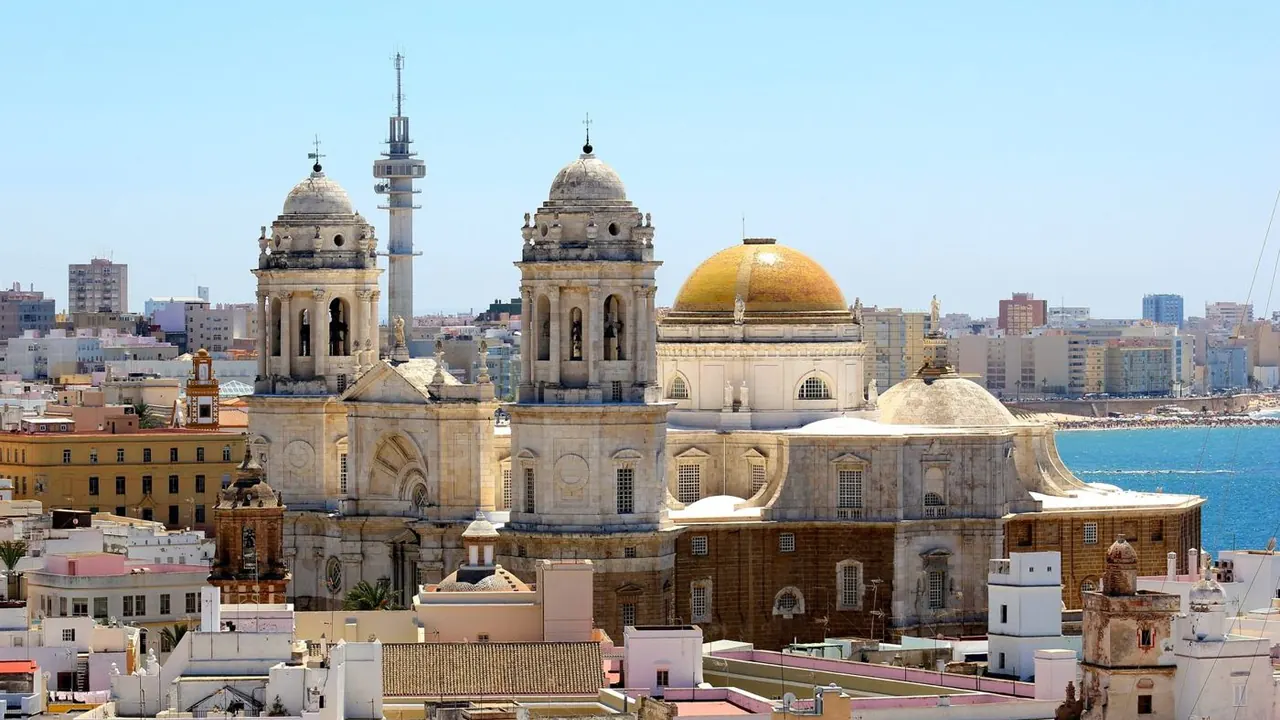
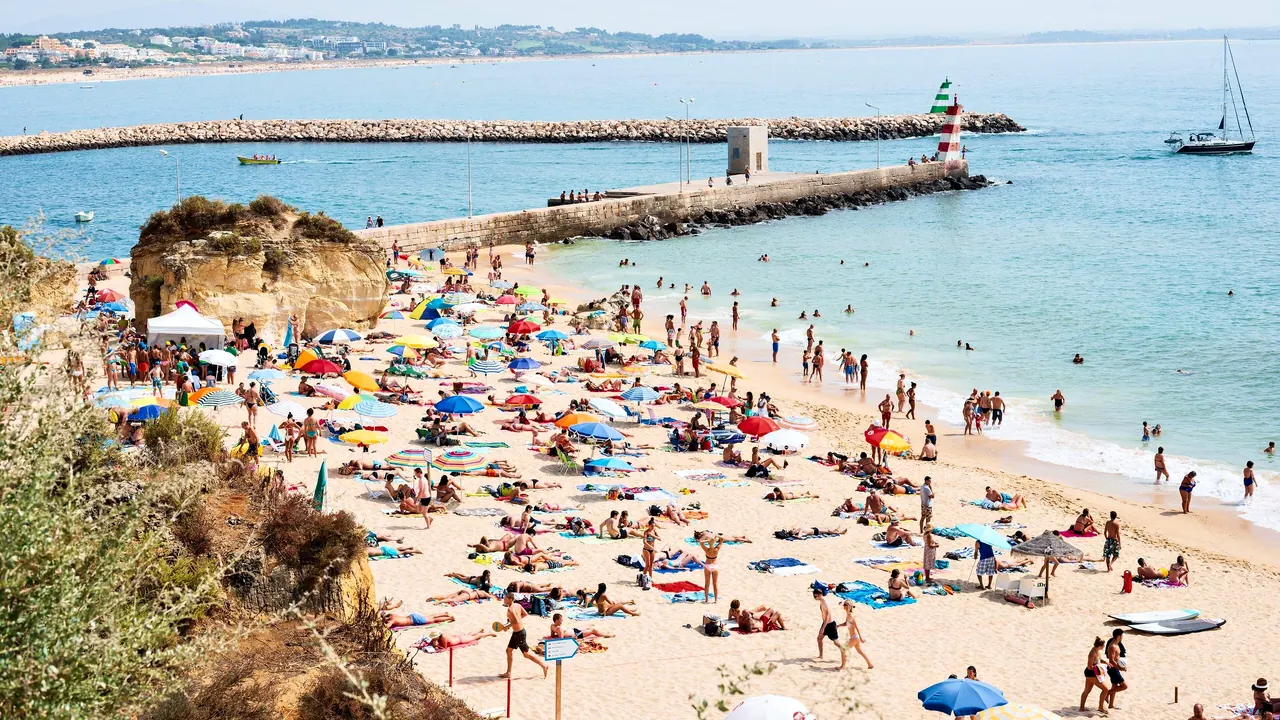
Photos: Cadiz by Bronch, CC BY-SA 3.0 ES, cropped; Lagos, Portugal by Norbert Nagel, CC BY-SA 4.0, cropped.
Cadiz or Lagos, Portugal?
Our verdict in twelve categories, each scored against the same fixed benchmark cities, and the climate month by month, so you can choose for your trip.
Choose Cadiz for
- live music and the arts
- culture and sights
- day trips
Cadiz suits travellers who want a proper Spanish city with the beach attached. The old town of pale watchtower houses fills a peninsula, there's fried fish and almadraba tuna in the bars of La Viña, flamenco in members' clubs, and trains run out to Jerez and Seville. It rewards a trip that mixes swimming with eating, history and day trips, and it's easier without a car.
Choose Lagos, Portugal for
- nature and the outdoors
- nightlife
- families
Lagos is the better pick when the coast itself is the point. The coves below honey-coloured cliffs, kayaking into the grottoes at Ponta da Piedade, clifftop paths towards Luz and the wild Costa Vicentina make it an outdoor base first and a town second. Younger travellers will also find more going on after dark in summer, though the town has far less to see and eat than Cadiz.
Scoreboard
Twelve categories on one fixed scale from 0 to 100. The shaded stretch is the gap between the two.
Your match
Pick a travel style or drag the sliders, and both match scores follow your weighting.
Wins on live music and the arts and culture and sights with your weighting.
Wins on nature and the outdoors and nightlife with your weighting.
What matters to you?
Category by category
What the scores mean for a trip.
Beaches & swimming
For swimming, the two are equally strong, but the beaches are different in kind. Cadiz's are part of the city: you can swim at La Caleta between two castles in the old town, or walk out along kilometres of flat golden sand at Playa Victoria. The water is a little warmer than in Lagos. Within an hour lie the long, empty strands of the Costa de la Luz, though the levante wind can blow sand across them for days.
Lagos offers scenery rather than space. Small coves such as Camilo and Dona Ana sit under cliffs and sea stacks at the bottom of long wooden stairways, and they're calm and clear but crowded in August. When you want room, the open sweep of Meia Praia across the river has plenty of it.
Food & drink
Cadiz is clearly the better place to eat. Its fish cooking has real depth: paper cones from the freidurías, marinated dogfish, shrimp fritters and almadraba bluefin tuna in the old-town tapas bars. Glasses of manzanilla from the sherry towns nearby go with all of it, and the Mercado Central is worth a visit morning and evening.
Lagos has good raw material, with sardines and octopus off the charcoal grill and cataplana in a copper pan. The trouble is finding it. The central lanes are full of photo-menu tourist places, so the better meals take some hunting in family places a street back or by the harbour.
Culture & sights
Cadiz has far more to see. Its claim to be Western Europe's oldest city is backed by Phoenician sarcophagi in the Museo de Cádiz and a Roman theatre in the Barrio del Pópulo. Add the gold-domed cathedral, the camera obscura in the Torre Tavira and the Oratorio of 1812, and you have two or three full days of sightseeing.
In Lagos the sights fit into a single morning. They are the old walls, the harbour fort, the gilded baroque interior of Santo António and the sobering slave market museum. After that, the region's heritage lies in other towns.
Nightlife
Lagos is the livelier of the two for a night out, at least in summer. Its old-town streets fill with young travellers, surfers and pub crawls, bars stay open well past midnight and a few small clubs last until near dawn. From November to March it goes quiet.
Evenings in Cadiz are Spanish rather than backpacker. You eat late, move between tapas bars in La Viña and sit out in the squares, and in summer the terraces along Playa Victoria stay open into the small hours. The big exception is February's Carnival, when the whole city becomes an all-night street party.
Nature & outdoors
Lagos has the more dramatic outdoors, and it starts right on the edge of town. You can paddle among the arches and grottoes of Ponta da Piedade or walk the clifftops to Luz. Further west, the Costa Vicentina has the Fishermen's Trail and surf all year, and the Serra de Monchique offers walking and cycling about an hour inland.
Cadiz itself is flat, with the sea for scenery. Close by it has the salt pans and marshes of the bay, full of flamingos and spoonbills. Its bigger draws need longer journeys: kitesurfing and whale-watching at Tarifa, and mountain walking in the Sierra de Grazalema.
Day trips
Cadiz is the far better base for days out. Jerez is half an hour away by train, a ferry crosses the bay to El Puerto de Santa María, and Seville is under two hours by rail. With a car you can add Sanlúcar, the white hill towns of Vejer and Arcos, and the Roman ruins at Baelo Claudia.
From Lagos, the outstanding trip is to Sagres and Cape St Vincent at Europe's south-western tip. Silves, with its red Moorish castle, and the river town of Tavira are pleasant too, but almost everything is easier by car, and many visitors simply stay on the beaches.
Good for families
Both work well for a beach vacation with children, but in different ways. Cadiz is easier on foot. The old town is flat and mostly free of cars, the Alameda and Genovés parks have shade, and Playa Victoria has lifeguards and room to spread out. What it lacks is anything built for children, so older ones may tire of castles and camera obscuras.
Lagos has more to fill the days, with grotto boat trips, water parks and a large marine park within forty minutes' drive. Its gently shelving Meia Praia is ideal for small children. The catch is getting about: steep stairs down to the coves and cobbles that are hard work with a pushchair.
Getting around
Cadiz is easier to manage without a car. Its flat old town can be crossed on foot, buses run out to Playa Victoria, trains leave the old town for Jerez and Seville, and a catamaran crosses the bay. Only the Costa de la Luz beaches and the white villages really call for a hire car.
Lagos is walkable too, but its lanes are cobbled and some are steep. Beyond the town it sits at the slow far end of the Algarve railway, with infrequent regional buses, so most visitors rent a car.
Shopping & style
Neither is a shopping destination, but Cadiz has a little more range. Around Calle Ancha and Plaza de las Flores you'll find Spanish chains and old family shops, and fans, flamenco fashion and sherry make good things to take home. Lagos is browsing on the way to dinner: Algarve ceramics, cork goods, surf shops, and honey and medronho brandy from the market.
Affordability
Cadiz is a little kinder to the budget day to day. Tapas, freidurías, sherry, trains and the bay ferry all cost little, and the expense is the scarce old-town rooms in high summer and Carnival week. Lagos runs closer to the Western European average. Resort pricing in July and August hits both rooms and main-street restaurants, but from October to May the town becomes a good-value base for long stays.
Live music & performing arts
Cadiz has a living tradition here and Lagos does not. As a cradle of flamenco, it has peñas in the old Santa María quarter where knowledgeable audiences listen to alegrías. The neo-Mudéjar Gran Teatro Falla stages the sharp, satirical chirigota contest at Carnival, as well as plays and concerts through the year.
Lagos offers a modest programme at its cultural centre, fado and guitar evenings put on for visitors, and cover bands in the bars. For serious performances you'd have to go as far as Lisbon.
Wellness & relaxation
Neither town has a spa culture of its own, and both offer rest mainly through their slow pace. Around Cadiz, the options are resort spas with sea-water treatments at Novo Sancti Petri and Arab-style baths in Jerez, and the town itself runs on long lunches and siestas.
Lagos leans more towards retreats. Yoga and surf-and-wellness stays gather towards Luz and the west coast, and Caldas de Monchique, an hour inland, has thermal springs used since Roman times. In August, though, the town is noisy enough that spring or autumn suits rest better.
When should you go?
Pick your month. The climate figures are measured averages, not a forecast.
Cadiz in July
Lagos, Portugal in July
Daytime high, °C
Rainfall in the month, mm
Where the figures come from
Lagos, Portugal's temperatures are measured 63 km from the centre, at Faro / Aeroporto.
Lagos, Portugal has no rain gauge within 25 km of the centre, so its rainfall comes from a gridded climate dataset read at the city rather than from a gauge further away.
Temperature and rainfall are climate normals, averaged over the years shown. Cadiz: 1991-2020 (sunshine 1961-1990) normals, Cadiz Bay / Puntales (5.2 km from centre). Lagos, Portugal: 1991-2020 normals, Faro / Aeroporto (63.4 km from centre).
The two climates run almost in step. Winters are mild in both, with daytime highs around 16°C, which is pleasant for walking but not for the beach. Both warm steadily through spring, and June to August is nearly dry, with highs of about 28°C in Cadiz and a degree more in Lagos. Sunshine is generous in both from spring to autumn. Rain returns in October. It peaks in November in Cadiz and in December in Lagos.
The sea is the real difference. Around Cadiz the Atlantic reaches about 23°C in July and August and is still warm in September. In Lagos it barely passes 20°C even at the end of summer. For swimming, Cadiz is better from late June into early October. For walking and outdoor activity, both are at their best in spring and autumn, when the heat is lower and the rain hasn't yet set in.
Which traveller are you?
On a culture and arts trip, Cadiz is the clear choice. It has a Roman theatre, Phoenician sarcophagi, a cathedral tower to climb and the room where the 1812 constitution was signed. It also has flamenco clubs and the Gran Teatro Falla, while Lagos has a morning's worth of sights.
For an outdoors trip, choose Lagos. You can kayak below the sea stacks of Ponta da Piedade, walk the Fishermen's Trail, find surf schools all year on the west coast and go cycling in the Monchique hills. Cadiz's best landscapes, from Grazalema to Tarifa, need longer drives.
On a food and nightlife trip, the answer depends on which half matters more. Cadiz eats much better, with fried fish, bluefin tuna and chilled manzanilla. Lagos stays out later in summer, with packed bar streets and a few clubs open until near dawn.
Before you go
| Measure | Cadiz | Lagos, Portugal |
|---|---|---|
| Official language | Spanish | Portuguese |
| Currency | Euro (EUR) | Euro (EUR) |
| Sockets | CF230 V, 50 Hz | CF230 V, 50 Hz |
| Driving side | Right | Right |
| Time zone | UTC+1, UTC+2 in summer | UTC, UTC+1 in summer |
| Emergency number | 112 | 112 |
| Elevation | 11 m | 3 m |
| Main airport | Jerez Airport (XRY)31 km from centre26 non-stop destinations | Faro - Gago Coutinho International Airport (FAO)63 km from centre91 non-stop destinations |
| Public holidays this year | 12 days | 14 days |
By the numbers
| Measure | Cadiz | Lagos, Portugal |
|---|---|---|
| City population | 109,950 | 31,049 |
| People per km² | 9,087 | 146 |
| Museums within 10 km | 12 | 6 |
| UNESCO World Heritage sites within 50 km | 0 | 0 |
| Swim season, months above 21 °C | 3 months | None |
Where else could you go?
Every comparison below shares a destination with this one, so you can follow Cadiz or Lagos, Portugal somewhere new.
- Jerez de la Fronteravs Cadiz
- Albufeiravs Lagos, Portugal
- Farovs Lagos, Portugal
- Sevillevs Cadiz
- Rondavs Cadiz
- Marbellavs Cadiz