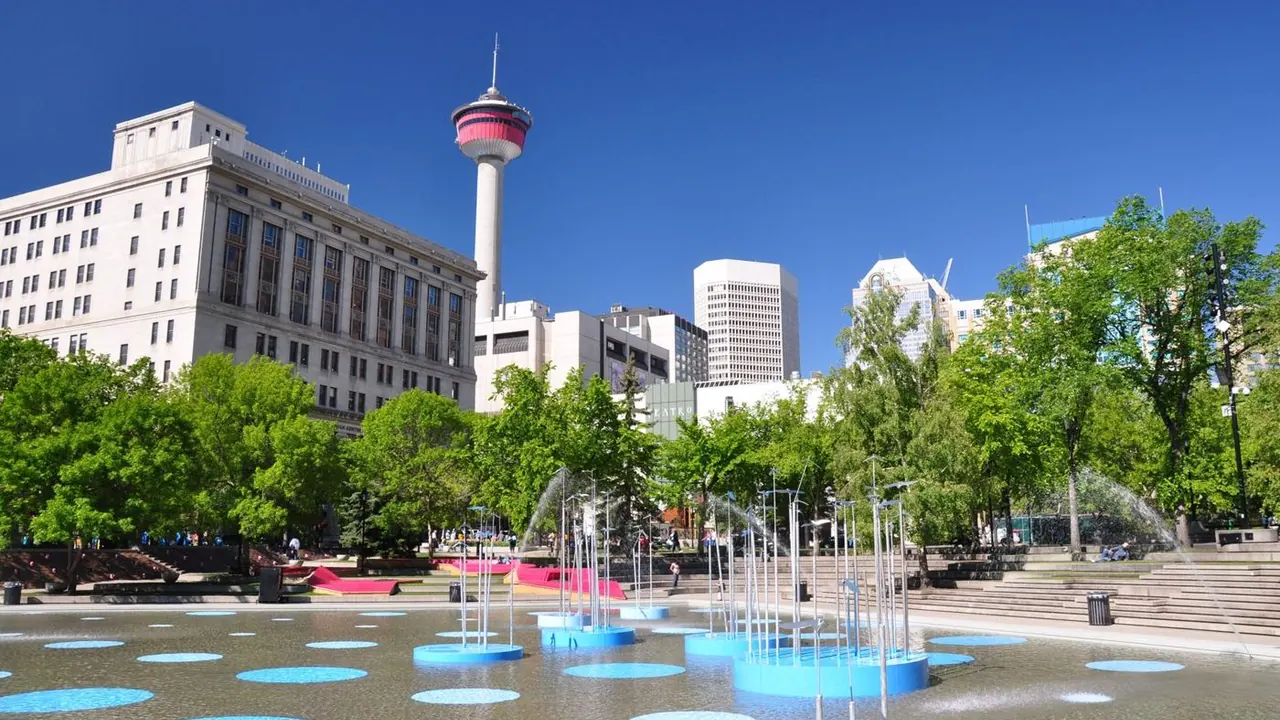
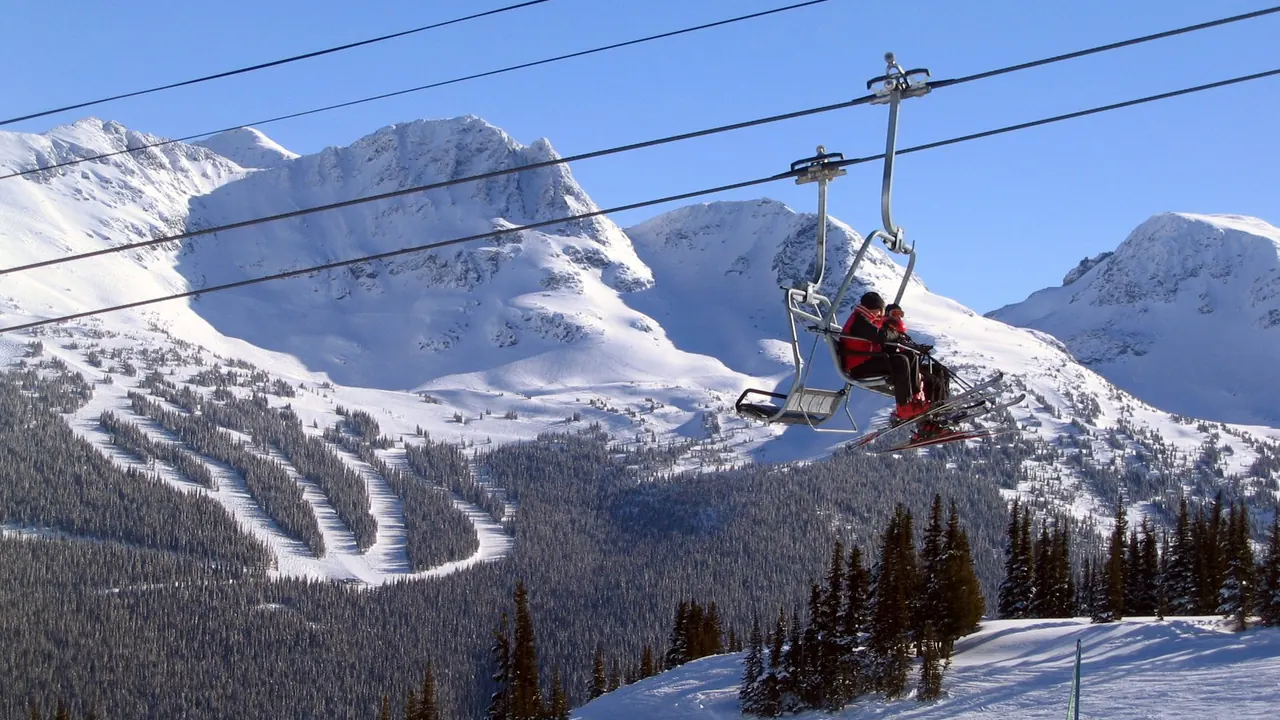
Photos: Calgary by abdallahh, CC BY 2.0, cropped; Whistler by Ruth Hartnup, CC BY 2.0, cropped.
Calgary or Whistler?
Our verdict in twelve categories, each scored against the same fixed benchmark cities, and the climate month by month, so you can choose for your trip.
Choose Calgary for
- live music and the arts
- prices
- day trips
Calgary suits travellers who want a city base with the Rockies on the horizon and the freedom to range widely. With a car you can be hiking in Kananaskis, walking around Banff, looking at dinosaur fossils in the Drumheller badlands or standing at Head-Smashed-In Buffalo Jump. In the evenings you come back to museums, a concert hall and a proper theatre season. It costs noticeably less than Whistler, and in July the Stampede gives it a character no mountain resort has.
Choose Whistler for
- getting around
- beaches
- wellness
Whistler is for a trip where the mountain is the whole point. The gondolas leave from the edge of a car-free village. Two huge ski mountains fill the winter and a famous bike park fills the summer, and the day ends in a silent forest spa. You pay resort prices and give up almost all city sightseeing. In return you rarely need a vehicle, and the outdoors starts at your door rather than a long drive away.
Scoreboard
Twelve categories on one fixed scale from 0 to 100. The shaded stretch is the gap between the two.
Your match
Pick a travel style or drag the sliders, and both match scores follow your weighting.
Wins on live music and the arts and prices with your weighting.
Wins on getting around and beaches with your weighting.
What matters to you?
Category by category
What the scores mean for a trip.
Beaches & swimming
Neither city is anywhere near the sea, but Whistler does summer swimming better. Lost Lake has a sandy shore and a dock that you can walk to from the village, and Alta and Alpha Lakes have grassy parks and rafts. The shallower lakes warm to about 20°C in a hot spell.
Calgary's swimming is further away from the centre. You can swim at Sikome Lake in Fish Creek Park or at Chestermere Lake, east of the city. The local favourite is floating down the Bow River on an inner tube. The glacial lakes in the Rockies are too cold for anything but paddling.
Food & drink
The two eat about equally well, in different ways. Calgary's strengths are Alberta beef in its steakhouses, the ginger beef it claims as its own in Chinatown, and Vietnamese, Filipino and Lebanese cooking spread across the suburbs. On top of that come the breweries around Manchester and Ramsay and prairie produce such as bison and Saskatoon berry pies at the farmers' markets.
Whistler's eating is concentrated in a few village streets. A handful of ambitious kitchens cook BC salmon and spot prawns and keep deep British Columbia wine cellars, and après-ski nachos and craft beer fill the gaps. Calgary gives you more variety over a week. Whistler has a small but more polished selection close together.
Culture & sights
Calgary has more to see, though it is still a young city. The Glenbow covers western Canadian art and history, Studio Bell holds the archives of Canadian music, and Heritage Park re-creates prairie settlement with steam trains. The 1880s sandstone buildings on Stephen Avenue and the site of Fort Calgary make good stops on a walk.
Whistler has no old town at all. Its two serious visits are the Audain Art Museum, with its Emily Carr paintings and Northwest Coast masks, and the Squamish Lil'wat Cultural Centre. Together with the 2010 Olympic sites they fill an afternoon. Calgary fills a couple of days.
Nightlife
Neither is a big night-out destination, but the nights out are very different. Calgary's evenings centre on the pubs and patios of 17th Avenue SW and on its country bars, with line dancing, a mechanical bull and live country bands. For ten days in July the Stampede tents keep the whole city out past midnight.
Whistler's nightlife is tied to the ski day. It starts with après on the patios as the lifts close and moves on to a few loud clubs full of seasonal workers and groups on winter weekends. Outside the ski season and the bike festivals the village goes quiet early.
Nature & outdoors
Both are superb bases for the mountains, but Whistler has them at the door. Whistler and Blackcomb, joined by the Peak 2 Peak Gondola, have more than 200 runs and deep Coast Mountains snow. In summer the lower slopes become a downhill bike park, and the Garibaldi trails and the River of Golden Dreams are close by.
From Calgary, the Rockies take a drive. Kananaskis, with its golden September larches, is about an hour away, and Banff's canyons, glacial lakes and wildlife about ninety minutes. In exchange you can choose between several mountain areas and ski hills. The city also has its own outdoors in the Bow River pathways and the open grassland of Nose Hill.
Day trips
Calgary has far more good outings within reach. Banff and Canmore are mountain towns with real streets and museums. The Royal Tyrrell Museum in the Drumheller badlands is one of the world's great fossil collections, and Head-Smashed-In Buffalo Jump adds a UNESCO-listed piece of Blackfoot history to the south.
Around Whistler there is mostly wilderness and few towns. Pemberton, Squamish with its gondola and the Britannia mine museum make modest stops. The one big outing is Vancouver, two hours down the Sea to Sky Highway, and it really needs an overnight stay.
Good for families
Both work well for children, but they suit different trips. Calgary is a city vacation with attractions built for children: the zoo with its life-size dinosaurs, TELUS Spark, the steam train at Heritage Park, Canada Olympic Park and the Stampede midway in July.
Whistler is a resort vacation. The village is car-free, the ski schools are large, and there is tubing in winter and lake beaches, mini-golf and gondola rides to see marmots in summer. It has no zoo or science centre, so on a rainy day there is less to fall back on.
Getting around
Whistler is far simpler on foot. The village is pedestrian-only and the gondolas leave from its edge. Free shuttles run along the valley, and the paved Valley Trail links the lakes for walking and cycling.
Calgary's downtown grid is compact, and the Plus 15 skywalks keep you indoors on cold days. Two CTrain lines and the riverside cycle paths reach the central neighbourhoods. Beyond the core, though, the city sprawls, and most visitors hire a car for the mountains. In both places, anything outside the valley or the city needs a car, a coach or a tour.
Shopping & style
Calgary has more range. CORE and Chinook Centre carry the major chains, and Kensington, Inglewood and 17th Avenue add independent boutiques, record shops and antique dealers. Its real speciality is western wear, from hand-made boots and felt hats to saddlery.
Whistler's village shops are excellent for skis, bikes and technical outerwear, and a few galleries sell Indigenous prints and carvings. Beyond gear there is little choice.
Affordability
Calgary costs clearly less. Outside Stampede week its hotels are reasonable, and food courts and family restaurants help a budget. What drives the bill up is the mountains: a hire car, park entry and lift passes add up if you ski or tour from the city.
Whistler is expensive in almost every way. Lift passes are among the costliest anywhere, slopeside lodgings are priced as a resort and climb steeply over Christmas, and village meals are priced for visitors. Kitchens in your lodgings, the free shuttles and coming in spring or autumn ease the cost but do not change it.
Live music & performing arts
Calgary has a real performing arts programme and Whistler barely has one. At the Werklund Centre you can hear the Calgary Philharmonic or see a Theatre Calgary production, and Calgary Opera stages a season at the Jubilee Auditorium. In summer there is the Folk Music Festival on Prince's Island and the Stampede's grandstand show with chuckwagon races.
Whistler offers free summer concerts on Olympic Plaza, buskers, a small community arts centre and cover bands in the pubs. For an orchestra or a play you have to go down to Vancouver.
Wellness & relaxation
Whistler is the better place to unwind. Its large Nordic-style spa sits among cedars by the river, where guests soak in silence, often under falling snow. Hotel spas and massage studios for sore skiers are everywhere, and the shoulder seasons are calm.
Calgary itself offers hotel spas and yoga studios at a working city's pace. Its best soaks need a drive: the Nordic spa in Kananaskis is an hour away and Banff's historic Upper Hot Springs about ninety minutes.
When should you go?
Pick your month. The climate figures are measured averages, not a forecast.
Calgary in July
Whistler in July
Daytime high, °C
Rainfall in the month, mm
Where the figures come from
Whistler has no rain gauge within 25 km of the centre, so its rainfall comes from a gridded climate dataset read at the city rather than from a gauge further away.
Temperature and rainfall are climate normals, averaged over the years shown. Calgary: 1991-2020 normals, Calgary Int'l CS (8.2 km from centre). Whistler: 1991-2020 normals, Whistler - Nesters (1.1 km from centre).
Summer is much the same in both places. Each reaches about 25°C in July, and July and August are the only months warm enough to swim in their lakes or spend the evening outdoors on a patio. Calgary is dry for most of the year, but its rain gathers in early summer and peaks in June at 106mm. September is drier and mild, which makes it the best month for hiking in the nearby mountains. From December to February daytime highs sit around freezing, which is too cold for a long walk through the streets.
Whistler's year is shaped by heavy precipitation from October to January, close to 200mm in November. In the village that means grey, wet days, but up on the mountains it is the snow that makes the ski season. Its winters are a few degrees milder than Calgary's. Late spring and September are the driest calm spells between the ski and bike seasons.
Which traveller are you?
On an outdoors trip, Whistler wins. Ski runs, downhill bike trails, the paths up to Garibaldi's lakes and the Valley Trail all start from the village. From Calgary, nearly every mountain day begins with a drive of an hour or more.
For a culture and arts trip, Calgary has much more to offer. The Glenbow, Studio Bell and Heritage Park fill two days, and the Philharmonic, Theatre Calgary and the Folk Music Festival fill the evenings. Whistler has one fine museum and almost no stage.
On a trip with a tight budget, Calgary is much easier on the wallet. City hotels, food courts and suburban family restaurants keep daily costs down. Whistler's lift passes, slopeside lodgings and village restaurant prices make it expensive even in the cheaper seasons.
Before you go
| Measure | Calgary | Whistler |
|---|---|---|
| Official language | French, English | French, English |
| Currency | Canadian Dollar (CAD) | Canadian Dollar (CAD) |
| Sockets | AB120 V, 60 Hz | AB120 V, 60 Hz |
| Driving side | Right | Right |
| Time zone | UTC-7, UTC-6 in summer | UTC-8, UTC-7 in summer |
| Emergency number | 911 | 911 |
| Elevation | 1,045 m | 670 m |
| Main airport | Calgary International Airport (YYC)9 km from centre102 non-stop destinations | Vancouver International Airport (YVR)104 km from centre109 non-stop destinations |
| Public holidays this year | 13 days | 11 days |
By the numbers
| Measure | Calgary | Whistler |
|---|---|---|
| City population | 1,306,784 | 13,982 |
| People per km² | 1,583 | 58 |
| Museums within 10 km | 13 | 1 |
| UNESCO World Heritage sites within 50 km | 0 | 0 |
Where else could you go?
Every comparison below shares a destination with this one, so you can follow Calgary or Whistler somewhere new.