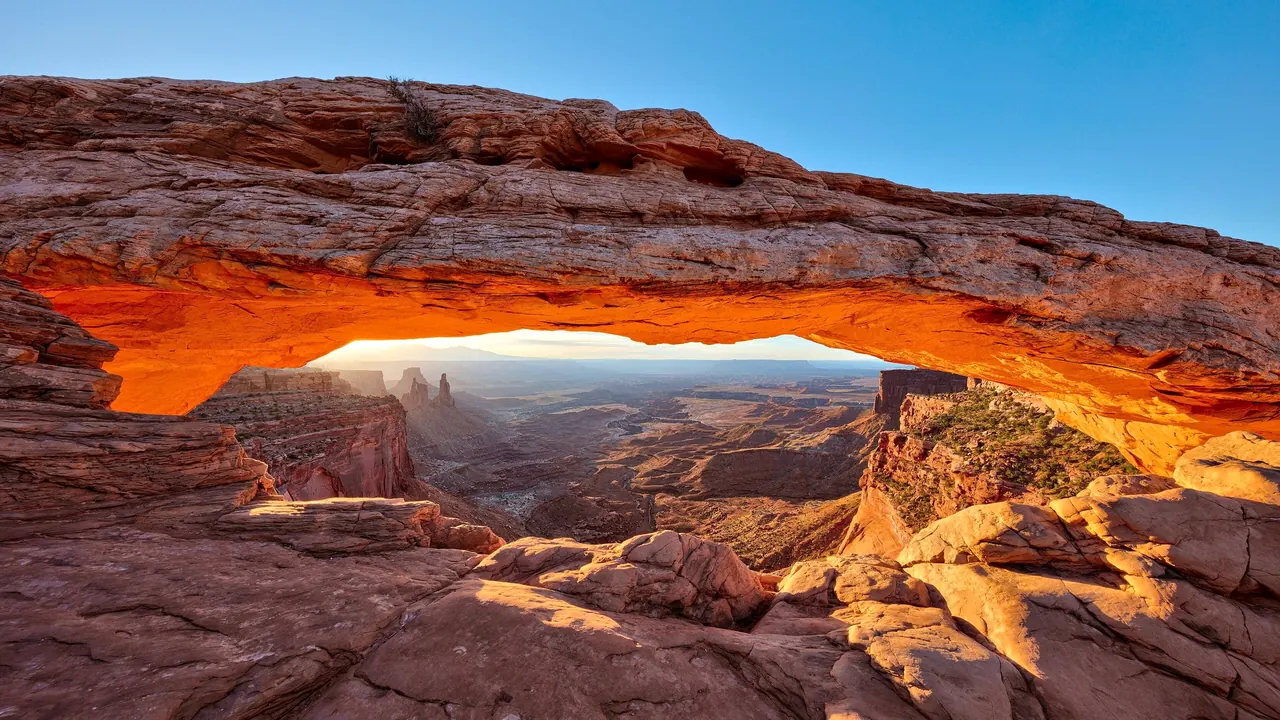
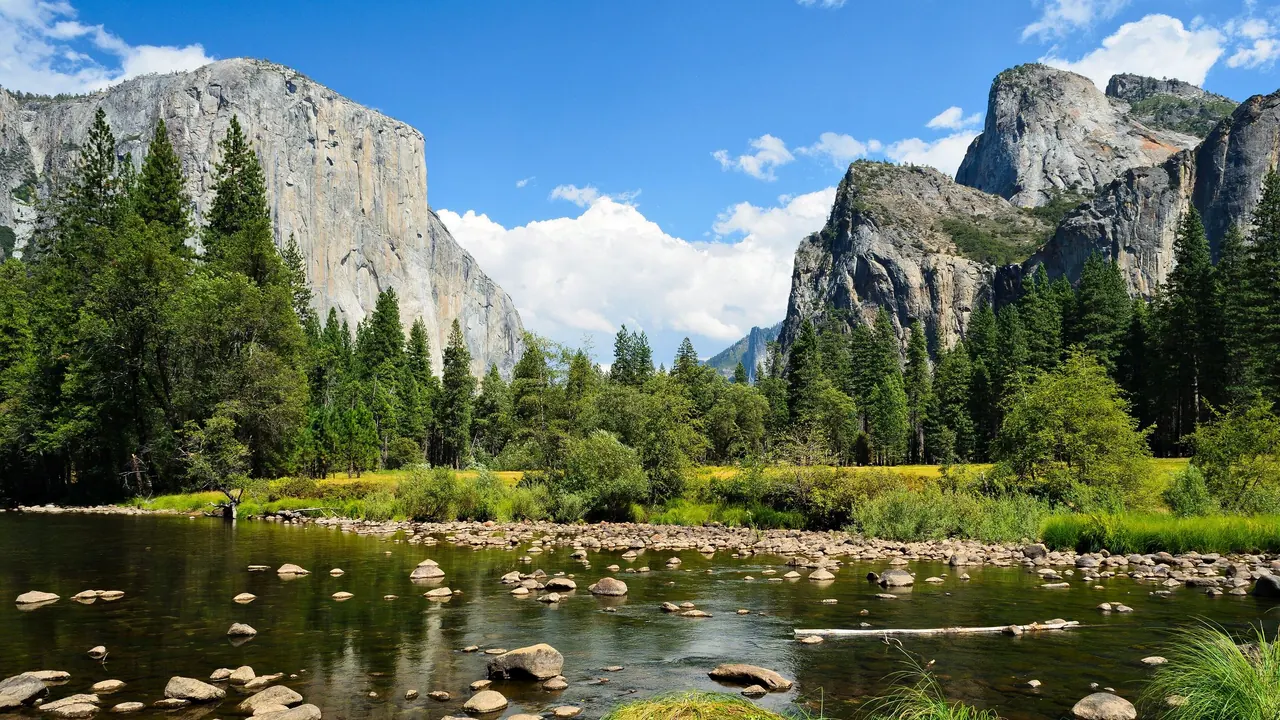
Photos: Canyonlands by Thomas Wolf, www.foto-tw.de, CC BY-SA 3.0, cropped; Yosemite by King of Hearts, CC BY-SA 3.0, cropped.
Canyonlands or Yosemite?
Our verdict in twelve categories, each scored against the same fixed benchmark cities, and the climate month by month, so you can choose for your trip.
Choose Canyonlands for
- getting around
- culture and sights
- shopping
Canyonlands is for travellers who want to be active in red-rock desert and don't mind driving. Moab works as a single base for Arches, Island in the Sky and the Needles. Beyond hiking there is slickrock biking, rafting and jeep tracks, ancient rock art along the way and a town with enough restaurants to end the day. Go in spring or autumn, and bring a tent if you want to keep costs down.
Choose Yosemite for
- beaches
- wellness
- day trips
Yosemite suits those who want one overwhelming valley of granite cliffs and waterfalls, explored on foot, with sequoias and alpine meadows close by. It is the better trip in high summer, with cool lake and river swims, and you can even reach the Valley without a car. The trade-off is crowds, scarce rooms and less choice of food and history.
Scoreboard
Twelve categories on one fixed scale from 0 to 100. The shaded stretch is the gap between the two.
Your match
Pick a travel style or drag the sliders, and both match scores follow your weighting.
Wins on getting around and culture and sights with your weighting.
Wins on beaches and wellness with your weighting.
What matters to you?
Category by category
What the scores mean for a trip.
Beaches & swimming
Neither is a swimming destination, but Yosemite at least gives you somewhere to get in the water. In late summer the Merced forms calm pools and sandbars on the Valley floor, and Tenaya Lake has a sandy shore in the high country. Bass Lake, just south of the park, is warm enough for a proper lake day.
Canyonlands has nothing comparable. The Colorado and Green rivers are cold, silty and fast, and they are for rafting, not swimming. In the summer heat you cool off in a motel pool, a quiet eddy or the small reservoir in the hills above Moab.
Food & drink
Both are places where you eat to refuel, but Moab gives you more choice. The whole food scene is in one small town: Southwestern and Tex-Mex plates, craft-beer taprooms, food trucks and breakfasts before dawn, all close together, though Utah's liquor laws limit the drinking.
In Yosemite, meals are split between lodge dining rooms, cafeterias and pizza counters inside the park and diners in gateway towns far apart. The grand historic dining room in the Valley is the one memorable setting, and the wine bars pouring foothill wines are a pleasure. Choice is thin late in the evening and outside summer, though.
Culture & sights
Canyonlands has the richer heritage, and it is far older. Fremont and Ancestral Puebloan rock art is found across the region, from Newspaper Rock and the Potash Road panels to the life-size painted figures of the Great Gallery in Horseshoe Canyon. The Great Gallery takes a long dirt drive and a hike to reach, but its figures are among the finest rock art in North America.
Yosemite's man-made history is more recent and more compact. It takes in the rustic timber and stone hotel in the Valley, the 1870s chapel, the Miwok basketry at the Yosemite Museum and the stagecoach-era buildings at Wawona. Each takes an hour or two, and none matches the thrill of finding rock art in a canyon.
Nightlife
Neither has a night out worth the name. The small difference is that Moab's few bars and brewpubs fill with rafting guides and mountain bikers and can be lively on a spring weekend. Yosemite's evenings mean a lodge lounge, a ranger talk or a campfire, with one saloon or brewpub in each gateway town. In both, the real show after dark is the stars.
Nature & outdoors
Both are among the great landscapes of the American West, and the difference lies in the kind of country. Canyonlands is red-rock desert spread over several districts: the arches minutes from Moab, the mesa-top overlooks of Island in the Sky, the spires of the Needles and the remote Maze. You explore it as much by bike, raft and four-wheel drive as on foot, on the slickrock, through Cataract Canyon and along the White Rim Road.
Yosemite is granite and water gathered around one valley. El Capitan and Half Dome rise about 1,000m above the meadows, and the waterfalls run hardest on spring snowmelt. Beyond the Valley are the giant sequoias of Mariposa Grove, the alpine high country of Tuolumne Meadows in summer, black bears and gentle winter skiing at Badger Pass.
Day trips
In both places most days lead to more landscape, and the outings beyond differ in character. From Moab they lead to small places with deep roots: Bluff's pioneer stone houses, the Ancestral Puebloan pottery at Edge of the Cedars in Blanding and the Hovenweep towers. Eastward, the orchards and vineyards of Palisade make a gentler day.
From Yosemite the best excursion goes back to the gold rush, with Columbia's preserved main street, Jamestown's steam railway yard and the wineries around Murphys. In summer, Tioga Pass opens the eastern side and the ghost town of Bodie. In winter the pass closes and those outings are not possible.
Good for families
For families, both are camping and hiking trips with no theme parks or rainy-day options, and both parks run Junior Ranger programmes. In Canyonlands, children have dinosaur tracks, short walks to Double Arch and the Windows and gentle float trips on the Colorado. The drawbacks are dangerously hot summer afternoons and long drives between sights.
Yosemite's flat Valley floor, with paved cycle paths, meadows and the short walk to Lower Yosemite Fall, is easier with small children, and the sequoias impress every age. Here the hazards are fast spring rivers, cliff edges and bears rather than heat.
Getting around
Canyonlands is the easier of the two to get around, once you have a car. Arches begins just outside Moab, and good paved roads reach Island in the Sky and Dead Horse Point in under an hour. Only the Maze, Horseshoe Canyon and the White Rim call for a high-clearance vehicle or a tour.
Yosemite is the one you can reach without a car, by regional bus from Merced, and free shuttles loop around the Valley. Beyond the Valley, Glacier Point, Mariposa Grove and Tuolumne are each an hour or more of winding road away. Summer brings full car parks, and Tioga Road is closed by snow for much of the year.
Shopping & style
Canyonlands has the better things to take home, mostly because of the trading posts around Bluff and Blanding, south of Moab. They sell Navajo rugs, silver jewellery and pottery, which make better souvenirs than anything else in either region. Moab's Main Street adds rock and fossil shops, a few local galleries and plenty of bike, climbing and camping gear.
Yosemite has less. Park stores sell maps, books and souvenirs, and the gateway towns have a few antique and craft shops. Its one real find is the long-standing gallery in the Valley that sells fine-art landscape prints.
Affordability
Camping is what makes Canyonlands the cheaper trip. The public lands around the parks have many campgrounds and free dispersed camping, one pass covers the national parks, and people who cook and drive themselves spend far less. The costly part is Moab's motels, which are priced well above their comfort in spring and autumn, and guided rafting and jeep trips add up quickly.
Yosemite's campsites are just as cheap but hard to get, so saving money there depends on luck. Rooms inside the park are few and sell out early, gateway motels charge peak rates all summer, and park food costs more than it is worth. To keep costs down, come in winter or stay lower in the foothills.
Live music & performing arts
Canyonlands has one thing Yosemite cannot match: the Moab Music Festival, a chamber-music series held from late summer into early autumn. Its concerts take place in sandstone grottoes reached by jet boat and on riverside ranches, and it is worth planning a trip around. Yosemite has ranger campfire talks, the occasional historical performance in the Valley and a small repertory theatre in Sonora, all pleasant but nothing to plan for.
Wellness & relaxation
Yosemite's slight edge comes from its hot springs. In summer, the open-air pools around Bridgeport and Mammoth Lakes, beyond Tioga Pass, give you a soak with mountain views, and a couple of resort hotels near the southern entrance offer spa treatments. The Valley is crowded in July, so for real quiet come in winter or go up to the high-country lakes.
Canyonlands has no thermal water at all. It has only a few day spas and massage studios in Moab for sore legs, plus some lodges along the river. What it gives you instead is desert silence, sunrise from a canyon rim and dark night skies after days of hiking and biking.
When should you go?
Pick your month. The climate figures are measured averages, not a forecast.
Canyonlands in July
Yosemite in July
Daytime high, °C
Rainfall in the month, mm
Where the figures come from
Canyonlands has no weather station within reach, so its figures come from a gridded climate model rather than a measured record, and read a broad area rather than one spot.
Yosemite has no weather station within reach, so its figures come from a gridded climate model rather than a measured record, and read a broad area rather than one spot.
Temperature and rainfall are climate normals, averaged over the years shown. Canyonlands: 2001-2020 normals, NASA POWER reanalysis grid, no weather station within 90 km. Yosemite: 1991-2020 normals, TerraClimate 4 km grid at the town, no weather station within 90 km.
Around Moab, spring and autumn are the seasons for the trails. April and May warm from mild to hot, and September and October stay warm and pleasant for hiking and biking, although late summer and autumn bring the year's small rain peak of about 27mm a month. By July highs reach 36°C, too hot to be out walking in the middle of the day. December and January are cold but bring little rain, and the desert is never wet for long.
Yosemite runs almost the other way round. Winter in the Valley is cool and very wet, with about 157mm of rain in January, and snow keeps Tioga Road and the high country closed until early summer. From late May to September it is nearly dry, and highs around 28°C in July and August suit long hikes and cold swims in the Merced. April to June is the time to see the waterfalls at full strength. Late May and late September are when both are comfortable.
Which traveller are you?
On a culture and arts trip, Canyonlands is the better choice. Its Ancestral Puebloan rock art, from Newspaper Rock to the Great Gallery, is older and more striking than Yosemite's lodges and museum. The Moab Music Festival's concerts in sandstone grottoes give classical-music lovers a reason to time the visit.
For a trip on a tight budget, Canyonlands again has the edge. The surrounding public lands have plenty of campgrounds and free dispersed camping, one pass covers the parks, and you can cook your own meals. Yosemite's cheap campsites, by contrast, are scarce and hard to book.
On a relaxing and wellness trip, Yosemite suits better. It has open-air hot springs beyond Tioga Pass, spa treatments near the southern entrance and mild summer days in the high-country meadows. The desert offers silence, but summer heat and the lack of any thermal water leave less room to unwind.
Before you go
| Measure | Canyonlands | Yosemite |
|---|---|---|
| Currency | US Dollar (USD) | US Dollar (USD) |
| Sockets | AB120 V, 60 Hz | AB120 V, 60 Hz |
| Driving side | Right | Right |
| Time zone | UTC-7, UTC-6 in summer | UTC-8, UTC-7 in summer |
| Emergency number | 911 | 911 |
| Main airport | Canyonlands Regional Airport (CNY)2 non-stop destinations | Fresno Yosemite International Airport (FAT)15 non-stop destinations |
| Public holidays this year | 12 days | 13 days |
Where else could you go?
Every comparison below shares a destination with this one, so you can follow Canyonlands or Yosemite somewhere new.
- Archesvs Canyonlands
- Kings Canyonvs Yosemite
- Sequoiavs Yosemite
- Bryce Canyonvs Canyonlands
- Death Valleyvs Yosemite
- Zionvs Canyonlands