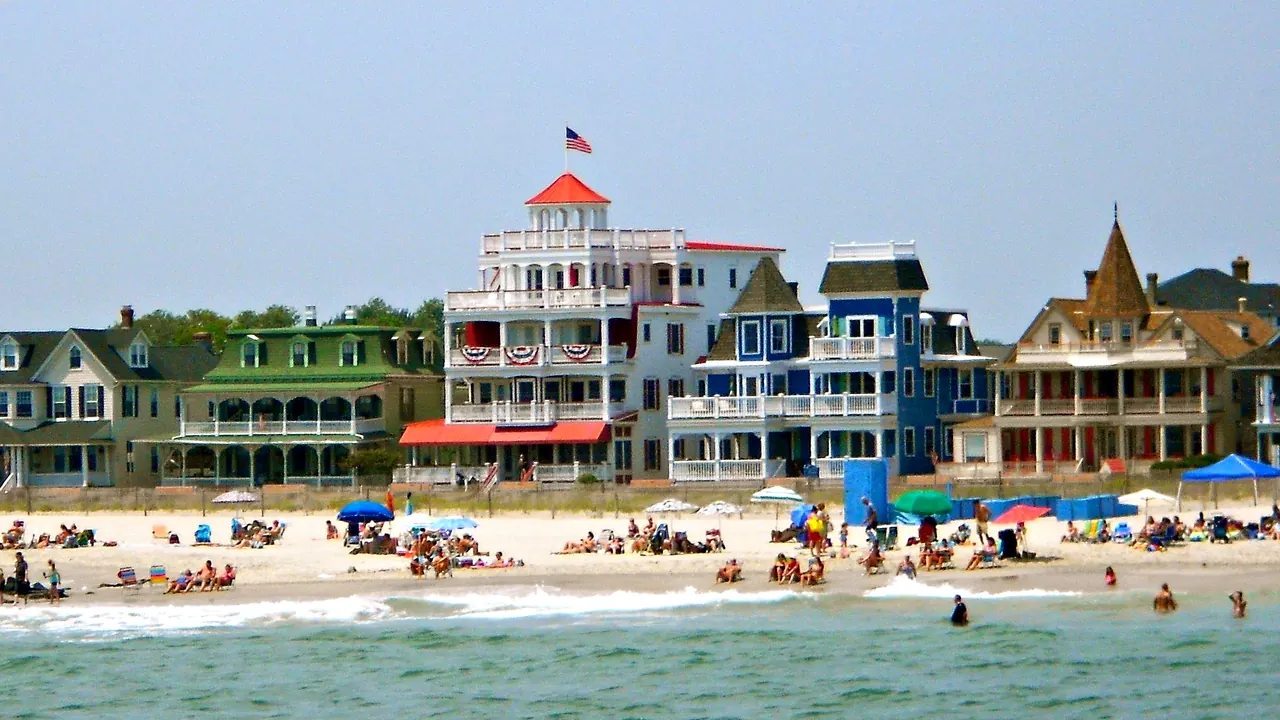
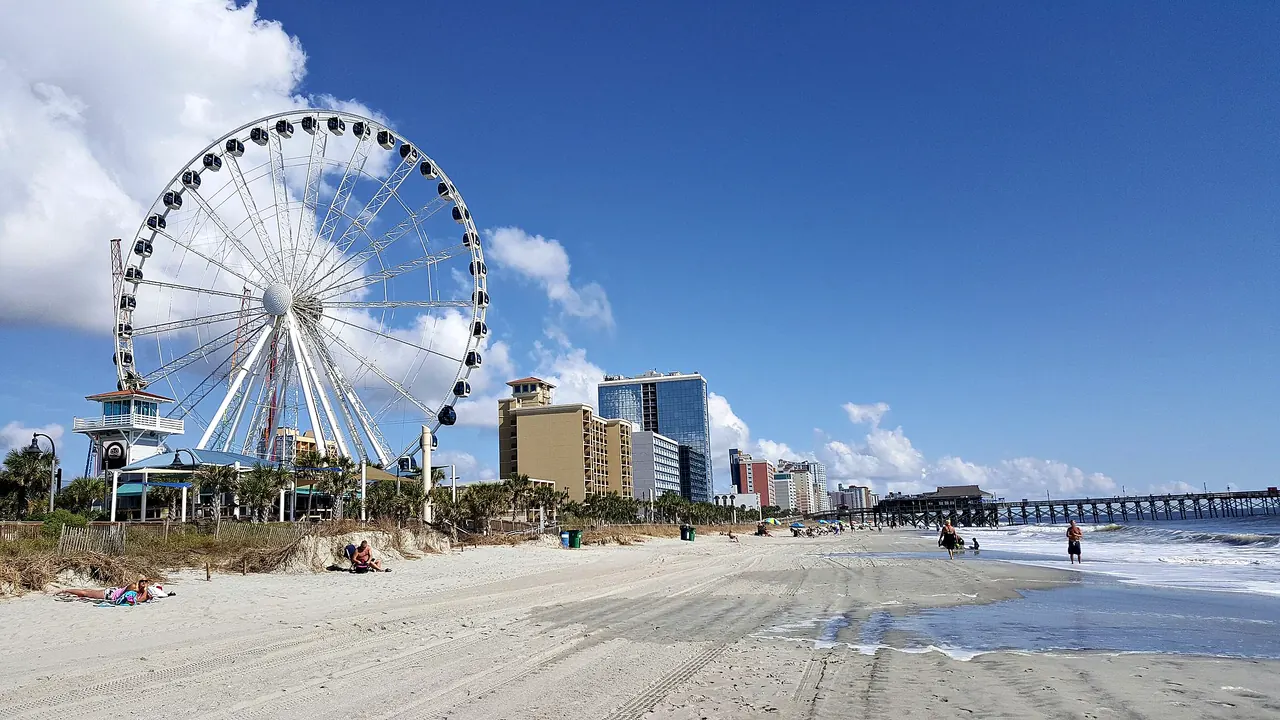
Photos: Cape May by Smallbones, CC0; Myrtle Beach by The ed17, CC BY-SA 4.0, cropped.
Cape May or Myrtle Beach?
Our verdict in twelve categories, each scored against the same fixed benchmark cities, and the climate month by month, so you can choose for your trip.
Choose Cape May for
- getting around
- culture and sights
- nature and the outdoors
Cape May is for travellers who want the town as much as the beach. Its Victorian streets are compact and walkable, its porches and gaslit lanes set a slow pace, and the birding at the Point and Higbee Beach makes spring and autumn worth a trip in their own right. It suits couples, history lovers and anyone happy to pay more for charm and quiet evenings.
Choose Myrtle Beach for
- prices
- nightlife
- beaches
Families chasing long hot days on the sand will get more from Myrtle Beach. The Grand Strand gives them warmer water, far more beach, an amusement park, an aquarium and endless mini-golf, at prices that stretch further, especially outside high summer. The trade-off is a car-bound strip with little history and a louder, more commercial feel.
Scoreboard
Twelve categories on one fixed scale from 0 to 100. The shaded stretch is the gap between the two.
Your match
Pick a travel style or drag the sliders, and both match scores follow your weighting.
Wins on getting around and culture and sights with your weighting.
Wins on prices and nightlife with your weighting.
What matters to you?
Category by category
What the scores mean for a trip.
Beaches & swimming
Both are Atlantic sand beaches with lifeguards and gentle surf, but Myrtle Beach has far more of it. The Grand Strand runs for about 100km of wide, shallow-shelving sand, the sea is several degrees warmer in summer and stays swimmable for longer, and if the central blocks feel crowded you can move south to the dune-backed beaches at Surfside or Garden City.
Cape May's oceanfront strip is shorter and its season is tighter, though it is rarely packed. What it adds is variety on a small scale: quiet beaches at the Point and the bay-side Sunset Beach, where people hunt for the polished quartz pebbles known as Cape May diamonds.
Food & drink
Both towns eat best when they stick to local seafood, so the overall standard is similar and the difference lies in setting. Cape May is a working fishing port, so scallops and oysters appear in dockside shacks and in dining rooms inside restored Victorian houses, with porch breakfasts as part of the ritual.
Myrtle Beach's strip is all buffets, pancake houses and chains, and the better meals mean a short drive to the waterfront at Murrells Inlet or to Calabash-style fried fish over the state line, with Lowcountry shrimp and grits along the way.
Culture & sights
Cape May gives you more to look at, because the whole town is the attraction: a National Historic Landmark district of gingerbread cottages and porch-fronted hotels, the Emlen Physick Estate and a lighthouse you can climb. It can be seen in a day or two, but you are walking through it the whole time.
Myrtle Beach is a twentieth-century resort with little old fabric. Its main sights lie south of the city: Brookgreen Gardens' sculpture among live oaks on a former rice plantation, with its account of the people enslaved there, and the Moorish-style Atalaya in the next-door state park.
Nightlife
Myrtle Beach is the place for a night out. In summer, beach bars, rooftop decks and dance clubs around the boardwalk and the entertainment complexes stay open late, and North Myrtle Beach keeps up the shag, the Carolina beach dance, in its old Main Street clubs. It is loud and casual rather than polished.
Cape May's evenings mean a hotel bar or pub near the mall, maybe a cover band, and bed by midnight. Anyone who wants more than that drives up to the Wildwoods.
Nature & outdoors
Cape May has the stronger natural draw because of where it sits. At the tip of a peninsula between ocean and bay, it funnels autumn hawks, songbirds and monarch butterflies through the Point and Higbee Beach, and it is one of the great migration sites in North America. Dolphin boats in summer and whale trips in the cooler months add to it.
Myrtle Beach's coastal plain is good rather than exceptional: marsh boardwalks with alligators at Huntington Beach, kayaking in the Waccamaw's cypress swamps, and golf courses all along the Strand. Neither place has hills, and summer humidity in South Carolina pushes walks to the early morning.
Day trips
Myrtle Beach has the better single day out in Charleston, about two hours south, with Georgetown's old port, Pawleys Island and Wilmington's riverfront as closer or alternative outings. All of them need a car.
From Cape May, the ferry to colonial Lewes in Delaware is the most enjoyable trip, and the Wildwoods and Atlantic City are close by. Philadelphia is within reach but makes for a tiring day.
Good for families
Both are long-standing family resorts, but Myrtle Beach is built around children. It has warm, shallow water, hotels with lazy rivers and kitchen suites, an aquarium, an amusement park with a wooden roller coaster, water parks and themed mini-golf everywhere. The drawbacks are the heat, the traffic and rowdy spring break weeks.
Cape May offers a gentler version: surrey rides on the promenade, crabbing on the bay, the lighthouse and a free county zoo, with rides left to the Wildwoods. Note that some B&Bs in the historic district do not accept small children.
Getting around
Cape May is much easier once you arrive. The historic district, the promenade and Washington Street Mall are a short, flat walk apart, bikes do the rest, and only the outlying sights call for the car you probably drove in with.
Myrtle Beach is spread along about 100km of multi-lane highway with few pavements, so almost everything means driving through slow summer traffic on Kings Highway. Only the oceanfront blocks around the boardwalk are comfortable on foot.
Shopping & style
Myrtle Beach has a slight edge for anyone who actually wants to buy things, with two large outlet centres, waterfront complexes and the Market Common, plus giant beachwear stores. Cape May's three-block pedestrian mall offers independent boutiques, bookshops, antiques and fudge instead: better for browsing on a rainy hour, thinner for a serious shop.
Affordability
Myrtle Beach costs much less, mainly because it has so many motels, condos and hotel rooms, and kitchens in many units cut food bills. Prices still jump in July and on long weekends.
Cape May's Victorian B&Bs and oceanfront hotels charge premium summer rates, often with minimum stays, and you also pay for beach tags and parking. Spring and autumn bring some relief, and some visitors save money by staying in the Wildwoods.
Live music & performing arts
Neither town is a performing arts destination, and they offer different kinds of evening. Cape May leans to straight theatre, with a professional company in a converted church, historic American drama and a long-running chamber music festival in late spring.
Myrtle Beach goes for spectacle: country and gospel revues, Christmas shows, dinner shows with knights and pirates, and touring country and rock acts at the main entertainment complex.
Wellness & relaxation
Cape May is a little more restful because its pace is built into the town: porch rocking chairs, afternoon tea in guesthouse parlours and bay sunsets, plus a few day spas. Myrtle Beach relies on resort and golf hotel spas, and its main strip is anything but calm in summer. In both, the shoulder seasons are the time to relax, and in Myrtle Beach the quieter area around Pawleys Island helps.
When should you go?
Pick your month. The climate figures are measured averages, not a forecast.
Cape May in July
Myrtle Beach in July
Daytime high, °C
Rainfall in the month, mm
Where the figures come from
Cape May has no rain gauge within 25 km of the centre, so its rainfall comes from a gridded climate dataset read at the city rather than from a gauge further away.
Myrtle Beach has no rain gauge within 25 km of the centre, so its rainfall comes from a gridded climate dataset read at the city rather than from a gauge further away.
Temperature and rainfall are climate normals, averaged over the years shown. Cape May: 2006-2020 (rainfall 1991-2020) normals, Wildwood / Sally Marshall Crossing (8.4 km from centre). Myrtle Beach: 1971-2000 (rainfall 1991-2020) normals, Myrtle Beach Air Force Base (5.5 km from centre).
Cape May has a short, sharp beach season. The Atlantic only becomes properly swimmable from late June, peaks around 24°C in August and cools quickly after mid-September. July is the warmest month for the town, while September and October stay mild and pleasant for walking the historic district and watching the autumn migration. Winters are cold, with January highs near 6°C, and rain falls fairly evenly through the year.
Myrtle Beach stays warmer for longer. The sea is comfortable from late May to October and reaches about 28°C in midsummer, but July to September are hot, humid and the wettest months, with August bringing around 187mm, often in heavy afternoon storms. Winter is mild, with January highs near 12°C, fine for golf and beach walks if not for swimming. For a beach week, Myrtle Beach gives you the wider window; for strolling in comfort, late spring and early autumn suit both.
Which traveller are you?
On a trip on a tight budget, Myrtle Beach is the clear choice. Its huge stock of motels and condos with kitchens keeps costs down, especially outside July, while Cape May's B&Bs, minimum stays, beach tags and parking make it expensive.
For a short city break, Cape May works better. Its historic district, promenade and pedestrian mall sit within a flat walk of each other, so a weekend covers the Victorian streets, the lighthouse and a theatre evening without needing to drive anywhere.
On a food and nightlife trip, Myrtle Beach offers more after dark, with boardwalk bars, late dance clubs and shag clubs in North Myrtle Beach. The seafood is similar in both places, but Cape May's bars are mostly quiet by midnight.
Before you go
| Measure | Cape May | Myrtle Beach |
|---|---|---|
| Currency | US Dollar (USD) | US Dollar (USD) |
| Sockets | AB120 V, 60 Hz | AB120 V, 60 Hz |
| Driving side | Right | Right |
| Time zone | UTC-5, UTC-4 in summer | UTC-5, UTC-4 in summer |
| Emergency number | 911 | 911 |
| Elevation | 3 m | 8 m |
| Main airport | Atlantic City International Airport (ACY)65 km from centre11 non-stop destinations | Myrtle Beach International Airport (MYR)5 km from centre60 non-stop destinations |
| Public holidays this year | 13 days | 12 days |
By the numbers
| Measure | Cape May | Myrtle Beach |
|---|---|---|
| City population | 2,768 | 35,682 |
| People per km² | 390 | 591 |
| Museums within 10 km | 4 | 2 |
| UNESCO World Heritage sites within 50 km | 0 | 0 |
| Swim season, months above 21 °C | 3 months | 6 months |
Where else could you go?
Every comparison below shares a destination with this one, so you can follow Cape May or Myrtle Beach somewhere new.
- Rehoboth Beachvs Cape May
- Bethany Beachvs Cape May
- Ocean City, Marylandvs Cape May
- Atlantic Cityvs Cape May
- Wilmingtonvs Myrtle Beach
- Philadelphiavs Cape May