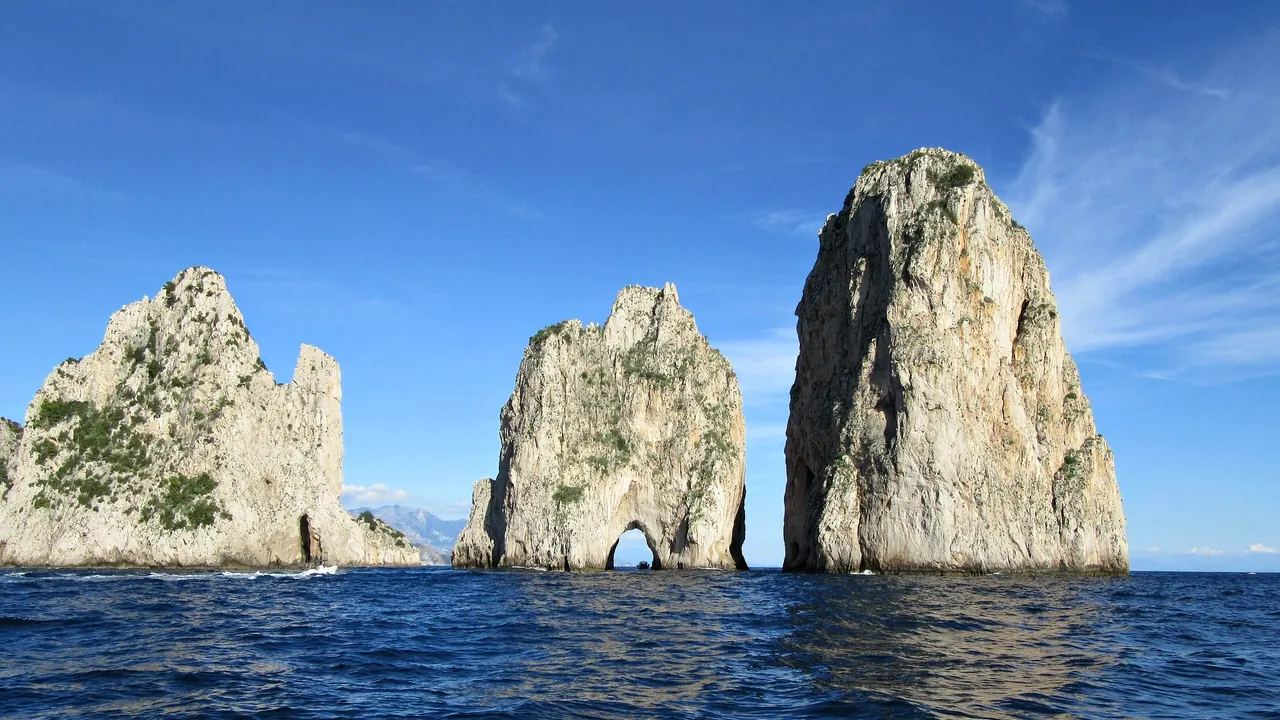
Photos: Capri by Sheeba Samuel, CC BY-SA 4.0, cropped.
Capri or Dolomites?
Our verdict in twelve categories, each scored against the same fixed benchmark cities, and the climate month by month, so you can choose for your trip.
Choose Capri for
- beaches
- nightlife
- shopping
Capri suits a short, polished stay by the sea. You swim off rocks into very clear water, take a boat round the Faraglioni and the grottoes, spend evenings dressed up on the Piazzetta and browse a few lanes of boutiques. It works best for couples and adults who swim confidently and accept paying heavily for the setting. Two or three days cover it, and it offers little for small children.
Choose Dolomites for
- families
- nature and the outdoors
- wellness
For a longer, active trip, the Dolomites are the stronger choice. The mountain scenery is among the finest anywhere, and lifts open it up to walkers of every level. Families find flat high-pasture paths and hotels built around children. Hut lunches, South Tyrolean wine and serious hotel spas fill the rest of the day. The trade-off is very little swimming and quiet nights, so this is for people happy to be outdoors from morning and asleep by eleven.
Scoreboard
Twelve categories on one fixed scale from 0 to 100. The shaded stretch is the gap between the two.
Your match
Pick a travel style or drag the sliders, and both match scores follow your weighting.
Wins on beaches and nightlife with your weighting.
Wins on families and nature and the outdoors with your weighting.
What matters to you?
Category by category
What the scores mean for a trip.
Beaches & swimming
For swimming, Capri wins easily, though it is not a sand destination. You swim from pebble coves at Marina Piccola, from rock platforms with ladders, or off a boat near the grottoes, in water clear and warm enough from June into early October.
The Dolomites have nothing like this. The famous high lakes such as Braies are for rowing and photographs. Real bathing means valley lidos and pools, with Lake Caldaro on the wine route the warmest option.
Food & drink
The Dolomites eat better and more variedly. Alpine and Italian cooking meet here: speck, canederli and strudel, then an espresso, with Ladin and Trentino dishes on top. Lunch on a hut terrace after a morning's walk, Lagrein and Gewürztraminer from the slopes below Bolzano, and the ambitious kitchens of Alta Badia give you plenty to plan meals around.
Capri has a few dishes of its own, such as insalata caprese, ravioli capresi and torta caprese. Around the Piazzetta, though, menus are aimed at day-trippers. The good meals are in family trattorias in Anacapri, and after a few days there is little left to discover.
Culture & sights
The Dolomites offer somewhat more, spread across the valley towns. Bolzano has its arcades and Ötzi the Iceman, Trento has the frescoed Castello del Buonconsiglio, and Bressanone has its cathedral and cloister. There are also First World War tunnels on the high passes. Seeing it all takes driving, and most people treat it as bad-weather days.
Capri's sights are fewer but close together. Tiberius's Villa Jovis sits on its headland, Villa San Michele in Anacapri, and the Certosa di San Giacomo below the town, all within two easy days.
Nightlife
Neither place is for a party, but Capri has more of an evening. Once the last ferry leaves, the Piazzetta fills with a dressed-up aperitivo crowd, and the piano taverns keep Neapolitan songs going late in summer. It is glamorous and expensive, and there are no clubs.
In the Dolomites, going out mostly means winter après-ski in Selva, Canazei or Cortina, which ends by early evening. In summer the villages go quiet well before midnight.
Nature & outdoors
The Dolomites are on another level. Pale limestone towers such as the Tre Cime and Sassolungo rise above green meadows, and lifts, via ferrata cables and routes such as the Alta Via 1 open them up for weeks. In winter the Dolomiti Superski network links a dozen valleys.
Capri's scenery is famous in its own right: the Faraglioni, the Arco Naturale, the chairlift up Monte Solaro and the Sentiero dei Fortini along the wild western coast. Snorkelling and kayaking add the sea, but the island is small enough to see in a few days.
Day trips
Both make excellent bases for outings, but you travel by boat from one and by road or rail from the other. From Capri the ferries reach Sorrento, Naples, Positano, Amalfi and Ischia, and Pompeii is a long day away. Rough seas can cancel any of these.
From the Dolomites, Bolzano puts Merano, Trento and the wine route within an hour, with Verona, the north end of Lake Garda and Innsbruck further off. From the high villages, every trip starts on slow pass roads.
Good for families
For children the Dolomites are much better. Families can walk the wide, almost flat paths of the Alpe di Siusi and the Armentara meadows, and they get huts with playgrounds and farm animals, summer toboggan runs and well-run ski schools. Rainy days are the weak point, with no zoos or theme parks to fall back on.
Capri has nothing made for children. Its steps, packed buses and deep-water swimming suit only older children who swim well, and they will enjoy the Blue Grotto and the chairlift.
Getting around
Both are manageable without a car, as long as you stay put. Capri is tiny: the funicular from Marina Grande, the small orange buses and open taxis cover everything. The difficulties are steep walking and summer queues.
The Dolomites cover a far larger area. Valley trains and buses on one regional pass work well, and lifts take over once you are in a village. Moving between valleys over slow hairpin passes is why most visitors hire a car.
Shopping & style
Capri is the stronger shopping stop, at least for fashion. Via Camerelle and the lanes off the Piazzetta pack in luxury boutiques. The island's own crafts include sandals made by hand while you wait, linen, ceramics and local perfumes.
The Dolomites lean towards craft and food. You will find wood carving in Ortisei, loden and delicatessens under Bolzano's arcades, and some of the best-known Advent markets in the Alps. Most visitors go home with speck, cheese and wine.
Affordability
Neither is cheap, but the Dolomites are easier on the budget. You can stay in the Fassa or Fiemme valleys or in Bolzano and Trento, travel in June or September, and use half board to keep costs down. Cortina and Alta Badia are the expensive exceptions.
Capri is among the costliest places in Italy, from rooms and sunbeds to boat trips and a drink on the Piazzetta. Cheap buses, free walks and Anacapri bakeries help. Staying in Sorrento saves money but means missing the island's evenings.
Live music & performing arts
The Dolomites have more to offer, though it is still modest. Bolzano and Trento have year-round orchestral and theatre programmes, and Bolzano hosts a long-standing piano competition. In summer there are concerts on alpine meadows, jazz in castles and wineries, and Merano holds an autumn festival in its old spa halls.
On Capri, live music is limited to the occasional summer concert in the Certosa cloisters or at Villa San Michele, plus the late-night songs in the taverns. For opera you take the boat to Naples.
Wellness & relaxation
The Dolomites are the better place to unwind properly. South Tyrol's hotels build their stays around saunas facing rock walls and heated outdoor pools. The hay bath is still offered around Völs am Schlern, and Merano's public thermal baths sit beside the river promenade.
Capri has no bathing tradition of its own, only hotel spas, and its calm comes early and late in the day, when the day-trippers have gone. For thermal water, people take the boat across to Ischia.
When should you go?
Pick your month. The climate figures are measured averages, not a forecast.
Capri in July
Dolomites in July
Daytime high, °C
Rainfall in the month, mm
Where the figures come from
Capri has no rain gauge within 25 km of the centre, so its rainfall comes from a gridded climate dataset read at the destination rather than from a gauge further away.
Capri's sunshine is measured 58 km from the centre, at Grazzanise.
Temperature and rainfall are climate normals, averaged over the years shown. Capri: 2005-2025 (sunshine 1991-2020, rainfall 1991-2020) normals, Capri (3.6 km from centre). Dolomites: 1991-2020 normals, Dobbiaco (22.3 km from centre).
Capri is a summer island. The sea is warm enough for swimming from June to early October and reaches about 26°C in August. July and August are also the sunniest months, but afternoons near 30°C make the steep lanes hard going. May, June and September are kinder for walking. Rain arrives in autumn and peaks at about 146mm in November, and winter is mild but grey.
The Dolomites run on a different calendar. Around the main valleys, summer highs of about 22°C make June to September comfortable for hiking. Summer is also the wettest part of the year, with July the wettest month at about 130mm. Winter days hover around freezing, which suits skiers. In spring and late autumn neither destination is at its best, though Capri stays far milder.
Which traveller are you?
On a beach and sun trip, choose Capri between June and September. Stay in Anacapri, close to the western rocks that catch the afternoon sun, and book several nights so you can swim before the day boats arrive. The Dolomites cannot offer this.
For an outdoors trip, pick the Dolomites for a week or more. A base in Val Gardena, Alta Badia or Cortina puts lifts at your door, with June to October for walking and winter for skiing. Capri's walks fill only a few days.
On a family trip with young children, choose the Dolomites in summer. Settle in one valley near the Alpe di Siusi, in a hotel built for families, and you can manage without a car. Save Capri until the children are older and swim well.
Before you go
| Measure | Capri | Dolomites |
|---|---|---|
| Official language | Italian | Italian |
| Currency | Euro (EUR) | Euro (EUR) |
| Sockets | CFL230 V, 50 Hz | CFL230 V, 50 Hz |
| Driving side | Right | Right |
| Time zone | UTC+1, UTC+2 in summer | UTC+1, UTC+2 in summer |
| Emergency number | 112 | 112 |
| Main airport | Naples International Airport (NAP)131 non-stop destinations | Venice Marco Polo Airport (VCE)103 non-stop destinations |
| Public holidays this year | 13 days | 13 days |
By the numbers
| Measure | Capri | Dolomites |
|---|---|---|
| Population | 12,903 | - |
| People per km² | 1,241 | - |
| Swim season, months above 21 °C | 5 months | - |
Where else could you go?
Every comparison below shares a destination with this one, so you can follow Capri or Dolomites somewhere new.
- Positanovs Capri
- Amalfi Coastvs Capri
- Ischiavs Capri
- Austrian Alpsvs Dolomites
- Lake Gardavs Dolomites
- Bavariavs Dolomites