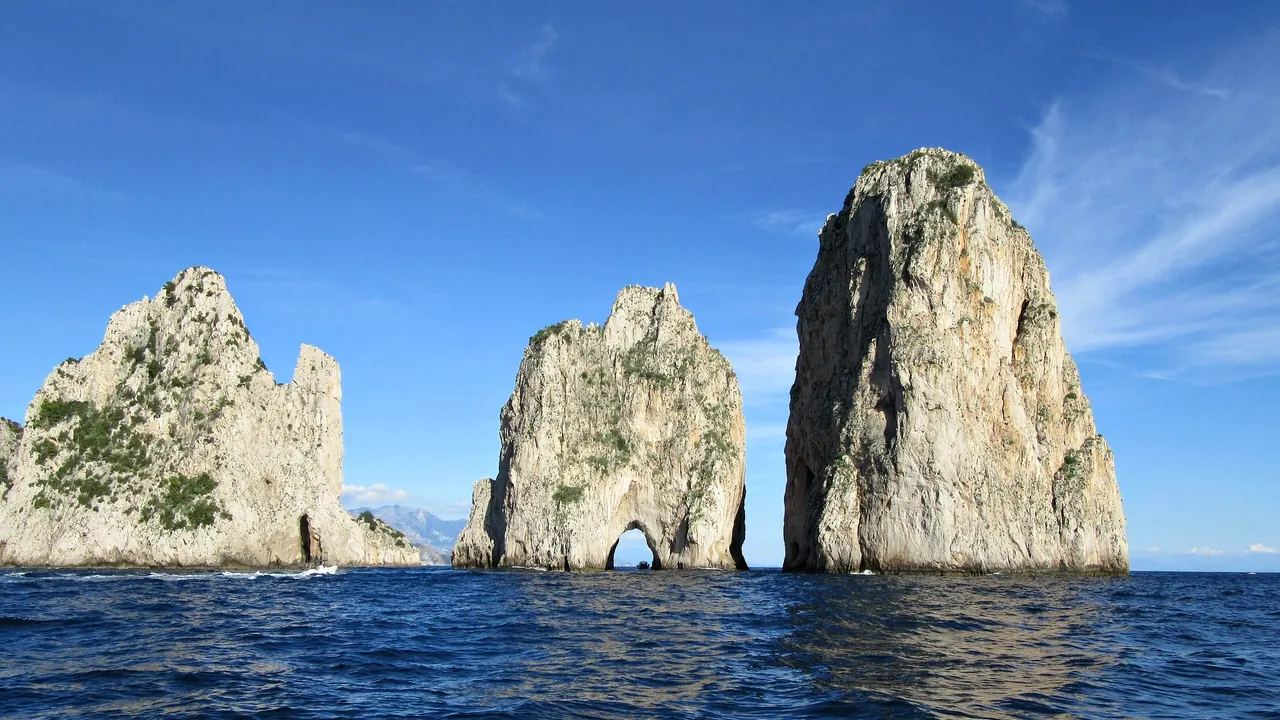
Photos: Capri by Sheeba Samuel, CC BY-SA 4.0, cropped.
Capri or Hvar?
Our verdict in twelve categories, each scored against the same fixed benchmark cities, and the climate month by month, so you can choose for your trip.
Choose Capri for
- shopping
- day trips
- nature and the outdoors
Capri suits a short, polished stay where the scenery is the point: the Faraglioni, cliff paths, the chairlift up Monte Solaro and a dressed-up evening on the Piazzetta. It also makes the stronger base for outings, with Naples, Sorrento, the Amalfi Coast and Pompeii all reachable by boat, and its few lanes hold serious luxury shopping. It is for travellers whose budget can stretch and who would rather linger over aperitivo than dance until dawn.
Choose Hvar for
- nightlife
- prices
- families
Choose Hvar for a longer summer spent in and on the water, with more coves to swim from and a real party scene in Hvar Town and on the Pakleni Islands. Families and quieter couples have the calm north-side towns of Jelsa, Stari Grad and Vrboska. The food and wine go deeper, from village konobas to family cellars. It is far from cheap, but it is easier to manage than Capri once you stay away from Hvar Town.
Scoreboard
Twelve categories on one fixed scale from 0 to 100. The shaded stretch is the gap between the two.
Your match
Pick a travel style or drag the sliders, and both match scores follow your weighting.
Wins on shopping and day trips with your weighting.
Wins on nightlife and prices with your weighting.
What matters to you?
Category by category
What the scores mean for a trip.
Beaches & swimming
Neither island has sand to speak of, and both draw swimmers with very clear water that reaches about 25°C in August. On Capri the swimming is spectacular but cramped. You go in from small pebble coves at the marinas, from ladders off rock platforms run by bathing clubs, off the rocks at Punta Carena, or from a boat under the Faraglioni.
Hvar simply has much more coastline to swim from. Taxi boats run to the pine-backed bays of the Pakleni Islands, quieter coves line the south coast, and the north side around Jelsa and Vrboska has calm, shallow water where you can wade in gently, which Capri rarely allows.
Food & drink
Capri's cooking is a short list of island classics: insalata caprese, ravioli capresi, torta caprese and lemons in everything. Around the Piazzetta and the marinas, much of the cooking is priced for the view, and the better meals are in family trattorias in Anacapri.
Hvar has more to explore. You find lamb and octopus cooked under the peka bell and gregada stew, and the konobas in Velo Grablje, Brusje and Pitve cook from their own land. The island also makes wine worth seeking out, with Plavac Mali from the southern slopes and Bogdanjuša from the plain behind Stari Grad poured in family cellars.
Culture & sights
The two are much alike here, each with a handful of good sites rather than a dense historic town, and two or three days covers either. Capri's sights are spread across its landscape: Tiberius's Villa Jovis on its headland, Villa San Michele in Anacapri, the Certosa and the Gardens of Augustus.
Hvar's heritage lies in its towns. Hvar Town has a Venetian square and cathedral, the 1612 theatre above the Arsenal and the Fortica fortress. Stari Grad was founded by the Greeks, and on its UNESCO-listed plain the fields still follow the boundaries the settlers laid out.
Nightlife
This is where the islands differ most. A night out on Capri is the Piazzetta after the last ferry has gone: dressed-up aperitivo, then piano bars and Neapolitan songs into the small hours. It is glamorous, but there are no clubs, and two nights is about as far as it goes.
In July and August, Hvar Town is a full party destination. The evening starts with sundowners on the harbour, moves to cocktail bars up the stepped lanes and ends at beach clubs on the Pakleni Islands that run from day into night, with taxi boats carrying people back and forth. If you want quiet nights, stay in Stari Grad or the villages.
Nature & outdoors
Capri packs more drama into a small space. The Faraglioni, the Arco Naturale and cliffs hundreds of metres high sit alongside the chairlift up Monte Solaro and the Sentiero dei Fortini along the wild western coast. A boat trip round the island adds the sea caves.
Hvar is gentler and bigger: a long limestone ridge with a walk up Sveti Nikola, abandoned stone villages, dry-stone terraces and lavender fields around Velo Grablje. Its best outdoor days are on the water, kayaking and sailing among the Pakleni Islands, or cycling its quiet roads in spring and autumn. Summer heat limits walking to the early morning.
Day trips
Both islands depend on boats, but the Bay of Naples gives Capri the bigger names. Naples is less than an hour away, Sorrento is closer still, and in season boats run to Positano, Amalfi and Ischia. Pompeii or Herculaneum make a long but possible day out via Sorrento.
From Hvar, Split and Diocletian's Palace are about an hour away by catamaran, and walled Korčula, Vis and Brač are also within reach. Stari Grad, Jelsa and Vrboska make easy outings from one another too. These are pleasant trips but lighter ones, and there are fewer of them outside summer.
Good for families
Capri is hard work with small children. Swimming means rocks and ladders into deep water, the lanes are mostly steps, and the buses are packed in summer. It suits older children who swim well and will enjoy the Blue Grotto, snorkelling and the Monte Solaro chairlift.
Hvar copes much better, although neither island has anything built for children. Stay in Jelsa, Stari Grad or Vrboska for shallow bays, some fine gravel and evening promenades, and avoid Hvar Town, which is steep, crowded and loud at night.
Getting around
Capri is compact enough to manage without a car. A funicular climbs from Marina Grande, small orange buses link the marinas with Anacapri, open-topped taxis fill the gaps, and much of the centre is pedestrian. The difficulties are the steep walking and the summer queues, and staying overnight eases both.
Hvar is long and spread out. Each town is walkable, but the buses along the island are infrequent, so the south coast, the hill villages and the eastern end really call for a car or scooter. The roads are narrow and include a single-lane tunnel. Taxi boats take you to the Pakleni Islands.
Shopping & style
For somewhere so small, Capri is a real place to shop. Via Camerelle and Via Vittorio Emanuele are lined with luxury boutiques, and you can also buy sandals made to measure by hand, perfumes made on the island, ceramics and linen.
On Hvar, shopping mostly means what the island produces: lavender oil, olive oil, honey, wine from the cellar and lace made by the Benedictine nuns. Hvar Town adds a few resort boutiques. It is good for souvenirs but has little for browsing.
Affordability
The gap shows most in the cost of a bed. Capri has few rooms and plenty of people wanting them, so a summer night there costs about as much as anywhere on the Mediterranean. Its pleasures carry the same premium, from a sunbed at a bathing club to a drink on the Piazzetta or a boat of your own. What stays modest is getting about by bus and funicular, walking the cliff paths, and a plain lunch at a bakery or trattoria in Anacapri.
Hvar costs noticeably less, but only once you leave Hvar Town, where harbour rooms and beach-club loungers in midsummer are just as steep. In Jelsa, Stari Grad or Vrboska, a family-run apartment, dinner at a konoba in the hill villages and wine bought from the grower bring the bill down a good deal. When you go matters as well: June and September cost far less than July and August, which stay dear even in the quieter towns.
Live music & performing arts
Neither island has a theatre season, so on both live music is a summer extra. Capri has occasional concerts at the Certosa or Villa San Michele and Neapolitan song in the piano taverns, and opera means the boat to Naples.
Hvar has a little more. There are classical and chamber evenings in churches and the Franciscan cloister, and klapa singers sometimes perform at village feasts.
Wellness & relaxation
The two are level here. Neither has thermal springs, and on both you rely on hotel spas and a slower pace. On Capri the calm depends on the time of day: early morning and evening, once the day-trippers have gone, are best enjoyed from Anacapri. Ischia's thermal baths are across the bay.
On Hvar the calm depends more on where you stay: Vrboska, Stari Grad and the hill villages, with seasonal yoga and massage on offer. In June and September the whole island slows down.
When should you go?
Pick your month. The climate figures are measured averages, not a forecast.
Capri in July
Hvar in July
Daytime high, °C
Rainfall in the month, mm
Where the figures come from
Capri has no rain gauge within 25 km of the centre, so its rainfall comes from a gridded climate dataset read at the destination rather than from a gauge further away.
Capri's sunshine is measured 58 km from the centre, at Grazzanise.
Hvar's temperatures are measured 38 km from the centre, at Split / Marjan.
Hvar has no rain gauge within 25 km of the centre, so its rainfall comes from a gridded climate dataset read at the destination rather than from a gauge further away.
Hvar's sunshine is measured 38 km from the centre, at Split / Marjan.
Temperature and rainfall are climate normals, averaged over the years shown. Capri: 2005-2025 (sunshine 1991-2020, rainfall 1991-2020) normals, Capri (3.6 km from centre). Hvar: 1991-2020 (sunshine 1971-2000) normals, Split / Marjan (38.2 km from centre).
The two islands keep much the same calendar: dry, hot summers, wet winters, and the sea warm enough for swimming from June into September. Hvar is a little hotter and sunnier in midsummer, at around 31°C in July and August, a degree or two above Capri. Capri's sea is a shade warmer late in the season and still allows a swim into early October. May and late September are the best months for walking on both islands, when it is warm without the midday heat.
Autumn is where they part. Capri turns wet earlier, with September already showery and November the wettest month at about 146mm. On Hvar the rain arrives a little later and falls less heavily, peaking at about 116mm in November. In winter both are cool and quiet, and Capri's days stay slightly milder.
Which traveller are you?
For a food and nightlife trip, Hvar is the better island. Capri's evenings are a polished aperitivo followed by a late piano bar, and its local menu is short. Hvar adds dancing into the small hours in summer, slow-cooked village dishes and wines grown on the island.
On a shopping trip, choose Capri. Few places its size combine designer fashion with handmade local crafts, so browsing fits easily between swims. On Hvar, shopping mostly means picking up a few things the island grows or makes, which takes very little time.
On a trip on a tight budget, neither island is easy, but Hvar costs less. On Capri the high prices are hard to avoid, and the usual way round them is to sleep on the mainland. Hvar's quieter towns let you spend noticeably less.
Before you go
| Measure | Capri | Hvar |
|---|---|---|
| Official language | Italian | Croatian |
| Currency | Euro (EUR) | Euro (EUR) |
| Sockets | CFL230 V, 50 Hz | CF230 V, 50 Hz |
| Driving side | Right | Right |
| Time zone | UTC+1, UTC+2 in summer | UTC+1, UTC+2 in summer |
| Emergency number | 112 | 112 |
| Main airport | Naples International Airport (NAP)131 non-stop destinations | Split Saint Jerome Airport (SPU)69 non-stop destinations |
| Public holidays this year | 13 days | 14 days |
By the numbers
| Measure | Capri | Hvar |
|---|---|---|
| Population | 12,903 | - |
| People per km² | 1,241 | - |
| Swim season, months above 21 °C | 5 months | 4 months |
Where else could you go?
Every comparison below shares a destination with this one, so you can follow Capri or Hvar somewhere new.