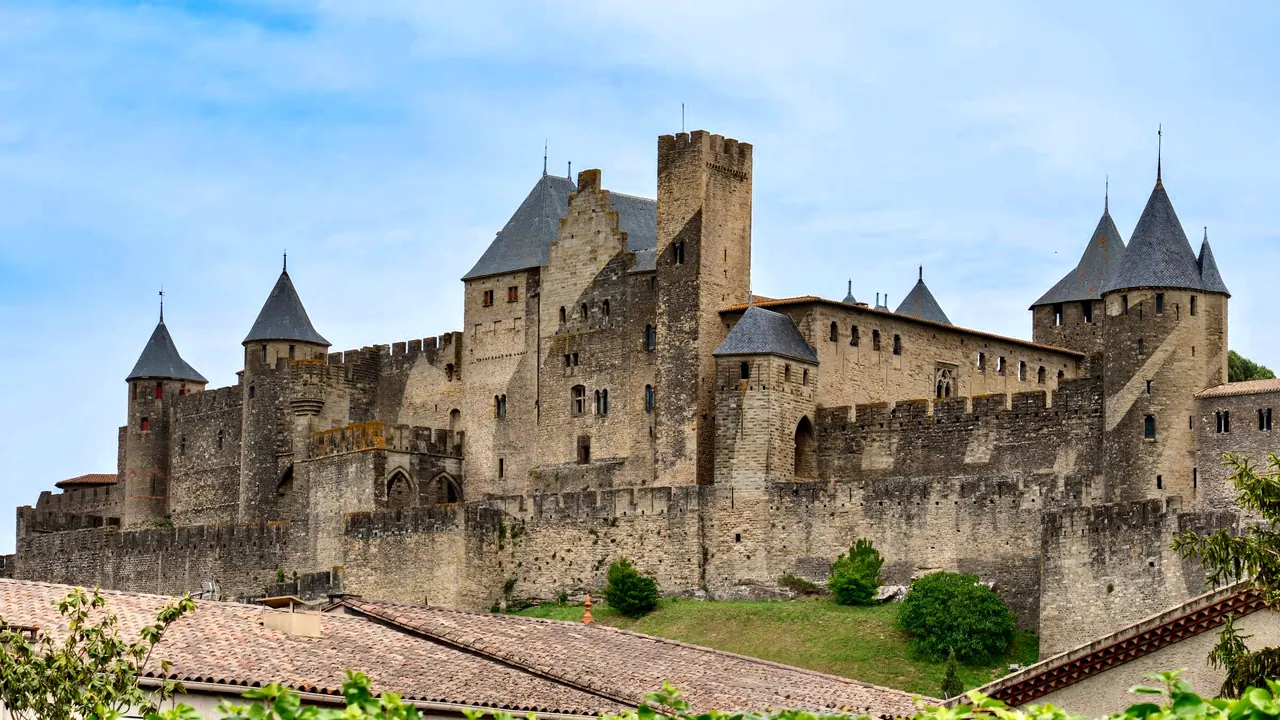
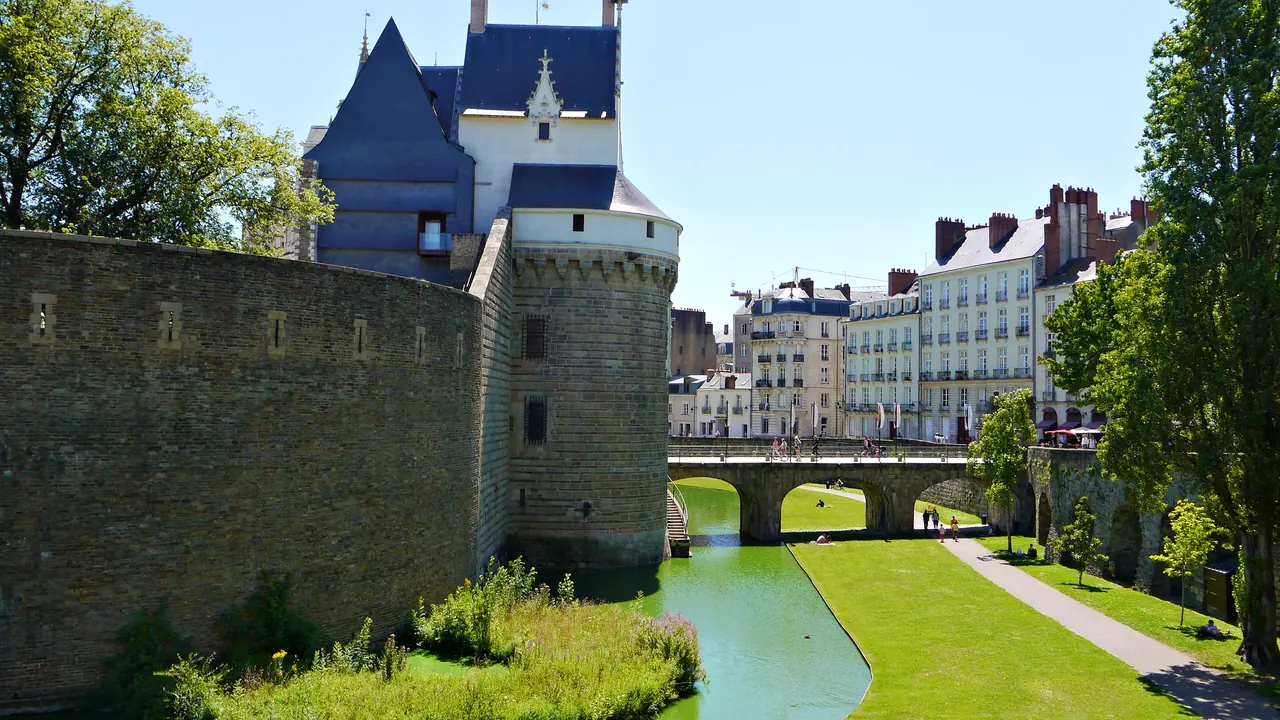
Photos: Carcassonne by Susanne Jutzeler, suju-foto, Pexels License; Nantes by Carole44, CC BY-SA 3.0, cropped.
Carcassonne or Nantes?
Our verdict in twelve categories, each scored against the same fixed benchmark cities, and the climate month by month, so you can choose for your trip.
Choose Carcassonne for
- prices
- day trips
- nature and the outdoors
Carcassonne is the pick for travellers who come for a medieval landmark and the countryside around it: the walled Cité, the Canal du Midi, and drives out to Cathar castles on their ridges and the Corbières wine estates. It is cheaper day to day and sunnier in summer. It suits couples and slow travellers who are happy with quiet evenings and a hire car.
Choose Nantes for
- nightlife
- live music and the arts
- getting around
Nantes suits those who want a real city rather than a monument. Trams make it easy without a car, the food and evenings are far fuller, there is opera and concert life all year, and the Machines de l'Ile give children a day they will remember. With the Atlantic coast and the Loire close by, it also holds up well over a longer stay.
Scoreboard
Twelve categories on one fixed scale from 0 to 100. The shaded stretch is the gap between the two.
Your match
Pick a travel style or drag the sliders, and both match scores follow your weighting.
Wins on prices and day trips with your weighting.
Wins on nightlife and live music and the arts with your weighting.
What matters to you?
Category by category
What the scores mean for a trip.
Beaches & swimming
Neither city is a beach base, and the real difference is which sea you get. From Carcassonne, the long sandy Mediterranean beaches at Gruissan and Narbonne-Plage are about an hour away by car. The water there is warmer, though the tramontane wind can make it choppy. Closer in, the Lac de la Cavayère has lake swimming with lifeguards.
From Nantes, a train reaches the Atlantic in about an hour, at La Baule's sheltered bay and the coves of Pornic, which helps if you have no car. The water is cooler and the season shorter, but the sand is wide and calm days suit families.
Food & drink
Nantes eats better and more widely. Beurre blanc was born there, oysters come from the nearby coast, Brittany adds galettes and crêpes, and Muscadet is made to go with all of it. Good bistros are spread from Bouffay to Graslin and the Ile de Nantes.
Carcassonne has one great dish, cassoulet, and very fairly priced wine from Corbières, Minervois and Limoux. Beyond southern French cooking the choice is narrow, and the set menus inside the Cité are hit and miss, so eat down in the Bastide.
Culture & sights
Both reward a couple of days, but in different ways. Carcassonne has one overwhelming sight: the double-walled Cité, with its towers, the Château Comtal and the stained glass of Saint-Nazaire, plus the grid-planned Bastide below. Museums are few.
In Nantes the interest is spread across the city: the ducal château with its frank history museum, the Gothic cathedral, the wide-ranging Musée d'Arts, the merchant façades of the Ile Feydeau and the Memorial to the Abolition of Slavery. Choose Carcassonne for spectacle and Nantes for variety.
Nightlife
Nantes is far ahead after dark. Students fill the pubs and terraces of the Bouffay, and the old warehouses on the Ile de Nantes hold bars and clubs that run into the early hours.
In Carcassonne, an evening means a walk on the floodlit walls, a glass on a terrace or a drink around Place Carnot. Anyone who wants a club has to go to Toulouse or Montpellier.
Nature & outdoors
The countryside around the two differs more in shape than in quality. Carcassonne has hills: the forested Montagne Noire, the garrigue and castle ridges of the Corbières, and Pyrenean gorges with rafting. The canal towpath is the easy ride, but most of the rest needs a car.
Around Nantes the land is flat and full of water: the Erdre by canoe or boat, the Loire à Vélo cycle route, the reed beds of the Brière and the cliff paths of the Côte Sauvage. Walkers who want climbs should pick Carcassonne, while cyclists and birdwatchers will prefer Nantes.
Day trips
Both are fine bases, but the outings have a different character. From Carcassonne they are about ruins and wine: Peyrepertuse, Quéribus and Lastours, villages such as Minerve and Lagrasse, and the Corbières estates. Most of these need a car, though Toulouse and Narbonne are easy by train.
From Nantes, more of it can be done by rail: Angers and its tapestry, Vannes, Rennes, and the coast at Le Croisic and La Baule. Guérande's salt marshes, Clisson and the Loire châteaux are a little further.
Good for families
Nantes is the easier city for families. The mechanical elephant and the sea-creature carousel at the Machines de l'Ile are made for children, the trams take buggies easily, and Puy du Fou and a safari park are within reach.
Carcassonne offers the more storybook moment, with drawbridges, ramparts and jousting in summer, and the lake adds a water park. But the steep, cobbled Cité is crowded and hot in midsummer, and much of the rest needs a car.
Getting around
A hire car is what separates the two. Carcassonne itself is easy on foot: the flat Bastide sits beside the station and the canal, and the Cité is a walk across the Pont Vieux and a steady climb away, with a shuttle bus in season. Beyond the town, though, buses barely reach the castles, villages and vineyards, so most visitors drive or join tours.
In Nantes you can manage almost an entire stay without a car. Three tram lines and a busway connect a flat centre where the château, Bouffay and the Ile de Nantes are all within walking distance of each other. Small river shuttles cross the Loire, and from the central station trains reach the coast in about an hour and Paris in about two.
Shopping & style
In Carcassonne, the best things to buy are food and drink to take home: tinned cassoulet, blanquette from Limoux and produce from the market on Place Carnot. Otherwise, the lanes of the Cité mostly sell plastic swords and knight costumes, and the Bastide has a modest provincial high street.
Nantes gives you far more to browse, though you still wouldn't plan a vacation around shopping there. The three-level Passage Pommeraye is worth seeing in its own right, Rue Crébillon has the fashion chains and some better boutiques, and independent designers and second-hand shops are found around Bouffay and Decré. For local gifts, look for berlingot sweets and Guérande salt.
Affordability
Carcassonne is the cheaper stay. It costs what a provincial southern town costs, with cheap local wine and moderately priced rooms in the Bastide, although the Cité's hotels and restaurants charge more and summer pushes prices up. Car hire is the main extra cost.
Nantes is reasonable for a large city, with hotels easy to find and cheap travel by tram, but dinners and drinks cost what they do elsewhere in France.
Live music & performing arts
Nantes has a year-round stage that Carcassonne cannot match: opera at the Théâtre Graslin, the national orchestra, La Folle Journée classical festival in winter, contemporary work at the Lieu Unique and giant street-theatre puppets.
Carcassonne's big moment is July, when the Festival de Carcassonne puts concerts and theatre on the open-air stage inside the walls, and the Bastille Day fireworks light up the Cité. The rest of the year is quiet.
Wellness & relaxation
Neither city has a bathing culture, and both rely on places about an hour away. Carcassonne has the small thermal villages of the upper Aude, such as Rennes-les-Bains, and the slow pace of the canal outside summer.
Nantes has the stronger tradition nearby, in the seawater thalassotherapy centres at La Baule and Pornic. In town, the Erdre and the Jardin des Plantes are good for a quiet afternoon.
When should you go?
Pick your month. The climate figures are measured averages, not a forecast.
Carcassonne in July
Nantes in July
Daytime high, °C
Rainfall in the month, mm
Where the figures come from
Carcassonne has no rain gauge within 25 km of the centre, so its rainfall comes from a gridded climate dataset read at the city rather than from a gauge further away.
Carcassonne's sunshine is measured 68 km from the centre, at Perpignan.
Temperature and rainfall are climate normals, averaged over the years shown. Carcassonne: 1999-2020 (sunshine 1991-2020, rainfall 1991-2020) normals, Carcassonne (2.8 km from centre). Nantes: 1991-2020 normals, Nantes (6.6 km from centre).
Carcassonne has the warmer, sunnier year. July and August reach about 29°C, and July is almost dry at 22mm. That is fine for the lake and the Mediterranean shore but hard work on the ramparts at midday. May, September and early October are the best months for walking the Cité and the hills. Rain picks up in autumn and winters are cool, though they stay noticeably brighter than in Nantes.
Nantes is milder. Summer highs of around 25°C keep July and August comfortable for exploring on foot, and the Atlantic warms to about 19°C in August, so swimming is brisk and the season short. June to September is the reliable stretch. From October the city turns grey and wet, with rain peaking at about 101mm in December and little sunshine all winter.
Which traveller are you?
For a food and nightlife trip, Nantes is the clear choice. Its bistros serve beurre blanc, coastal oysters and Muscadet, and the Bouffay lanes and the docks on the Ile de Nantes stay open late. In Carcassonne, evenings end with a quiet walk on the walls.
On a family trip with children, Nantes is the easier base. The mechanical elephant, flat streets and trams that take a buggy make the days simple, and a safari park and Puy du Fou are close. Carcassonne's castle enchants for a day or two, but its steep cobbles tire small legs.
For a trip on a tight budget, Carcassonne makes the money go further. Rooms in the Bastide are moderately priced outside high summer, the local wine is cheap and the lunch menus are good value. Avoid the Cité's expensive hotels, and travel in spring or autumn.
Before you go
| Measure | Carcassonne | Nantes |
|---|---|---|
| Official language | French | French |
| Currency | Euro (EUR) | Euro (EUR) |
| Sockets | CE230 V, 50 Hz | CE230 V, 50 Hz |
| Driving side | Right | Right |
| Time zone | UTC+1, UTC+2 in summer | UTC+1, UTC+2 in summer |
| Emergency number | 112 | 112 |
| Elevation | 81 m | 2 m |
| Main airport | Carcassonne Salvaza Airport (CCF)4 km from centre10 non-stop destinations | Nantes Atlantique Airport (NTE)8 km from centre97 non-stop destinations |
| Public holidays this year | 11 days | 11 days |
By the numbers
| Measure | Carcassonne | Nantes |
|---|---|---|
| City population | 46,080 | 327,734 |
| People per km² | 708 | 5,027 |
| Museums within 10 km | 6 | 11 |
| UNESCO World Heritage sites within 50 km | 2 | 0 |
| Swim season, months above 21 °C | - | None |
Where else could you go?
Every comparison below shares a destination with this one, so you can follow Carcassonne or Nantes somewhere new.
- Toulousevs Carcassonne
- Montpelliervs Carcassonne
- Gironavs Carcassonne
- Barcelonavs Carcassonne
- Avignonvs Carcassonne
- Marseillevs Carcassonne