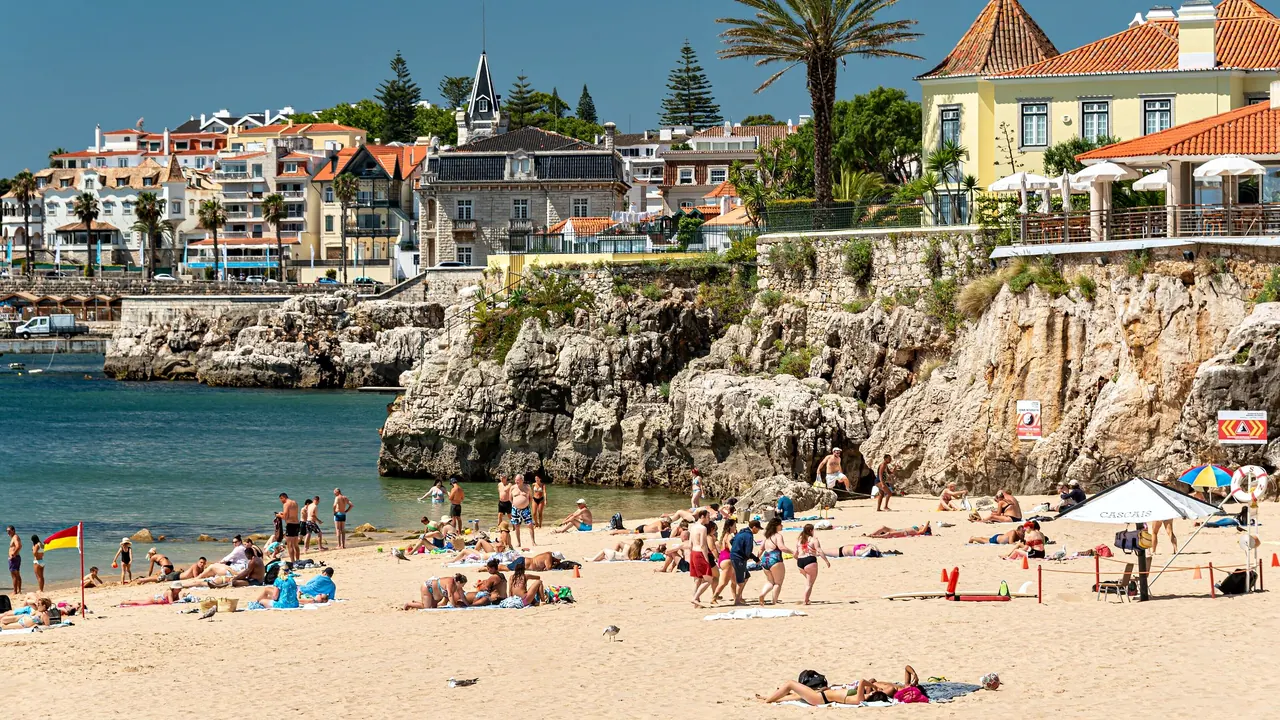

Photos: Cascais by Jorge Franganillo, CC BY 2.0, cropped; Santiago de Compostela by Luis Miguel Bugallo Sánchez (Lmbuga), CC BY-SA 3.0, cropped.
Cascais or Santiago de Compostela?
Our verdict in twelve categories, each scored against the same fixed benchmark cities, and the climate month by month, so you can choose for your trip.
Choose Cascais for
- beaches
- families
- nature and the outdoors
Cascais suits travellers who want sea air, a daily swim and plenty of outdoors close by. Its coves sit below the old centre, the wild coast runs west to Guincho and Cabo da Roca, and Lisbon and Sintra are each an easy day out. That makes it a calm base for families and walkers who don't mind resort prices.
Choose Santiago de Compostela for
- culture and sights
- prices
- food and drink
Santiago de Compostela is for a trip built around one great monument and a table of Galician seafood. The cathedral and the granite old town have a depth of history that Cascais can't match. The taverns and the market feed you well for less, and the student bars keep evenings livelier. The trade-off is rain and an inland city, with the beach a bus ride away.
Scoreboard
Twelve categories on one fixed scale from 0 to 100. The shaded stretch is the gap between the two.
Your match
Pick a travel style or drag the sliders, and both match scores follow your weighting.
Wins on beaches and families with your weighting.
Wins on culture and sights and prices with your weighting.
What matters to you?
Category by category
What the scores mean for a trip.
Beaches & swimming
Cascais is a beach town in a way Santiago is not. Conceição, Duquesa and Rainha lie right below the old centre and the promenade carries on to Estoril. Carcavelos and its surf are a few stops away by train, so a swim fits easily around everything else.
Santiago is inland, and its white sands on the Ría de Muros e Noia and the Ría de Arousa are about 35km away by bus or car. Both seas are cold Atlantic, a degree or two cooler in Galicia, so neither suits long days in warm water.
Food & drink
Both cities cook from the Atlantic, but Santiago does it with more depth. It has Galician octopus, scallops in the shell, razor clams and percebes. In the granite Mercado de Abastos, some counters will cook what you buy, and the taverns of Rúa do Franco pour Albariño. Here, eating is a main reason to come.
Cascais is good for grilled sardines and bream from its own harbour, or a long seafood lunch on the road to Guincho. But the old centre relies on tourist menus, and keen eaters take the train to Lisbon for dinner.
Culture & sights
This is Santiago's strongest card. The cathedral has the Pórtico da Gloria and the shrine of Saint James. Around it are the grand square of the Obradoiro and a UNESCO-listed granite old town, which together fill two or three days. The Museo do Pobo Galego and the Cidade da Cultura add more.
Cascais has charm on a smaller scale: royal-era villas along the seafront, the Citadel, and Paula Rego's paintings in the red pyramid towers of the Casa das Histórias. A day covers it, and the major monuments are in Lisbon and Sintra.
Nightlife
Neither is a place for big clubs, but Santiago has more going on after dark. During term the university fills the bars around Rúa da Raíña and the Praza de Cervantes, and folk sessions turn up in pub-like rooms. Spanish hours keep a few old-town clubs open until morning, though summer is quieter once the students leave.
Cascais has wine bars and cocktail terraces in a few old-town streets, plus the casino at Estoril, and is mostly asleep by midnight. A proper night out means Lisbon and watching the time of the last train back.
Nature & outdoors
Cascais has the more dramatic outdoors, starting at its door. The coastal path runs past Boca do Inferno and the dunes to Guincho, where kitesurfers and surfers make use of the wind and waves. The cliffs at Cabo da Roca and the misty forest trails of the Serra de Sintra are close by.
Santiago offers gentler green country: Camino paths leading out of town, oak woods and stone-walled fields, and parks with views over the roofs. Its wilder places, the Costa da Morte and the Fragas do Eume, need a drive of an hour or more, and rain is a constant companion.
Day trips
Both make good bases, but Cascais has the bigger prizes close at hand. Lisbon is about forty minutes away on the coastal train and Sintra's palaces about half an hour over the ridge. Mafra, Ericeira and Óbidos are an easy drive.
From Santiago the outings are to Galician towns. A Coruña and its Roman lighthouse are half an hour by train, and Pontevedra, Vigo, Ourense and walled Lugo are also within reach, with the Albariño villages and the Costa da Morte by car. It is a fine circuit, but there is no capital city on the doorstep.
Good for families
Cascais is the easier place with young children. Shallow, sheltered coves, a flat promenade for scooters and pushchairs, and the peacocks and playground of the Marechal Carmona park fill most days. The zoo and the Oceanarium mean a train to Lisbon.
Santiago is safe and welcomes children late into the evening. But its sights are churches and museums, the cobbled streets climb, and rain can wipe out several days. Most families see it quickly and head for A Coruña's aquarium or the coast.
Getting around
Both are easy on foot, in different ways. Cascais stretches along the shore, so walking means a flat seafront path between coves, and the coastal train runs straight into Lisbon. Buses to Guincho and the hills are slower, and a car helps for a wider tour.
Santiago is compact rather than spread out. You can cross the whole old town in about twenty minutes, over granite that turns slippery in the rain and with some short climbs. Trains link the Galician cities well, but the beaches and wine villages need a car or a tour.
Shopping & style
Neither is a shopping destination, and the difference is in what you bring home. Cascais leans towards beachwear, surf brands and Portuguese gifts such as azulejo tiles, cork and decorative tins of fish, with Lisbon for anything serious. Santiago sells pilgrim crafts, among a great many scallop-shell souvenirs: black jet set in silver in the Azabachería, Sargadelos ceramics, and tetilla cheese and tarta de Santiago from the delicatessens.
Affordability
Santiago is clearly the cheaper stay. Free tapas with a drink, generous set lunches, free entry to the cathedral and plenty of pensiones and pilgrim hostels keep daily costs low. Rooms climb mainly around the feast of Saint James in July.
Cascais is an upmarket resort, and its seafront hotels and harbour restaurants are expensive for Portugal, above all in July and August. Back-street cafés and the cheap train help, and coming outside high summer saves the most.
Live music & performing arts
Santiago has more to hear. The Real Filharmonía de Galicia plays at the Auditorio de Galicia, and two theatres stage drama in Galician and Spanish. Bagpipe sessions and student tunas in their black capes give the old town a sound of its own.
Cascais offers plays in Portuguese from the Teatro Experimental, cabaret at the Estoril casino and summer jazz on the coast. For fado, opera or an orchestra, you go to Lisbon.
Wellness & relaxation
Cascais has a slight edge for resting without leaving town. Estoril grew up around its thermal springs, and that spa past lives on in thalassotherapy and hotel spas. Quiet mornings on the seafront and yoga by the sea in summer suit an unhurried break, though summer weekends bring traffic from Lisbon.
In Santiago, the calm comes from slow evenings under the arcades. The real bathing is outside the city, in the old spa towns of Caldas de Reis and Cuntis or at Ourense's riverside thermal pools, a good outing for tired walking legs.
When should you go?
Pick your month. The climate figures are measured averages, not a forecast.
Cascais in July
Santiago de Compostela in July
Daytime high, °C
Rainfall in the month, mm
Temperature and rainfall are climate normals, averaged over the years shown. Cascais: 1991-2020 normals, Lisboa / Geof (23.6 km from centre). Santiago de Compostela: 1991-2020 normals, Santiago / Labacolla (8.4 km from centre).
Cascais has the longer, drier summer. June to August bring almost no rain, highs reach 28°C in July and August, and the long sunny days make it a reliable beach town, though the sea never gets much past 19°C. September is still fairly dry and warm. Together with May, it is the best time for walking the cliffs and the Sintra hills. The rain returns in earnest from October to January, but the days stay mild.
Santiago is cooler and much wetter all year. Even in July and August, highs stay around 25°C, which is pleasant for walking the old town but seldom beach weather, and the sea in the rías is a little colder than at Cascais. July is clearly the driest month. June and August are wetter but still among the better months, while September is noticeably damper again. From October to January every month passes 200mm of rain. Spring stays wet, and there is far less sunshine than in Cascais. Outside high summer, pack for rain, which at least makes the granite shine.
Which traveller are you?
For a beach and sun trip, Cascais is the clear choice. Sandy coves lie at the foot of the old town, the summer is dry and sunny, and Carcavelos and Estoril are a short train ride away. From Santiago, every beach day means a bus to the rías.
On a culture and arts trip, Santiago de Compostela comes out well ahead. The cathedral, the Praza do Obradoiro and the UNESCO-listed old town hold days of looking, with folk music and an orchestra for the evenings. Cascais sends you to Lisbon for its big sights.
On a tight budget, Santiago is the easier city to live in cheaply, and the eating that draws people there is also the inexpensive part. In Cascais, keeping costs down means staying away from the water and skipping high summer.
Before you go
| Measure | Cascais | Santiago de Compostela |
|---|---|---|
| Official language | Portuguese | Spanish |
| Currency | Euro (EUR) | Euro (EUR) |
| Sockets | CF230 V, 50 Hz | CF230 V, 50 Hz |
| Driving side | Right | Right |
| Time zone | UTC, UTC+1 in summer | UTC+1, UTC+2 in summer |
| Emergency number | 112 | 112 |
| Elevation | 0 m | 260 m |
| Main airport | Lisbon Humberto Delgado Airport (LIS)26 km from centre157 non-stop destinations | Santiago-Rosalía de Castro Airport (SCQ)10 km from centre29 non-stop destinations |
| Public holidays this year | 14 days | 13 days |
By the numbers
| Measure | Cascais | Santiago de Compostela |
|---|---|---|
| City population | 214,124 | 100,965 |
| People per km² | 2,198 | 459 |
| Museums within 10 km | 6 | 6 |
| UNESCO World Heritage sites within 50 km | 3 | 2 |
| Swim season, months above 21 °C | None | None |
Where else could you go?
Every comparison below shares a destination with this one, so you can follow Cascais or Santiago de Compostela somewhere new.
- Sintravs Cascais
- Lisbonvs Cascais
- Coimbravs Cascais
- Lagos, Portugalvs Cascais
- Portovs Santiago de Compostela
- Albufeiravs Cascais