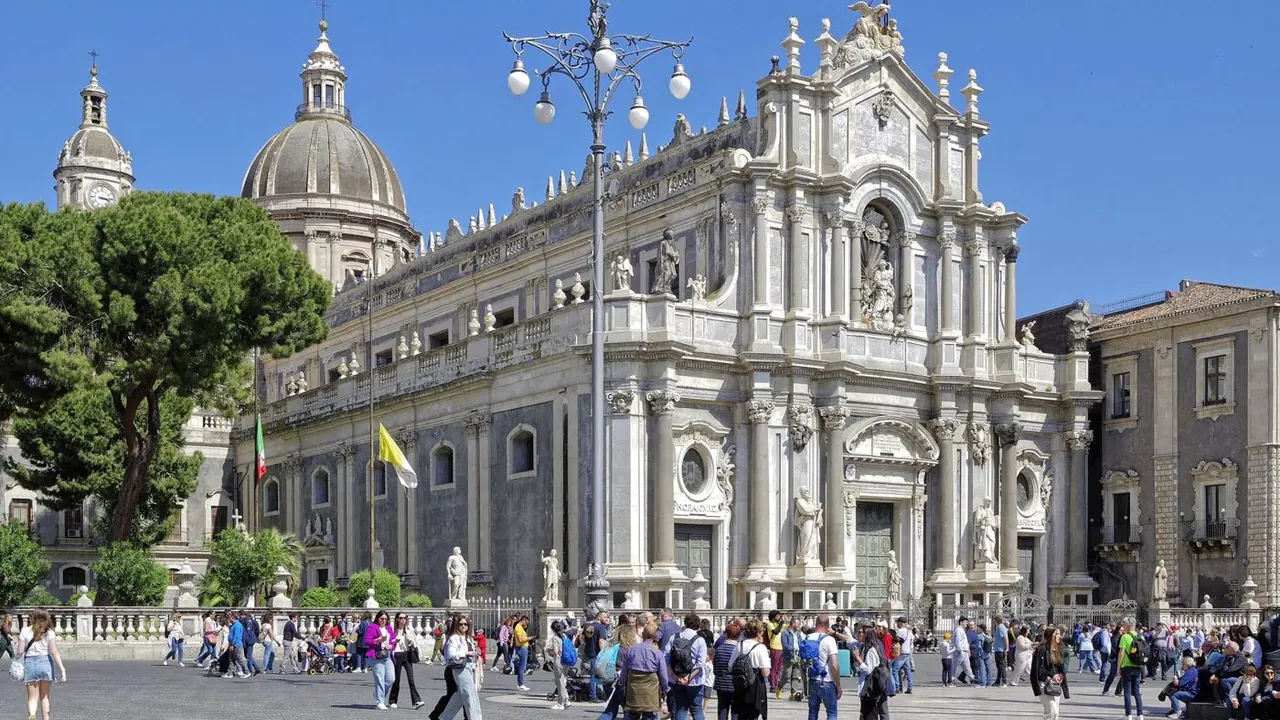
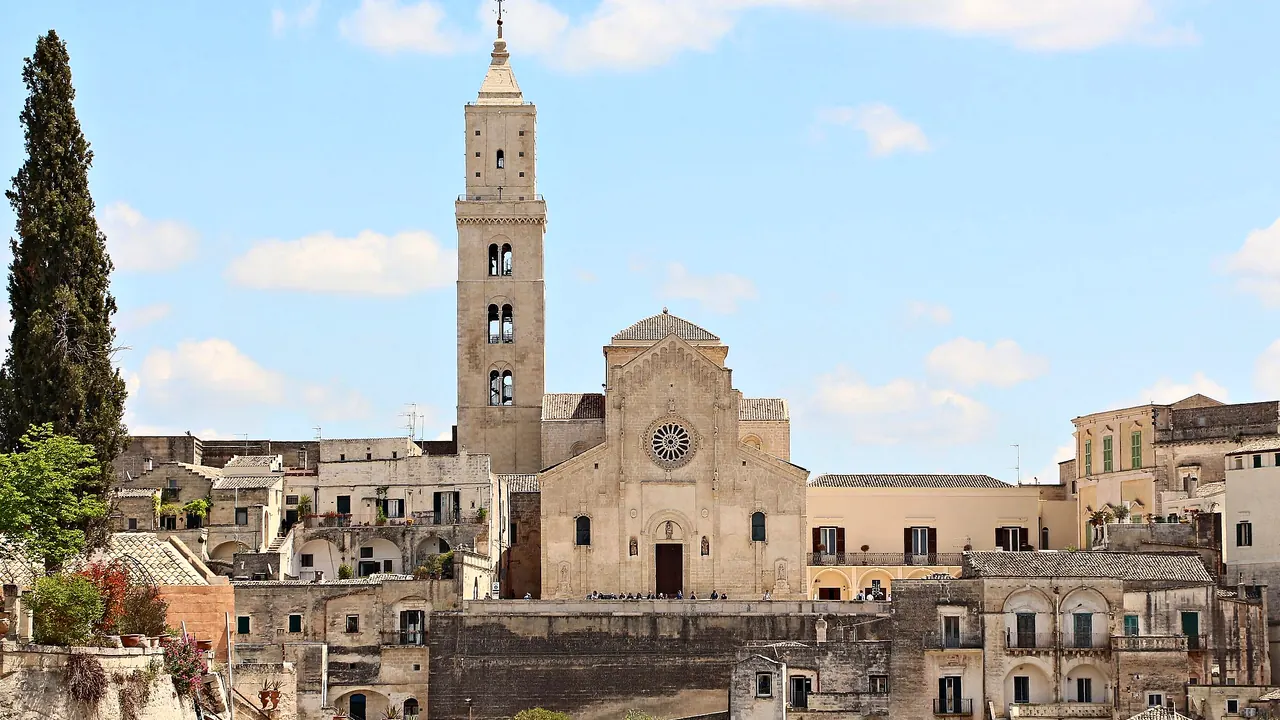
Photos: Catania by Berthold Werner, CC BY-SA 4.0, cropped; Matera by Bernard Gagnon, CC BY 4.0, cropped.
Catania or Matera?
Our verdict in twelve categories, each scored against the same fixed benchmark cities, and the climate month by month, so you can choose for your trip.
Choose Catania for
- nightlife
- live music and the arts
- beaches
Catania suits travellers who want a lively, full-blooded southern city with plenty to do. You get loud markets and some of Italy's best street food, late nights in the lanes around Piazza Bellini, a beach on the edge of town and Etna smoking on the skyline. It also makes the better base for a week or more, with Siracusa, Taormina and the baroque towns all within reach. It works for families and groups as well as couples, as long as you can put up with traffic and noise.
Choose Matera for
- culture and sights
- wellness
Matera is the choice for a slower, more atmospheric trip built around one extraordinary place. The cave districts of the Sassi, with their rock churches and lamplit views at dusk, are unlike anything in Sicily, and the town goes quiet after dinner. That suits couples and travellers who care more about setting than entertainment, and who plan to explore Basilicata and Puglia by car rather than spend their evenings out.
Scoreboard
Twelve categories on one fixed scale from 0 to 100. The shaded stretch is the gap between the two.
Your match
Pick a travel style or drag the sliders, and both match scores follow your weighting.
Wins on nightlife and live music and the arts with your weighting.
Wins on culture and sights and wellness with your weighting.
What matters to you?
Category by category
What the scores mean for a trip.
Beaches & swimming
Catania has the sea built into city life, and Matera does not. In Catania you can choose between the long sandy strip of La Playa, with its beach clubs, just south of the centre, and the black lava coast to the north. At Aci Castello and Aci Trezza you climb down ladders into clear water beside the basalt sea stacks.
From Matera the beach is a planned outing. The wide, pine-backed sands around Metaponto and Policoro are about 45 minutes by car, calm and shallow and very good for small children, but without a car most visitors never get there.
Food & drink
Catania is the more exciting place to eat. Its strength is food on the move: cone-shaped arancini, fried crispelle and pastries from the tavola calda counters, smoky grills in the evening and granita with brioche for breakfast. The Pescheria behind the cathedral supplies the trattorias around it, and Etna's volcanic wines are a real discovery.
Matera eats more simply. Its food is the hearty peasant cooking of Basilicata: the horn-shaped bread, crapiata, cavatelli, roast lamb and crackling peperoni cruschi with Aglianico. It is satisfying, but it is mostly a sit-down dinner, often in a cave room, with no street food or market life to graze through.
Culture & sights
Matera has the more remarkable sightseeing, even though there is less of it. The Sassi of Caveoso and Barisano climb the gorge in layers of cave houses and carved churches, with frescoed rock chapels such as Santa Maria de Idris and the walk-through Palombaro Lungo cistern beneath the main square. It feels like nowhere else in Italy.
Catania offers a grand baroque townscape in black lava and pale limestone instead. Highlights are Piazza del Duomo with its elephant fountain, the line of churches on Via dei Crociferi, the vast San Nicolò monastery, and Roman remains surfacing between the buildings. It is handsome and part of a UNESCO group, but its museums are modest and it lacks Matera's sense of entering another age.
Nightlife
This is one of the starkest gaps between the two. Catania's university crowd keeps the lanes around Piazza Bellini and Via Gemmellaro full of outdoor drinkers well past midnight, and in summer the La Playa beach clubs turn into open-air dance floors.
Matera's evening is a passeggiata on Via del Corso, a long dinner and perhaps a cocktail in a cave bar overlooking the lit Sassi. That is lovely for a couple, but there are no clubs, and outside summer the town empties soon after dinner.
Nature & outdoors
Etna gives Catania the bigger outdoor draw. You can take the cable car and off-road vehicles from Rifugio Sapienza towards the summit craters, walk across lava flows and through birch woods, and even ski with a sea view in winter. Add the wadeable Alcantara Gorge and snorkelling or kayaking among the sea stacks, and the range is wide.
Matera's nature is gentler and closer to hand. A path drops from Sasso Caveoso into the Gravina gorge and climbs to the Murgia plateau, with its abandoned rock churches and Neolithic sites, without any transport at all. The Lucanian Dolomites and Pollino need a car and a longer day.
Day trips
Both are excellent bases, with Catania slightly ahead. From Catania you reach Greek and baroque Sicily: Ortigia and the Neapolis in Siracusa, Taormina's theatre, the baroque trio of Noto, Modica and Ragusa Ibla, and the mosaics at Piazza Armerina. Buses cover the main towns.
Matera's outings cross into Puglia, which gives them a different flavour. The trulli of Alberobello, the white towns of the Valle d'Itria, Castel del Monte and Polignano a Mare are all about an hour away, and in Basilicata there are ghostly Craco and the mountain villages of Castelmezzano and Pietrapertosa. Almost every one of them needs a car.
Good for families
Catania gives children more to do, mostly outside the city. There is the gently shelving sand at La Playa, crater walks on Etna and the Etnaland theme and water park for a hot day. The centre itself is wearing, with heavy traffic, narrow pavements and little shade.
Matera is harder going with young ones. Older children love the caves, the cistern and the scramble into the gorge, but the Sassi are all steep stone steps where a pushchair is useless, and the nearest beach is a drive away. A short stay with a baby carrier works best.
Getting around
The two are broadly level. Both are easy on foot at the centre and awkward beyond it. Catania's main sights are close enough together that a day of sightseeing needs no transport. For longer journeys there is a metro line, regional buses to Siracusa, Taormina and up to the Etna refuge, and the slow Circumetnea railway around the volcano. What wears you down is the city itself: heavy traffic, drivers who do not always stop at crossings and very little parking.
Matera is quieter underfoot, because cars are kept out of most of the Sassi, but walking there means climbing. Steep stairways link the flat upper town to the cave districts. Leaving town is harder still. There is no mainline railway, only a slow narrow-gauge line to Bari and few buses, so a hire car matters even more than in Catania.
Shopping & style
Catania offers more, though neither is a shopping destination. Via Etnea gives you a long run of Italian chains, and La Fiera and the Pescheria are markets worth visiting for the spectacle alone. To take home there are Bronte pistachio creams, Etna wines and Caltagirone ceramics.
Matera's shopping fits into a few workshops in the Sassi selling the painted cuccù whistle, tufa carvings and papier-mâché, plus an ordinary high street. Its dried peppers and local pasta are the best souvenirs.
Affordability
The two cost broadly the same, but the savings fall in different places. In Catania the cheapest eating is street food, which can feed you all day for very little, and the city buses are inexpensive. Costs rise with summer rooms, beach-club sunbeds and guided trips to Etna's summit.
In Matera the simple trattorias of the upper town are good value and walking the Sassi and the Murgia costs nothing. The town's famous cave hotels are expensive, though, so staying in the newer town a short walk away saves a lot. In both places a hire car is the biggest extra.
Live music & performing arts
Catania clearly has more on stage. As Bellini's birthplace it has the Teatro Massimo Bellini, a grand opera house with a proper opera and symphonic season, and small companies still perform the opera dei pupi with its marionette knights and Saracens. In summer there are concerts in courtyards and ancient theatres.
Matera has conservatory concerts, a summer jazz festival and open-air events against the Sassi, while the Festa della Bruna, when the papier-mâché float is torn apart, is its one great night. On most evenings the entertainment is the view.
Wellness & relaxation
Neither is a spa destination, and neither has a thermal tradition, but the calm comes in different forms. Catania is noisy and traffic-heavy. Its spas are in resorts along the coast and on Etna's lower slopes, and the volcano's villages make a quieter base.
Matera is restful by nature once the day groups leave. Some hotel spas have candlelit pools cut into the rock, and early mornings in the Sassi are quiet. The cooler months from autumn to spring are the most peaceful time to visit.
When should you go?
Pick your month. The climate figures are measured averages, not a forecast.
Catania in July
Matera in July
Daytime high, °C
Rainfall in the month, mm
Where the figures come from
Matera has no rain gauge within 25 km of the centre, so its rainfall comes from a gridded climate dataset read at the city rather than from a gauge further away.
Temperature and rainfall are climate normals, averaged over the years shown. Catania: 1991-2020 (sunshine 1961-1990, rainfall 1971-2000) normals, Catania / Fontanarossa (5.2 km from centre). Matera: 2005-2025, 10 years observed (rainfall 1991-2020) normals, Matera / Martella (4.8 km from centre).
Catania has the longer warm season. The sea is warm enough for swimming from June into October and peaks around 26°C in August. Summer is almost rainless, and July is the sunniest month. High summer is very hot, with highs near 32°C, so walk the streets in the morning and evening and spend the middle of the day by the sea. Spring and autumn are the comfortable months for sightseeing. Rain returns in September and peaks sharply in October, and in December and January Catania is actually wetter than Matera. Even so, winter days reach about 15°C, which is mild enough for a day in the baroque streets.
Matera stands on an inland plateau, so its winters are much colder, around 10°C in January, and spring arrives later. Its rain is spread more evenly through the year, so a summer shower is more likely than in Catania, and October and November are its wettest stretch. July and August are just as hot as in Catania, and the bare stone gives little shade. April, May, September and early October are the best months for the Sassi and the gorge walks. The Ionian coast below the town warms up as much as Catania's sea, but you have to drive to reach it.
Which traveller are you?
For a beach and sun trip, Catania is the clear pick. Sandy La Playa and the lava-rock swimming at Aci Trezza are right on the city's doorstep, and the long dry summer helps. From Matera the nearest sand is a drive away.
On a food and nightlife trip, Catania wins easily. You have arancini and granita at the counters, the Pescheria at lunchtime, horse-meat grills on Via Plebiscito and bars full until after midnight. Matera offers good regional dinners and a quiet glass of wine, then bed.
For a short city break, Matera works beautifully. In two days you can walk the Sassi, see the rock churches and the underground cistern, cross the gorge to the Murgia and watch the lights come on at dusk, all without needing a car.
Before you go
| Measure | Catania | Matera |
|---|---|---|
| Official language | Italian | Italian |
| Currency | Euro (EUR) | Euro (EUR) |
| Sockets | CFL230 V, 50 Hz | CFL230 V, 50 Hz |
| Driving side | Right | Right |
| Time zone | UTC+1, UTC+2 in summer | UTC+1, UTC+2 in summer |
| Emergency number | 112 | 112 |
| Elevation | 7 m | 401 m |
| Main airport | Catania-Fontanarossa Airport (CTA)4 km from centre96 non-stop destinations | Bari Karol Wojtyła International Airport (BRI)54 km from centre104 non-stop destinations |
| Public holidays this year | 13 days | 13 days |
By the numbers
| Measure | Catania | Matera |
|---|---|---|
| City population | 311,584 | 59,685 |
| People per km² | 1,704 | 152 |
| Museums within 10 km | 25 | 8 |
| UNESCO World Heritage sites within 50 km | 3 | 1 |
| Swim season, months above 21 °C | 5 months | 5 months |
Where else could you go?
Every comparison below shares a destination with this one, so you can follow Catania or Matera somewhere new.