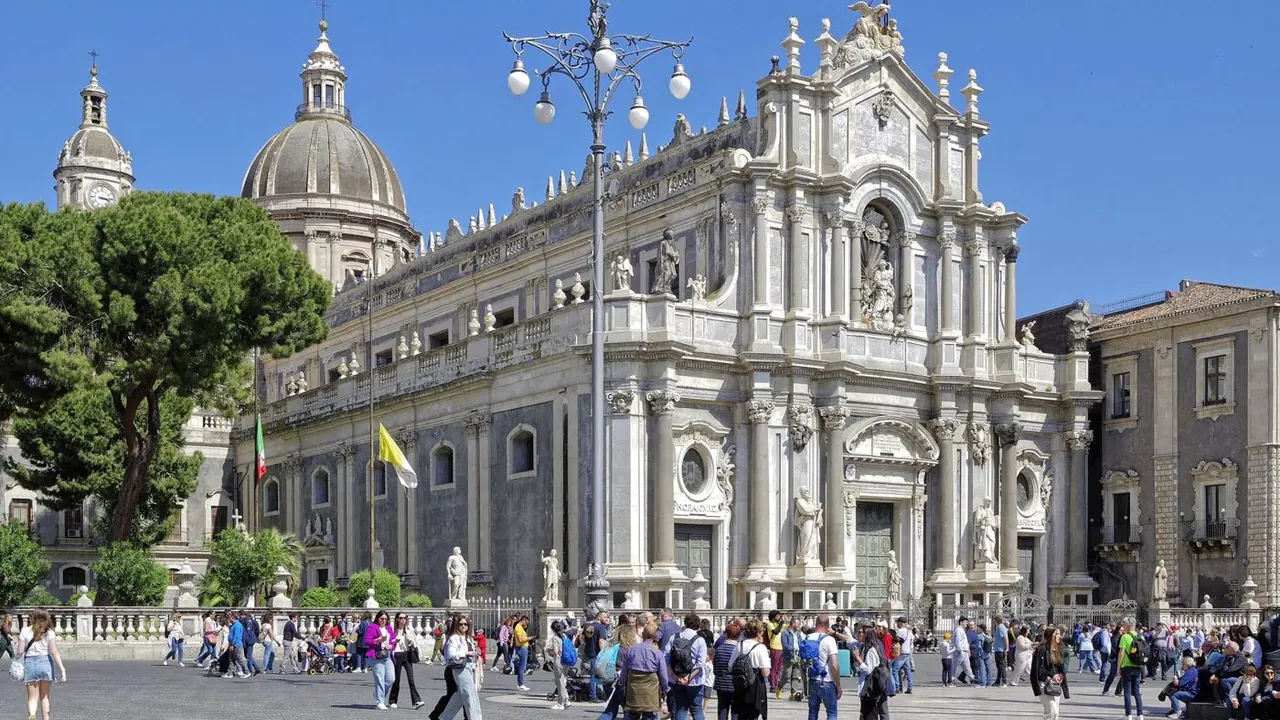
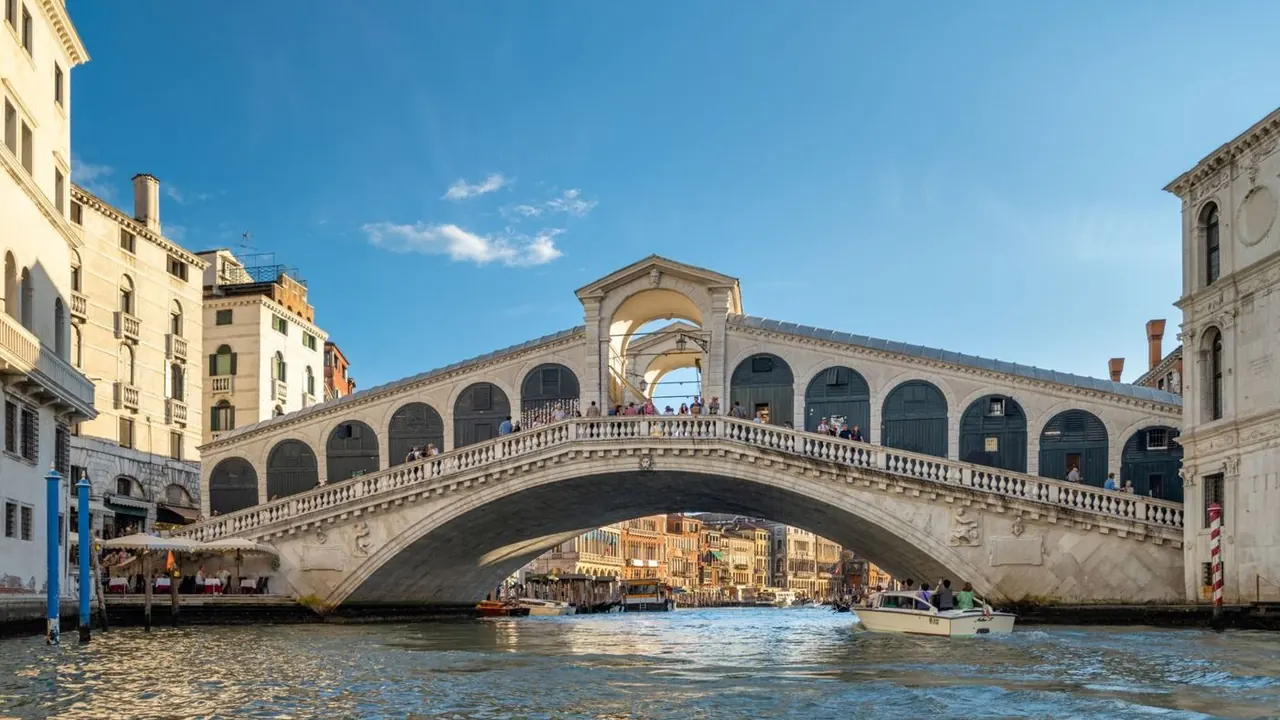
Photos: Catania by Berthold Werner, CC BY-SA 4.0, cropped; Venice by David Vives, Pexels License.
Catania or Venice?
Our verdict in twelve categories, each scored against the same fixed benchmark cities, and the climate month by month, so you can choose for your trip.
Choose Catania for
- prices
- nature and the outdoors
- nightlife
Catania suits travellers who want sun, sea and a volcano in one trip, and who would rather spend on long lunches than on a hotel room. The street food, the lava coast and the climb up Etna give it a physical, outdoor appeal. It stays out late, and it costs far less than Venice to stay in.
Choose Venice for
- culture and sights
- getting around
- shopping
If your trip is built around art and architecture, go to Venice. Its palaces, churches and galleries go much deeper than Catania's baroque centre, and its car-free lanes are made for slow walking. It is expensive and quiet after dark, so it suits people who come for days of looking rather than nights out.
Scoreboard
Twelve categories on one fixed scale from 0 to 100. The shaded stretch is the gap between the two.
Your match
Pick a travel style or drag the sliders, and both match scores follow your weighting.
Wins on prices and nature and the outdoors with your weighting.
Wins on culture and sights and getting around with your weighting.
What matters to you?
Category by category
What the scores mean for a trip.
Beaches & swimming
Catania gives you a choice of two shores. To the south is the long sand of La Playa with its beach clubs. To the north are the lava platforms of Aci Castello and Aci Trezza, where you climb down ladders into clear water beside the basalt stacks. Venice has one real option, the Lido, a short boat ride away, with fine sand and shallow water that is warm but greenish.
Both seas are about as warm in August, but Catania's swimming season is longer and its water clearer. The Lido is good for small children paddling and for an afternoon off from sightseeing. In Catania the coast can shape the whole trip.
Food & drink
Both cities eat best informally, but in different styles. Catania does street food on a big scale: arancini filled with ragù, fried crispelle, horse meat grilled on Via Plebiscito, pasta alla Norma and granita with brioche for breakfast. La Pescheria is at the centre of it all, and there are Etna wines to drink.
Venice's answer is the bacaro, where cicchetti such as creamed salt cod and sarde in saor come with a spritz, and the lagoon supplies risotto blackened with cuttlefish ink. The real difference is how reliable it is. In Venice the tourist menus around San Marco mean you have to search for a good meal, while in Catania it is hard to eat badly.
Culture & sights
Venice is in a different league here. The whole city is the sight, from San Marco and the Doge's Palace to the palazzi along the Grand Canal. The art behind its doors, Titian at the Frari, Tintoretto at San Rocco, the Accademia and the Guggenheim, easily fills a week.
Catania's appeal is narrower but real. It is a late-baroque city rebuilt in black lava and pale limestone after the earthquake of 1693, with Via dei Crociferi, the vast monastery of San Nicolò l'Arena and Roman ruins below the streets. Its museums are modest and two or three days cover it, though the Feast of Sant'Agata in February is one of Italy's largest processions.
Nightlife
Catania stays out far later. Its students fill the lanes around Piazza Bellini and Via Gemmellaro, drinking outdoors until well past midnight, and in summer the La Playa beach clubs turn into open-air dance floors. Venice is at its liveliest at aperitivo time, with spritzes in the bacari of the Rialto and the Fondamenta della Misericordia. After that it thins out to a few student bars on Campo Santa Margherita.
Neither city has real club culture. The difference is that in Catania the night out is the point, while in Venice the late hours are for a quiet walk along dark canals.
Nature & outdoors
Catania has an active volcano less than an hour away, and that changes the whole trip. On Etna there is a cable car up towards the summit craters, trails over lava flows and through beech woods, and even skiing in winter. Beyond it lie the Alcantara Gorge and the Nebrodi forests, and you can dive off the lava coast.
Venice's nature is flat and quieter. It is mostly the salt marshes of the northern lagoon around Torcello, where you can see herons and flamingos from a kayak, plus cycling along the sea walls of Pellestrina. Real mountains are more than two hours away.
Day trips
Both make excellent bases, but the trips around them are very different. From Catania the draw is the ancient and baroque south-east: Ortigia and the Greek theatre at Siracusa, Taormina's theatre above the sea, the baroque towns of Noto and Modica, and the mosaics at Piazza Armerina.
Venice's strength is the railway. Padua, Vicenza and Verona are all within about an hour and a quarter by fast train, with Bologna further on, and the lagoon islands of Murano, Burano and Torcello need only a boat. You can manage Venice's day trips without a car, while around Catania a car opens up far more.
Good for families
Neither is an easy city for families, and the problems differ. Catania gives children the gently shelving sand at La Playa, crater walks on Etna and the Etnaland water park, but the city itself means heavy traffic, narrow pavements and fierce summer afternoons.
Venice has no cars at all, and the boats, glass-blowing on Murano and the Lido make it an adventure. Yet the stepped bridges defeat pushchairs, and there are few parks or playgrounds. Catania suits a family summer built around the beach, Venice a short stay with older children.
Getting around
Venice is easier to get around, even with no roads. Almost everything is within a long walk, the vaporetto reaches the islands and the Lido, and trains arrive at Santa Lucia on the edge of the centre. The steps on its bridges are hard on wheeled luggage, though, and the alleys get people lost.
Catania's compact centre along Via Etnea is simple on foot, but beyond it things get harder: there is a single metro line, buses are slow in traffic and drivers do not always stop for pedestrians. Many visitors end up hiring a car and then struggle to park it.
Shopping & style
Venice has the stronger shopping because its crafts are its own: Murano glass, Burano lace, papier-mâché masks, marbled paper and furlane slippers. They are best bought in the workshops of Dorsoduro and Castello rather than on the main routes, which are full of imports. The fashion names gather on Calle Larga XXII Marzo.
Catania is more about markets and food. Via Etnea has the chains, La Fiera is a loud daily market, and the things worth taking home are Bronte pistachio cream, Etna wine and ceramics from Caltagirone.
Affordability
The gap here is wide. In Catania street food makes a full meal for little money, guesthouses in the old centre are reasonable for most of the year and the baroque streets are free. The real extra costs are guided trips to Etna's summit, a hire car and sunbeds in summer.
Venice is one of the most expensive places to stay in Italy, with costly rooms, boats priced for visitors and entry fees at most churches and sights. Eating standing at a bacaro counter, sleeping in Mestre or coming in late autumn brings the cost down, but rarely to Catania's level.
Live music & performing arts
Both are opera cities with a famous name attached, and Venice goes a little further. La Fenice runs a full season of opera, ballet and concerts, the Biennale adds contemporary music, theatre and dance, and Vivaldi is played in churches most evenings, some of it very well.
Catania has its native composer Bellini, with the Teatro Massimo Bellini and a museum about him, and a living tradition of opera dei pupi marionette theatre that Venice lacks. Beyond that, both have little jazz or independent music.
Wellness & relaxation
Neither is a spa destination, but Venice is the calmer place to stay. With no traffic, its mornings and evenings are hushed, the residential quarters of Castello, Cannaregio and Giudecca move slowly, and real thermal pools are about an hour away at Abano Terme.
Catania is noisy and full of cars, and its spas are mostly in resorts on the coast and on Etna. Its rest comes from the rhythm of the day, the long lunches and the evening passeggiata, or from moving up to a quiet village on the volcano.
When should you go?
Pick your month. The climate figures are measured averages, not a forecast.
Catania in July
Venice in July
Daytime high, °C
Rainfall in the month, mm
Where the figures come from
Catania's sunshine is measured 88 km from the centre, at Messina.
Venice has no rain gauge within 25 km of the centre, so its rainfall comes from a gridded climate dataset read at the city rather than from a gauge further away.
Venice's sunshine is measured 26 km from the centre, at Treviso / S. Angelo.
Temperature and rainfall are climate normals, averaged over the years shown. Catania: 1991-2020 normals, Catania / Fontanarossa (5.2 km from centre). Venice: 1991-2020 normals, Venezia / Tessera (6.7 km from centre).
Catania has the longer warm season and far more sunshine. The sea is warm enough for swimming from June into October and reaches about 26°C in August. July and August climb to 32°C, too hot for walking the streets or hiking low on Etna in the middle of the day, so May and late September into October suit sightseeing better. Summers are almost completely dry and winters are mild. The rain returns in September and builds to its heaviest in December.
Venice is cooler and less sunny all year. July and August reach about 30°C, warm enough for the Lido, where the sea gets almost as warm as Catania's, but humid in the narrow alleys. In winter the days drop to about 8°C, cold for long walks but fine for churches and museums. Unlike Catania, Venice has no dry season. January and March are its driest months, rain picks up from April and stays steady through the summer, and it peaks in October at about 87mm. May, June and early autumn have the most comfortable temperatures for walking, but whichever month you choose, pack for showers.
Which traveller are you?
On a culture and arts trip, Venice rewards every hour you give it. You can spend mornings in galleries, afternoons slipping into parish churches whose altarpieces still hang where they were painted, and evenings at the opera. Catania works better as one stop on a wider Sicilian baroque tour.
On a trip on a tight budget, Catania lets you stay longer for the same money. A day can run on granita for breakfast, a street-food lunch and an evening walking the old centre without paying an entry fee anywhere. In Venice the same budget usually means sleeping on the mainland and travelling in.
For an outdoors trip, Catania lets you walk on a volcano in the morning and swim off the rocks in the afternoon, with guides to take you higher towards the craters. In Venice the outdoors is gentler, a morning paddling or rowing on the lagoon, and anything mountainous takes a long day out.
Before you go
| Measure | Catania | Venice |
|---|---|---|
| Official language | Italian | Italian |
| Currency | Euro (EUR) | Euro (EUR) |
| Sockets | CFL230 V, 50 Hz | CFL230 V, 50 Hz |
| Driving side | Right | Right |
| Time zone | UTC+1, UTC+2 in summer | UTC+1, UTC+2 in summer |
| Emergency number | 112 | 112 |
| Elevation | 7 m | 2 m |
| Main airport | Catania-Fontanarossa Airport (CTA)4 km from centre96 non-stop destinations | Venice Marco Polo Airport (VCE)7 km from centre103 non-stop destinations |
| Public holidays this year | 13 days | 13 days |
By the numbers
| Measure | Catania | Venice |
|---|---|---|
| City population | 311,584 | 250,369 |
| People per km² | 1,704 | 602 |
| Museums within 10 km | 25 | 52 |
| UNESCO World Heritage sites within 50 km | 3 | 5 |
| Swim season, months above 21 °C | 5 months | 4 months |
Where else could you go?
Every comparison below shares a destination with this one, so you can follow Catania or Venice somewhere new.