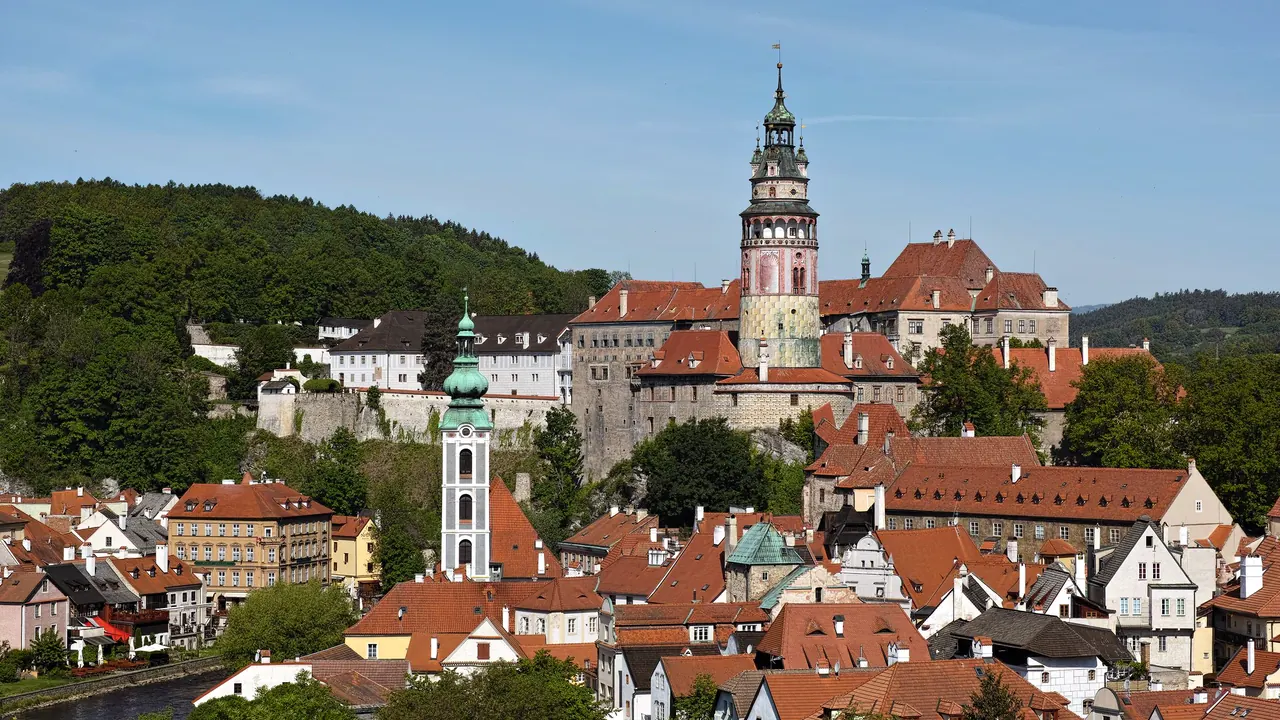
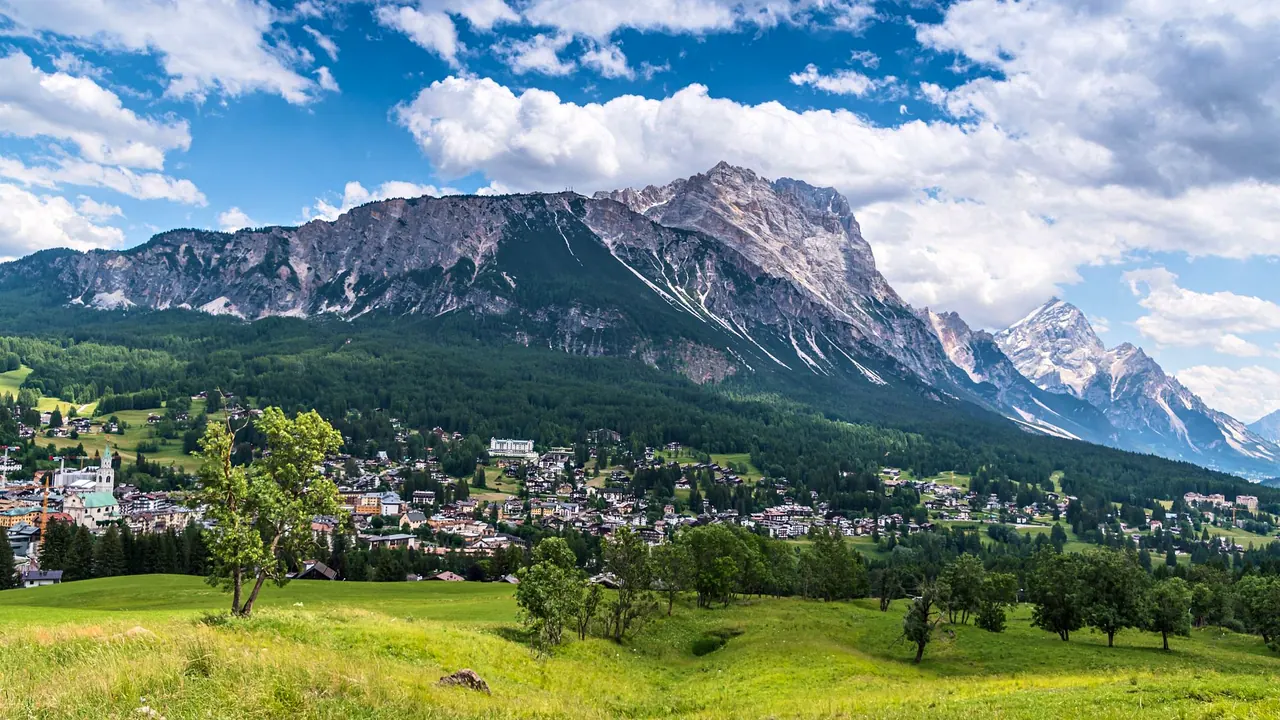
Photos: Cesky Krumlov by Xth-Floor, CC BY-SA 4.0, cropped; Cortina d'Ampezzo by Andreas Neubauer, Pexels License.
Cesky Krumlov or Cortina d'Ampezzo?
Our verdict in twelve categories, each scored against the same fixed benchmark cities, and the climate month by month, so you can choose for your trip.
Choose Cesky Krumlov for
- prices
- culture and sights
- beaches
Cesky Krumlov suits travellers who want a storybook old town, a great castle to explore and the soft green countryside of South Bohemia, all at a moderate cost. It is ideal for a short stay of two or three days, with a raft trip down the Vltava and outings to nearby castles, monasteries and market towns.
Choose Cortina d'Ampezzo for
- nature and the outdoors
- shopping
- food and drink
When the mountains are the whole point of the trip, Cortina d'Ampezzo is the choice. The Dolomites rise straight from the valley, with lifts onto the peaks, a vast linked ski area in winter and hut-to-hut trails and via ferrata in summer. Expect to pay heavily for it, and don't expect much in town beyond good mountain cooking and one polished shopping street.
Scoreboard
Twelve categories on one fixed scale from 0 to 100. The shaded stretch is the gap between the two.
Your match
Pick a travel style or drag the sliders, and both match scores follow your weighting.
Wins on prices and culture and sights with your weighting.
Wins on nature and the outdoors and shopping with your weighting.
What matters to you?
Category by category
What the scores mean for a trip.
Beaches & swimming
Neither town is a swimming destination, but Cesky Krumlov at least has Lipno. This large reservoir half an hour south has grassy and sandy shores and water near 20°C in high summer, while the Vltava in town is for rafting rather than swimming.
Cortina has nothing comparable. Its alpine lakes stay snowmelt-cold all year and the Adriatic is more than two hours away, so a swim usually means the hotel pool.
Food & drink
Cesky Krumlov serves hearty South Bohemian cooking, such as roast pork, duck with dumplings and river trout, in vaulted cellars and on riverside terraces. The locally brewed beer is the best thing on the table. The range is narrow, though, and many menus are written for day-trippers.
Cortina eats noticeably better because it cooks for a wealthy crowd. Ampezzan dishes such as beetroot-filled casunziei have a Venetian accent, and the wine bars pour Veneto and South Tyrolean wines. Lunch on a rifugio terrace among the peaks is often the meal of the trip, though very little of it comes cheap.
Culture & sights
For sights, Cesky Krumlov is in another league. The entire old town is UNESCO-listed, with painted Renaissance and Baroque houses packed into a bend of the Vltava below one of the largest castles in the country. The castle's Baroque theatre still has its original stage machinery. Seeing the town well takes a day or two, ideally early or late, once the tour buses have gone.
Cortina is a resort with a pleasant centre: a basilica, painted Tyrolean-style houses, the 1956 Olympic ice stadium and three small museums, the best of them the Rimoldi collection of modern Italian art. Its most striking heritage is the First World War tunnels and trenches on Lagazuoi and the Cinque Torri, and reaching them takes a day in the mountains.
Nightlife
Neither town is for a night out, and the difference is mainly one of style. In Cesky Krumlov, evenings mean a beer on a riverside terrace or in a cellar bar, some of them popular with backpackers, and there are no clubs at all.
Cortina has a little more going on in the peak winter weeks. Après-ski drinks, the evening passeggiata along the Corso Italia, a few smart bars and a club or two draw a glamorous Italian crowd. In summer it is quiet by late evening too.
Nature & outdoors
Cesky Krumlov's outdoors is soft and green. You can spend a day canoeing or rafting down the Vltava's wooded meanders, walk and cycle in the Bohemian Forest half an hour away, or look towards the Alps from Klet on a clear day.
Cortina sits in one of the world's great mountain landscapes, with the Dolomites ringing the valley and lifts climbing straight onto the peaks. Winter brings the Dolomiti Superski area and the Sella Ronda, while summer brings the Alta Via 1, via ferrata, climbing and paragliding, and the Tre Cime di Lavaredo are under an hour away. For anyone who wants real mountains, there is no contest.
Day trips
Cesky Krumlov has the better range of excursions. České Budějovice, with its huge arcaded square and the Budvar brewery, is half an hour away. Hluboká castle, the UNESCO-listed village of Holašovice, the monastery at Zlatá Koruna and the spa town of Třeboň are all close, and Linz is across the Austrian border.
From Cortina, most outings lead further into the mountains. San Candido, Dobbiaco and Brunico in South Tyrol are pleasant, and Bolzano with its Iceman is about two hours away. Venice makes a long day at around two and a half hours each way.
Good for families
Cesky Krumlov charms children with the bears in the castle moat, a tower to climb and a gentle family raft trip. The steep cobbled lanes are hard going with a pushchair, though, and the interior tours suit adults better.
Cortina works a little better for active families. It has ski schools for all ages, beginner slopes at Socrepes, public skating at the Olympic stadium and easy summer walks to huts and lakes. Rainy days are harder, because nothing is built for children beyond the outdoors, and costs climb quickly.
Getting around
Both centres are small enough to cross on foot, but Cesky Krumlov is easier to reach and to leave. Its bus and railway stations are within walking distance, with regional links to České Budějovice. Inside town the cobbles and the climb to the castle take some effort, and the countryside still calls for a car.
Cortina has had no railway since 1964, so arriving means a coach from Venice or a long drive. Ski buses and lifts work well in winter. In summer, buses to the passes and the Tre Cime run a limited service, and the roads get crowded in August.
Shopping & style
Cesky Krumlov's lanes sell souvenirs: Bohemian glass, garnet jewellery, marionettes and the green moldavite stone. There are a few ceramics workshops, and little beyond that.
Cortina has more for anyone looking to buy something serious. The pedestrian Corso Italia is lined with luxury fashion, jewellers and upmarket mountain wear, and the Cooperativa di Cortina, founded in 1893, sells everything from local food to outdoor gear. It is still only one short street.
Affordability
Cesky Krumlov is good value, with guesthouses in old houses and Czech meals and beer at moderate prices. Only castle-view rooms and restaurants on the main lanes charge extra for their position.
Cortina is one of the most expensive places to stay in Italy. It charges luxury-resort rates in the winter peak and in August, and lift passes and equipment hire come on top. Rifugio meals and early summer or late September ease the bill, but many budget travellers stay in cheaper valleys nearby and drive in.
Live music & performing arts
Neither town has much of a season, but Cesky Krumlov's summer is the more memorable. Plays and opera are staged in the castle garden's open-air theatre, whose revolving auditorium turns between scenes, and an international music festival brings classical concerts into the castle and its churches.
Cortina's offer is thinner. There are summer chamber and classical concerts in churches and halls, sometimes out in the mountains, a programme of talks and the odd concert over Christmas and New Year.
Wellness & relaxation
Cesky Krumlov offers calm more than treatments. There are only a few hotel wellness rooms and beer baths, but the old town grows still once the day visitors leave. For a proper spa, Třeboň's peat baths are within reach for a day.
Cortina is the better place to unwind in comfort. Many of its hotels have Alpine-style spas with saunas, hay baths and indoor pools, and an afternoon on a hut terrace in June or September is restful in itself. In the peak weeks, traffic and crowds take much of that calm away.
When should you go?
Pick your month. The climate figures are measured averages, not a forecast.
Cesky Krumlov in July
Cortina d'Ampezzo in July
Daytime high, °C
Rainfall in the month, mm
Where the figures come from
Cesky Krumlov's temperatures are measured 50 km from the centre, at Grainet-Rehberg.
Cesky Krumlov has no rain gauge within 25 km of the centre, so its rainfall comes from a gridded climate dataset read at the city rather than from a gauge further away.
Temperature and rainfall are climate normals, averaged over the years shown. Cesky Krumlov: 1991-2020 normals, Grainet-Rehberg (50.3 km from centre). Cortina d'Ampezzo: 1991-2020 normals, Dobbiaco (22.5 km from centre).
Both towns have a short warm season and cold winters, with daytime highs at or just above freezing in December and January. Cesky Krumlov is at its best from May to September. It peaks around 23°C in July and August, has the most sunshine then and is warm enough for a swim at Lipno, but summer is also its wettest stretch, with July the rainiest month. Late spring and early autumn are pleasant for walking the lanes and floating down the river. From November to February the town is cold and grey.
Cortina follows a similar curve, a degree or so cooler, with highs near 22°C in midsummer. Its rain falls even more heavily in summer, about 130mm in July, while winter is notably dry, with around 23mm in January, which suits the ski season. For hiking, June brings mild weather to the valley before the July peak, though showers are already frequent. September is cooler and noticeably drier than high summer, which makes it the steadier month for long days on the trails.
Which traveller are you?
On a culture and arts trip, Cesky Krumlov is the clear pick. The whole UNESCO-listed old town, the castle with its rare Baroque theatre and the Schiele art centre fill two full days. Cortina offers a church, three small museums and wartime trenches high in the mountains.
For an outdoors trip, Cortina wins easily. Lifts climb from town onto Dolomite peaks, the Tre Cime are under an hour away, and the choice runs from Dolomiti Superski runs to via ferrata and the Alta Via 1. Cesky Krumlov's canoeing and forest walks are far gentler.
On a trip on a tight budget, Cesky Krumlov makes your money go much further, with guesthouses in old houses, moderately priced Czech meals and local beer. Cortina is among the most expensive places in Italy, and many budget visitors sleep in cheaper valleys nearby and drive in.
Before you go
| Measure | Cesky Krumlov | Cortina d'Ampezzo |
|---|---|---|
| Official language | Czech | Italian |
| Currency | Czech Koruna (CZK) | Euro (EUR) |
| Sockets | CE230 V, 50 Hz | CFL230 V, 50 Hz |
| Driving side | Right | Right |
| Time zone | UTC+1, UTC+2 in summer | UTC+1, UTC+2 in summer |
| Emergency number | 112 | 112 |
| Elevation | 492 m | 1,224 m |
| Main airport | Václav Havel Airport Prague (PRG)143 km from centre178 non-stop destinations | Venice Marco Polo Airport (VCE)116 km from centre103 non-stop destinations |
| Public holidays this year | 13 days | 13 days |
By the numbers
| Measure | Cesky Krumlov | Cortina d'Ampezzo |
|---|---|---|
| City population | 12,797 | 5,546 |
| People per km² | 576 | 22 |
| Museums within 10 km | 4 | 3 |
| UNESCO World Heritage sites within 50 km | 2 | 1 |
Where else could you go?
Every comparison below shares a destination with this one, so you can follow Cesky Krumlov or Cortina d'Ampezzo somewhere new.
- Innsbruckvs Cortina d'Ampezzo
- Venicevs Cortina d'Ampezzo
- Praguevs Cesky Krumlov
- Salzburgvs Cesky Krumlov
- Hallstattvs Cesky Krumlov
- Veronavs Cortina d'Ampezzo