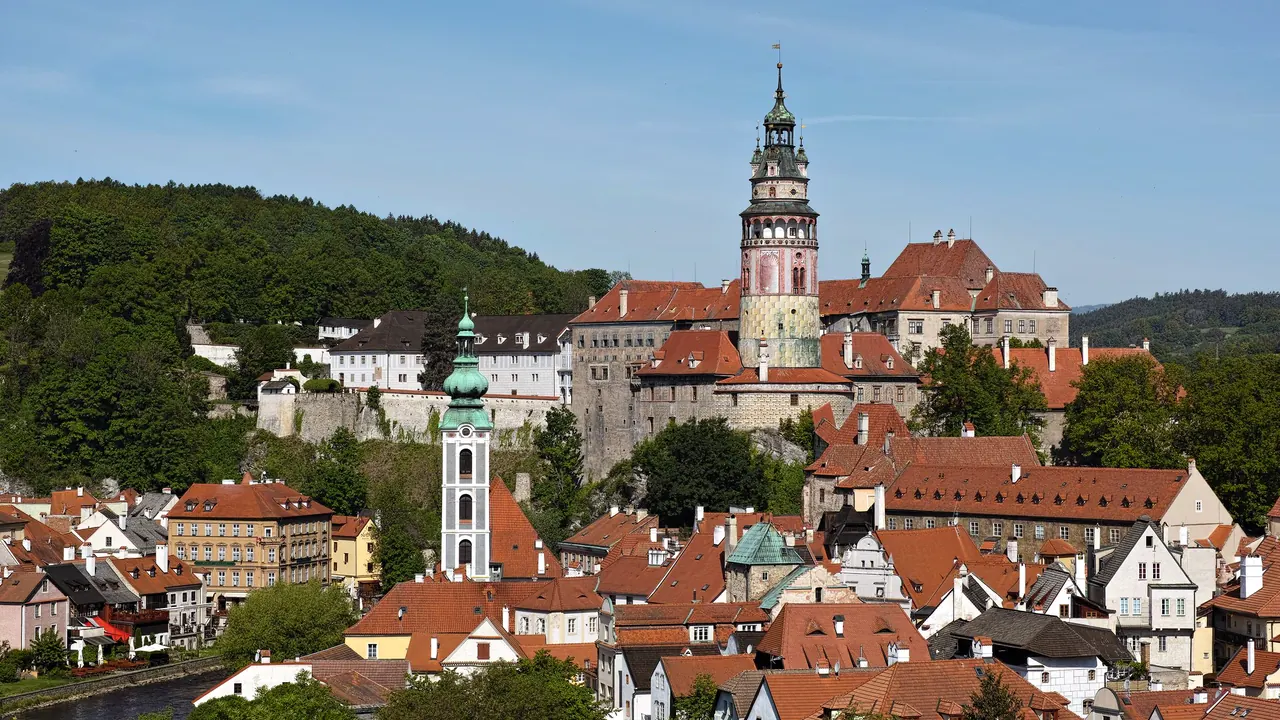
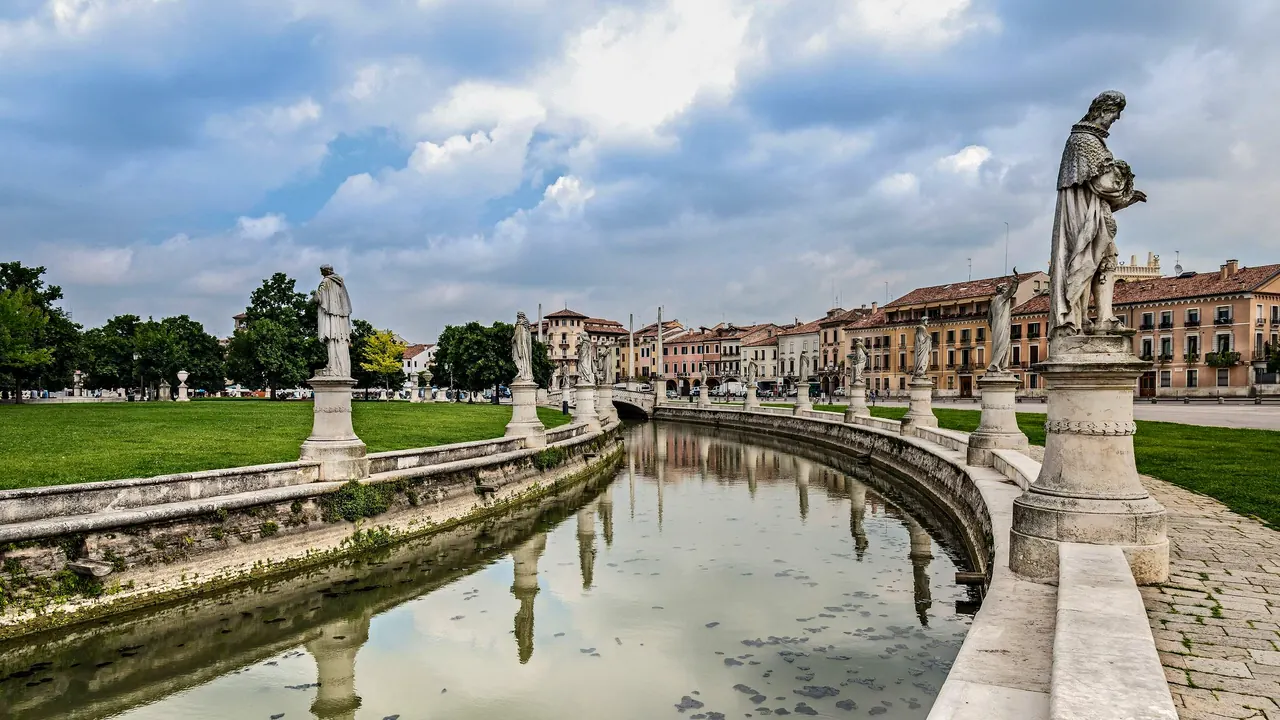
Photos: Cesky Krumlov by Xth-Floor, CC BY-SA 4.0, cropped; Padua by Didier Descouens, CC BY-SA 4.0, cropped.
Cesky Krumlov or Padua?
Our verdict in twelve categories, each scored against the same fixed benchmark cities, and the climate month by month, so you can choose for your trip.
Choose Cesky Krumlov for
- nature and the outdoors
- prices
Cesky Krumlov suits a short, slow trip built around one perfect small town: a castle above a river bend, a day in a canoe on the Vltava, walks in the Bohemian Forest and quiet evenings with a local beer. It is the greener of the two and a little easier on the budget. After dark there is little to do, though, and you will want a car to see the region.
Choose Padua for
- wellness
- day trips
- food and drink
Padua gives more to fill each day. It has Giotto's frescoes, markets and an evening spritz in the arcaded squares, and trains to Venice, Vicenza and Verona whenever the city itself runs out. Add the thermal pools of Abano a short ride away and it works for a longer stay in a way a single castle town cannot.
Scoreboard
Twelve categories on one fixed scale from 0 to 100. The shaded stretch is the gap between the two.
Your match
Pick a travel style or drag the sliders, and both match scores follow your weighting.
Wins on nature and the outdoors and prices with your weighting.
Wins on wellness and day trips with your weighting.
What matters to you?
Category by category
What the scores mean for a trip.
Beaches & swimming
Neither city is a place to come for swimming. In Cesky Krumlov the only option is the Lipno reservoir, about half an hour's drive away, which has grassy and sandy shores and lake water that stays fairly cool even in July and August. The Vltava in town is for rafts, not swimming.
Padua has the edge because it has a real sea within about an hour. The Adriatic at Sottomarina or on the Venice Lido is shallow, calm and warmer than the lake, so it is easy with small children, even if the beaches are flat rows of umbrellas rather than anything to look at.
Food & drink
Cesky Krumlov serves hearty South Bohemian food in vaulted cellars and on river terraces: roast pork or duck with dumplings, svíčková, trout and game. The town's own beer is the best part of it, but the range is narrow and many menus are written with day visitors in mind.
Padua is clearly the better place to eat. Its kitchens follow Venetian home cooking, from bigoli with duck sauce to baccalà and spring risotto. The morning markets in Piazza delle Erbe and Piazza della Frutta, along with the delicatessens beneath the Palazzo della Ragione, give each day a rhythm of buying, tasting and an early-evening spritz with Euganean wine close at hand.
Culture & sights
In Cesky Krumlov the sight is the town itself. The UNESCO-listed townscape has painted Renaissance houses, a huge castle with a three-tiered Cloak Bridge and a rare Baroque theatre with its stage machinery intact, and you can take it all in within a day or two.
Padua goes deeper. Giotto's Scrovegni Chapel is a landmark of European painting, and it sits within a wider group of fourteenth-century fresco cycles. The city also has Donatello's work at the Basilica of Saint Anthony, the oldest permanent anatomical theatre in the world at Palazzo Bo and a sixteenth-century botanical garden, so its sights are about great art and learning rather than a picture-book setting.
Nightlife
Cesky Krumlov goes to bed early. Apart from a few cellar pubs and summer evenings on the riverside terraces, there is no real night out, and the lanes are empty early outside the peak months.
Padua is much livelier after dark, though it is sociable rather than wild. The aperitivo fills Piazza delle Erbe and Piazza dei Signori from early evening, and students keep the wine bars of the old ghetto and the streets around the Bo busy during term. Clubs are few, and the city goes quiet in the university breaks.
Nature & outdoors
Cesky Krumlov has the outdoors on its doorstep. A day floating down the wooded meanders of the Vltava starts in town, and the Bohemian Forest national park, with its bogs, ridges and long walking and cycling routes, is half an hour away. Klet hill adds views towards the Alps, and in winter there is cross-country skiing.
Padua sits on a flat plain, so getting outdoors takes a short journey. The Euganean Hills, about 15km away, are good for vineyard walks and road cycling, and the Brenta towpaths make easy, level rides. Real mountain walking means driving about an hour and a half to the pre-Alps.
Day trips
Cesky Krumlov has a pleasant regional circuit: the arcaded square and Budvar brewery in České Budějovice, the white castle at Hluboká, the Baroque farmhouses of Holašovice and the fish ponds around Třeboň. Most of these are far easier by car, and Prague is too far for a comfortable day.
Padua is one of the best bases in northern Italy. Venice is under half an hour away by train, so you can sleep somewhere calmer and still spend several days there. Vicenza, Verona, Bologna and Ferrara are all an easy rail trip, and the Brenta villas, the walled towns below the Euganean Hills and the Prosecco country fill any spare days.
Good for families
The two are about equal for families, but for different reasons. Cesky Krumlov has the more magical setting for children: bears in the castle moat, a tower to climb and a gentle raft trip on the river, plus Lipno's treetop walk nearby. The steep cobbles are tiring with a pushchair, though.
Padua is the easier place to get around with small children. It is flat, largely pedestrianised and welcoming in any trattoria, but its sights are mostly frescoes and churches. The fun comes from day trips to Gardaland, Lake Garda or the Adriatic.
Getting around
Cesky Krumlov's centre takes a quarter of an hour to cross on foot, with some climbing up to the castle. Leaving town is the hard part: buses and trains to the forest and the smaller castles are thin, so most visitors hire a car or join a tour.
Padua is easier on both counts. Its flat, arcaded centre puts the main sights within a 20-minute walk, and a tram and buses cover the rest. Above all, the station has fast trains in every direction, so you can explore the whole region without driving.
Shopping & style
Cesky Krumlov sells souvenirs and little else: Bohemian glass, garnet jewellery, marionettes and the green moldavite stone found in the region, plus a few workshops selling ceramics and prints.
Padua has more ordinary shopping to offer. Italian fashion and shoe shops line the arcades between the station and the squares, and there are university bookshops and independent boutiques. The best things to take home are cheese and Euganean wine from the markets, and once a month there is a large Sunday antiques market on Prato della Valle.
Affordability
Cesky Krumlov is the cheaper of the two. Family guesthouses, local beer and Czech meals keep daily costs moderate, although rooms with castle views and the separately priced castle tours add up. Staying just outside the centre or coming outside summer helps most.
Padua is moderate for a northern Italian city and good value as a base compared with sleeping in Venice. Market food and a standing spritz cost little, and you can walk everywhere. Expect normal museum fees and dearer rooms during trade fairs and graduation season.
Live music & performing arts
Cesky Krumlov has a summer stage and little else. On warm evenings the open-air theatre in the castle garden, whose auditorium turns between scenes, puts on plays and opera, and an international festival brings classical concerts to the castle and its churches. Most visitors only see the Baroque castle theatre on a tour, and from autumn to spring there is very little to attend.
Padua comes out ahead because it has something on in every season. Teatro Verdi, a nineteenth-century horseshoe theatre, stages plays and some opera, and the city's chamber orchestra plays in the frescoed Sala dei Giganti and in the Basilica of Saint Anthony. If you want grand opera, the Fenice in Venice and Verona's summer Arena are both an easy train ride away.
Wellness & relaxation
Cesky Krumlov's restfulness comes from its quiet. Evenings by the river after the day visitors leave are very still, but treatments go no further than a few hotel wellness rooms and beer baths. For a real spa you would need to travel to Třeboň's peat baths for the day.
Padua has one of Europe's largest thermal districts about 12km away. At Abano and Montegrotto, hot mineral water fills indoor and outdoor pools, and the local mud has been used for treatments since Roman times. You can easily add a soak to a day of sightseeing.
When should you go?
Pick your month. The climate figures are measured averages, not a forecast.
Cesky Krumlov in July
Padua in July
Daytime high, °C
Rainfall in the month, mm
Where the figures come from
Cesky Krumlov's temperatures are measured 50 km from the centre, at Grainet-Rehberg.
Cesky Krumlov has no rain gauge within 25 km of the centre, so its rainfall comes from a gridded climate dataset read at the city rather than from a gauge further away.
Padua's temperatures are measured 35 km from the centre, at Treviso / Istrana.
Padua has no rain gauge within 25 km of the centre, so its rainfall comes from a gridded climate dataset read at the city rather than from a gauge further away.
Padua's sunshine is measured 36 km from the centre, at Treviso / S. Angelo.
Temperature and rainfall are climate normals, averaged over the years shown. Cesky Krumlov: 1991-2020 normals, Grainet-Rehberg (50.3 km from centre). Padua: 1991-2020 normals, Treviso / Istrana (35.4 km from centre).
Cesky Krumlov is a summer town. Days only turn properly mild in May and peak at about 23°C in July and August, which is also the wettest stretch, with July the rainiest month at 111mm. From November to February days stay close to freezing and are short on sunshine, so the river, the forest and the lake belong to late spring through early autumn.
Padua is warmer all year round, and its best months for walking the streets are April, May, September and October. July and August reach 31°C on a humid plain, which makes long sightseeing days hard work, but they are also the sunniest months and the time the Adriatic warms to about 25°C for a day at the coast. Rain is heaviest in autumn, peaking in November, and winters are cool rather than cold.
Which traveller are you?
For an outdoors trip, Cesky Krumlov is the better choice. You can push off by canoe on the Vltava from town, and the spruce woods and quiet cycling routes of the Bohemian Forest begin half an hour away. Padua's hills and mountains each need an outing first.
On a food and nightlife trip, Padua wins easily. The Piazza delle Erbe market in the morning, Venetian cooking at lunch and a spritz with students in the squares at dusk beat a cellar dinner and a quiet riverside beer.
On a relaxing and wellness trip, choose Padua. The thermal pools and mud treatments of Abano and Montegrotto are a short ride away. Cesky Krumlov is very still once the tour buses leave, but it has little beyond a few hotel wellness rooms.
Before you go
| Measure | Cesky Krumlov | Padua |
|---|---|---|
| Official language | Czech | Italian |
| Currency | Czech Koruna (CZK) | Euro (EUR) |
| Sockets | CE230 V, 50 Hz | CFL230 V, 50 Hz |
| Driving side | Right | Right |
| Time zone | UTC+1, UTC+2 in summer | UTC+1, UTC+2 in summer |
| Emergency number | 112 | 112 |
| Elevation | 492 m | 12 m |
| Main airport | Václav Havel Airport Prague (PRG)143 km from centre178 non-stop destinations | Venice Marco Polo Airport (VCE)39 km from centre103 non-stop destinations |
| Public holidays this year | 13 days | 13 days |
By the numbers
| Measure | Cesky Krumlov | Padua |
|---|---|---|
| City population | 12,797 | 206,496 |
| People per km² | 576 | 2,220 |
| Museums within 10 km | 4 | 29 |
| UNESCO World Heritage sites within 50 km | 2 | 5 |
| Swim season, months above 21 °C | - | 4 months |
Where else could you go?
Every comparison below shares a destination with this one, so you can follow Cesky Krumlov or Padua somewhere new.
- Venicevs Padua
- Veronavs Padua
- Bolognavs Padua
- Cortina d'Ampezzovs Padua
- Piranvs Padua
- Praguevs Cesky Krumlov