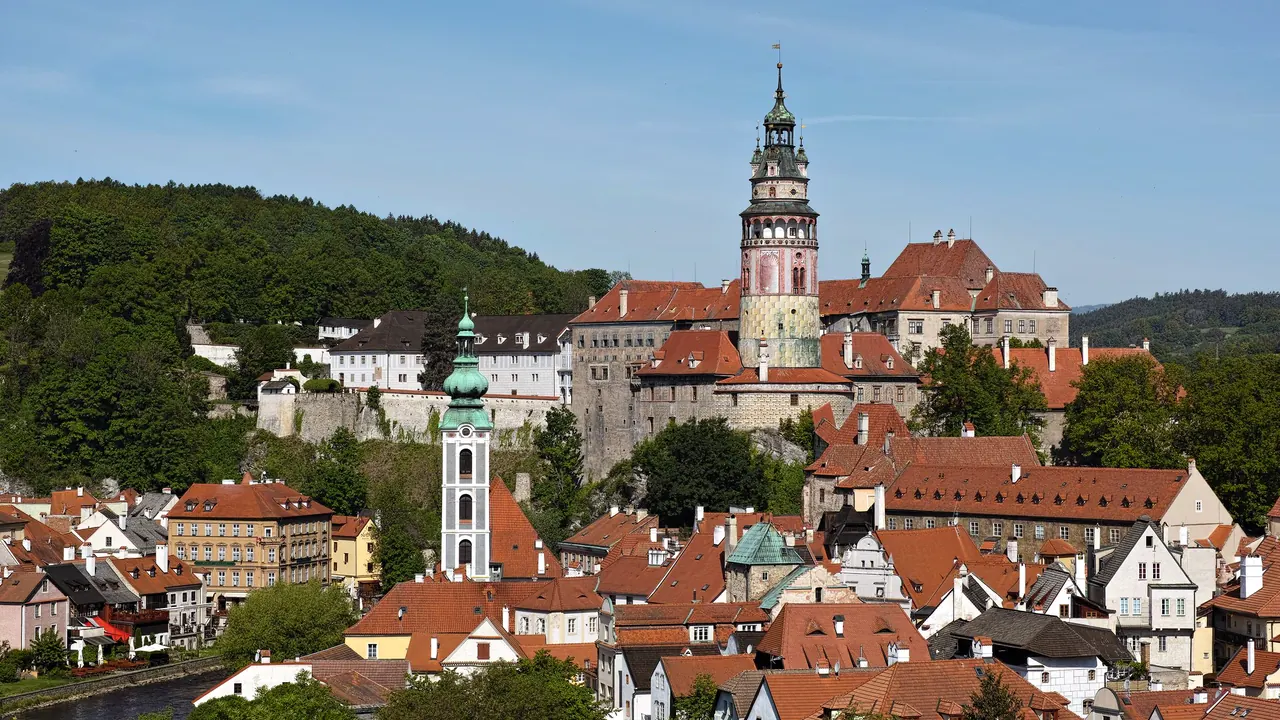
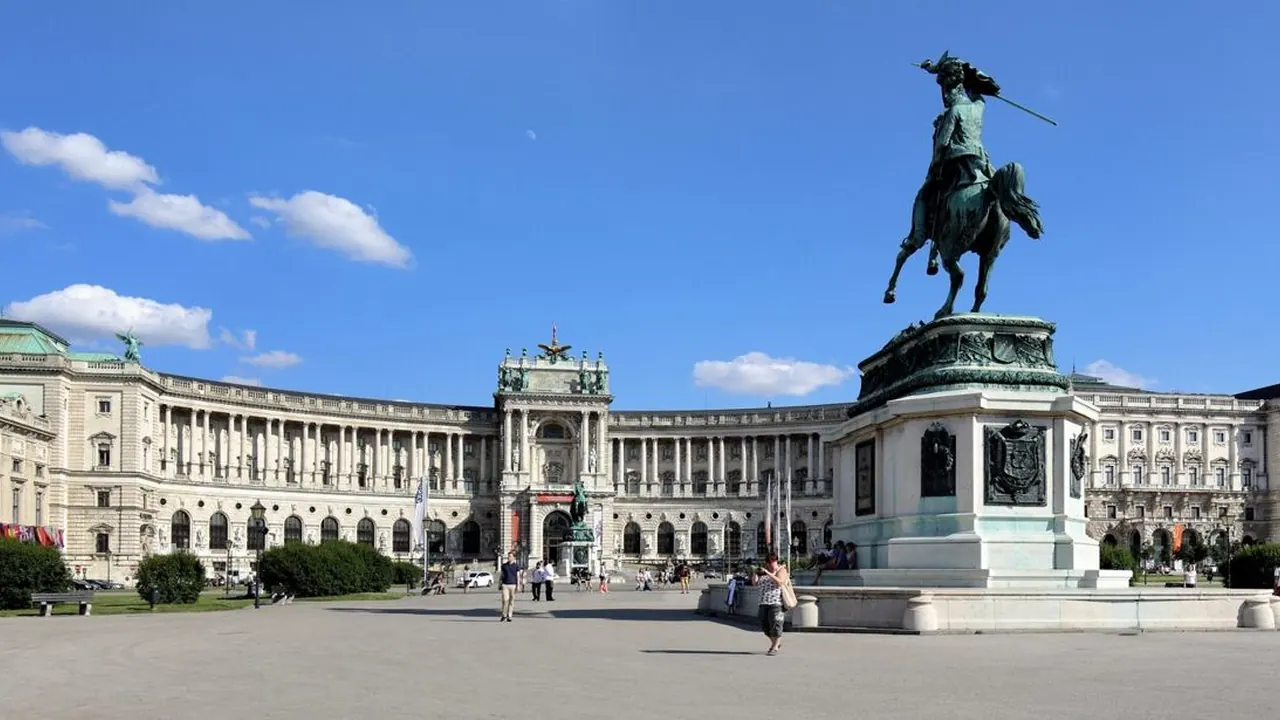
Photos: Cesky Krumlov by Xth-Floor, CC BY-SA 4.0, cropped; Vienna by C.Stadler/Bwag, CC BY-SA 3.0 AT, cropped.
Cesky Krumlov or Vienna?
Our verdict in twelve categories, each scored against the same fixed benchmark cities, and the climate month by month, so you can choose for your trip.
Choose Cesky Krumlov for
- prices
- nature and the outdoors
Cesky Krumlov suits a slower, smaller trip: a couple of days in one of Europe's most intact Renaissance townscapes, a canoe down the Vltava, walks in the Bohemian Forest and quiet evenings over the local beer. It costs less than the capital and needs little planning. It is seen quickly and goes quiet after dark, though, so it works best as a short stop or as a base for touring South Bohemia by car.
Choose Vienna for
- live music and the arts
- shopping
- food and drink
Travellers who want a full week of things to do will be happier in Vienna. Opera and concerts every night, imperial palaces with first-rank art collections, a cuisine of its own and a transport network that reaches everything make it the stronger choice for families, music lovers and anyone without a car. It costs more, but it gives far more back.
Scoreboard
Twelve categories on one fixed scale from 0 to 100. The shaded stretch is the gap between the two.
Your match
Pick a travel style or drag the sliders, and both match scores follow your weighting.
Wins on prices and nature and the outdoors with your weighting.
Wins on live music and the arts and shopping with your weighting.
What matters to you?
Category by category
What the scores mean for a trip.
Beaches & swimming
Neither is a beach destination, and summer swimming in both means fresh water rather than sea. The real difference is distance. From Cesky Krumlov you drive about half an hour to the grassy and sandy shores of the Lipno reservoir, because the Vltava in town is for rafting, not swimming.
In Vienna you can swim without leaving the city, on the long gravel banks of the Danube Island or at the old lidos along the calmer Alte Donau, both reached by U-Bahn.
Food & drink
Cesky Krumlov serves filling South Bohemian cooking, such as roast duck, svíčková, river trout and game, in vaulted cellars and on riverside terraces, and its beer is excellent. The choice is narrow, though, and many menus are written for day-trippers.
Vienna has a cuisine of its own and the institutions that go with it. You get schnitzel and Tafelspitz in wood-panelled Beisl, strudel and Sachertorte in the grand coffee houses, and Heuriger taverns pouring wine grown on the city's own slopes. Its weak point is international range, not depth.
Culture & sights
Cesky Krumlov is a single, near-perfect set piece. The painted castle tower, the Cloak Bridge and a Baroque castle theatre with its original machinery stand above a bend of the Vltava. The pleasure is the townscape itself, and a day or two covers it.
Vienna works on another scale. It has two imperial palaces, St Stephen's, the Ringstrasse and a whole Jugendstil layer of architecture, alongside museums of world rank, from the Bruegels in the Kunsthistorisches Museum to Klimt at the Belvedere. Even for Schiele, who lived for a time in Krumlov, the Leopold's collection goes much further than the small town's art centre.
Nightlife
In Cesky Krumlov an evening ends with a beer on a riverside terrace or in a cellar bar. There are no clubs, and outside summer the lanes empty early.
Vienna gives you a proper night out when you want one. There are late bars under the Gürtel arches, the Bermuda Triangle drinking quarter in the old town and deckchair bars on the Danube Canal in summer. Its winter ball season, with formal balls in palaces that visitors can buy tickets for, has no counterpart in the small town.
Nature & outdoors
The two are close here, but the outdoors works differently in each. Cesky Krumlov is at its best on the water, floating down the Vltava's wooded meanders by canoe or raft. The spruce woods and peat bogs of the Bohemian Forest are half an hour away for long walks, cycling and cross-country skiing in winter.
In Vienna the green land is reached by public transport. Hiking trails climb through vineyards to the Kahlenberg, the beech hills of the Vienna Woods roll west, and the Donau-Auen protects wild floodplain forest. Flat Danube cycle routes and the limestone plateaus of the Rax add more for those willing to travel further.
Day trips
Cesky Krumlov has a good handful of outings. You can see the arcaded square of České Budějovice, the white castle at Hluboká, the Baroque farmhouses of Holašovice and the spa town of Třeboň among its fish ponds. Most are much easier by car, and Prague is too far for a comfortable day.
Vienna's central position gives it more, and by train or boat. Bratislava is about an hour away, the Wachau valley has Melk abbey and Dürnstein among its vineyards, and Brno, Eisenstadt and the Neusiedler See all make easy days out.
Good for families
Cesky Krumlov makes a lovely day for children. There are bears in the castle moat, a tower to climb and a gentle raft trip, plus Lipno's treetop walk nearby. Over several days it runs thin, and the steep cobbles are hard going with a pushchair.
Vienna can keep children busy for a week. Options include Schönbrunn Zoo and its maze, the Prater's Ferris wheel and meadows, sharks at the Haus des Meeres, and dinosaurs at the Natural History Museum. There are playgrounds in every district.
Getting around
In Cesky Krumlov you walk everywhere. The whole old town fits inside one bend of the river, the bus and railway stations are a short stroll away, and the steep cobbled approach to the castle is the only real effort. The limits show as soon as you look beyond the town. Public transport to the forest, the lake and the outlying castles is sparse, so a hire car or an organised tour is the practical way to see the region.
Vienna doesn't have that problem. A single integrated ticket covers the U-Bahn, trams and buses, so Schönbrunn, the bathing spots on the Danube Island and the Heuriger villages are as easy to reach as the Ring itself, and the U-Bahn runs through the night at weekends. A visitor who would need a car in South Bohemia can do without one here, and the flat districts along the Danube Canal suit a bike.
Shopping & style
Cesky Krumlov's lanes sell souvenirs: Bohemian glass, garnet jewellery, marionettes and moldavite, the green stone found in the region, plus a few ceramic workshops. Beyond that there is little.
Vienna can carry a real shopping trip. It runs from the luxury houses on the Kohlmarkt and Graben to everyday fashion on Mariahilfer Strasse and independent designers in Neubau. For gifts there is Augarten porcelain, Loden coats and dirndls, and there are a Saturday flea market and Christmas markets as well.
Affordability
Cesky Krumlov is the cheaper stay. Guesthouses in old houses, Czech meals and local beer are all moderately priced. Rooms with castle views and restaurants on the main lanes charge for the setting, though, and each castle tour has its own ticket.
Vienna costs more for hotels, meals and above all admission to the big palaces and museums. It softens the bill with good-value transport passes, free palace gardens and churches, Heuriger buffets and standing places at the State Opera.
Live music & performing arts
This is where the two are furthest apart. Cesky Krumlov has a short summer season, with plays and opera in the castle garden's revolving open-air theatre and a classical festival in the castle and churches. There is little to attend the rest of the year.
Vienna has music every night of the year, at the State Opera, the Musikverein's Golden Hall with the Vienna Philharmonic, the Konzerthaus and the Volksoper. The Burgtheater and the Vienna Boys' Choir add to that. The city where Mozart, Beethoven, Schubert and the Strauss family worked still builds its programme around them.
Wellness & relaxation
In Cesky Krumlov the rest comes from quiet rather than facilities. Once the day visitors leave, the old town falls still. Spa options are limited to a few hotel wellness rooms and beer baths, and the peat baths at Třeboň need a day out.
Slowness is part of daily life in Vienna, with long coffee-house afternoons and walks through the palace gardens. It also has proper thermal bathing at Therme Wien in Oberlaa, the Art Deco Amalienbad and the sulphur springs of Baden, about half an hour away.
When should you go?
Pick your month. The climate figures are measured averages, not a forecast.
Cesky Krumlov in July
Vienna in July
Daytime high, °C
Rainfall in the month, mm
Where the figures come from
Cesky Krumlov's temperatures are measured 50 km from the centre, at Grainet-Rehberg.
Cesky Krumlov has no rain gauge within 25 km of the centre, so its rainfall comes from a gridded climate dataset read at the city rather than from a gauge further away.
Temperature and rainfall are climate normals, averaged over the years shown. Cesky Krumlov: 1991-2020 normals, Grainet-Rehberg (50.3 km from centre). Vienna: 1991-2020 normals, Wien / Hohe Warte (4.7 km from centre).
Both have a central European climate, but Vienna runs a few degrees warmer all year and gets noticeably more sunshine from spring to late summer. Late May to September is the best time for both. Cesky Krumlov peaks at about 23°C in July and August, which is ideal for river trips and forest walks. Vienna reaches 27°C, warm enough for Danube bathing but sometimes sticky for a long day on the pavements. Summer is also the wettest stretch in both places, and more so in the river valley, where July brings around 111mm against Vienna's drier summer months.
From November to February both are cold, with highs close to freezing and short, grey days. Vienna's indoor life carries those months well. In Cesky Krumlov the quiet season is restful, but the outdoors mostly shuts down apart from cross-country skiing in the forest. April and September are the most comfortable walking months in either city.
Which traveller are you?
For a culture and arts trip, Vienna is the clear pick. It has an opera house playing most nights, great orchestras and concert halls, and imperial palaces backed by world-class art museums. Cesky Krumlov's castle and painted lanes fill a day or two at most.
On a family trip with children, Vienna works far better. It has a zoo, a funfair, an aquarium and hands-on museums for wet days, all easy to reach by public transport. Cesky Krumlov makes a lovely day out, but its steep cobbles and adult-oriented tours limit a longer stay.
On a tight budget, Cesky Krumlov stretches the money further. The small town's guesthouses and Czech cooking cost noticeably less, and the sights don't take long to see. In Vienna, the ticket prices for palaces and museums add up quickly over a longer stay.
Before you go
| Measure | Cesky Krumlov | Vienna |
|---|---|---|
| Official language | Czech | German, Austrian Sign Language |
| Currency | Czech Koruna (CZK) | Euro (EUR) |
| Sockets | CE230 V, 50 Hz | CF230 V, 50 Hz |
| Driving side | Right | Right |
| Time zone | UTC+1, UTC+2 in summer | UTC+1, UTC+2 in summer |
| Emergency number | 112 | 112 |
| Elevation | 492 m | 151 m |
| Main airport | Václav Havel Airport Prague (PRG)143 km from centre178 non-stop destinations | Vienna International Airport (VIE)18 km from centre202 non-stop destinations |
| Public holidays this year | 13 days | 16 days |
By the numbers
| Measure | Cesky Krumlov | Vienna |
|---|---|---|
| City population | 12,797 | 2,028,289 |
| People per km² | 576 | 4,890 |
| Museums within 10 km | 4 | 152 |
| UNESCO World Heritage sites within 50 km | 2 | 4 |
Where else could you go?
Every comparison below shares a destination with this one, so you can follow Cesky Krumlov or Vienna somewhere new.
- Bratislavavs Vienna
- Brnovs Vienna
- Praguevs Cesky Krumlov
- Grazvs Vienna
- Salzburgvs Cesky Krumlov
- Hallstattvs Cesky Krumlov