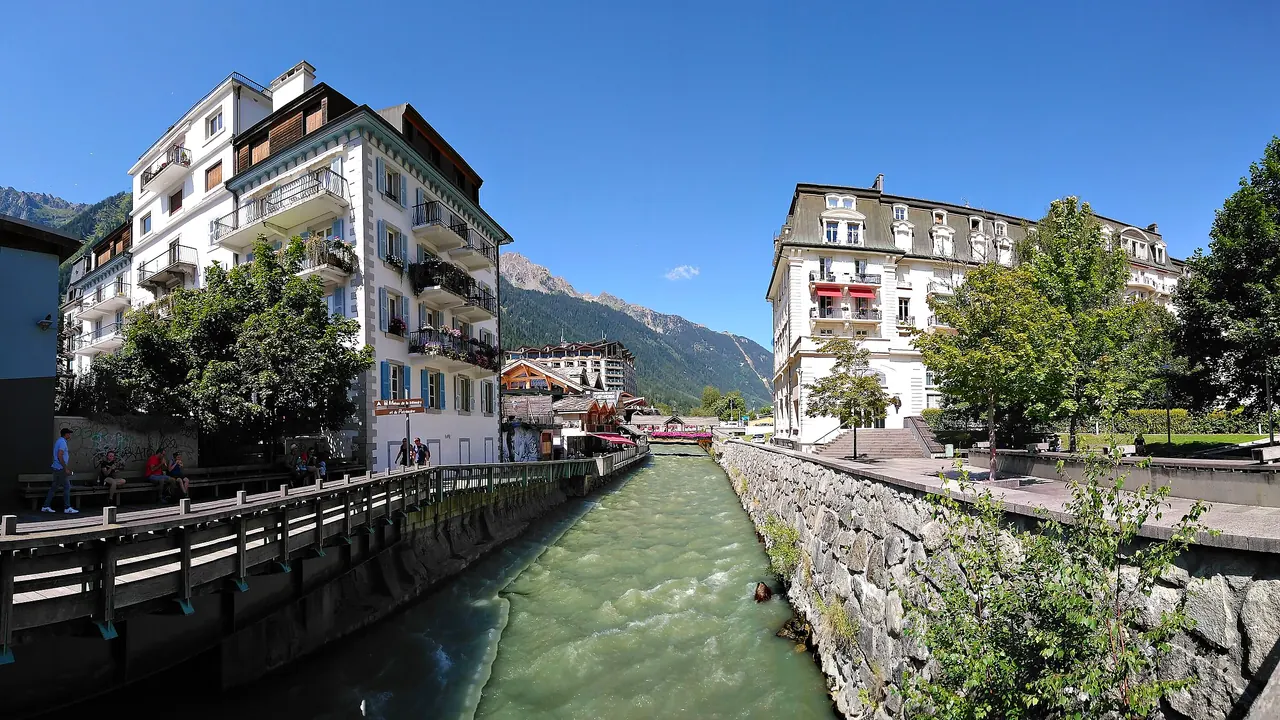
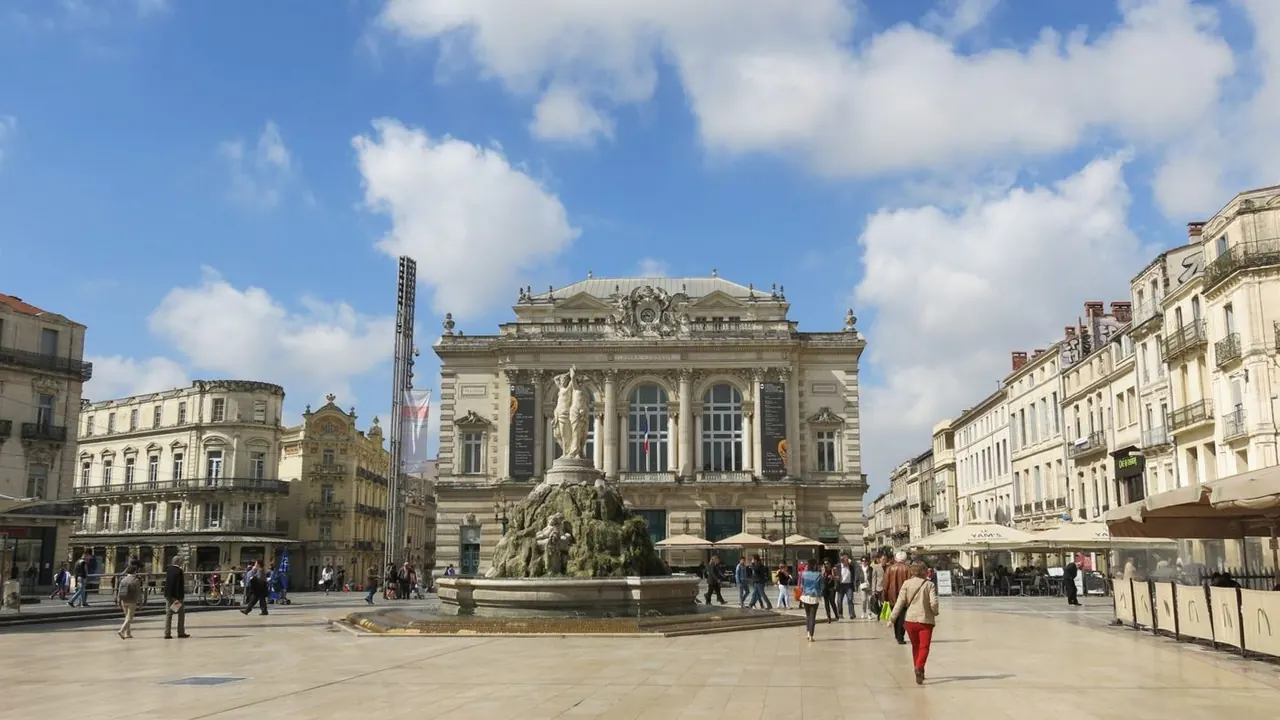
Photos: Chamonix by Tiia Monto, CC BY-SA 3.0, cropped; Montpellier by Peter, CC BY 2.0, cropped.
Chamonix or Montpellier?
Our verdict in twelve categories, each scored against the same fixed benchmark cities, and the climate month by month, so you can choose for your trip.
Choose Chamonix for
- nature and the outdoors
- wellness
Choose Chamonix if the mountains are the whole point. Cable cars lift you from the town centre straight onto glaciers below Mont Blanc, and the valley has skiing, alpinism and long trails in the same few kilometres. The town itself is small, costly and quiet on culture, but after a hard day a hot outdoor pool facing the ice makes a good end to it.
Choose Montpellier for
- live music and the arts
- beaches
- culture and sights
Montpellier suits a traveller who wants a whole region rather than one spectacle. It has a medieval old town, a serious art museum and a proper opera and dance season. Roman Nîmes, Arles and Avignon are an easy train ride away, and sandy beaches are a tram and bus ride off. It is also gentler on the budget, livelier at night and far better for anyone who wants a swim in the sea.
Scoreboard
Twelve categories on one fixed scale from 0 to 100. The shaded stretch is the gap between the two.
Your match
Pick a travel style or drag the sliders, and both match scores follow your weighting.
Wins on nature and the outdoors and wellness with your weighting.
Wins on live music and the arts and beaches with your weighting.
What matters to you?
Category by category
What the scores mean for a trip.
Beaches & swimming
Montpellier is plainly the place for swimming. A tram and bus take you to Palavas and Carnon, and from there long, gently shelving sand runs to the dunes of l'Espiguette. The water is warm in late summer, though the nearer beaches crowd in July and August.
Chamonix has nothing like this. Bathing means Lac de Passy down the valley, Lake Annecy just over an hour away, or the outdoor basin of the town pool, which makes a summer afternoon off rather than a beach day.
Food & drink
Chamonix eats like a ski resort. Fondue, raclette and tartiflette are made with Reblochon and Beaufort, often on a terrace facing a glacier, and the cheese shops are ideal for a picnic. But many menus look alike, and plenty of places close between seasons.
Montpellier has more to explore. Pic Saint-Loup wines, Thau oysters, Sète's tielle and the market halls of Castellane and Laissac give you regional variety, and the student crowd keeps cheap, casual eating easy all year round.
Culture & sights
There is a real gap here. Chamonix's heritage is the story of alpinism: the Musée Alpin, the statues of the first ascent and the climbers' cemetery. It is interesting, but you will see it all in a morning.
Montpellier needs two or three days. You get the car-free lanes and courtyards of the Écusson, the Peyrou terrace with its aqueduct, the oldest botanical garden in France, the Musée Fabre's European painting, and Bofill's neoclassical Antigone.
Nightlife
Montpellier has the more dependable night out. Its large student population fills the bars around Place Jean-Jaurès and the Écusson squares on weeknights too, and the clubs out towards Lattes and the coast take over later. The centre is quieter outside term time.
Chamonix's scene is louder than you would expect but much smaller. Après-ski runs into a single lane of pubs and two or three clubs in winter, with a young, English-speaking crowd. Summer evenings are mostly terrace drinks, and the shoulder seasons are close to dead.
Nature & outdoors
Chamonix is in a different league. The Mont Blanc massif rises almost 4km above the valley floor, and lifts put you among glaciers and granite needles within minutes. Skiing, the Vallée Blanche, climbing, via ferrata and trail running are all on the doorstep.
Montpellier's outdoors are gentler and more varied. Flamingos feed in the coastal lagoons, the Camargue is about an hour away, and you can climb Pic Saint-Loup or canoe the Hérault gorges. Flat cycling paths and kitesurfing on the windy coast round it off, best in spring and autumn.
Day trips
From Montpellier, a whole sequence of famous places is within reach. Nîmes and its arena are half an hour by train, with the Pont du Gard beyond, while Arles, Avignon and Carcassonne are all comfortable days out. Closer in are Sète, Aigues-Mortes and Saint-Guilhem-le-Désert.
Chamonix's advantage is borders. Courmayeur and Roman Aosta lie through the tunnel, Martigny is over the line in Switzerland, and Annecy and Geneva are an hour or so away. After those, most nearby places are other resorts, reached on slow mountain roads.
Good for families
Both work well with children, but they suit different families. Chamonix is for outdoor families: nursery slopes and sledging in winter, the Merlet animal park, the summer luge and the little red train to the Mer de Glace. The highest cable cars are no place for toddlers, though, and rainy days are thin.
Montpellier is a city-and-beach mix. There are calm, shallow seas, the Lunaret zoo and the aquarium and planetarium at Odysseum. Its trouble is heat, as July and August in the stone streets push you towards beach mornings and indoor afternoons.
Getting around
Both centres are compact and easy on foot, so the difference lies in what you need to reach. In Chamonix, free valley buses and the Mont Blanc Express link the hamlets and ski areas, but winter ski buses are packed and evening services thin out.
Montpellier's trams cross the whole city and the main station has fast trains to the Roman towns. The beach bus is slow in summer, and the gorges and Camargue really call for a car.
Shopping & style
Neither is a shopping destination, but Montpellier offers a broader spread: boutiques and bookshops in the Écusson lanes, the Polygone mall beside the Comédie, and wine and olive oil from the markets.
Chamonix's strength is narrow and deep. Its long-established climbing and ski shops are where serious mountaineers buy technical gear, and beyond those there is little more than cheese, génépi and souvenirs.
Affordability
Montpellier is noticeably easier on the wallet. Central hotels are moderately priced most of the year, and the student economy keeps bars and casual food cheap, with costs climbing mainly in summer and at sit-down dinners.
Chamonix is expensive almost by design. Lift passes, the big cable cars, guides and resort restaurants all add up, and peak weeks fill at high prices. Self-catering, picnics, the free guest-card transport and trails that start without a lift soften it, as do the shoulder seasons.
Live music & performing arts
Montpellier has a real stage and Chamonix barely has one. Montpellier's national orchestra, opera and ballet share the Opéra Comédie and the Corum, the city is a European name in contemporary dance, and summer brings free Radio France concerts and outdoor theatre at the Domaine d'O.
In Chamonix, live performance amounts to a summer jazz festival with sets up in the mountains, the odd church concert and mountain film evenings. For opera, you would drive to Geneva.
Wellness & relaxation
Chamonix has the better place to unwind, provided you have earned it. Its large day spa has hot outdoor pools and saunas facing the glaciers, chalets often have their own, and Saint-Gervais has thermal springs in a wooded gorge. The town itself is busy and starts early.
Montpellier relaxes you through its pace rather than its facilities. Think long lunches and shaded squares in the old town. For proper thermal water, you go to Balaruc-les-Bains on the Thau lagoon, half an hour away.
When should you go?
Pick your month. The climate figures are measured averages, not a forecast.
Chamonix in July
Montpellier in July
Daytime high, °C
Rainfall in the month, mm
Where the figures come from
Chamonix's temperatures are measured 35 km from the centre, at Bourg-St-Maurice.
Chamonix has no rain gauge within 25 km of the centre, so its rainfall comes from a gridded climate dataset read at the city rather than from a gauge further away.
Temperature and rainfall are climate normals, averaged over the years shown. Chamonix: 1999-2020 (rainfall 1991-2020) normals, Bourg-St-Maurice (34.9 km from centre). Montpellier: 1991-2020 normals, Montpellier (7.8 km from centre).
Chamonix has two seasons that matter. From June to September the valley is warm, with highs around 25°C to 27°C, which is perfect for hiking and climbing, though rain falls in every month and the high peaks can cloud over quickly. Winter is cold enough for snow on the slopes, with highs near 5°C in January, and late autumn and early winter are the wettest months. Spring and autumn are quiet in-between times.
Montpellier is mild for most of the year and sunny right through spring and summer. July is hot, around 30°C, so walking the stone streets is best done in the morning, while the sea is at its warmest in August at 22°C, which makes June to September the beach months. Rain comes mostly in autumn, peaking in October at about 93mm, so spring is the most comfortable season for sightseeing and walking in the hills.
Which traveller are you?
On an outdoors trip, Chamonix is the obvious choice. The Aiguille du Midi, the Mer de Glace, Lac Blanc and the Tour du Mont Blanc all start from town, with guided mountaineering, paragliding and steep skiing besides. Montpellier's garrigue and gorges are pleasant but not on the same scale.
For a culture and arts trip, Montpellier wins clearly. There is the Musée Fabre, the medieval Écusson and an opera season split between two houses, plus the Montpellier Danse festival and Roman sites a short train ride away. Chamonix's mountaineering museums take half a day.
On a tight budget, Montpellier makes far more sense. Student bars, market halls and lunch menus keep eating cheap, and central hotels are moderately priced. In Chamonix, lift passes, cable cars, guides and resort restaurants add up fast, even with free valley transport.
Before you go
| Measure | Chamonix | Montpellier |
|---|---|---|
| Official language | French | French |
| Currency | Euro (EUR) | Euro (EUR) |
| Sockets | CE230 V, 50 Hz | CE230 V, 50 Hz |
| Driving side | Right | Right |
| Time zone | UTC+1, UTC+2 in summer | UTC+1, UTC+2 in summer |
| Emergency number | 112 | 112 |
| Elevation | 995 m | 7 m |
| Main airport | Geneva International Airport (GVA)68 km from centre150 non-stop destinations | Montpellier-Méditerranée Airport (MPL)8 km from centre41 non-stop destinations |
| Public holidays this year | 11 days | 11 days |
By the numbers
| Measure | Chamonix | Montpellier |
|---|---|---|
| City population | 8,705 | 310,240 |
| People per km² | 75 | 5,452 |
| Museums within 10 km | 3 | 14 |
| UNESCO World Heritage sites within 50 km | 0 | 2 |
| Swim season, months above 21 °C | - | 2 months |
Where else could you go?
Every comparison below shares a destination with this one, so you can follow Chamonix or Montpellier somewhere new.
- Annecyvs Chamonix
- Genevavs Chamonix
- Lausannevs Chamonix
- Avignonvs Montpellier
- Turinvs Chamonix
- Interlakenvs Chamonix