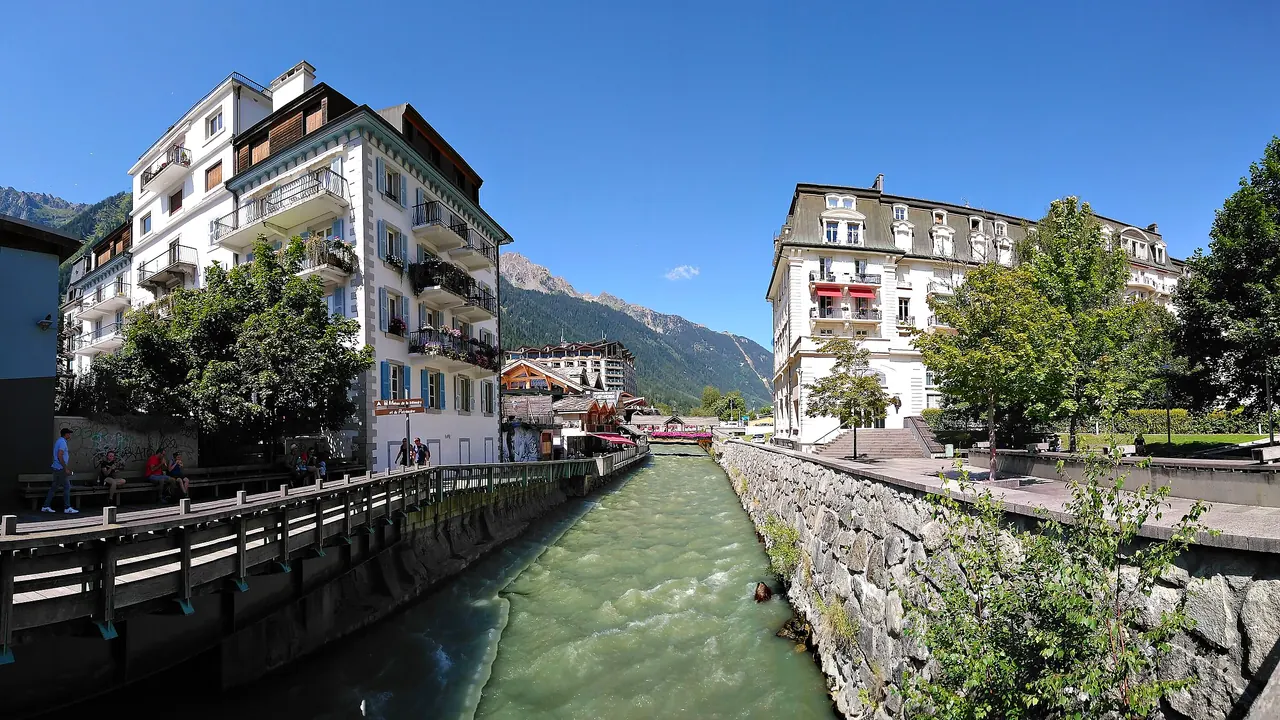
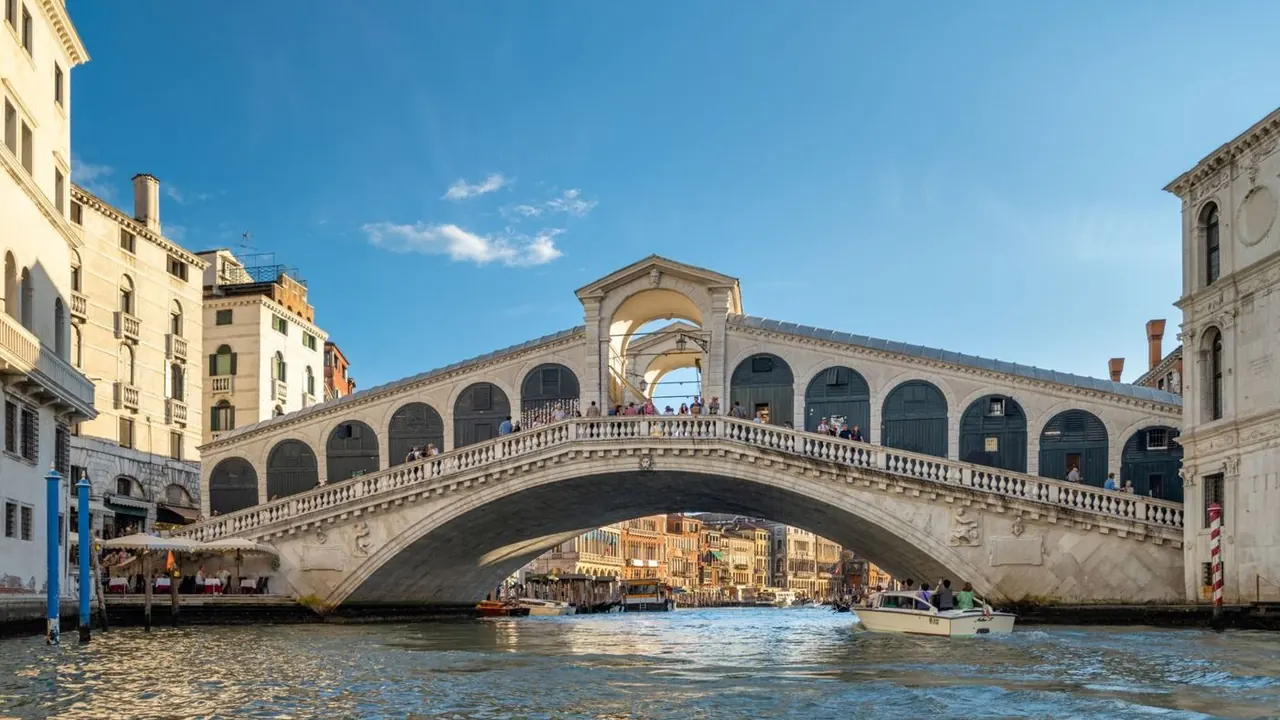
Photos: Chamonix by Tiia Monto, CC BY-SA 3.0, cropped; Venice by David Vives, Pexels License.
Chamonix or Venice?
Our verdict in twelve categories, each scored against the same fixed benchmark cities, and the climate month by month, so you can choose for your trip.
Choose Chamonix for
- nature and the outdoors
- families
- wellness
Chamonix is for travellers who measure a trip in altitude. Cable cars lift you from the town straight into glacier country, the trails and the ski runs start at the edge of town, and the evenings are about hot pools and loud après-ski bars full of guides and seasonal workers. It also suits families who like being outdoors. Pick it if you want to be active every day and don't mind that there is almost nothing to see indoors.
Choose Venice for
- culture and sights
- live music and the arts
- beaches
Venice is the opposite trip. You come to look, listen and eat: Titian and Tintoretto in the churches and scuole, opera at La Fenice, cicchetti at a bacaro counter, and Padua, Verona and the lagoon islands for day trips. The landscape is flat water and marsh rather than mountain, and nights end early. If art, architecture and a city with no cars appeal more than summits, this is the one.
Scoreboard
Twelve categories on one fixed scale from 0 to 100. The shaded stretch is the gap between the two.
Your match
Pick a travel style or drag the sliders, and both match scores follow your weighting.
Wins on nature and the outdoors and families with your weighting.
Wins on culture and sights and live music and the arts with your weighting.
What matters to you?
Category by category
What the scores mean for a trip.
Beaches & swimming
Chamonix has no sea and very little bathing. The town pool is there year-round and adds an outdoor basin in summer. Down the valley, Lac de Passy has a grassy shore and a sandy strip facing Mont Blanc, and it is warm enough to swim only in July and August. Lake Annecy is clearer and warmer, but it is over an hour away by car.
Venice is the better choice for a swim, though nobody would call it a beach destination. The Lido is a short vaporetto ride from San Marco, with kilometres of fine sand and shallow Adriatic water at around 25°C in high summer. The water is greenish but gentle enough for children, and Pellestrina is quieter. In both places a swim is a break from the real reason for the trip: the peaks in one and the paintings and palazzi in the other.
Food & drink
Venice eats better and with more character. You graze on cicchetti in the bacari around the Rialto, and the lagoon cooking includes cuttlefish risotto in its ink and soft-shell crab. The skill is avoiding the picture-menu places around San Marco.
Chamonix's food is heavy and cheese-based: fondue, raclette and tartiflette made with Reblochon and Beaufort, ideally eaten on a refuge terrace facing a glacier. The town's cheese shops and bakeries are best for picnics. Beyond that, resort menus repeat themselves, and many places close between seasons.
Culture & sights
This is where the two differ most. In Venice the whole city is the sight: the Basilica and the Doge's Palace, the palazzi along the Grand Canal, and masterpieces hanging in ordinary parish churches. You could spend a week and still not run out.
Chamonix's heritage is the story of mountaineering, from the first ascent of Mont Blanc to the 1924 Winter Olympics, told in the Musée Alpin and the climbers' cemetery. It is interesting but quickly done. People come here to look at the mountains.
Nightlife
Neither has much of a night scene, but Chamonix stays out later. In winter, après-ski runs into a lane of crowded pubs in the old town, and a couple of small clubs open on busy nights. The crowd is young and mostly English-speaking, and summers are much calmer.
In Venice the evening peaks at aperitivo time, with spritzes along the Fondamenta della Misericordia. After that, a few student bars stay open on Campo Santa Margherita, and by midnight the canals are silent.
Nature & outdoors
Chamonix is one of the great mountain bases in the world. The Mont Blanc massif rises nearly 4km above the valley, the Mer de Glace is a train ride away, and the Tour du Mont Blanc starts from town. Skiing, climbing, trail running and paragliding fill the year.
Venice's outdoors is gentle and flat. You can watch herons and flamingos in the salt marshes near Torcello, row Venetian-style or cycle the Lido. The nearest real hills are an hour away, and the Dolomites are a long day there and back.
Day trips
Venice has the richer surroundings, and fast trains make them easy to reach. Padua's Scrovegni Chapel, Verona's arena and Palladio's Vicenza are each a short ride away, and Murano, Burano and Torcello are just a boat trip across the lagoon.
Chamonix's appeal is three countries close together. You can reach Courmayeur and Roman Aosta through the tunnel, take the train to Martigny in Switzerland, or drive to Annecy and Geneva. After those, mostly other resorts are within reach, and the mountain roads are slow.
Good for families
Chamonix works better with children, as long as they like fresh air. In winter there are ski schools and sledging. In summer there are easy walks to lakes, treetop courses and the marmots and ibex of the Merlet park. The highest cable cars are too much for small children, though, and wet days are hard to fill.
Venice thrills children at first, with boats instead of buses and Murano glass-blowing. Then the stepped bridges, summer crowds and lack of playgrounds start to wear everyone down. It suits a short visit with older children best.
Getting around
Both are easy without a car, but in different ways. Chamonix has a small, flat centre, and free buses and the Mont Blanc Express run the length of the valley with a guest card. In winter, though, the ski buses are packed.
Venice is a city you cross on foot, through twisting alleys and over hundreds of stepped bridges. Vaporetti handle the longer hops to the Lido and the islands, and they are slow and crowded. Wheeled luggage is a real burden here, and much less of one in Chamonix.
Shopping & style
Venice offers more, and much of it is made in the city: Murano glass, Burano lace, papier-mâché masks, marbled paper and furlane slippers, with designer names along the Mercerie. The trick is telling real workshops from the imported copies on the main routes.
Chamonix is for mountain gear. Its long-established climbing and ski shops are worth saving a big purchase for. Apart from that, it is cheese, génépi and souvenirs, and for anything more you need Geneva or Annecy.
Affordability
Both are expensive, so the question is where the money goes. In Chamonix, the lift passes, big cable cars, guides and paragliding add up on top of peak-season chalet prices. Free valley transport, self-catering and trails that start from the valley floor help.
In Venice, the cost is mostly the room, along with water transport and entry fees to sights. Standing at a bacaro counter, staying in Mestre or coming in late autumn keeps it bearable.
Live music & performing arts
Venice wins easily. La Fenice runs a full season of opera, ballet and symphonic concerts, the Biennale stages contemporary theatre and dance, and there are Vivaldi concerts in churches most evenings, some of them very good.
Chamonix has a summer jazz festival with sets high in the mountains, and mountain film nights. For anything more formal, you have to go to Geneva.
Wellness & relaxation
Chamonix is the better place to recover. Its large day spa has hot outdoor pools looking up at the glaciers, many chalets have their own saunas, and Saint-Gervais has thermal springs in a gorge down the valley. The town itself is busy and starts early.
Venice has hotel spas in palazzi and on Giudecca, and its real thermal towns are an hour away near Padua. Its calm comes from silence instead. With no traffic, Castello and Cannaregio are very quiet in the early morning.
When should you go?
Pick your month. The climate figures are measured averages, not a forecast.
Chamonix in July
Venice in July
Daytime high, °C
Rainfall in the month, mm
Where the figures come from
Chamonix's temperatures are measured 35 km from the centre, at Bourg-St-Maurice.
Chamonix has no rain gauge within 25 km of the centre, so its rainfall comes from a gridded climate dataset read at the city rather than from a gauge further away.
Temperature and rainfall are climate normals, averaged over the years shown. Chamonix: 1999-2020 (rainfall 1991-2020) normals, Bourg-St-Maurice (34.9 km from centre). Venice: 1991-2020 (sunshine 1971-2000, rainfall 1981-2010) normals, Venezia / Tessera (6.7 km from centre).
Chamonix has two seasons for two different trips. Winter brings skiing, the Vallée Blanche and evenings in the spa. From June to September the valley is warm enough for hiking, climbing and a swim at Lac de Passy, with highs near 27°C in July. It is wet all year, though, with no truly dry month and the heaviest rain from late autumn into December. Plan for showers and for cloud sitting on the valley floor, whatever the season.
Venice is much drier than Chamonix. Spring and early autumn are the best months for walking the sestieri. July and August reach about 29°C and feel humid, but they are also the sunniest months and the only time the Lido is properly warm for swimming, with the sea at around 25°C. Rain peaks in October and November, and winter is chilly but rarely harsh.
Which traveller are you?
For an outdoors trip, Chamonix is the clear choice. Cable cars go up to the Aiguille du Midi, trails lead to Lac Blanc, and there is skiing, climbing and paragliding. Venice can offer only kayaking on the lagoon and flat cycling along the Lido sea walls.
On a culture and arts trip, Venice is in a different league. It has the Accademia, the Frari, San Rocco, the Biennale and a full season at La Fenice. In Chamonix, the alpinism museum and the guides' quarter take about half a day.
On a family trip with children, Chamonix is easier. There are nursery slopes, a summer luge, the Merlet animal park and the little train to the Mer de Glace, in a small town that is easy to walk. In Venice, stepped bridges, crowds and the lack of parks make every day hard work.
Before you go
| Measure | Chamonix | Venice |
|---|---|---|
| Official language | French | Italian |
| Currency | Euro (EUR) | Euro (EUR) |
| Sockets | CE230 V, 50 Hz | CFL230 V, 50 Hz |
| Driving side | Right | Right |
| Time zone | UTC+1, UTC+2 in summer | UTC+1, UTC+2 in summer |
| Emergency number | 112 | 112 |
| Elevation | 995 m | 2 m |
| Main airport | Geneva International Airport (GVA)68 km from centre150 non-stop destinations | Venice Marco Polo Airport (VCE)7 km from centre103 non-stop destinations |
| Public holidays this year | 11 days | 13 days |
By the numbers
| Measure | Chamonix | Venice |
|---|---|---|
| City population | 8,705 | 250,369 |
| People per km² | 75 | 602 |
| Museums within 10 km | 3 | 52 |
| UNESCO World Heritage sites within 50 km | 0 | 5 |
| Swim season, months above 21 °C | - | 4 months |
Where else could you go?
Every comparison below shares a destination with this one, so you can follow Chamonix or Venice somewhere new.