China
Suzhou
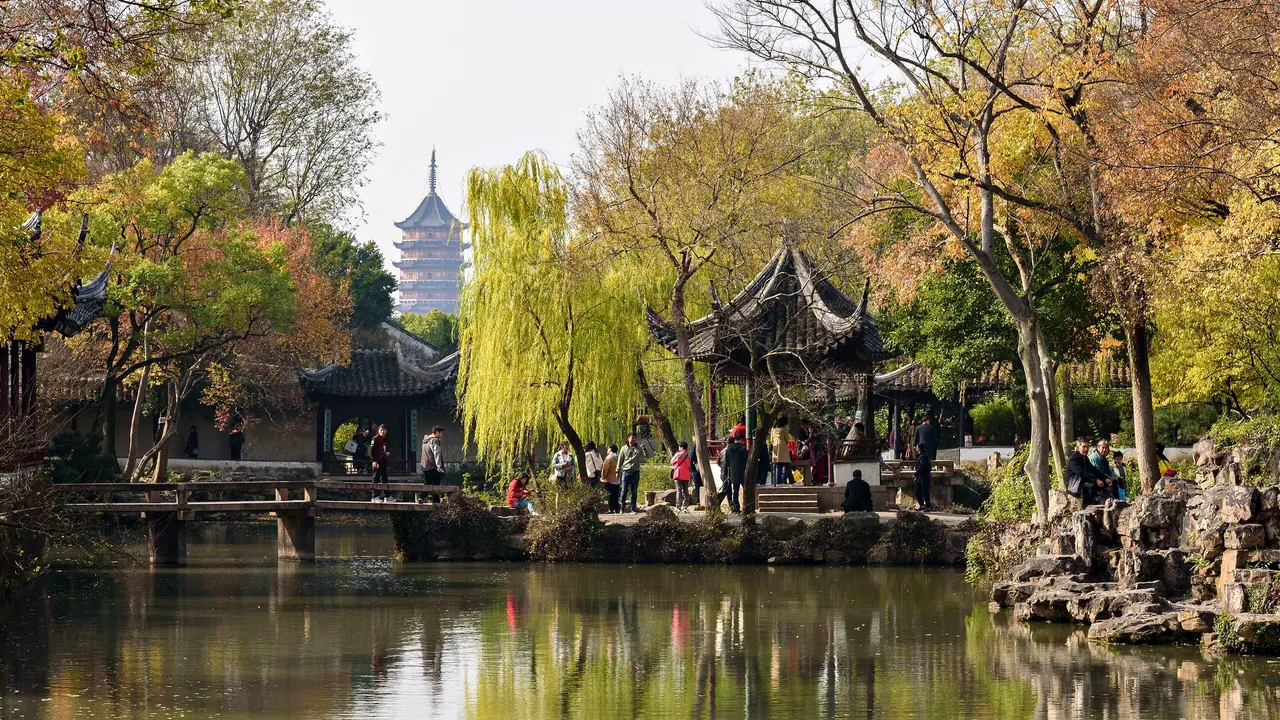
The Beisi Pagoda from the Humble Administrator's Garden
- Day trips90
- Culture & sights80
- Getting around72
Photo: King of Hearts, CC BY-SA 4.0, cropped
Match
57
Every category weighted equally
- Beach & sun52
- Culture & arts65
- Food & nightlife59
- Family trip57
- Outdoors59
- Relax & unwind55
- Shopping & style60
- On a budget59
Suzhou in twelve categories
Our verdict on each, scored 0 to 100 against the same fixed benchmark cities, so a score means the same thing on every page.
Beaches & swimming. Scores 5 out of 100.
Food & drink. Scores 70 out of 100.
Culture & sights. Scores 80 out of 100.
Nightlife. Scores 38 out of 100.
Nature & outdoors. Scores 48 out of 100.
Day trips. Scores 90 out of 100.
Good for families. Scores 52 out of 100.
Getting around. Scores 72 out of 100.
Shopping & style. Scores 55 out of 100.
Affordability. Scores 72 out of 100.
Live music & performing arts. Scores 50 out of 100.
Wellness & relaxation. Scores 55 out of 100.
Suzhou category by category
Beaches & swimming
5Suzhou is not a place for swimming. The city sits on the flat, watery Yangtze delta, but its canals and lakes are for looking at, and Lake Tai is not used for bathing. The nearby coast is the muddy, silty shore of the Yangtze estuary rather than anything resembling a beach. In the hot, humid summer, a hotel pool is the realistic way to get into the water.
Food & drink
70Suzhou cooking is the delicate, slightly sweet branch of Jiangsu cuisine. It is built on freshwater fish, shrimp and the produce of the lakes, and it follows the seasons closely. Squirrel-shaped mandarin fish is the showpiece, deep-fried and glazed in sweet and sour sauce. The everyday ritual is a breakfast bowl of Suzhou noodles in a dark, rich broth, with toppings that change through the year. In autumn the hairy crabs from Yangcheng Lake draw people from across the country.
Teahouses serve Biluochun green tea grown on the hills by Lake Tai. Old-established pastry shops make sweet osmanthus and pine nut cakes. The old-town streets around Pingjiang Road and Shiquan Street have small noodle shops and snack stalls, and more polished restaurants gather around Jinji Lake. International food is limited beyond the business district.
Culture & sights
80Suzhou's classical gardens are the reason the city is famous. Small walled worlds of rockeries, pavilions, ponds and framed views were laid out by scholars and officials over several centuries. The Humble Administrator's Garden, the Lingering Garden, the tiny Master of the Nets Garden and the rock maze of the Lion Grove are all listed by UNESCO, and all sit within or close to the old moat. They are best seen early in the day, before the tour groups fill the narrow paths.
Beyond the gardens are the leaning brick pagoda on Tiger Hill and the Panmen water gate on the city wall. Hanshan Temple is known from a Tang poem, and Pingjiang Road and Shantang Street are canal streets with whitewashed houses and stone bridges. I. M. Pei's Suzhou Museum is a modern landmark in its own right, and the Silk Museum explains the trade that made the city rich. Much of the old town has been rebuilt, but the canal grid still sets its shape.
Nightlife
38Evenings in Suzhou are mostly about a lit-up canal walk along Pingjiang Road or Shantang Street, followed by a drink by the water. Shiquan Street in the old town has a cluster of small bars. The glassy district around Jinji Lake adds rooftop lounges, beer bars and a few clubs aimed at local professionals and expatriate workers. Little runs very late, and the city is calm by international standards. People who want a proper night out take the fast train to Shanghai.
Nature & outdoors
48The landscape around Suzhou is flat delta country of lakes, canals and farmland. Its most attractive corner is Lake Tai, a vast shallow lake to the west. On the Dongshan and Xishan peninsulas, orchards and tea terraces climb low hills, and lakeside roads make good cycling. Closer in, Lingyan Hill and Tianping Hill offer short climbs with temple views and autumn maples, and the path around Jinji Lake suits an evening walk or ride. Spring and autumn are the seasons for being outside. Summers are hot and sticky, and there are no real mountains within easy reach.
Day trips
90Suzhou is one of the best bases in China for day trips, because high-speed rail puts major cities within easy reach. Shanghai is about half an hour away. Nanjing, with its Ming walls and imperial tombs, takes about an hour, and Hangzhou and West Lake are about an hour and a half. Wuxi is close enough for a lakeside afternoon. Yangzhou, with its gardens and canal heritage, is within two hours.
Closer to home is a ring of canal water towns, with arched bridges, merchant houses and boat rides on narrow waterways. Tongli and Luzhi are under an hour away. Zhouzhuang is the most visited, and Wuzhen and Xitang lie a little further south. They are lovely, but similar enough that one or two is plenty. Go on weekdays, as weekends bring heavy crowds.
Good for families
52Suzhou is safe and orderly, and Chinese families travel here in large numbers, so children are welcome everywhere. The main sights are less rewarding for them. The gardens are crowded, narrow and contemplative, and young children tire of them quickly. Boat rides on the canals and the open lakeside parks around Jinji Lake go down better. The amusement and water parks in the new districts west of the old town give a day aimed squarely at children. Summer heat and humidity, heavy crowds during the national festival weeks and long distances between districts make it harder work than its calm reputation suggests.
Getting around
72The old town inside the moat is compact enough to walk or cycle, and its canal-side lanes are the nicest way to move between gardens. A modern metro links the old town with the railway stations, the Jinji Lake district and the outer suburbs. It is clean, cheap and signed in English. Distances beyond the centre are large, though, and sights such as Tiger Hill or the Lake Tai shore are easier by taxi or ride-hailing app. Shared bikes are everywhere. Paying through Chinese mobile apps makes everything simpler, and a little preparation helps visitors who do not speak Chinese.
Shopping & style
55Silk is what visitors come to Suzhou to buy. Suzhou embroidery is one of China's great needle crafts, with double-sided pieces so fine they look painted. Zhenhu, an embroidery village on the western edge of the city, has workshop after workshop where women stitch in front of buyers. Silk scarves, quilts and clothing are sold all over town, from the long-established shops on Guanqian Street to factory outlets.
The old canal streets sell fans, tea, sandalwood and souvenirs. Around Jinji Lake, large modern malls carry international chains. For luxury fashion and designer boutiques, most people wait for Shanghai.
Affordability
72Suzhou is good value by Western standards, though it is a prosperous city and not among China's cheapest. Comfortable hotels cost far less than in Europe, and a bowl of noodles or a teahouse snack costs very little. Metro rides and taxis are inexpensive. The famous gardens charge entry, and seeing several in a day adds up, as do dinners featuring hairy crab or the signature fish dishes in the smarter restaurants. Hotel rates climb sharply during the national festival weeks such as Golden Week, when much of China travels at once.
Live music & performing arts
50Suzhou is the birthplace of Kunqu, the refined and slow-moving opera form that shaped much of Chinese theatre. Performances are staged at the Kunqu Opera Museum, at the city's theatres and, on summer evenings, in garden pavilions where short scenes are sung by lantern light. Pingtan is the local storytelling art, a sung narrative in Suzhou dialect accompanied by pipa and sanxian. It is heard in small teahouses and at its own museum. Western-style concerts, touring shows and the city's orchestra perform in the large arts centre beside Jinji Lake. Much of what is distinctive is in Chinese, so visitors take it in as atmosphere rather than drama.
Wellness & relaxation
55Suzhou has long been associated with gentle, cultivated leisure, and something of that survives. An early morning in a garden before the crowds arrive, or an afternoon in a canal-side teahouse over a pot of local green tea, is restful in a way few Chinese cities manage. Foot massage and traditional Chinese massage parlours are on almost every street and cost little. Lake Tai has quiet resort hotels with spas. There is no real thermal bathing tradition, though, and the gardens themselves can be anything but calm at weekends and during the national festival weeks.
When should you go?
Pick a month to see what it is like. The climate figures are measured averages, not a forecast.
Suzhou in July
Daytime high, °C
Rainfall in the month, mm
The whole year
Shaded against this city’s own year: the deepest cell is its best month for that figure and the palest its weakest.
Where the figures come from
Suzhou's temperatures are measured 79 km from the centre, at Shanghai / Hongqiao.
Suzhou has no rain gauge within 25 km of the centre, so its rainfall comes from a gridded climate dataset read at the city rather than from a gauge further away.
Suzhou's sunshine is measured 81 km from the centre, at Shanghai.
Temperature and rainfall are climate normals, averaged over the years shown. Suzhou: 1991-2020 normals, Shanghai / Hongqiao (78.8 km from centre).
Before you go
| Measure | Suzhou |
|---|---|
| Official language | Putonghua |
| Currency | Yuan Renminbi (CNY) |
| Sockets | ACI220 V, 50 Hz |
| Driving side | Right |
| Time zone | UTC+8 |
| Emergency number | Police 110, ambulance 120, fire 119 |
| Elevation | 5 m |
| Main airport | Shanghai Hongqiao International Airport (SHA)69 km from centre82 non-stop destinations |
| Public holidays this year | 6 days |
By the numbers
| Measure | Suzhou |
|---|---|
| City population | 12,748,262 |
| People per km² | 1,473 |
| Museums within 10 km | 9 |
| UNESCO World Heritage sites within 50 km | 1 |
Compare Suzhou with
Every comparison with a written verdict behind it.