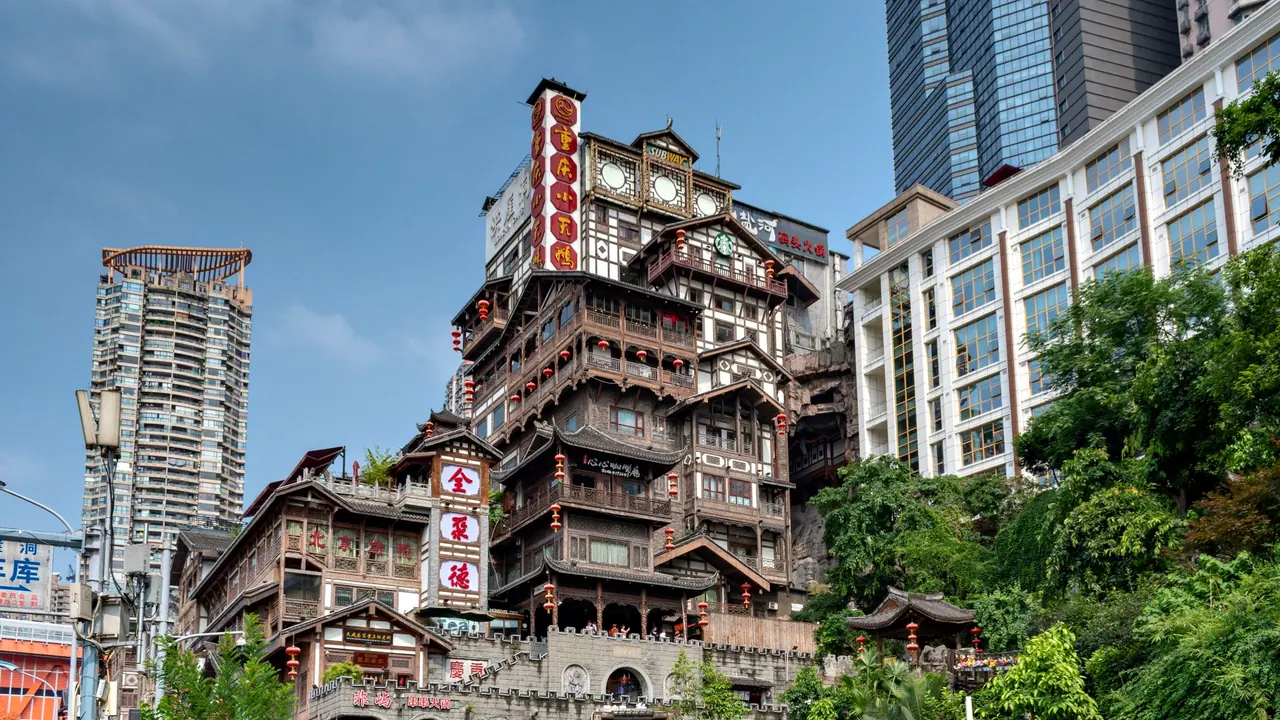
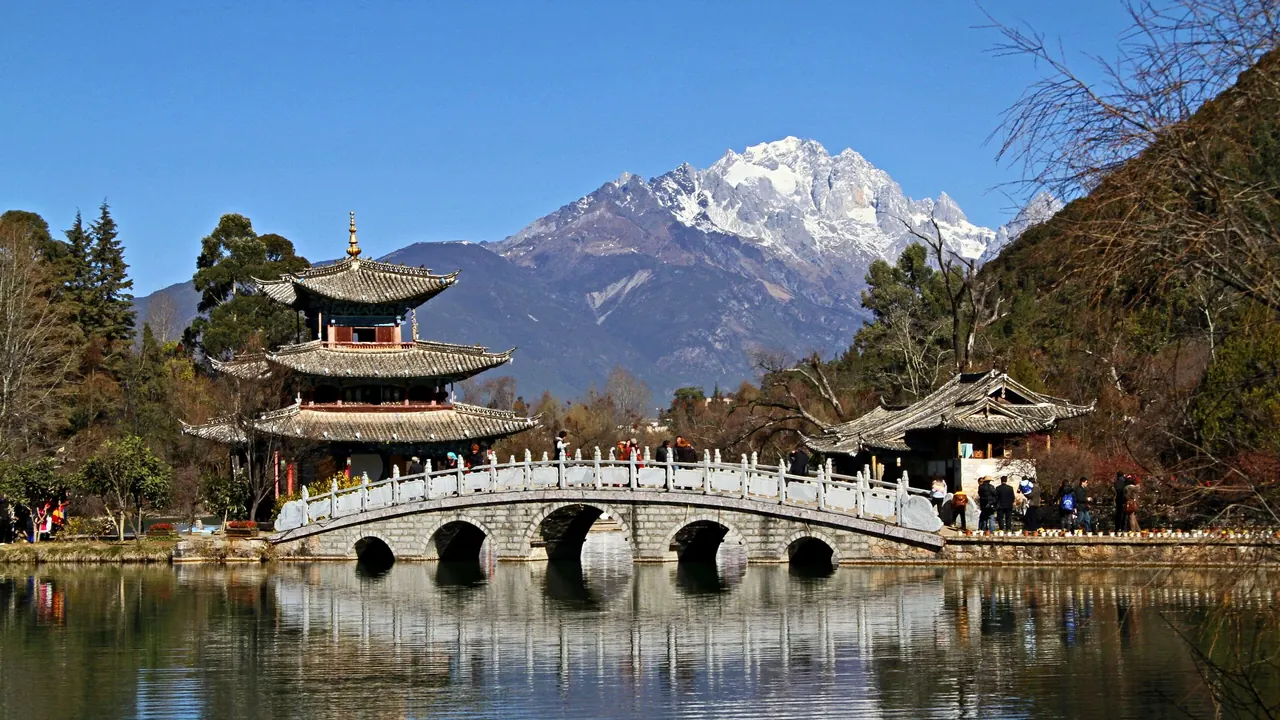
Photos: Chongqing by xiquinhosilva, CC BY 2.0, cropped; Lijiang by Miltos Gikas from Lutsa, Attiki, Greece, CC BY 2.0, cropped.
Chongqing or Lijiang?
Our verdict in twelve categories, each scored against the same fixed benchmark cities, and the climate month by month, so you can choose for your trip.
Choose Chongqing for
- food and drink
- getting around
- wellness
Chongqing is the pick for travellers who plan their days around meals and late nights. Hotpot, fiery noodle breakfasts and skewers well past midnight are the main reason to go. A huge metro and monorail network and cheap taxis make a steep, layered city manageable, and hot-spring resorts on its edges give you somewhere to recover. Families also find more to do, from pandas at the zoo to theme parks and cable cars over the Yangtze.
Choose Lijiang for
- nature and the outdoors
- culture and sights
If the scenery matters more than dinner, go to Lijiang. Jade Dragon Snow Mountain fills the skyline, Tiger Leaping Gorge is within reach for a two-day trek, and the mild plateau climate makes outdoor days pleasant for much of the year. The Naxi Old Town is a pretty, if heavily commercial, base for a slow trip on foot, with taxis or a hired driver for everything beyond it.
Scoreboard
Twelve categories on one fixed scale from 0 to 100. The shaded stretch is the gap between the two.
Your match
Pick a travel style or drag the sliders, and both match scores follow your weighting.
Wins on food and drink and getting around with your weighting.
Wins on nature and the outdoors and culture and sights with your weighting.
What matters to you?
Category by category
What the scores mean for a trip.
Beaches & swimming
Neither city is a beach destination. Both are far inland, and anyone who wants the sea will need a separate trip. What differs is how you might cool off. In Chongqing's punishing summer, locals use hotel pools and hot-spring resorts. Lijiang's lakes are cold mountain water for boating or birdwatching, and few hotels there have a pool at all.
Food & drink
For eating, the two cities are far apart. In Chongqing, food is a reason to travel in itself: tallow hotpot heavy with numbing pepper, xiaomian noodles for breakfast, chillied chicken and chuanchuan skewers, served in hillside neighbourhoods where kitchens stay open into the small hours. The one real limit is spice, though you can ask for a split pot.
Lijiang's Naxi and Yunnan cooking is pleasant rather than memorable. Baba flatbread, goat hotpot and wild mushrooms in the rainy season are the highlights, but the Old Town lanes repeat the same menus at tourist prices. The best meals there are simple breakfasts eaten outside the walls.
Culture & sights
On sightseeing the two are fairly evenly matched, though what you see is very different. In Chongqing the city itself is the spectacle: towers on ridges, monorails through hillsides and the lit-up peninsula at night. Add the Three Gorges Museum and the wartime-capital sites such as the Stilwell Museum, and you have a modern city with a layer of twentieth-century history.
Lijiang offers a historic townscape and a living minority culture: the UNESCO-listed Naxi lanes of Dayan, the Mu Family Mansion, the Dongba pictographic script and the Ming-era murals at Baisha. Much of it was rebuilt after the 1996 earthquake and has a staged feel, but the setting is far prettier. Each city takes two or three days to see.
Nightlife
Chongqing offers more after dark and more variety. An evening might move from the river views to hotpot, then on to the glossy table-service clubs of Jiujie or a craft-beer bar near Jiefangbei, and you will be out among locals until late.
Lijiang's famous nightlife is mostly one canal-side strip of open-fronted bars with singers and drums, crowded with tour groups and easy to find but much the same from door to door. The better option there is a quiet drink in a courtyard bar in the back lanes or in Shuhe, because proper clubs hardly exist.
Nature & outdoors
Lijiang has much the grander landscape. The glaciated Jade Dragon Snow Mountain rises about 30km from town, Blue Moon Valley has turquoise pools below it, and Tiger Leaping Gorge is one of China's great treks. Lashi Lake adds wetland birds and horse trails. The mountain itself is crowded and tightly managed, and the altitude is noticeable at the top.
Chongqing's nature mostly comes in half-day doses: forest paths on Nanshan looking back at the skyline, and the wooded slopes of Jinyun Mountain. Its big landscapes, the Wulong karst and the Three Gorges, take a long day or a cruise, and summer heat and winter haze limit when they are worth doing.
Day trips
Both cities make good bases for excursions, but they lead to different things. From Chongqing, a fast train reaches Chengdu's teahouses and pandas in about an hour, and the Dazu Rock Carvings and the Song-era Diaoyu Fortress add serious history. Stilt-house towns such as Songji and Laitan make gentler outings.
Lijiang's trips lead into other cultures. Dali's walled town and the Bai villages on Erhai Lake are to the south, and Songzanlin Monastery in Shangri-La gives a first taste of Tibet. Lugu Lake and Shaxi need an overnight stay.
Good for families
Chongqing is the easier choice with children, despite its stairs. It has the zoo's giant pandas, the riverfront science museum and theme parks on the edge of town, and the cable car and building-threading monorail are a treat for younger children. Summer heat and spicy food are the main drawbacks, so go in spring or autumn.
Lijiang has little beyond the car-free Old Town, its streams and the park at Black Dragon Pool. The town already sits at 2,400m and the snow mountain goes much higher, so its biggest sight is best skipped with small children.
Getting around
Chongqing is much easier to get around. Its metro and monorail lines, with English signs, cover nearly everything a visitor wants, and cable cars, escalators and cheap taxis help on the slopes. The difficulty is vertical: the layered streets confuse map apps and mean plenty of stairs.
Lijiang's Old Town is small and walkable, if mazy, but beyond it there is no rail transit and buses are hard to use without Chinese. The mountain, the gorge and the lake are spread out, so most visitors hire a driver or rely on taxis and ride-hailing apps that need Chinese payment.
Shopping & style
Chongqing has far more shopping. The malls and department stores around Jiefangbei and in Guanyinqiao carry international and luxury brands, although it is much the same as any big Chinese city. The best local things to buy are hotpot base and Sichuan pepper.
In Lijiang almost every Old Town house is a shop, but the hand drums, scarves and trinkets repeat from lane to lane. Pu'er tea and carefully compared silver are the purchases worth making, and there is no fashion shopping at all.
Affordability
Both are cheap places to visit, with Chongqing a little cheaper overall. Its food, metro rides and comfortable hotels all cost little, and the main extras are Yangtze cruises and cable cars. Lijiang's guesthouses and breakfasts are just as easy on the budget, but the Old Town entry fee, the expensive snow mountain outing and the marked-up main lanes add up faster.
Live music & performing arts
Neither city is worth planning a trip around for performance, and each has one tradition worth catching. In Chongqing that is Sichuan opera with its face-changing and fire-spitting, and the glass Grand Theatre and a symphony orchestra add touring ballet and concerts. In Lijiang it is Naxi ancient music, a Taoist ritual repertoire played by older musicians in an Old Town hall, alongside large song-and-dance shows staged for tour groups.
Wellness & relaxation
Chongqing has a real bathing culture, which Lijiang lacks. Centuries-old hot springs at Beiwenquan and Nanwenquan offer outdoor pools in wooded valleys, and cheap foot-massage parlours open late round off a hotpot night. The city centre itself is noisy and steep, though, so getting proper rest means heading out to the edges.
Lijiang offers slowness rather than treatments: tea in a sunny courtyard inn and early walks in Shuhe or Baisha before the groups arrive. Beyond hotel spas and simple massage shops, that is all it offers.
When should you go?
Pick your month. The climate figures are measured averages, not a forecast.
Chongqing in July
Lijiang in July
Daytime high, °C
Rainfall in the month, mm
Temperature and rainfall are climate normals, averaged over the years shown. Chongqing: 1991-2020 normals, Chongqing (10.2 km from centre). Lijiang: 1991-2020 normals, Lijing (23.5 km from centre).
Chongqing's summers are hot and sticky. July and August reach about 34°C, which is too hot for long days on its stairs and riverbanks, and June is the wettest month at around 211mm. Winters are cool, grey and almost sunless, with barely 16 hours of sunshine in all of December. The comfortable months are April and May, then late September and October, when days are warm rather than hot.
Lijiang stays mild all year and never gets much above 24°C, so heat is never the problem there. Rain is. The monsoon runs from June to September and peaks in July at about 245mm, with cloud over the peaks. The best months are October and November, when the dry season begins, and the dry, mild weather lasts until April. In midwinter Lijiang is the better choice of the two. In late spring Chongqing is at its best, just before Lijiang's rains begin.
Which traveller are you?
On a food and nightlife trip, choose Chongqing without hesitation. It is the home of hotpot, its kitchens keep cooking long after midnight, and Jiujie adds proper clubs. Lijiang's tourist menus and single bar strip with its drummers can't compete.
For an outdoors trip, Lijiang is the clear choice. You can ride a cable car up to the glaciers of Jade Dragon Snow Mountain, walk the high trail through Tiger Leaping Gorge or cycle the Baisha valley. Chongqing's forested hills are pleasant, but the climate holds them back.
On a family trip with children, Chongqing offers far more: pandas at the zoo, a big science museum, theme parks and a monorail that runs through buildings. Lijiang's altitude makes the snow mountain unsuitable for young children, and the town has almost nothing built for families.
Before you go
| Measure | Chongqing | Lijiang |
|---|---|---|
| Official language | Putonghua | Putonghua |
| Currency | Yuan Renminbi (CNY) | Yuan Renminbi (CNY) |
| Sockets | ACI220 V, 50 Hz | ACI220 V, 50 Hz |
| Driving side | Right | Right |
| Time zone | UTC+8 | UTC+8 |
| Emergency number | Police 110, ambulance 120, fire 119 | Police 110, ambulance 120, fire 119 |
| Elevation | 237 m | 2,400 m |
| Main airport | Chongqing Jiangbei International Airport (CKG)19 km from centre167 non-stop destinations | Lijiang Sanyi International Airport (LJG)22 km from centre60 non-stop destinations |
| Public holidays this year | 6 days | 6 days |
By the numbers
| Measure | Chongqing | Lijiang |
|---|---|---|
| City population | 32,054,159 | 1,253,878 |
| Museums within 10 km | 7 | 2 |
| UNESCO World Heritage sites within 50 km | 0 | 1 |
Where else could you go?
Every comparison below shares a destination with this one, so you can follow Chongqing or Lijiang somewhere new.
- Chengduvs Chongqing
- Zhangjiajievs Chongqing
- Chengduvs Lijiang
- Xi'anvs Chongqing
- Guilinvs Chongqing
- Yangshuovs Chongqing