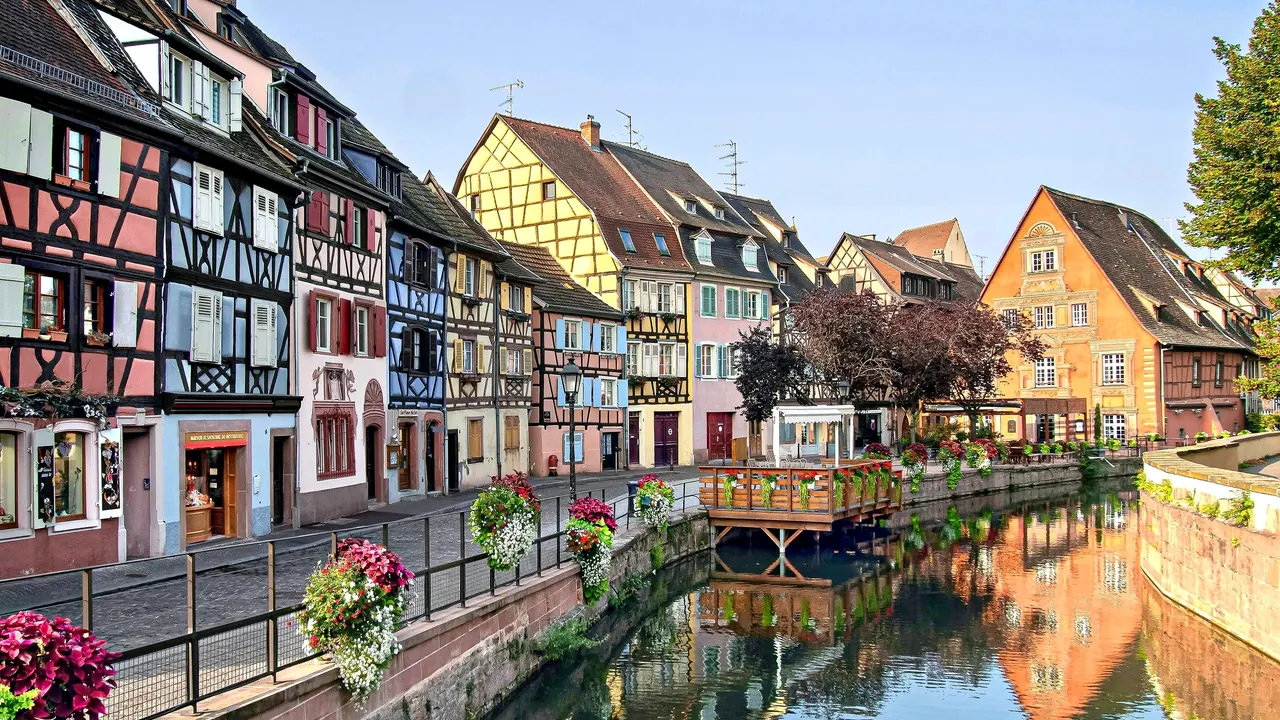
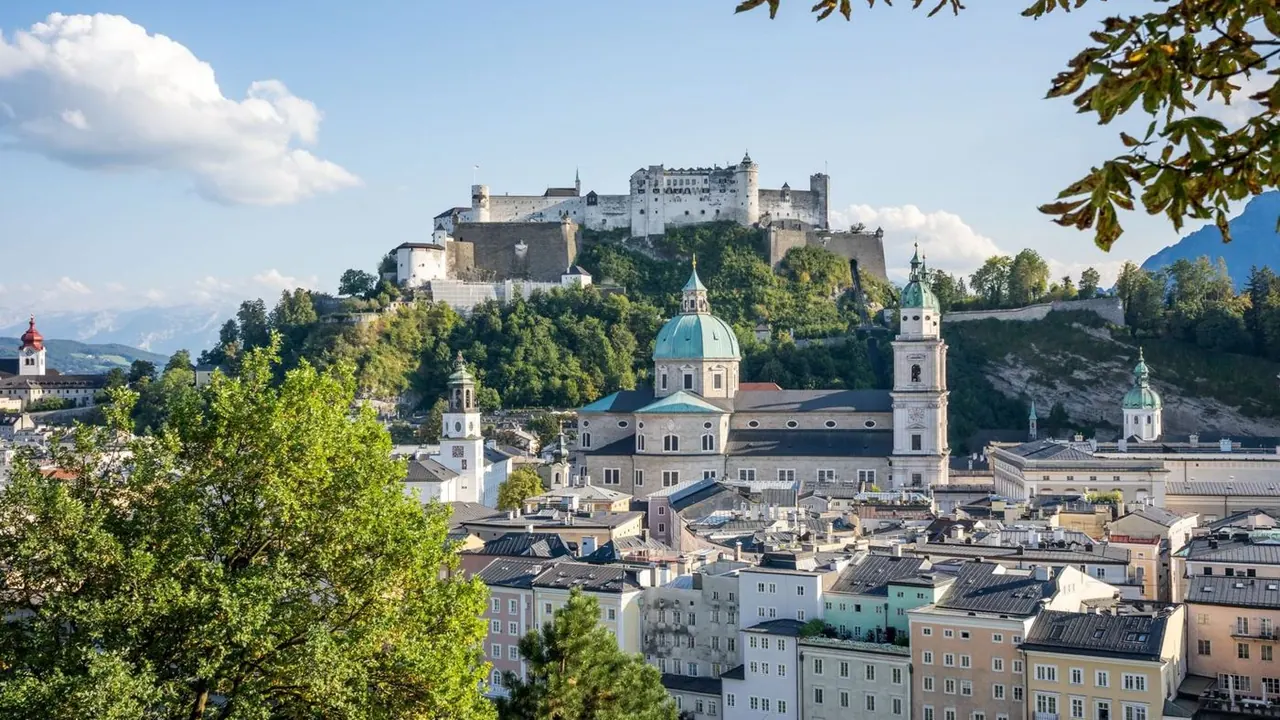
Photos: Colmar by Rolf Kranz, CC BY-SA 4.0, cropped; Salzburg by Leonhard Niederwimmer, Pexels License.
Colmar or Salzburg?
Our verdict in twelve categories, each scored against the same fixed benchmark cities, and the climate month by month, so you can choose for your trip.
Choose Colmar for
- food and drink
- prices
- day trips
Colmar suits a slower trip built around food and wine: a compact half-timbered town, Alsace cooking in wood-panelled winstubs, and the wine villages of the Route des Vins a short drive or bike ride away. It is the better pick if the table and the glass matter more to you than evening entertainment. It is also the gentler of the two on the wallet, especially if you sleep in a nearby village.
Choose Salzburg for
- live music and the arts
- beaches
- wellness
Music lovers should head for Salzburg. Its festival halls, the Mozarteum and the nightly chamber concerts give it an evening life Colmar cannot come close to. The Alps also start at the edge of town, with the Untersberg, the Salzkammergut lakes and Berchtesgaden all close by. Expect to pay more, and to plan well ahead if you come for a festival.
Scoreboard
Twelve categories on one fixed scale from 0 to 100. The shaded stretch is the gap between the two.
Your match
Pick a travel style or drag the sliders, and both match scores follow your weighting.
Wins on food and drink and prices with your weighting.
Wins on live music and the arts and beaches with your weighting.
What matters to you?
Category by category
What the scores mean for a trip.
Beaches & swimming
Neither city is a place for the water, but Salzburg at least has a real summer swim. The Salzkammergut lakes, Fuschlsee, Wolfgangsee and Mondsee, are under an hour away. Their clear water warms to roughly 20-24°C in midsummer, and you get in from lawns and wooden jetties rather than sand.
Colmar has nothing comparable. Swimming there means the municipal pools or a cold little lake high in the Vosges near the Route des Crêtes.
Food & drink
Colmar is the better city to eat in. Alsace cooking is the whole point: choucroute, baeckeoffe and tarte flambée in panelled winstubs, munster cheese from the valleys above town, and Riesling and Gewurztraminer from vineyards you can see from the edge of town, with cellar tastings in the villages a few minutes away.
Salzburg's strength is its coffee houses and beer gardens rather than its kitchens. The Augustiner monastery brewery in Mülln, with its barrel beer under the chestnuts, is the highlight. Schnitzel, Kasnocken and Salzburger Nockerl are filling, but many old-town menus are aimed at tour groups. Both cities offer little beyond their regional cooking.
Culture & sights
Salzburg has the deeper set of sights. Its UNESCO-listed Baroque centre of cathedral, Residenz and arcaded squares sits below Hohensalzburg, one of Europe's largest intact medieval fortresses. Add the two Mozart houses, the rock-cut catacombs of St Peter and the gardens of Mirabell and Hellbrunn, and you have two or three full days.
Colmar's appeal is more concentrated. The painted half-timbered streets of Petite Venise and the tanners' quarter survive as a single late-medieval whole, and the Unterlinden Museum holds Grünewald's Isenheim Altarpiece, a painting worth the journey on its own. Two days covers it.
Nightlife
Both are early-to-bed towns, and Salzburg has a little more life after dark. Its beer halls fill long wooden tables with locals, and the student pubs along Rudolfskai keep going later at weekends during term. Colmar's evenings rarely go beyond dinner, a glass of wine on a summer terrace and a nightcap in a brasserie near Petite Venise. For a real night out, Colmar people take the short train to Strasbourg, while Salzburg's go to Munich.
Nature & outdoors
Salzburg is the stronger outdoor base, because the mountains begin almost in the city. You can walk wooded ridges above the domes without leaving the centre, ride a cable car up the Untersberg to limestone paths at about 1,800m, or reach the Königssee fjord in Berchtesgaden National Park within half an hour. Proper ski areas are around an hour's drive away.
Colmar's landscape is gentler: waymarked paths through the vines between wine villages, then the rounded, forested Vosges with summer pastures, glacial lakes and views to the Black Forest. It is fine cycling country, but most of it needs a car.
Day trips
Both are excellent bases, but the trips are different in kind. From Colmar you visit three countries' worth of old towns: the wine villages of Eguisheim, Riquewihr and Kaysersberg a few kilometres apart, Strasbourg half an hour by train, and Basel and Freiburg about an hour away.
Salzburg's outings are about lakes and salt. Hallstatt is the famous one, with quieter St Wolfgang and St Gilgen, the salt mines of Hallein and Berchtesgaden, and the clifftop fortress at Werfen, plus Munich by train. In both cases the villages are much easier to reach by car than by bus.
Good for families
Families do equally well in both, but the outings differ. Colmar's centre is flat, which is easy with a pushchair, and children enjoy the boat rides and nesting storks. The bigger draws are outside town: the macaque park and eagle show near Kintzheim, the Mulhouse railway and car museums, and Europa-Park about an hour away, all of which need a car.
Salzburg keeps more inside the city, with Hellbrunn's trick fountains, the zoo, the hands-on Haus der Natur and the marionette theatre. Further out are the salt-mine slides and underground boat rides, but there is no theme park, and the cobbled slopes are hard work with a pushchair.
Getting around
Salzburg is the easier city to get around without a car. Its pedestrianised centre is walkable, and a dense network of trolleybuses runs out to Hellbrunn and the Untersberg cable car, with direct trains to Munich and Vienna. Only the lake villages really call for hire wheels.
Colmar's old town and station are just as easy on foot, and regional trains reach Strasbourg and Mulhouse quickly. Beyond that, buses are sparse, so seeing the wine villages and the Vosges usually means hiring a car or riding a bike along the vineyard roads.
Shopping & style
Salzburg offers rather more to buy. Getreidegasse, hung with wrought-iron guild signs, is a proper shopping street, and the city's speciality is Tracht: dirndls, loden jackets and leather goods, often made to measure in old-town workshops.
Colmar's shopping is almost all regional: wine bought from the grower, Soufflenheim pottery and kougelhopf moulds, printed table linen and gingerbread, plus Christmas markets spread over several squares. Neither city is the place for fashion or luxury brands.
Affordability
Colmar is the cheaper stay. Set lunches, local wine and free or cheap village tastings keep daily costs moderate, and its only real cost problem is rooms during the Christmas market weeks and in summer.
Salzburg is expensive all year. Old-town hotels and restaurants cost a lot, and prices rise sharply during the festival and Advent. Staying across the river, eating in the beer halls and outer-district inns, and using the city card are the usual ways to keep the bill down.
Live music & performing arts
This is where the two cities differ most. Salzburg is built around music: the Salzburg Festival fills the Grosses Festspielhaus and the Felsenreitschule with opera and orchestral concerts, Jedermann is played outdoors in front of the cathedral, and Mozart Week and the Easter Festival add two more seasons. Between festivals, the Mozarteum, the Landestheater and the Marionette Theatre keep the programme going.
Colmar has a small Italian-style theatre, a classical festival in early July and a jazz festival in autumn. Outside those weeks, serious opera or orchestral music means a trip to Strasbourg or Basel.
Wellness & relaxation
Salzburg is the better choice for a spa break. In town, the Paracelsus Bad has saunas and a pool looking out over the Kapuzinerberg. The salt-water spa town of Bad Reichenhall is twenty minutes away, and the Gastein valley's radon springs and Belle Époque spa hotels are within reach.
Colmar has only hotel spas. What it offers instead is an unhurried pace: quiet evenings by the canals and long lunches between walks in the vines.
When should you go?
Pick your month. The climate figures are measured averages, not a forecast.
Colmar in July
Salzburg in July
Daytime high, °C
Rainfall in the month, mm
Temperature and rainfall are climate normals, averaged over the years shown. Colmar: 1991-2020 normals, Ihringen (21.1 km from centre). Salzburg: 1991-2020 normals, Salzburg (3.4 km from centre).
Colmar has the warmer, drier and sunnier summer of the two. Highs reach about 27°C in August, July and August are its sunniest months, and even May, its wettest month, brings only moderate rain. That makes June to early September the time for long days among the vineyards. September and October stay mild and fairly dry, which makes them the most pleasant months for walking the old town and the wine villages. Salzburg is a degree or two cooler in summer but much wetter. Every month from May to August brings far more rain than Colmar, peaking at about 168mm in June, so expect showery afternoons whenever you come in summer.
For walking Salzburg's streets, April and October are the better bets: mild, and much less rainy than the summer months. September is a reasonable compromise. Winter is cold in both and colder in Salzburg, where January highs reach only about 3°C against 6°C in Colmar, though Salzburg gets rather more winter sun. From November to March, plan either city around indoor sights.
Which traveller are you?
On a culture and arts trip, choose Salzburg. The Baroque old town and the fortress hold their own against Colmar's townscape. On top of that, the Salzburg Festival, Mozart Week, the Landestheater and the nightly chamber concerts fill your evenings, while Colmar only offers this during its few festival weeks.
On a trip with a tight budget, Colmar makes the money go further. Stay in a wine village rather than the old town, buy picnic food at the covered market by the Lauch canal, and cycle the vineyard roads rather than hiring a car. The same few days cost noticeably more in Salzburg.
On an outdoors trip, base yourself in Salzburg for more varied active days. Hiking and paragliding on the Gaisberg, sailing and paddling on the lakes, and riding the Salzach bike path are all close, much of it reachable by bus or bike. Colmar suits gentler cycling and walks through the vineyards.
Before you go
| Measure | Colmar | Salzburg |
|---|---|---|
| Official language | French | German, Austrian Sign Language |
| Currency | Euro (EUR) | Euro (EUR) |
| Sockets | CE230 V, 50 Hz | CF230 V, 50 Hz |
| Driving side | Right | Right |
| Time zone | UTC+1, UTC+2 in summer | UTC+1, UTC+2 in summer |
| Emergency number | 112 | 112 |
| Elevation | 185 m | 424 m |
| Main airport | EuroAirport Basel–Mulhouse–Freiburg (BSL)55 km from centre112 non-stop destinations | Salzburg Airport (SZG)3 km from centre64 non-stop destinations |
| Public holidays this year | 11 days | 16 days |
By the numbers
| Measure | Colmar | Salzburg |
|---|---|---|
| City population | 66,970 | 155,021 |
| People per km² | 1,006 | 2,360 |
| Museums within 10 km | 9 | 38 |
| UNESCO World Heritage sites within 50 km | 3 | 3 |
Where else could you go?
Every comparison below shares a destination with this one, so you can follow Colmar or Salzburg somewhere new.
- Hallstattvs Salzburg
- Baselvs Colmar
- Strasbourgvs Colmar
- Baden-Badenvs Colmar
- Munichvs Salzburg
- Zurichvs Colmar