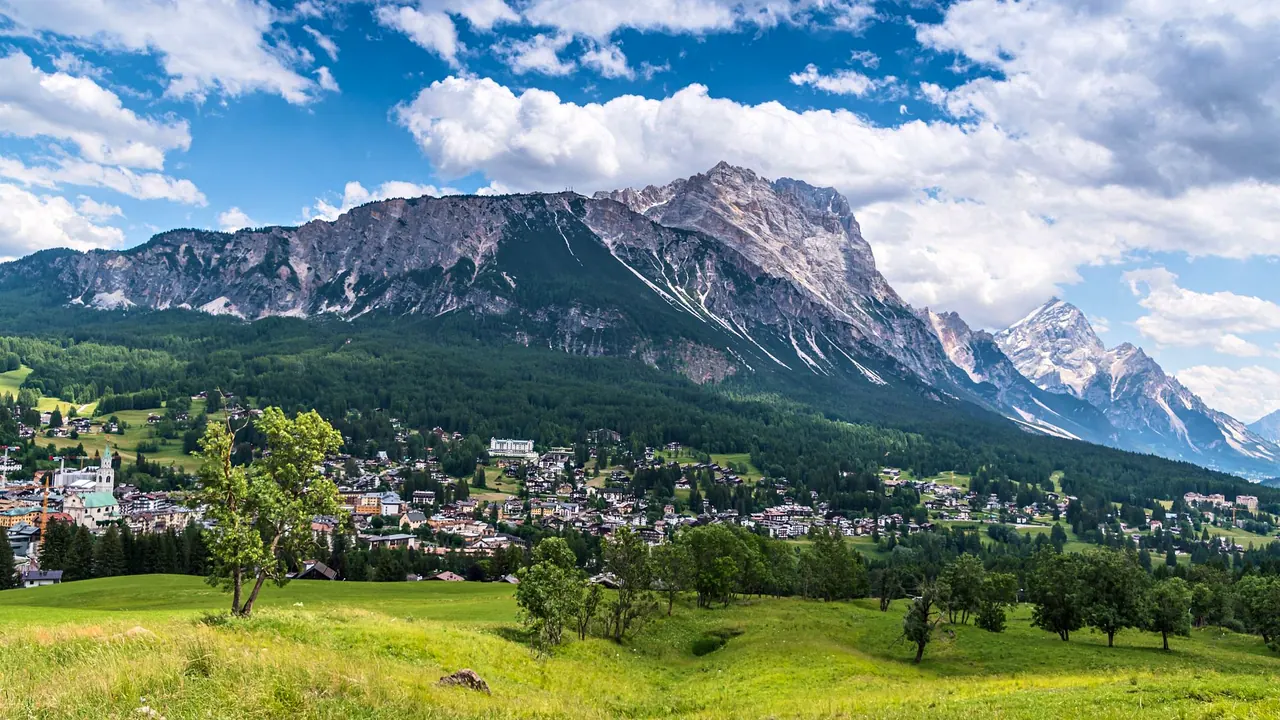
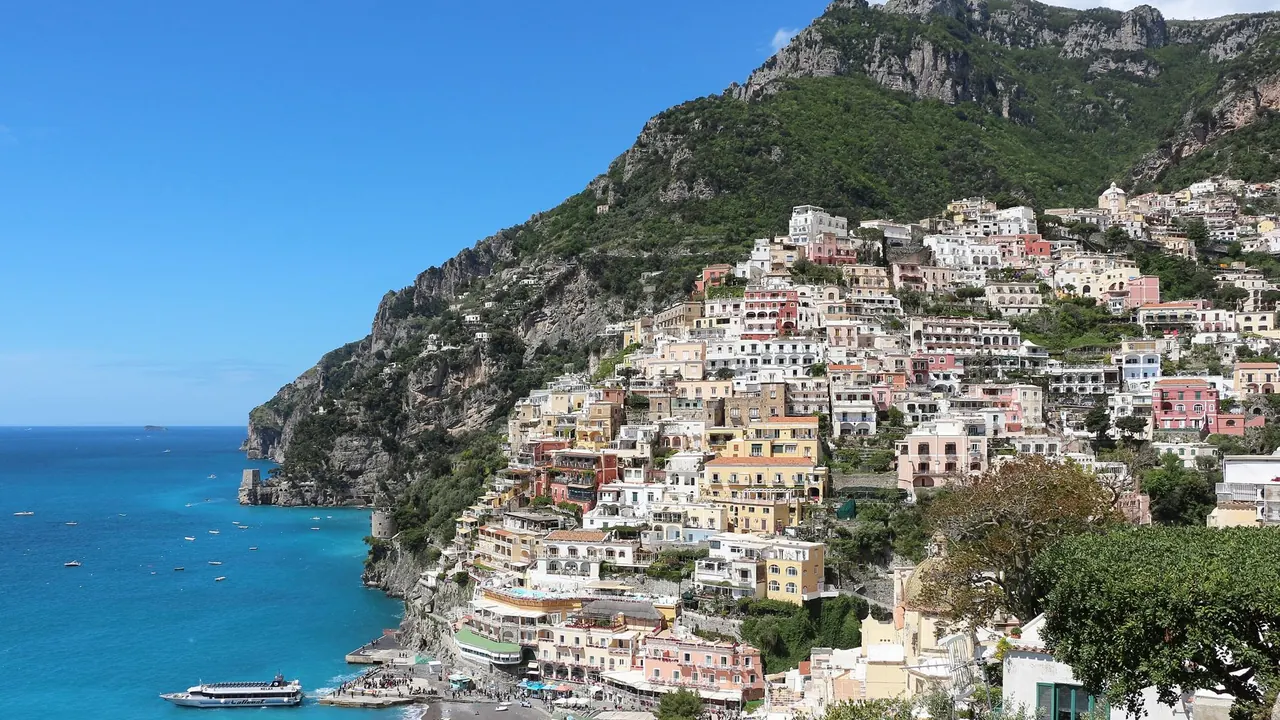
Photos: Cortina d'Ampezzo by Andreas Neubauer, Pexels License; Positano by Bernard Gagnon, CC BY 4.0, cropped.
Cortina d'Ampezzo or Positano?
Our verdict in twelve categories, each scored against the same fixed benchmark cities, and the climate month by month, so you can choose for your trip.
Choose Cortina d'Ampezzo for
- families
- nature and the outdoors
- getting around
Choose Cortina d'Ampezzo if the mountains are the point of the trip. In winter that means skiing the Dolomiti Superski area straight from town. In summer it means hut-to-hut hiking, the Alta Via 1 and some of the oldest via ferrata routes in the Alps. It is also the easier choice for families who ski or walk, with a flat centre, ski schools and gentle trails to the huts. In July and August it stays cool while the south bakes.
Choose Positano for
- beaches
- day trips
- shopping
Positano is the one for a summer vacation by the sea: clear water below the town, boats to coves and Capri, and long lunches on terraces over the waves. It is also the better base for seeing more than one place, because Amalfi, Ravello, Pompeii and Paestum all lie within a day. Couples who don't mind climbing stairs get the most from it. Families with toddlers will find it hard going.
Scoreboard
Twelve categories on one fixed scale from 0 to 100. The shaded stretch is the gap between the two.
Your match
Pick a travel style or drag the sliders, and both match scores follow your weighting.
Wins on families and nature and the outdoors with your weighting.
Wins on beaches and day trips with your weighting.
What matters to you?
Category by category
What the scores mean for a trip.
Beaches & swimming
Positano is a beach town and Cortina is not. Spiaggia Grande and the calmer Fornillo sit right below the houses. Arienzo and Laurito are a stairway or short boat ride away, and the water is clear and warm through summer. Bring water shoes for the coarse, steep shore.
Cortina is a high valley more than two hours from the Adriatic. Lago Ghedina and Pianozes are lovely to walk round, but they are fed by snowmelt and stay cold, so most swimming happens in a hotel pool.
Food & drink
The two eat about as well as each other, but the food could hardly be more different. Cortina serves mountain food with a Venetian accent: casunziei with poppy seeds, polenta with game, barley soup, and wines from the Veneto and South Tyrol. Its best meals tend to come on rifugio terraces high among the peaks.
Positano cooks the sea and the lemon: spaghetti with clams, scialatielli with seafood, grilled fish and limoncello, all with the water below the terrace. Both have a narrow range with little that is cheap, and many of Positano's kitchens close between November and Easter.
Culture & sights
Neither is a place for sightseeing, and each has a few hours' worth. Cortina has the bell tower of its basilica, the 1956 Olympic ice stadium and the Rimoldi collection of twentieth-century Italian art. Its most striking history, the First World War tunnels on Lagazuoi and the Cinque Torri, takes a day in the mountains to reach.
In Positano the town itself is the sight. Look for the majolica dome of Santa Maria Assunta and the painted Roman villa preserved under ash beneath it. For more, people go to Naples.
Nightlife
Both are quiet after dinner, but they come alive at opposite times of year. Cortina's evenings are après-ski and a passeggiata along the Corso Italia, with a few smart bars and clubs open late only in the peak winter weeks. Positano's busy season is summer: aperitivo with a sea view, a few bars near the beach and a club in a cave at the end of Spiaggia Grande. Both suit a long, unhurried dinner far better than a night out.
Nature & outdoors
Both are superb places to be outdoors, but Cortina gives you far more to do. It has a whole range to explore in both seasons. Winter means skiing across the linked Dolomiti Superski area. Summer brings multi-day treks between huts on the Alta Via 1, via ferrata routes laid along old wartime paths, climbing, mountain biking and paragliding. The lifts take you up among the Tofane and Cristallo minutes after leaving town, and landmarks such as the Tre Cime are an easy morning's drive away.
Positano's outdoors is narrower but unlike anything in the Alps, because the mountains and the sea fill the same view. The Path of the Gods is one of Italy's great coastal walks, high above the lemon terraces. The water adds what Cortina cannot: kayaking or a hired boat along the cliffs to sea caves and the Li Galli islets. There is no snow, though, and the walking comes down to a few classic routes rather than a range you could spend weeks in.
Day trips
Positano has far more within a day's reach. Ferries run to Amalfi and its paper mills, to Ravello's gardens and, in about half an hour, to Capri. Pompeii, Herculaneum and the Greek temples of Paestum are all manageable, as long as you remember the ferries mostly run only from spring to autumn.
From Cortina, most outings lead further into the mountains. The towns of South Tyrol, Bolzano with the Iceman, and Lienz across the Austrian border are pleasant rather than essential, and Venice is a long day by coach.
Good for families
Cortina is clearly better with children, as long as the family skis or walks. There are ski schools for every age, beginner slopes at Socrepes, public skating at the Olympic stadium, and easy trails to huts with meadows to run around in. Rainy days can drag, because there is nothing built for children indoors.
Positano is a town of stairs where pushchairs are useless. Its beaches shelve quickly, which suits confident older children who love boats and swimming far more than toddlers.
Getting around
Cortina is the easier of the two, though neither is simple. Its centre is flat and quick to cross, and in winter ski buses and lifts do most of the work. With no railway since 1964 and only a limited bus service up to the passes, though, a hire car is the practical way to see the wider Dolomites.
In Positano a car is more of a problem than a help. Every walk means hundreds of steps, the coast buses crawl in summer, and the seasonal ferries are the easiest way to reach the neighbouring towns.
Shopping & style
Shopping is about equal, and each town sells its own look. Cortina's Corso Italia offers luxury fashion, jewellers, furriers and serious mountain wear, anchored by the Cooperativa di Cortina, founded in 1893, alongside wood carving and filigree.
Positano's lanes sell moda Positano: loose white linen, bright resort prints and sandals cut to fit while you wait, along with ceramics and lemon soaps. Both are polished, but neither goes far beyond its one style.
Affordability
Both rank among the most expensive places to stay in Italy, and the costs simply fall in different places. In Cortina, lift passes and equipment hire add to luxury hotel rates, though meals at the rifugi are fair for the setting and many people save by staying in cheaper valleys nearby.
In Positano the extras are loungers, boat trips and transfers. The usual saving is to sleep in Praiano or Sorrento and come in by bus or ferry, and May and October are kinder than high summer.
Live music & performing arts
There is little to see in either town, so go for the scenery rather than a season of performances. Cortina's summer chamber and classical festivals bring concerts to churches and sometimes to mountain settings, plus talks and cultural evenings.
Positano itself manages only occasional summer concerts. Its advantage is Ravello's summer music festival on a terrace above the sea, close enough for an evening, with Naples further off for opera.
Wellness & relaxation
For rest, the two are on a par. Neither has a bathing tradition, so wellness means hotel spas: Alpine saunas, hay baths and indoor pools in Cortina, and treatment rooms and pools cut into the cliff in Positano.
What differs is how each one calms you. In Cortina it is clear air and a hut terrace in June, September or a quiet winter week. In Positano it is a slow lunch above the sea in May, June or late September, away from the August crowds and the tiring stairs.
When should you go?
Pick your month. The climate figures are measured averages, not a forecast.
Cortina d'Ampezzo in July
Positano in July
Daytime high, °C
Rainfall in the month, mm
Where the figures come from
Positano's temperatures are measured 25 km from the centre, at Capri.
Positano has no rain gauge within 25 km of the centre, so its rainfall comes from a gridded climate dataset read at the city rather than from a gauge further away.
Positano's sunshine is measured 59 km from the centre, at Grazzanise.
Temperature and rainfall are climate normals, averaged over the years shown. Cortina d'Ampezzo: 1991-2020 normals, Dobbiaco (22.5 km from centre). Positano: 2005-2025 (sunshine 1991-2020, rainfall 1991-2020) normals, Capri (25.3 km from centre).
The two places peak in opposite ways. Cortina has two seasons. Winter is cold and fairly dry, with daytime highs around 0°C in January, which is what the ski season needs. Summer runs from June to September, with highs near 22°C that are ideal for hiking. July and August are the wettest months, though, so plan for some rain. April, November and the dark weeks of early winter fall between the two seasons.
Positano is at its best from May to early October. June to September is beach weather, with the sea reaching 26°C in August and over 300 hours of sunshine a month in high summer. August highs around 30°C make the endless stairs tiring in the middle of the day, so May, June and late September are kinder for walking. The rain comes in late autumn and peaks at 127mm in November. Winters are mild rather than cold, but grey.
Which traveller are you?
For a beach and sun trip, Positano wins without a contest. It has swimmable sea from June into October, beaches below the town and boats to coves, while Cortina offers only snowmelt lakes too cold for more than a quick dip.
On a family trip with young children, Cortina is far easier. Its flat centre, ski schools, skating rink, rope park and short walks to the huts suit small legs. Positano's stairways rule out pushchairs, and its pebbly beaches shelve steeply.
For skiers, only Cortina makes sense. Lifts climb from town into the Dolomiti Superski area, with the Sella Ronda and long runs within reach. Positano is a summer coastal town with no snow sports at all.
Before you go
| Measure | Cortina d'Ampezzo | Positano |
|---|---|---|
| Official language | Italian | Italian |
| Currency | Euro (EUR) | Euro (EUR) |
| Sockets | CFL230 V, 50 Hz | CFL230 V, 50 Hz |
| Driving side | Right | Right |
| Time zone | UTC+1, UTC+2 in summer | UTC+1, UTC+2 in summer |
| Emergency number | 112 | 112 |
| Elevation | 1,224 m | 142 m |
| Main airport | Venice Marco Polo Airport (VCE)116 km from centre103 non-stop destinations | Naples International Airport (NAP)33 km from centre131 non-stop destinations |
| Public holidays this year | 13 days | 13 days |
By the numbers
| Measure | Cortina d'Ampezzo | Positano |
|---|---|---|
| City population | 5,546 | 3,729 |
| People per km² | 22 | 429 |
| Museums within 10 km | 3 | 10 |
| UNESCO World Heritage sites within 50 km | 1 | 5 |
| Swim season, months above 21 °C | - | 5 months |
Where else could you go?
Every comparison below shares a destination with this one, so you can follow Cortina d'Ampezzo or Positano somewhere new.
- Sorrentovs Positano
- Amalfivs Positano
- Salernovs Positano
- Naplesvs Positano
- Innsbruckvs Cortina d'Ampezzo
- Venicevs Cortina d'Ampezzo