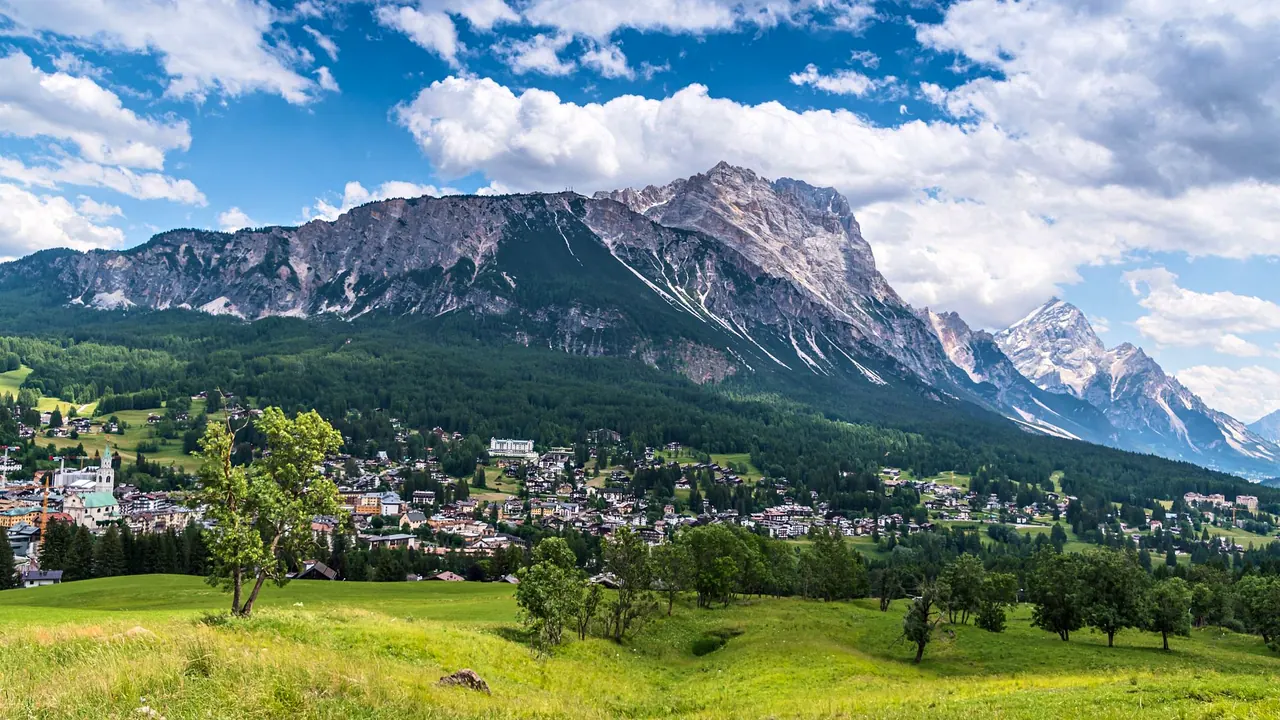
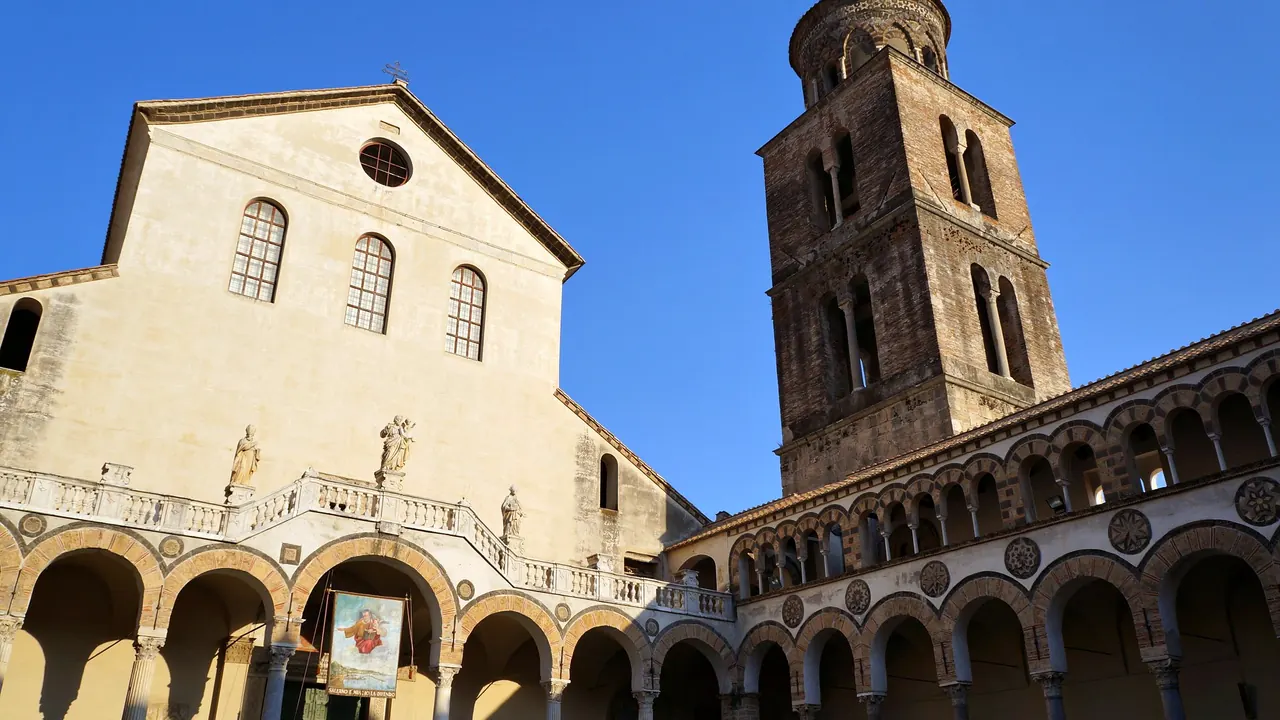
Photos: Cortina d'Ampezzo by Andreas Neubauer, Pexels License; Salerno by Leandro Neumann Ciuffo, CC BY 2.0, cropped.
Cortina d'Ampezzo or Salerno?
Our verdict in twelve categories, each scored against the same fixed benchmark cities, and the climate month by month, so you can choose for your trip.
Choose Cortina d'Ampezzo for
- nature and the outdoors
- wellness
Cortina d'Ampezzo is for travellers who want the mountains to be the whole point. The pale Dolomite peaks start at the edge of town, lifts climb straight onto them, and the valley works as well for skiing in winter as for hut-to-hut hiking and via ferrata in summer. You give up a lot for that: it is very expensive, the evenings are quiet and there is little to see in town. It suits active couples and families who will spend every day outdoors and don't mind the bill.
Choose Salerno for
- beaches
- day trips
- prices
Salerno makes more sense for a varied, sociable trip on a sensible budget. The city is an affordable base for one of Italy's most expensive coastlines. Paestum, Pompeii, Naples and the Amalfi villages are all an easy train or ferry ride away, and back in town you get warm sea, honest Campanian food and lively old-town evenings. Choose it if you want sightseeing, swimming and good meals in one stay rather than one great landscape.
Scoreboard
Twelve categories on one fixed scale from 0 to 100. The shaded stretch is the gap between the two.
Your match
Pick a travel style or drag the sliders, and both match scores follow your weighting.
Wins on nature and the outdoors and wellness with your weighting.
Wins on beaches and day trips with your weighting.
What matters to you?
Category by category
What the scores mean for a trip.
Beaches & swimming
Cortina has no beach to speak of. The small lakes at Ghedina and Pianozes are fed by snowmelt, so a swim usually means a hotel pool, and the Adriatic is over two hours away.
Salerno is on the sea itself, with grey-sand city beaches a short walk east of the centre. A day trip south brings wide sandy shores among pine woods, and the ferries go west to the clear, pebbly coves of the Amalfi Coast.
Food & drink
Cortina eats well for a small mountain town. The best of it is Ampezzan cooking like poppy-seed casunziei and polenta with game, ideally on a rifugio terrace among the peaks. Choice in the valley is narrow, though, and almost nothing is cheap.
Salerno gives you more and better everyday eating. There is wood-fired pizza, fried seafood, buffalo mozzarella made that morning on the Paestum plain and colatura from Cetara next door. Its old-town trattorias, friggitorie and pastry shops feed you well at any hour and for far less.
Culture & sights
Cortina's sights fill an afternoon: the basilica and its bell tower, the 1956 Olympic ice stadium and the Rimoldi collection of modern Italian art. Its most moving heritage is the First World War tunnels on Lagazuoi and the Cinque Torri, but reaching them takes a mountain outing.
Salerno has more to see within the city. There is the Norman cathedral with Saint Matthew's crypt, the Giardino della Minerva, which is tied to Europe's first medical school, and the Arechi Castle above the gulf. A day or two covers it, but there is real history in those stepped lanes.
Nightlife
Neither town is built for clubbing, but Salerno has the livelier evenings. On weekends and all summer long, young locals spill out of the wine bars and pubs into the lanes around Largo Campo until late, and Naples is close for anything bigger.
Cortina's evenings are après-ski drinks, a stroll along the Corso Italia and a long dinner. Only in the peak winter weeks do a few smart bars stay open late. In summer the town is quiet early.
Nature & outdoors
Cortina sits in one of the world's great mountain landscapes. A ring of Dolomite peaks surrounds the valley, the Tre Cime and Lago di Misurina are close by, and lifts run straight from town. The skiing, climbing and hut-to-hut walking are of a different order from anything near Salerno.
Salerno's natural setting is still very fine. You have the Amalfi cliffs and lemon terraces, the Path of the Gods, and the gorges and headlands of the Cilento, plus kayaking and sailing that the Alps can't offer. Spring and autumn are the times to hike there.
Day trips
Day trips are where Salerno pulls well ahead. Paestum's Greek temples and Pompeii are each about half an hour away by train, and Amalfi is a short ferry crossing. Naples, Herculaneum, Caserta and Ravello are all easy days out, so a week can be packed with first-rate sites.
From Cortina, most outings head deeper into the mountains. The towns within reach, such as San Candido, Brunico and Bolzano with its Iceman, are pleasant rather than essential, and Venice is a long day there and back.
Good for families
The two are about even for families, and the difference is the kind of trip. Cortina suits children who ski or hike. It has ski schools, beginner slopes at Socrepes, public skating and gentle trails to huts with meadows, but rainy days drag and costs climb fast.
Salerno is a sea-and-gelato vacation. The car-free promenade has playgrounds along it, and the sandy beaches to the south are shallow, but the old town's steps and the winding Amalfi roads are harder work with small children.
Getting around
Both centres are easy to walk, but Salerno is far better connected. Direct trains run to Naples, Pompeii and Paestum, ferries serve the Amalfi Coast in summer, and most visitors never need a car.
Cortina has had no railway since 1964, so arriving means a coach from Venice or a long drive. Buses to the passes are infrequent, which is why many visitors end up hiring a car.
Shopping & style
Shopping is about even, but the two towns sell different things. Cortina's Corso Italia is a short luxury strip of jewellers, furriers and upmarket ski wear, anchored by the old Cooperativa store.
Salerno's long Corso Vittorio Emanuele is mostly Italian chains with very little luxury. Its best buys are local: Vietri majolica, limoncello and Cetara's anchovy sauce.
Affordability
This is one of the sharpest differences between the two. Cortina charges luxury-resort prices for hotels and meals in peak winter and August, and lift passes and equipment hire add more. Only the rifugi and the shoulder seasons ease the bill.
Salerno is a working port city where pizzerias and trains charge what locals pay. It is a cheap base for the costly coast nearby. Summer ferries, lido sunbeds and entry to the big archaeological sites are the main costs to plan for.
Live music & performing arts
Salerno has a proper stage in the gilded Teatro Verdi, modelled on the San Carlo in Naples, with a season of opera, ballet and concerts. In summer you can also reach the Ravello Festival's cliff-top concerts.
Cortina has no theatre season at all. Apart from summer chamber music in churches and the odd concert at New Year, there is little to go to.
Wellness & relaxation
Cortina is the better choice for a restful stay. Many of its hotels have Alpine spas with saunas, hay baths and indoor pools, and in June or September the clear air and quiet hut terraces are restful too, though the peak weeks are crowded.
Salerno's spas are also in its hotels, and the nearest thermal pools are at Contursi Terme, about an hour inland. Its calm comes from sunset walks along the palm-lined seafront, against the traffic and noise of a port city.
When should you go?
Pick your month. The climate figures are measured averages, not a forecast.
Cortina d'Ampezzo in July
Salerno in July
Daytime high, °C
Rainfall in the month, mm
Where the figures come from
Salerno's temperatures are measured 71 km from the centre, at Grazzanise.
Salerno has no rain gauge within 25 km of the centre, so its rainfall comes from a gridded climate dataset read at the city rather than from a gauge further away.
Temperature and rainfall are climate normals, averaged over the years shown. Cortina d'Ampezzo: 1991-2020 normals, Dobbiaco (22.5 km from centre). Salerno: 1991-2020 normals, Grazzanise (71.3 km from centre).
Cortina has two seasons. In winter the valley is dry and freezing, with daytime highs around zero from December to February, which is what the ski season needs. Summer is mild rather than hot, peaking at about 22°C in July and August, and it is also the wettest time, with around 130mm in July. That makes mornings the best time to be on the high trails. June and September are cooler but often more settled, and they suit hiking well.
Salerno runs the other way. Its summers are hot and dry, reaching 31°C in July and August, with long sunny days and the sea warm enough to swim in from June to September, at about 25°C in July. That heat makes midday sightseeing at Pompeii or Paestum hard work, so spring and October are better for walking and ruins. The rain comes in late autumn and winter, heaviest in November at around 154mm, though the city stays mild through those months while Cortina is deep in its cold season.
Which traveller are you?
On an outdoors trip, Cortina wins easily. The Dolomites rise straight from the valley, with lifts onto the peaks, the Alta Via 1, historic via ferrata routes and the vast Dolomiti Superski area in winter. Salerno's coastal paths are fine, but they can't compete with that.
For a beach and sun trip, Salerno is the only real option. It has warm sea through the summer, long sandy beaches with lidos towards Paestum and clear coves along the Amalfi Coast. Cortina's alpine lakes stay cold even in August.
On a tight budget, Salerno is far kinder. Its trattorias, guesthouses and regional trains charge local prices, and it makes a cheap base for the costly Amalfi Coast. Cortina is among Italy's most expensive resorts, and budget visitors often end up sleeping in other valleys.
Before you go
| Measure | Cortina d'Ampezzo | Salerno |
|---|---|---|
| Official language | Italian | Italian |
| Currency | Euro (EUR) | Euro (EUR) |
| Sockets | CFL230 V, 50 Hz | CFL230 V, 50 Hz |
| Driving side | Right | Right |
| Time zone | UTC+1, UTC+2 in summer | UTC+1, UTC+2 in summer |
| Emergency number | 112 | 112 |
| Elevation | 1,224 m | 4 m |
| Main airport | Venice Marco Polo Airport (VCE)116 km from centre103 non-stop destinations | Naples International Airport (NAP)46 km from centre131 non-stop destinations |
| Public holidays this year | 13 days | 13 days |
By the numbers
| Measure | Cortina d'Ampezzo | Salerno |
|---|---|---|
| City population | 5,546 | 127,186 |
| People per km² | 22 | 2,123 |
| Museums within 10 km | 3 | 9 |
| UNESCO World Heritage sites within 50 km | 1 | 5 |
| Swim season, months above 21 °C | - | 5 months |
Where else could you go?
Every comparison below shares a destination with this one, so you can follow Cortina d'Ampezzo or Salerno somewhere new.
- Amalfivs Salerno
- Positanovs Salerno
- Sorrentovs Salerno
- Naplesvs Salerno
- Innsbruckvs Cortina d'Ampezzo
- Venicevs Cortina d'Ampezzo