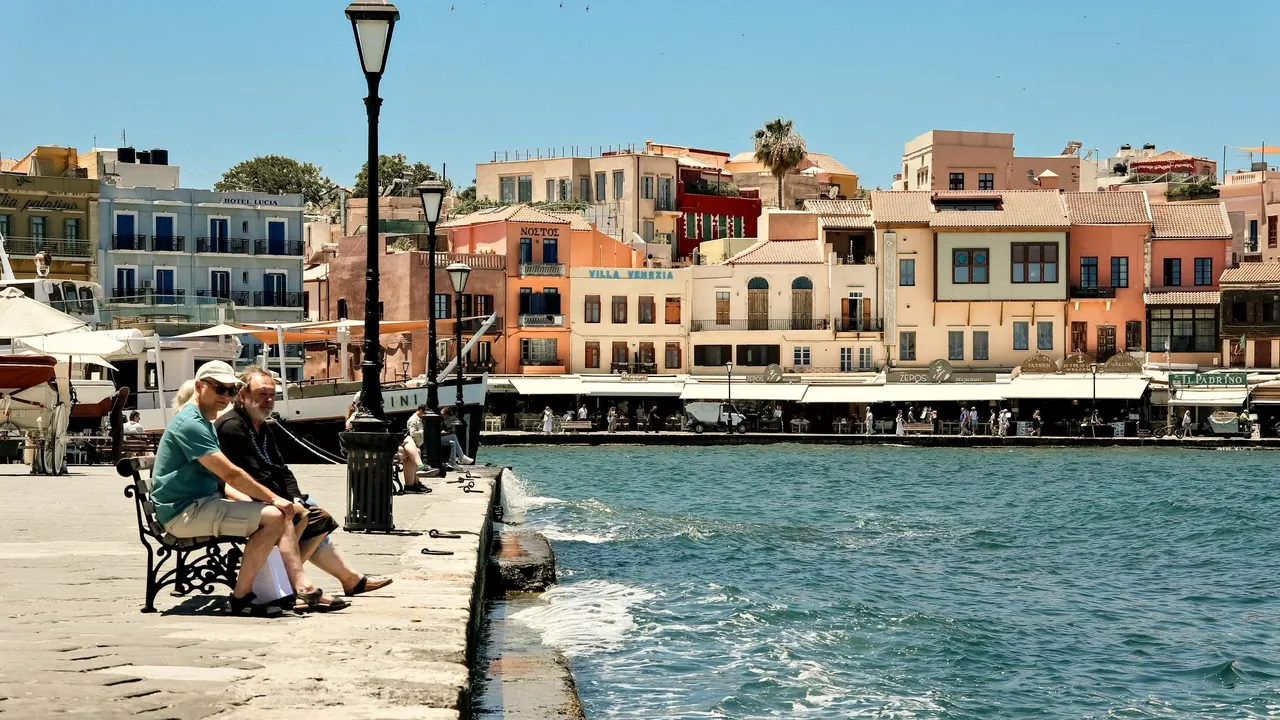
Photos: Crete by Piotr Baranowski, Pexels License.
Crete or Halkidiki?
Our verdict in twelve categories, each scored against the same fixed benchmark cities, and the climate month by month, so you can choose for your trip.
Choose Crete for
- culture and sights
- nature and the outdoors
- shopping
Crete is the island for a trip that mixes the beach with everything else. The Minoan palaces and the Heraklion museum, the Venetian old towns of Chania and Rethymno, the gorges of the White Mountains and a cuisine with a real identity of its own give a week here far more range than sun and sea alone. The price is distance: it is a big, mountainous island, and seeing it properly means long drives on winding roads.
Choose Halkidiki for
- wellness
Halkidiki makes more sense if the sea is the whole point and you want little else to plan. Its pine-backed sandy bays and calm, shallow water, the wild coves of Sithonia and an easy hop from Thessaloniki airport make for a simple, slow beach vacation. Culture, serious food and shopping all mean a day trip into Thessaloniki.
Scoreboard
Twelve categories on one fixed scale from 0 to 100. The shaded stretch is the gap between the two.
Your match
Pick a travel style or drag the sliders, and both match scores follow your weighting.
Wins on culture and sights and nature and the outdoors with your weighting.
Wins on wellness with your weighting.
What matters to you?
Category by category
What the scores mean for a trip.
Beaches & swimming
The two are evenly matched for beaches, but the beaches differ. Crete's best ones are scattered and spectacular: Elafonissi's pink sand and Balos lagoon in the far west, palm-fringed Vai in the east, and pebble coves on the Libyan Sea reached by boat or on foot. Some of them mean a long drive, crowds at midday, and the meltemi wind roughing up the north coast.
Halkidiki gives you hundreds of kilometres of shore close together, mostly pale sand or fine pebble with pine forest running down to the water and a calm sea. Kassandra has the organised beaches with sunbeds and bars, while Sithonia's granite coves at Kavourotrypes and Karydi are quieter. The main drawback is the weekend traffic from Thessaloniki in July and August.
Food & drink
Crete eats noticeably better. Its cooking is one of the most distinctive in the Mediterranean, built on its own olive oil, wild greens, graviera and mizithra cheeses, slow-cooked lamb and dakos. The backstreets of Chania and Rethymno, Heraklion's market street and the wine villages to its south give you good places to look for it.
Halkidiki's table is the honest Greek seaside taverna: grilled octopus and fish, mussels and its own large green olives, at their best in Nikiti, Toroni and Ouranoupoli. It does not add up to a regional cuisine, and serious eating means a day in Thessaloniki.
Culture & sights
This is where the two differ most. Crete was the centre of the Minoan world, with Knossos, the palaces of Phaistos and Malia, Roman Gortyn and the finest Minoan collection anywhere in the Heraklion museum. On top of that come Chania's Venetian harbour, Rethymno's fortress and mosques, Arkadi monastery and Spinalonga, enough for a whole trip built around sightseeing.
Halkidiki's one great site, the monastic republic of Mount Athos, is closed to women and open to men only by permit, so most visitors see its cliff-top monasteries from a cruise boat out of Ouranoupoli. Olynthos, ancient Stagira and the Petralona cave are pleasant breaks from the beach rather than reasons to choose it.
Nightlife
Crete offers more choice after dark. Malia and Hersonissos are loud package party strips for young groups, while the Chania harbour, the Rethymno waterfront and Heraklion's old-centre café-bar quarter offer a more grown-up evening among Greek students and locals.
Halkidiki's going-out is almost all on Kassandra in summer: open-air clubs at Kallithea and bar strips in Pefkohori and Hanioti, filled at weekends by young people from Thessaloniki. The clubs shut after early September, and Sithonia stays quiet.
Nature & outdoors
Crete is wilder and higher. The White Mountains and Psiloritis hold snow into spring, the Samaria, Imbros and Aradena gorges run down towards the Libyan Sea, and griffon vultures and the wild kri-kri live in the cliffs. Hikers, climbers at Agiofarago and cyclists on the Lasithi plateau all have real terrain to work with.
Halkidiki's nature is gentler and centred on the sea. Pine forest meets clear water, at its best around Sithonia's granite headlands and Mount Itamos, and you are more likely to spend the day kayaking or sailing to Diaporos than hiking.
Day trips
There is a similar amount to do on days out, but where you go differs. On Crete the day trips mostly stay on the island: the other old towns, the wine villages around Peza and Archanes, mountain Anogia, or a boat to Chrissi or Gramvousa, with the long ferry day to Santorini as the big extra.
Halkidiki's best days are spent beyond its borders. Thessaloniki, with its Byzantine churches and waterfront, is the obvious one, and the royal tombs at Vergina, Pella and the harbour town of Kavala are within reach on the mainland.
Good for families
Both suit families about equally well, with resort hotels, pools and tavernas happy to feed children late. Crete has more to do away from the sand, with waterparks along the north coast, the aquarium at Gournes and Elafonissi's warm lagoon.
Halkidiki has the gentler water: beaches on Kassandra and around Gerakini stay shallow a long way out on a usually calm sea, but there are no zoos or theme parks to fall back on.
Getting around
Both really need a hire car, and neither is easy. Crete at least has a dependable bus line along the north coast linking its main towns. Off that line, though, the island is large and mountainous, and the roads south are steep and slow.
Halkidiki's problem is its shape. To get from one peninsula to the next you drive back up to the base and down the other, the buses are too sparse to rely on, and the road down Kassandra crawls on summer weekends.
Shopping & style
Neither is a place to shop, but Crete gives you more to browse. Chania has its leather-makers' lane, knife-makers and covered market hall, Heraklion's market street sells cheese, herbs and raki, and you can buy pottery straight from the village of Margarites.
Halkidiki is mostly beachwear and souvenir strips. The exceptions are local olive oil and honey and the icons and incense sold in Ouranoupoli, and anything more means Thessaloniki.
Affordability
Overall costs are much the same, and in both the village tavernas and family-run rooms are good value. On Crete the unavoidable extra is the hire car, which gets dearer in July and August, and prices climb around the western beaches and Elounda.
Halkidiki is kept moderate by Greek and Balkan families who drive in, though beachfront rooms on Kassandra and sunbeds at organised beaches add up in high summer. In both, the shoulder months give you the same warm sea for less.
Live music & performing arts
Neither has much in the way of formal stages, but Crete has a musical tradition that is still alive: lyra and lute, improvised mantinades and circle dancing in the music tavernas of Rethymno and Chania, at village saints' day festivals and in Anogia.
Halkidiki's offer is two summer festivals, with concerts and theatre in the amphitheatre at Siviri and jazz and classical evenings at Sani, plus the occasional village feast. Anything more means the stages of Thessaloniki.
Wellness & relaxation
The two are level here, both better for slowing down than for spa culture. Halkidiki has the one working bathing site of the pair, the warm mineral pools of Agia Paraskevi above the sea on Kassandra, and Sithonia's pine shade is calm.
Crete's old Ottoman baths no longer work, so its spas are resort spas around Elounda and the Gulf of Mirabello. Its most restful corners are villages like Loutro, which you can reach only by boat or on foot.
When should you go?
Pick your month. The climate figures are measured averages, not a forecast.
Crete in July
Halkidiki in July
Daytime high, °C
Rainfall in the month, mm
Where the figures come from
Halkidiki's temperatures are measured 64 km from the centre, at Thessaloniki Airport.
Halkidiki has no rain gauge within 25 km of the centre, so its rainfall comes from a gridded climate dataset read at the destination rather than from a gauge further away.
Temperature and rainfall are climate normals, averaged over the years shown. Crete: 1991-2020 normals, Heraklion Airport (3.6 km from centre). Halkidiki: 1991-2020 normals, Thessaloniki Airport (63.7 km from centre).
Both are warm-season destinations with the same swimming window, roughly June to early October, and the sea reaches about 25°C in high summer in each. The summers feel different, though. Halkidiki gets hotter, with afternoons around 32°C in July and August against about 29°C on Crete, and it sees the odd summer shower, while Crete is almost completely dry and sunnier from May to September. On Crete the sea also holds its warmth through September better, which makes early autumn a strong time for a beach week there.
Spring and autumn are the seasons for walking and sightseeing in both, but Crete starts earlier and finishes later: it is already pleasant in April and still mild in November, while Halkidiki cools noticeably once October is out. Winter is the wetter season in both. Crete's rain is heavier, near 95mm a month in December and January, though its days stay milder; Halkidiki is chillier in winter, at about 10°C, and the beach resorts close then.
Which traveller are you?
On a culture and arts trip, choose Crete. Knossos, Phaistos and the Heraklion Archaeological Museum sit alongside Venetian Chania and Ottoman Rethymno. Halkidiki's great heritage, Mount Athos, is mostly seen from a boat, and its other sights fill only half-days.
For an outdoors trip, Crete is clearly better. It has peaks above 2,400m, the Samaria gorge and quieter gorges around it, the E4 path and the coast walk from Loutro to Agia Roumeli. Halkidiki offers fine kayaking and coast drives in Sithonia, but little serious hiking.
On a food and nightlife trip, Crete again has more to give. There is village taverna cooking with raki, old-town eating in Chania and Rethymno, and evenings that range from harbour cocktail bars to the party strips at Malia. In Halkidiki, Kallithea's clubs are lively in summer but the food is simpler.
Before you go
| Measure | Crete | Halkidiki |
|---|---|---|
| Official language | Greek | Greek |
| Currency | Euro (EUR) | Euro (EUR) |
| Sockets | CF230 V, 50 Hz | CF230 V, 50 Hz |
| Driving side | Right | Right |
| Time zone | UTC+2, UTC+3 in summer | UTC+2, UTC+3 in summer |
| Emergency number | 112 | 112 |
| Main airport | Heraklion International Nikos Kazantzakis Airport (HER)129 non-stop destinations | Thessaloniki Macedonia International Airport (SKG)93 non-stop destinations |
| Public holidays this year | 15 days | 15 days |
By the numbers
| Measure | Crete | Halkidiki |
|---|---|---|
| Population | 623,065 | 110,587 |
| People per km² | 75 | 38 |
| Swim season, months above 21 °C | 5 months | 5 months |
Where else could you go?
Every comparison below shares a destination with this one, so you can follow Crete or Halkidiki somewhere new.