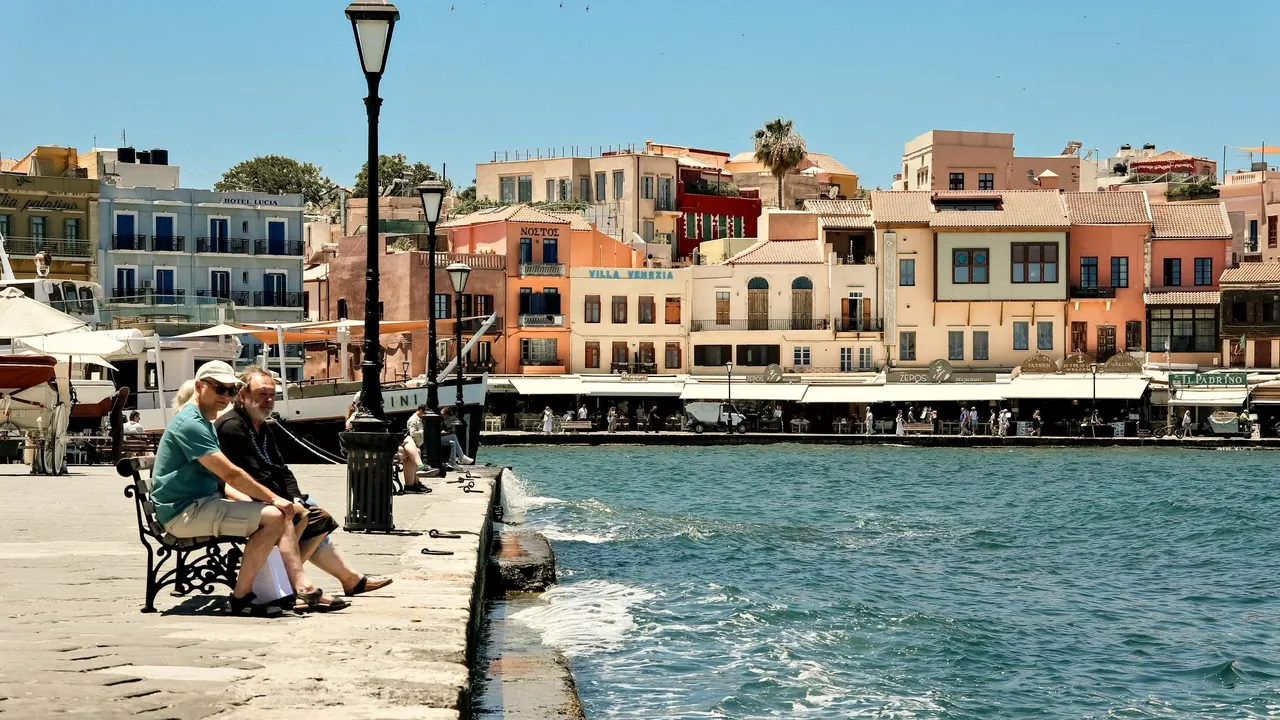
Photos: Crete by Piotr Baranowski, Pexels License.
Crete or Kefalonia?
Our verdict in twelve categories, each scored against the same fixed benchmark cities, and the climate month by month, so you can choose for your trip.
Choose Crete for
- culture and sights
- nightlife
- day trips
Crete is the island for a trip that wants more than a beach. Minoan palaces, the Heraklion Archaeological Museum and the Venetian old towns of Chania and Rethymno sit alongside one of the Mediterranean's most distinctive kitchens, high mountains with long gorges, and enough evening life to suit students and party groups as well as couples. It suits travellers who will drive a lot and want every day to be different, and families who like waterparks and resort clubs as well as sand.
Choose Kefalonia for
Kefalonia does not lead in any category we score.
Kefalonia is the quieter choice: a green, cliff-edged island where most days come down to choosing a cove, driving to it and staying for a long taverna dinner by a harbour. It has much less to see and much less to do after dark, and that is the point. Pick it for a slow beach trip with clear water, fir-covered Mount Ainos and the hop across to Ithaca, rather than for sightseeing or going out.
Scoreboard
Twelve categories on one fixed scale from 0 to 100. The shaded stretch is the gap between the two.
Your match
Pick a travel style or drag the sliders, and both match scores follow your weighting.
Wins on culture and sights and nightlife with your weighting.
Has no clear advantage with the weighting you have chosen.
What matters to you?
Category by category
What the scores mean for a trip.
Beaches & swimming
Both islands have outstanding beaches, but the experience differs. Crete gives more variety and more sand: the pink-tinged shallows of Elafonissi, the turquoise lagoon at Balos, the long open strand of Falassarna, the palms at Vai and easy resort beaches along the north coast, with wilder pebble coves such as Preveli on the south side.
Kefalonia is more about pebbles, cliffs and exceptionally clear water. Myrtos and Petani are white-shingle bays under steep green slopes, while the sandier, gentler beaches lie at Xi on Paliki and at Skala and Lourdas in the south. On both islands the best spots are spread across different coasts, so you choose a base and drive.
Food & drink
Crete eats better. Its cooking stands on its own, with island olive oil, wild greens, graviera, slow-cooked lamb and dakos, and the old towns of Chania and Rethymno and the market street in Heraklion reward a food-led trip, backed by the vineyards south of Heraklion.
Kefalonia has a few dishes worth seeking out, such as its spiced meat pie and aliada with salt cod, and Robola tastings in the Omala valley make a good afternoon. Away from Argostoli, though, harbour menus repeat from village to village, and neither island has much fine or international dining.
Culture & sights
There is no contest here. Crete holds the heart of Minoan civilisation, with Knossos, Phaistos and the Heraklion Archaeological Museum, then layers Roman Gortyn, Venetian harbours and walls, Ottoman Rethymno, Spinalonga and Arkadi on top. It is enough to fill a trip on its own.
Kefalonia lost almost all its old buildings in the 1953 earthquake. Fiskardo's harbour houses, the fortress at Assos, the Mycenaean tomb at Tzanata and the monastery of Agios Gerasimos make pleasant half-days out, but nobody chooses the island for its sights.
Nightlife
Crete offers two real scenes: the loud package-resort strips of Malia and Hersonissos for young groups, and a more grown-up evening of cocktail bars and late terraces in Chania, Rethymno and Heraklion, kept lively by Greek students.
Kefalonia has neither in any strength. A summer night means Argostoli's square and the Lithostroto, the beach bars at Lassi or a harbour drink in Skala or Fiskardo, and outside July and August most places close before midnight.
Nature & outdoors
Crete is the bigger outdoor destination. The White Mountains and Psiloritis rise above 2,400m, the Samaria gorge runs down to the Libyan Sea with Imbros and Aradena as shorter options, and the E4 path and the coast path to Loutro make serious walking, with climbing at Agiofarago besides.
Kefalonia is gentler and greener. The fir forest of Mount Ainos with its semi-wild horses, the cliffs above Myrtos, the Melissani lake cave and loggerhead turtles in Argostoli harbour make for varied days, and sea kayaking or sailing towards Ithaca suit it better than long hikes.
Day trips
Crete has more to fill free days with. Its four main towns each feel different, the wine villages around Archanes and mountain Anogia show the inland island, and boats run to Chrissi and Gramvousa, with Santorini reachable by fast ferry from Heraklion for a long day.
Kefalonia's one outstanding outing is Ithaca, a short crossing from Sami to Vathy, Kioni and Frikes. Summer boats to Zakynthos and Lefkada add a little, but the list is short and most crossings stop outside the warm season.
Good for families
Crete is easier with children. Long, gently shelving beaches on the north coast and around Chania come with resort pools and kids' clubs, Elafonissi's warm lagoon suits toddlers, and the waterparks and the aquarium at Gournes help on a hot day.
Kefalonia works for a beach-and-pool week if you stay near the sandy shallows of Skala, Lourdas or Xi, and the Melissani boat ride and the turtles go down well. With no theme parks, zoos or aquariums, a family that needs daily activities will run out of ideas faster.
Getting around
On both islands a hire car is all but essential, and on both the roads are mountainous and winding. Crete at least has a reliable bus line linking Chania, Rethymno, Heraklion and Agios Nikolaos, but it is a far larger island, and crossing from one end to the other takes most of a day.
Kefalonia's buses run too rarely to rely on, yet the distances are shorter: Argostoli to Fiskardo takes about an hour and a half, and the ferry to Lixouri cuts out a long drive. Expect tight parking at Myrtos, Assos and Fiskardo in summer.
Shopping & style
Neither island is for fashion, but Crete has more worth browsing. Chania's leather-makers' lane, knife-makers and covered market, Heraklion's stalls of cheese, herbs and raki, and the ceramics of Margarites make it a good place for crafts. Kefalonia offers the everyday shops of the Lithostroto and a few boutiques in Fiskardo, and its best souvenirs are edible: Robola, thyme honey and red mandoles.
Affordability
Crete is the slightly gentler island on the wallet. Village tavernas and family-run rooms are good value, and costs only climb sharply in Chania's old town, around the famous western beaches and in luxury Elounda.
Kefalonia is a little dearer overall, with Fiskardo and Assos clearly the expensive spots, though the south around Skala and Lourdas is fair. On both, car hire is the cost you cannot avoid, and June or September is the best balance.
Live music & performing arts
Crete is the better island for live music, because it can be heard on most summer evenings rather than by luck. Lyra and lute players lead fast circle dances and trade improvised mantinades verses in the music tavernas of Rethymno and Chania, mountain Anogia is known for its musicians, and on saints' days whole villages dance until late. On top of that, Heraklion and Chania put on summer festivals inside their fortresses and in open-air theatres.
Kefalonia has a gentler and much smaller offer. Its harmonised kantades serenades and the brass of Argostoli's philharmonic band are worth catching, but they come mainly at a village festival or an open-air concert in Argostoli's squares, so you are more likely to happen on one than to plan around it.
Wellness & relaxation
Neither island has a bathing culture, and on both the real restorative quality is pace rather than pampering. The difference is in kind: Crete has the more serious resort spas, gathered around Elounda and the Gulf of Mirabello, and car-free Loutro on the south coast for real quiet.
Kefalonia's spas are simply those of larger hotels at Lassi, Skala and Fiskardo, but the whole island runs slower, and the Paliki peninsula and north-east coast are easy places to switch off, especially in June and September.
When should you go?
Pick your month. The climate figures are measured averages, not a forecast.
Crete in July
Kefalonia in July
Daytime high, °C
Rainfall in the month, mm
Where the figures come from
Kefalonia's temperatures are measured 59 km from the centre, at Zakinthos / Agrilia.
Kefalonia has no rain gauge within 25 km of the centre, so its rainfall comes from a gridded climate dataset read at the destination rather than from a gauge further away.
Temperature and rainfall are climate normals, averaged over the years shown. Crete: 1991-2020 normals, Heraklion Airport (3.6 km from centre). Kefalonia: 1991-2020 normals, Zakinthos / Agrilia (58.6 km from centre).
Both islands share the same swimming season, roughly June to October, with the sea at about 25°C in August. Where most visitors stay, though, Kefalonia gets noticeably hotter in high summer, with highs around 33°C in August against about 29°C on Crete, so walks and drives there are best kept to early morning. Crete stays almost completely dry from May to September, while Kefalonia's rains come earlier and harder.
Autumn is where they differ most. On Crete, September and early October are still settled and sunny, which makes them ideal for beaches and gorge walks together. On Kefalonia, September already brings around 65mm of rain and by November it reaches about 159mm, so the island's best shoulder months are late May, June and early September. Winter is mild and wet on both, and spring is the time for hiking on either.
Which traveller are you?
On a culture and arts trip, Crete wins easily. Knossos, the Minoan frescoes in Heraklion, Venetian Chania and Ottoman Rethymno give days of sightseeing, while Kefalonia, rebuilt after its 1953 earthquake, offers Fiskardo and a few castles and little else.
For a food and nightlife trip, Crete is the better pick. Its village cooking, Heraklion's market and wine country, and the late bars of Chania's harbour and Rethymno's waterfront beat Kefalonia's repetitive taverna menus and a scene that goes quiet early.
On a relaxing and wellness trip, Kefalonia suits those who unwind through quiet: the Paliki peninsula, harbour evenings in Assos and few crowds outside high summer. Crete is the choice only if a serious resort spa around Elounda matters more than calm.
Before you go
| Measure | Crete | Kefalonia |
|---|---|---|
| Official language | Greek | Greek |
| Currency | Euro (EUR) | Euro (EUR) |
| Sockets | CF230 V, 50 Hz | CF230 V, 50 Hz |
| Driving side | Right | Right |
| Time zone | UTC+2, UTC+3 in summer | UTC+2, UTC+3 in summer |
| Emergency number | 112 | 112 |
| Main airport | Heraklion International Nikos Kazantzakis Airport (HER)129 non-stop destinations | Kefalonia International Airport "Anna Pollatou" (EFL)41 non-stop destinations |
| Public holidays this year | 15 days | 15 days |
By the numbers
| Measure | Crete | Kefalonia |
|---|---|---|
| Population | 623,065 | 36,064 |
| People per km² | 75 | 49 |
| Swim season, months above 21 °C | 5 months | 5 months |
Where else could you go?
Every comparison below shares a destination with this one, so you can follow Crete or Kefalonia somewhere new.