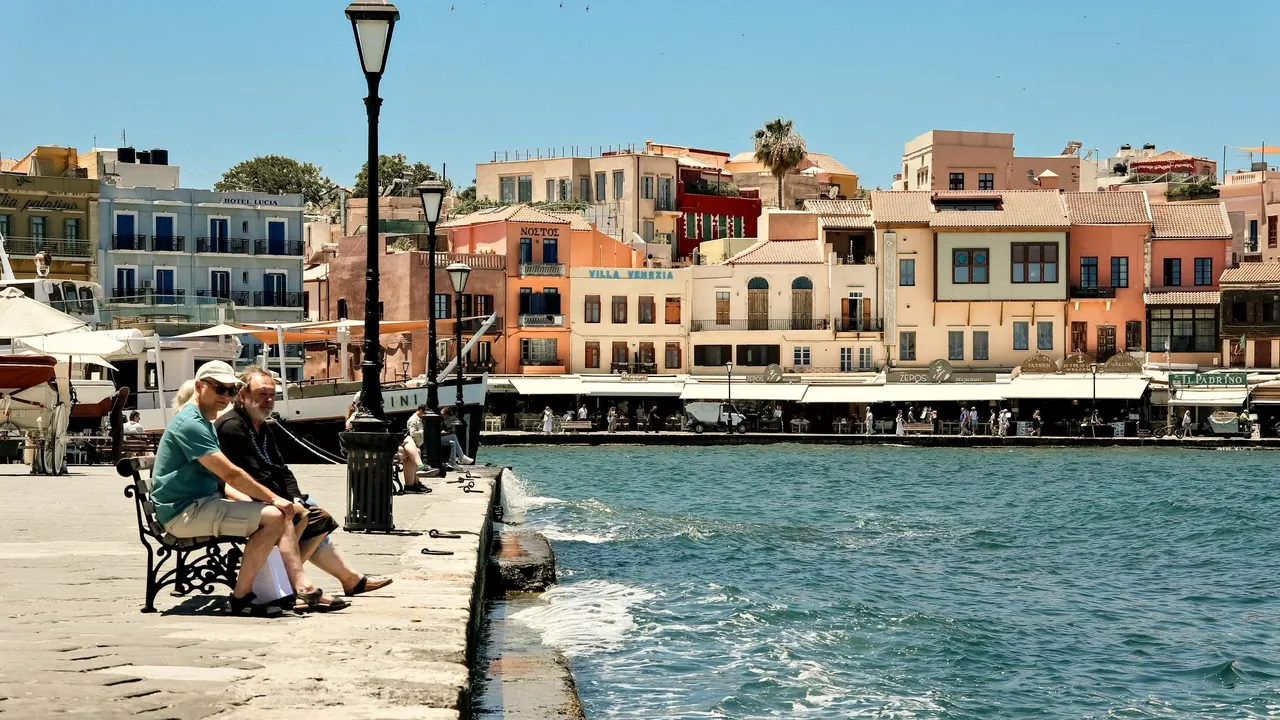
Photos: Crete by Piotr Baranowski, Pexels License.
Crete or Kos?
Our verdict in twelve categories, each scored against the same fixed benchmark cities, and the climate month by month, so you can choose for your trip.
Choose Crete for
- nature and the outdoors
- culture and sights
- food and drink
Crete is the island for a trip with real range. Go there if you want Minoan palaces and a museum of world rank, Venetian harbour towns, gorges to walk through and one of the Mediterranean's most distinctive kitchens, all on top of excellent beaches. In return you hire a car, accept long drives on winding roads, and probably come back knowing you missed half of it.
Choose Kos for
- getting around
Kos asks far less of you. It is a compact, mostly flat beach island where buses, bikes and short drives reach almost everything, Kos Town has its ruins in a walkable centre, and boats leave for Bodrum, Nisyros and Kalymnos. It suits a sun-and-sand week with little planning, though it has less depth in food, culture and landscape.
Scoreboard
Twelve categories on one fixed scale from 0 to 100. The shaded stretch is the gap between the two.
Your match
Pick a travel style or drag the sliders, and both match scores follow your weighting.
Wins on nature and the outdoors and culture and sights with your weighting.
Wins on getting around with your weighting.
What matters to you?
Category by category
What the scores mean for a trip.
Beaches & swimming
Both are true beach islands, but Crete has the greater variety and the more famous names. In the west there are Elafonissi's pink sand and lagoons, Balos under Gramvousa and the long strand at Falassarna. The east has the palm-backed bay at Vai, and on the south coast pebble coves reached by boat or on foot, such as Preveli.
Kos is mostly sand, with long open strands from Tigaki to Mastichari and its loveliest bays, Paradise Beach and Agios Stefanos, on the Kefalos peninsula. On both islands the meltemi stirs up the north coast in high summer, so the calmer water is on the south side.
Food & drink
Here Crete is far ahead. Its cooking is a regional cuisine in its own right, built on its own olive oil, wild greens, graviera and mizithra cheeses, slow-cooked lamb and dakos. The old towns of Chania and Rethymno, Heraklion's market street and the wine country to its south make eating a real reason to travel.
Kos serves pleasant Greek island food, with grilled octopus, meze, chickpea pitaroudia and wine-matured krasotyri. The best of it is in Zia, Pyli and the fishing harbours, and much of the resort cooking is written for package tourists. Crete's north-coast strips have the same problem, but there it is the exception.
Culture & sights
Crete offers a different scale of history. Knossos, the Heraklion museum's frescoes and the Phaistos Disc, the palaces at Phaistos and Malia and Roman Gortyn carry the story back to Europe's first great civilisation. Chania's Venetian harbour, Rethymno's fortress and Ottoman balconies, Spinalonga and Arkadi add later layers, though you need to drive to see them all.
Kos packs its sights tightly. Roman ruins, the Odeon and Neratzia Castle sit inside Kos Town, the Asklepieion is a short ride away, and Old Pyli and Antimachia's castle are further out. It makes two or three good days, where Crete can fill a whole trip.
Nightlife
The two are evenly matched for going out, and each has its party resort for young groups: Malia and Hersonissos on Crete, Kardamena on Kos. The difference is the rest of the evening. Crete's towns, Chania's harbour, Rethymno's waterfront and Heraklion's café-bar quarter, offer a calmer night of cocktail bars and terraces shared with Greek students and locals.
On Kos the scene is narrower. It is the loud bar lanes of Kos Town's old quarter and a few beach clubs at Lambi, run for summer visitors and almost closed out of season.
Nature & outdoors
Crete is a mountain island with a coast attached, and that is the gap. The White Mountains and Psiloritis hold snow into spring, gorges such as Samaria, Imbros and Aradena run down to the Libyan Sea, and there are griffon vultures, kri-kri goats, sport climbing at Agiofarago and the E4 across the island.
Kos is low and dry, with one range of hills rising behind Zia to Mount Christos. It has pleasant extras, such as peacocks in the Plaka forest and flamingos on the Alikes salt lake in spring and winter. Its outdoor strength lies on the water, in windsurfing and kitesurfing at Marmari and Tigaki.
Day trips
Crete gives a little more, and most of it is on the island itself. The other towns each make a day out, along with the wine villages around Peza and Archanes, the potters of Margarites and the mountain villages of Anogia and the Amari valley. Boats reach Chrissi and Gramvousa, and Santorini is a long but popular ferry day from Heraklion.
On Kos almost every outing is by boat. That has its own appeal: Bodrum's castle and bazaar in Turkey (bring a passport), the volcanic crater on Nisyros, sponge-diving Kalymnos and quiet lunches on Pserimos. In summer, though, everything depends on the boat timetables.
Good for families
Both work about equally well for families, with gently shelving sandy beaches, resort pools, kids' clubs, waterparks and tavernas happy to see children late. Crete has more to do on a hot or rainy day, such as the aquarium at Gournes and Elafonissi's warm lagoon, but it costs long, winding drives.
Kos trades variety for ease. Distances are short and the land is flat enough for families to cycle together. It has no zoo or aquarium, though, and little for children beyond the beach and the pool.
Getting around
Kos is much the easier island to get around. It is long and narrow, so nowhere is much over an hour's drive away. Buses link the town, the airport and the main resorts, and cycle lanes make bikes a real way to reach the beaches near Kos Town. A car or scooter for a day or two covers the far south-west.
On Crete a car is close to essential. Buses run reliably along the north coast, but the gorges, villages and southern beaches lie over steep mountain roads, the north-coast highway is demanding, and distances take longer than they look.
Shopping & style
Neither island is for fashion, but Crete has more worth taking home. Chania's leather-makers' lane, its knife-makers and its cross-shaped market hall are the high point, along with thyme honey, olive oil, raki and pottery from Margarites. On Kos the old-town lanes are mostly souvenirs, sandals and sponges, with the Italian-era market hall on Eleftherias Square the place for herbs and local produce.
Affordability
Costs are much the same on both, mid-range by Mediterranean standards and gentler than the Cyclades. The difference is where the money goes. On Crete car hire is hard to avoid and rises in summer, while the Elounda area and Chania's old town push prices up. Kos is built for package and all-inclusive travel, so buses and bike hire can replace the car for much of a stay, though harbour-front meals and sunbeds add up.
Live music & performing arts
Crete has the stronger music of its own. The lyra and lute, improvised mantinades and fast circle dances still live in the music tavernas of Rethymno and Chania, in Anogia and at village saints' day festivals. Summer festivals also use fortresses and open-air theatres in Heraklion and Chania.
On Kos the summer Hippokrateia festival, with its stages at the Asklepieion, the Odeon and the castle, is most of what there is. Apart from village feasts, the rest is resort Greek nights.
Wellness & relaxation
Neither island has a bathing tradition, and both rely on resort spas and an easy pace, so they are evenly matched. On Crete the serious spas gather around Elounda and the Gulf of Mirabello, and the deepest quiet is in boat-only Loutro and the olive-grove hill villages.
Kos has one natural pleasure Crete lacks: the sulphur spring at Therma, where hot water runs down into rock pools on the beach and mixes with the sea. It is best early or late in the day.
When should you go?
Pick your month. The climate figures are measured averages, not a forecast.
Crete in July
Kos in July
Daytime high, °C
Rainfall in the month, mm
Where the figures come from
Kos has no rain gauge within 25 km of the centre, so its rainfall comes from a gridded climate dataset read at the destination rather than from a gauge further away.
Temperature and rainfall are climate normals, averaged over the years shown. Crete: 1991-2020 normals, Heraklion Airport (3.6 km from centre). Kos: 1993-2020 (rainfall 1991-2020) normals, Kos Airport (23.2 km from centre).
The two islands follow almost the same pattern: cool, wet winters, a quick warm-up in spring and dry, hot weather from June to September. On both, the sea is warm enough to swim from June to October and peaks at around 25°C in late summer. The differences come at the extremes. On Crete, July and August afternoons reach about 29°C, while Kos climbs to around 31°C, so walking around Kos Town at midday is harder work. Winter is wetter on Kos too. January brings about 95mm of rain on Crete but around 170mm on Kos.
For a beach trip, June to September works on either island, and the sea is still warm in October. For walking, whether in Crete's gorges or among the ruins of Kos Town, April, May and October are the comfortable months. Crete's figures show long sunny days from May to September and bright weather in spring and autumn, so the months either side of summer are a good time to go.
Which traveller are you?
For a culture and arts trip, Crete is the clear choice. Knossos, Phaistos and the Heraklion Archaeological Museum are the heart of Minoan civilisation, Chania and Rethymno add Venetian and Ottoman townscapes, and the lyra music in town tavernas is a living tradition.
On an outdoors trip, Crete again wins easily. It has mountains above 2,400m, the Samaria gorge and many quieter ones, the E4 path and the south-coast trail past Loutro. Kos offers gentle hill walks and good windsurfing, but its landscapes are mild by comparison.
For a relaxing and wellness trip, Kos makes it easier. Drives are short, the quiet coasts around Kefalos and the hill villages of Zia and Pyli are close at hand, and the natural hot spring at Therma runs into the sea, a kind of bathing Crete simply does not have.
Before you go
| Measure | Crete | Kos |
|---|---|---|
| Official language | Greek | Greek |
| Currency | Euro (EUR) | Euro (EUR) |
| Sockets | CF230 V, 50 Hz | CF230 V, 50 Hz |
| Driving side | Right | Right |
| Time zone | UTC+2, UTC+3 in summer | UTC+2, UTC+3 in summer |
| Emergency number | 112 | 112 |
| Main airport | Heraklion International Nikos Kazantzakis Airport (HER)129 non-stop destinations | Kos International Airport "Ippokratis" (KGS)75 non-stop destinations |
| Public holidays this year | 15 days | 15 days |
By the numbers
| Measure | Crete | Kos |
|---|---|---|
| Population | 623,065 | 33,387 |
| People per km² | 75 | 115 |
| Swim season, months above 21 °C | 5 months | 5 months |
Where else could you go?
Every comparison below shares a destination with this one, so you can follow Crete or Kos somewhere new.