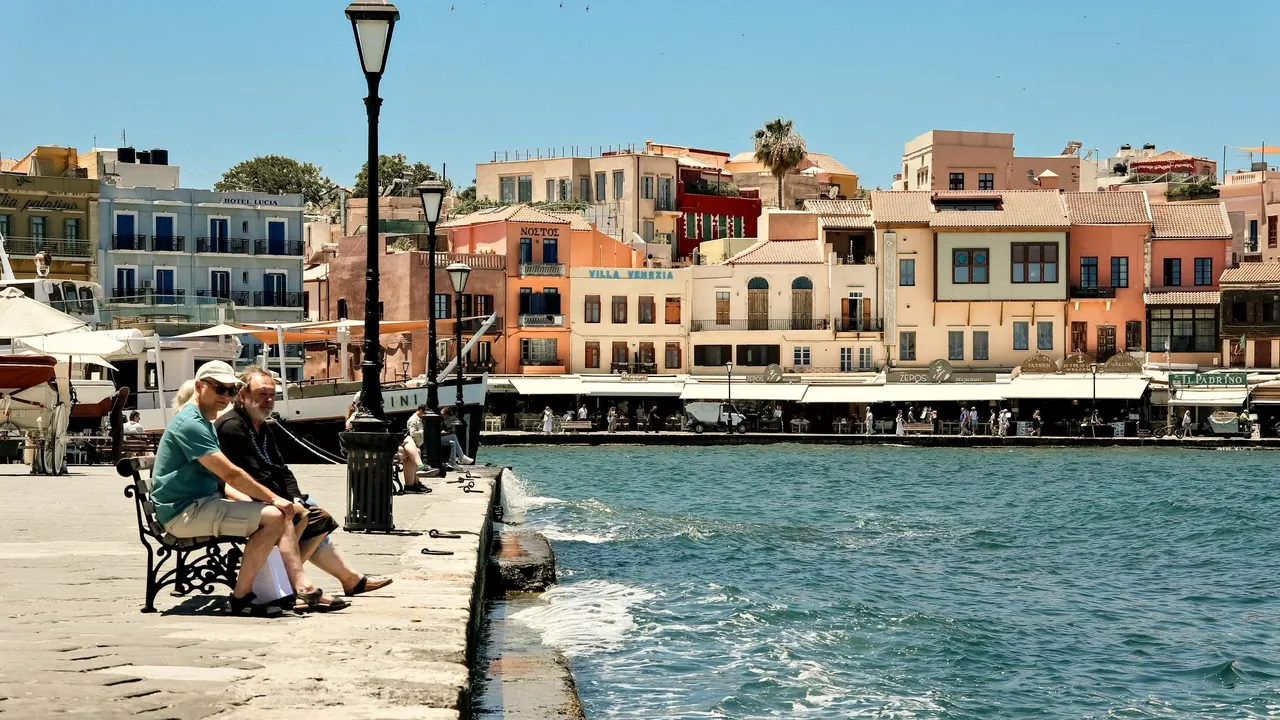
Photos: Crete by Piotr Baranowski, Pexels License.
Crete or Lefkada?
Our verdict in twelve categories, each scored against the same fixed benchmark cities, and the climate month by month, so you can choose for your trip.
Choose Crete for
- culture and sights
- food and drink
- nightlife
Crete is the island for a trip that mixes beaches with a great deal more. The Minoan palaces at Knossos and Phaistos, the Heraklion Archaeological Museum and Chania's Venetian harbour give days of sightseeing that Lefkada cannot match. Its cooking, from mountain cheeses to slow-cooked lamb, rewards anyone who plans the day around meals, and its resort coast suits families. It is a big island that needs driving, so it repays a longer stay.
Choose Lefkada for
Lefkada does not lead in any category we score.
Lefkada suits a smaller, simpler trip built around the water. It is reached by causeway rather than ferry. The turquoise beaches under the west-coast cliffs, the calm east-coast bays and the windsurfing bay at Vasiliki are all within a short but winding drive of each other, and the marina makes it a natural start for a week of sailing. Travellers who want to swim, sail and eat simply will have less to organise here, provided they don't need a major sight to plan around.
Scoreboard
Twelve categories on one fixed scale from 0 to 100. The shaded stretch is the gap between the two.
Your match
Pick a travel style or drag the sliders, and both match scores follow your weighting.
Wins on culture and sights and food and drink with your weighting.
Has no clear advantage with the weighting you have chosen.
What matters to you?
Category by category
What the scores mean for a trip.
Beaches & swimming
Both islands have outstanding beaches, so the choice comes down to the kind of shore. Crete offers more variety across its length: the pink-tinged lagoons of Elafonissi, the bay at Balos, Vai's palms in the east, long easy resort sands on the north coast, and pebble coves on the south coast reached by boat or on foot, such as Preveli.
Lefkada's best beaches are more dramatic but less easy. Porto Katsiki, Egremni and Kathisma lie under tall white cliffs on the open west coast, with steeply shelving water and waves in the afternoon. For calm swimming you cross to the small east-coast bays around Nikiana and Ligia, or go south to Agiofili.
Food & drink
Crete is the island to choose for food. Its cooking is one of the most distinctive in the Mediterranean, based on its own olive oil, wild greens, graviera and mizithra cheeses, and dakos. There are rewarding backstreet tavernas in the old towns of Chania and Rethymno, a market street in Heraklion and wine villages to its south.
On Lefkada you eat well but simply, with grilled fish on the harbours at Lefkada town and Nidri, Eglouvi lentils, a local cured salami and traditional cooking in villages such as Karya. It is good taverna food, but there is no food scene to travel for.
Culture & sights
There is a large gap here. Crete was the centre of the Minoan world, and Knossos, Phaistos, Malia and the frescoes and the Phaistos Disc in the Heraklion Archaeological Museum would justify the trip on their own. Venetian Chania, Ottoman-era Rethymno, Spinalonga and the monastery at Arkadi add many more layers of history.
Lefkada's sights are pleasant breaks from the beach rather than reasons to come. They include the fortress of Santa Maura at the causeway, a small museum, painted church ceilings in the town, Faneromeni monastery and the cliff at Cape Lefkatas linked to the legend of Sappho.
Nightlife
Crete has more choice after dark, in two very different scenes. Malia and Hersonissos are loud, late club strips aimed at young groups. The harbour at Chania, the waterfront at Rethymno and the old centre of Heraklion offer cocktail bars and late terraces, where Greek students help keep things lively.
Lefkada has no clubbing to speak of. Summer nights mean strolling and drinking in the lanes of Lefkada town, on the Nidri harbour strip among sailing crews, or at Vasiliki's relaxed windsurfers' bars, and outside July and August the island goes to bed early.
Nature & outdoors
On land, Crete is the bigger adventure. The White Mountains and Psiloritis rise above 2,400m. The Samaria gorge leads down to the Libyan Sea, the E4 path crosses the island, and vultures and the wild kri-kri goat live in the western cliffs. Lefkada's interior is greener but lower, with walks to the Dimosari waterfall and between hill villages.
On the water, however, Lefkada is a match for Crete. The afternoon wind at Vasiliki is among the best known in the Mediterranean for windsurfing, and the sheltered channels to Meganisi and the islets beyond are classic sailing waters.
Day trips
Both islands offer plenty of days out, but they point in different directions. On Crete the outings are mostly within the island itself: the other old towns, the wine villages around Peza and Archanes, Anogia and the Amari valley. There are boat trips to Chrissi and Gramvousa, and a long day on the fast ferry to Santorini.
Lefkada looks outward. Boats from Nidri visit Meganisi, Kalamos and Kastos, ferries from Vasiliki reach Fiskardo and Ithaca, and the mainland offers the Roman ruins at Nikopolis, the oracle at the Acheron and Venetian Parga.
Good for families
Crete is better set up for children. The north coast and the area around Chania have long sandy beaches that shelve gently, resort hotels with pools and children's clubs, waterparks and the aquarium at Gournes, and Elafonissi's warm lagoon is ideal for toddlers. Long, winding drives and midsummer heat are the main drawbacks.
Lefkada can work for a simple beach vacation if you stay on the east side, where the bays at Nikiana and Ligia are calm. There is little built for children, and the famous west-coast beaches, with surf, steep shelving and long cliff staircases, are hard work with small children.
Getting around
On both islands a hire car is the realistic answer, but the challenges differ. Crete is large and mountainous. Driving from one end to the other takes most of a day, the north-coast highway is busy and demanding, and the roads to the south are steep. A reliable bus line along the north coast at least links the main towns.
Lefkada is compact and needs no ferry, and the airport is about half an hour away. Its buses are too infrequent for visiting several beaches, though, the west-coast roads are slow, and summer brings congestion through Nidri and at Porto Katsiki.
Shopping & style
Crete has more worth buying. Chania's leather-makers' lane, its knife-makers and covered market, together with Heraklion's market street selling cheese, herbs, honey and raki, make for a rewarding morning's browsing. Pottery from Margarites is also worth bringing home.
On Lefkada shopping is mostly part of the evening walk along the pedestrian main street in Lefkada town, with olive oil, honey and lentils for sale. Karya's hand embroidery is the one local craft to look for.
Affordability
The two islands cost much the same. Both are mid-priced for Greece, and both are easiest on the budget in the months either side of high summer. On Crete, family-run rooms and generous village meals with free raki keep costs down, and prices rise in Chania's old town, near the western beaches and around Elounda's luxury resorts.
On Lefkada, accommodation near the west-coast beaches in August is the main cost, and boat excursions add up over a week of island-hopping. On both islands, car hire is a cost you can rarely avoid.
Live music & performing arts
Neither island has much formal theatre or concert life, but Crete's music has deeper roots. The lyra and the lute, with improvised verses and circle dances, are still a living tradition in the music tavernas of Rethymno and Chania, at village saints' day festivals and in Anogia. In summer, Heraklion and Chania also stage festivals in their fortresses.
Lefkada's highlight is its long-running international folklore festival in August, along with a few village festivals in summer. For the rest of the year there is very little to see.
Wellness & relaxation
Neither island has a bathing tradition, but Crete has more for a spa stay. The most serious resort spas are around Elounda and the Gulf of Mirabello, while Lefkada's treatments are limited to its better hotels and a handful of yoga retreats in the hills.
On both islands, the slower pace is the real way to unwind. On Crete that means Loutro, which you can reach only by boat or on foot, and hill villages among olive groves. On Lefkada it means quiet evenings in the small east-coast harbours.
When should you go?
Pick your month. The climate figures are measured averages, not a forecast.
Crete in July
Lefkada in July
Daytime high, °C
Rainfall in the month, mm
Where the figures come from
Lefkada has no rain gauge within 25 km of the centre, so its rainfall comes from a gridded climate dataset read at the destination rather than from a gauge further away.
Temperature and rainfall are climate normals, averaged over the years shown. Crete: 1991-2020 normals, Heraklion Airport (3.6 km from centre). Lefkada: 1998-2020 (rainfall 1991-2020) normals, Aktion Airport (24.3 km from centre).
The two islands share a summer. On both the sea is warm enough to swim from June into early October, reaching about 25°C in high summer. Midday heat makes July and August better for the beach than for hiking or long sightseeing walks. On Crete the long, sunny days of June and July bring almost no rain at all, and highs settle at around 29°C. Lefkada runs a little hotter, at about 31°C in August.
The real difference comes in autumn. Crete stays dry for longer, with around 55mm in October, which makes it the safer choice for a late trip. On Lefkada the rain returns in September and is heavy by October, at about 101mm, so beach days become less reliable even though the sea is still warm. Both islands are wet and too cool for the beach from November to March. April and May are mild and good for walking on either, though the sea is still cool and Crete is the drier of the two.
Which traveller are you?
On a culture and arts trip, Crete is the clear choice. Knossos, the Heraklion Archaeological Museum, the palaces in the south and the Venetian old towns of Chania and Rethymno fill days, while Lefkada's fortress and small museum fill only an afternoon.
On a family trip with children, Crete has far more to offer. It has resort hotels with pools and children's clubs, waterparks and the aquarium at Gournes, and the shallow lagoon at Elafonissi suits small children. Lefkada has calm east-coast bays but little else made for children.
For windsurfers and sailors, Lefkada is the island to pick. The steady afternoon wind in Vasiliki bay draws boards from across Europe, and the sheltered channels between its satellite islands, with a large marina nearby, make it a classic place to start a week on a yacht.
Before you go
| Measure | Crete | Lefkada |
|---|---|---|
| Official language | Greek | Greek |
| Currency | Euro (EUR) | Euro (EUR) |
| Sockets | CF230 V, 50 Hz | CF230 V, 50 Hz |
| Driving side | Right | Right |
| Time zone | UTC+2, UTC+3 in summer | UTC+2, UTC+3 in summer |
| Emergency number | 112 | 112 |
| Main airport | Heraklion International Nikos Kazantzakis Airport (HER)129 non-stop destinations | Aktion National Airport (PVK)47 non-stop destinations |
| Public holidays this year | 15 days | 15 days |
By the numbers
| Measure | Crete | Lefkada |
|---|---|---|
| Population | 623,065 | 22,652 |
| People per km² | 75 | 64 |
| Swim season, months above 21 °C | 5 months | 5 months |
Where else could you go?
Every comparison below shares a destination with this one, so you can follow Crete or Lefkada somewhere new.