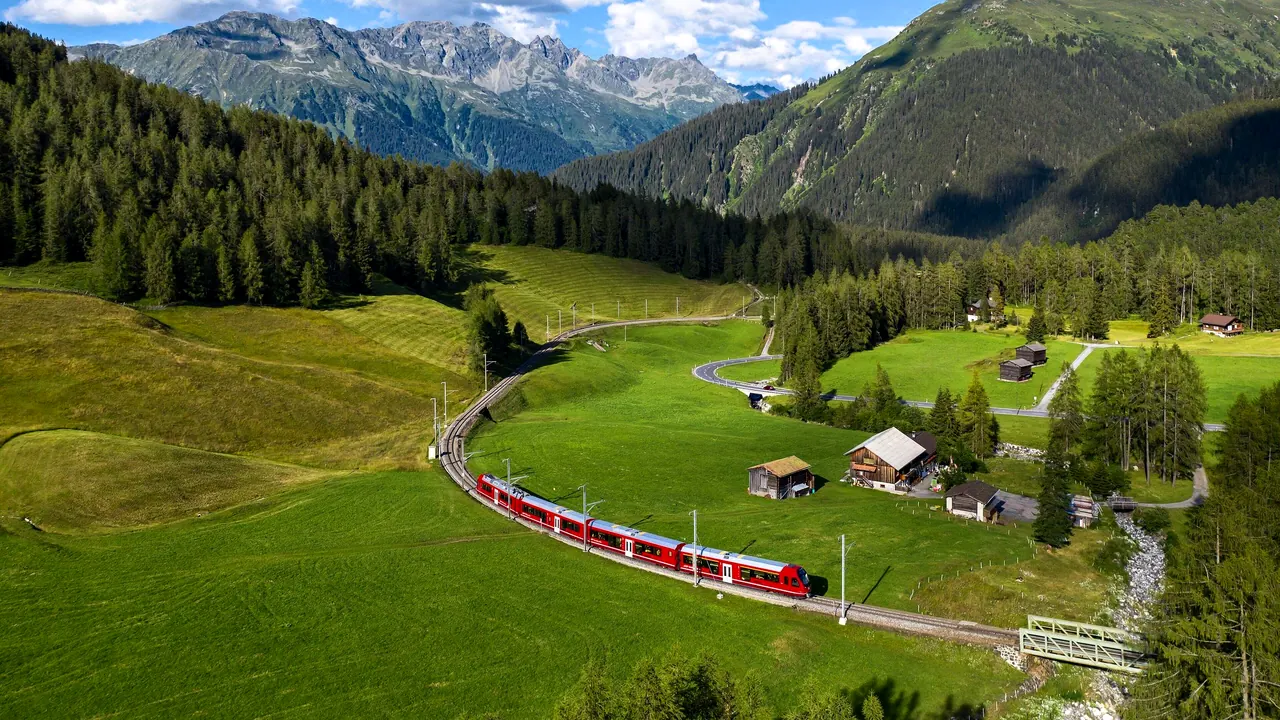
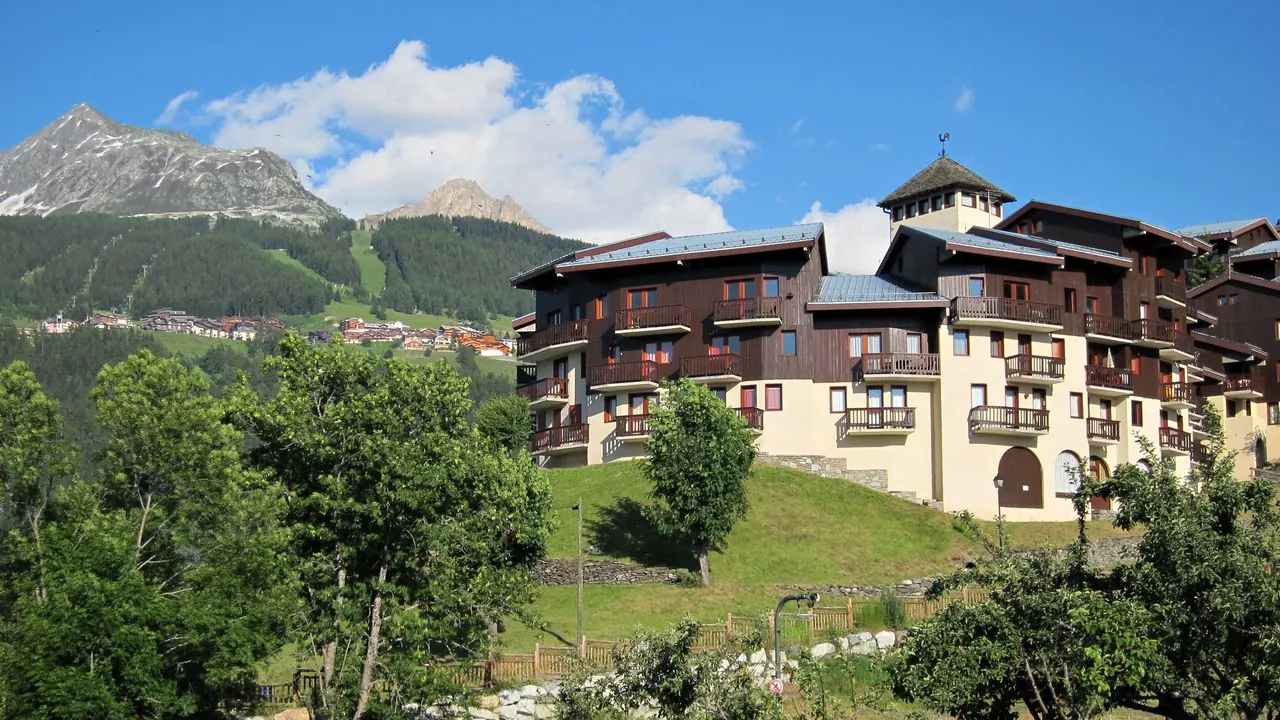
Photos: Davos by Kabelleger / David Gubler, CC BY-SA 4.0, cropped; La Plagne by Henk Monster, CC BY 3.0, cropped.
Davos or La Plagne?
Our verdict in twelve categories, each scored against the same fixed benchmark cities, and the climate month by month, so you can choose for your trip.
Choose Davos for
- getting around
- wellness
- culture and sights
Davos suits travellers who want a mountain vacation with a real town attached. You can arrive by train, ride free buses between Davos Dorf and Davos Platz, and spend an off-slope afternoon at the Kirchner Museum or up at the old Schatzalp sanatorium. The Rhaetian Railway opens up the Albula line and the Engadine for days away, and hotel spas and the clear dry air make it the better choice for a slower pace. It is also one of the costliest places you could pick.
Choose La Plagne for
- prices
- families
- nightlife
La Plagne is built for families on a ski week. Belle Plagne and the other villages sit right on the snow, children walk straight out to gentle slopes, and self-catering apartments keep a long stay within reach. There is very little to do away from the pistes and lifts, and you need a car to leave the resort easily. Skiing and summer walking are just as good as at Davos, and for a family that mostly wants to be outside together, La Plagne is the simpler and cheaper choice.
Scoreboard
Twelve categories on one fixed scale from 0 to 100. The shaded stretch is the gap between the two.
Your match
Pick a travel style or drag the sliders, and both match scores follow your weighting.
Wins on getting around and wellness with your weighting.
Wins on prices and families with your weighting.
What matters to you?
Category by category
What the scores mean for a trip.
Beaches & swimming
Neither is a place to swim, and the differences are small. Davos has an actual lido on the Davosersee, with lawns and a jetty for a cold summer dip. La Plagne's mountain lakes are better for a picnic, so swimming there means the heated pools at the resort's leisure centres.
Food & drink
The food is equally good in both places and very similar: hearty mountain cooking, at its best over lunch at a hut on the slopes. Davos serves Graubünden dishes such as capuns, pizokel, barley soup and air-dried Bündnerfleisch, with Engadiner Nusstorte for dessert.
La Plagne is Savoyard country, where tartiflette, croziflette and Beaufort take the place of Bündnerfleisch. Self-catering plays a bigger part there, and the resort cheese counters are a pleasure in themselves.
Culture & sights
Davos has a story to tell, and La Plagne mostly does not. In the late nineteenth century Davos became a tuberculosis resort, and it is the setting of The Magic Mountain. You can still see that era in the sun balconies of the Schatzalp, and the Kirchner Museum is worth a visit of its own.
La Plagne dates from the 1960s, and its sights are the resort itself: the liner-shaped Aime 2000 block, the high-rise Plagne Centre and the Olympic bobsleigh track. Anything older, such as the Romanesque basilica at Aime, means driving down to the valley.
Nightlife
Both are quiet once the lifts close, and evenings centre on après-ski in winter. Davos has more of a town to go out in, with pubs, hotel bars and a couple of small clubs strung along the Promenade.
La Plagne's nightlife is spread across separate villages, mainly Plagne Centre and Belle Plagne. Because it is a family resort, most guests are in bed early for first lifts.
Nature & outdoors
For mountains, the two are equals, but the skiing works differently. Davos spreads across five separate areas, from Parsenn and Jakobshorn to Madrisa above Klosters, and it has more than 100km of long-established cross-country trails into the Sertig and Dischma valleys.
La Plagne is one vast linked area. It joins Les Arcs by the Vanoise Express to form Paradiski, with broad intermediate slopes that climb to the Bellecôte glacier. In summer, Davos has the denser trail and singletrack network, while La Plagne adds paragliding, via ferrata, rafting on the Isère and a direct path into the Vanoise National Park.
Day trips
Davos has the clear advantage, because the trip there is half the pleasure. The Rhaetian Railway crosses the Landwasser Viaduct and runs along the UNESCO-listed Albula line to St Moritz, and other lines reach Chur's medieval centre or the painted houses of Guarda, all without a car.
From La Plagne, every outing starts with the long road down the mountain. Conflans, Chambéry and Annecy are rewarding but need a car, and the high passes to the Beaufortain and the Aosta Valley only open in summer.
Good for families
La Plagne is the more natural fit for children. It was planned around families, and in villages such as Belle Plagne they step out of the door onto the snow, with no traffic to watch for.
Davos is a good family choice too, with nursery slopes, the Schatzalp toboggan run and an indoor pool with slides for wet days. But it is a spread-out town rather than a ski-in village, and families do more travelling between home and the slopes.
Getting around
Davos is far easier to reach and to leave. The train from Zurich stops at two stations in town, guest-card buses run the length of the valley, and the Parsenn funicular and Jakobshorn cable car leave from the streets.
La Plagne is simple once you are up there, thanks to ski-in, ski-out lodging and free shuttles between villages. The approach is the hard part: a bus or car up a winding road from Aime, often with snow chains in winter.
Shopping & style
Neither is somewhere to shop, but Davos gives you a bit more to browse. Alongside the ski shops, its Promenade has watch and jewellery stores and a few fashion boutiques, while La Plagne has little beyond rental, outdoor gear and groceries. Both send you home with good mountain food: Bündnerfleisch and Nusstorte from the Davos delicatessens, Beaufort, génépi and cured sausages from La Plagne's cheese and produce counters.
Affordability
Both are expensive, but Davos is in a class of its own. Hotels, lift passes and meals all come at Swiss resort prices, and rooms get even scarcer and costlier during the World Economic Forum.
La Plagne is pricey in a winter week too, yet its large stock of apartments lets families cook for themselves. Summer and quieter ski weeks bring costs down noticeably.
Live music & performing arts
Davos has at least one reason to plan around music: its summer classical festival, where young musicians play in churches and hotels around the valley. La Plagne offers only torchlight descents and bands in après-ski bars, and the nearest proper stage is in Chambéry.
Wellness & relaxation
Davos is the better place to unwind, and its facilities are larger. Most of the bigger hotels have proper spas with pools and treatment rooms. The town's leisure pool also lets day visitors use its sauna area, so you can have a spa afternoon without staying anywhere grand. For a full thermal day, the train runs through the Vereina tunnel to the mineral baths at Scuol, and you don't need a car.
La Plagne's spas are smaller and are there mainly to ease aching legs. You get hot tubs and saunas in the apartment residences, plus the resort's aquatic centres. Its spa towns, Brides-les-Bains and La Léchère, are about as far away as Scuol is from Davos, but to reach them you have to take the long road down to the valley. Most guests also come to ski hard, so a week here tends to leave you more tired than rested.
When should you go?
Pick your month. The climate figures are measured averages, not a forecast.
Davos in July
La Plagne in July
Daytime high, °C
Rainfall in the month, mm
Where the figures come from
Davos's temperatures are measured 53 km from the centre, at S. Valentino Alla Muta.
Davos has no rain gauge within 25 km of the centre, so its rainfall comes from a gridded climate dataset read at the destination rather than from a gauge further away.
La Plagne has no weather station within reach, so its figures come from a gridded climate model rather than a measured record, and read a broad area rather than one spot.
Temperature and rainfall are climate normals, averaged over the years shown. Davos: 1991-2020 normals, S. Valentino Alla Muta (53.4 km from centre). La Plagne: 2001-2020 normals, NASA POWER reanalysis grid, no weather station within 90 km.
Neither place is a warm-weather destination. Davos is the milder of the two all year. Its summer highs reach about 20°C in July and August, which suits hiking and long terraces, though this is also its wettest stretch, with August bringing around 142mm of rain, mostly as afternoon showers. La Plagne sits higher and colder. Daytime highs stay below freezing from December to February and drop to about -4°C in January, so the snow lasts well. Summer peaks around 18°C, and rain is spread more evenly through the year, with May the wettest month at about 103mm.
For skiing, both are at their best from December to March, and La Plagne's colder winter gives it the more reliable cover high up. For walking and biking, July to September is the window at both. Davos is warmer then, but you are more likely to be rained on. Late spring and November are dull, muddy months in both places.
Which traveller are you?
On a family trip with young children, La Plagne is the easier choice. Its car-free villages open straight onto beginner slopes, the ski schools run large programmes for small children, and a padded bob-raft ride down the Olympic track thrills older ones.
For a trip on a tight budget, La Plagne hurts less. Neither is cheap, but its many self-catering apartments and quieter ski weeks keep costs in check, while Davos charges Swiss resort prices for nearly everything, and more in peak weeks.
For a relaxing and wellness trip, Davos is the better pick. It made its name as a place to recover in clear, dry mountain air, most of its larger hotels have pools and treatment rooms, and Scuol's mineral baths are about an hour away.
Before you go
| Measure | Davos | La Plagne |
|---|---|---|
| Official language | French, German, Italian, Romansh | French |
| Currency | Swiss Franc (CHF) | Euro (EUR) |
| Sockets | CJ230 V, 50 Hz | CE230 V, 50 Hz |
| Driving side | Right | Right |
| Time zone | UTC+1, UTC+2 in summer | UTC+1, UTC+2 in summer |
| Emergency number | 112 | 112 |
| Elevation | 1,559 m | 1,974 m |
| Main airport | Zürich Airport (ZRH)122 km from centre226 non-stop destinations | Geneva International Airport (GVA)92 km from centre150 non-stop destinations |
| Public holidays this year | 9 days | 11 days |
By the numbers
| Measure | Davos | La Plagne |
|---|---|---|
| Population | 10,738 | - |
| People per km² | 38 | - |
| Museums within 10 km | 3 | 2 |
| UNESCO World Heritage sites within 50 km | 2 | 0 |
Where else could you go?
Every comparison below shares a destination with this one, so you can follow Davos or La Plagne somewhere new.
- Klostersvs Davos
- Courchevelvs La Plagne
- Arosavs Davos
- Les Arcsvs La Plagne
- Méribelvs La Plagne
- Tignesvs La Plagne