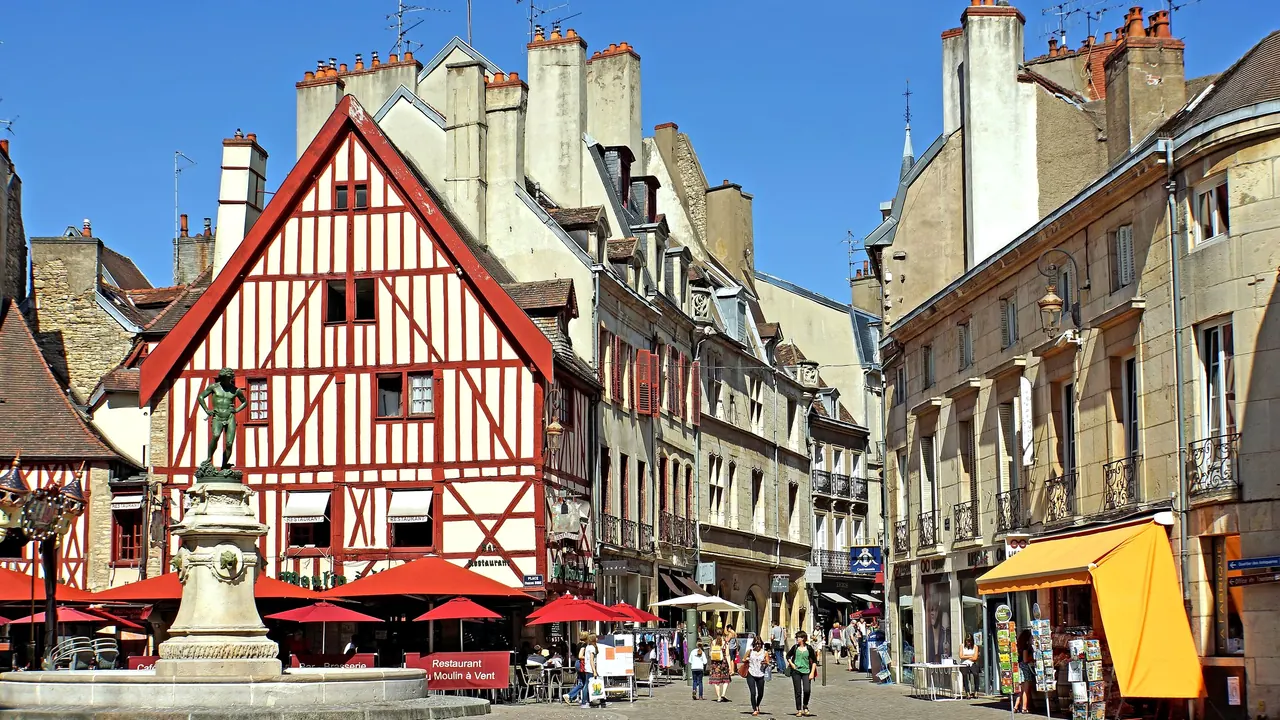
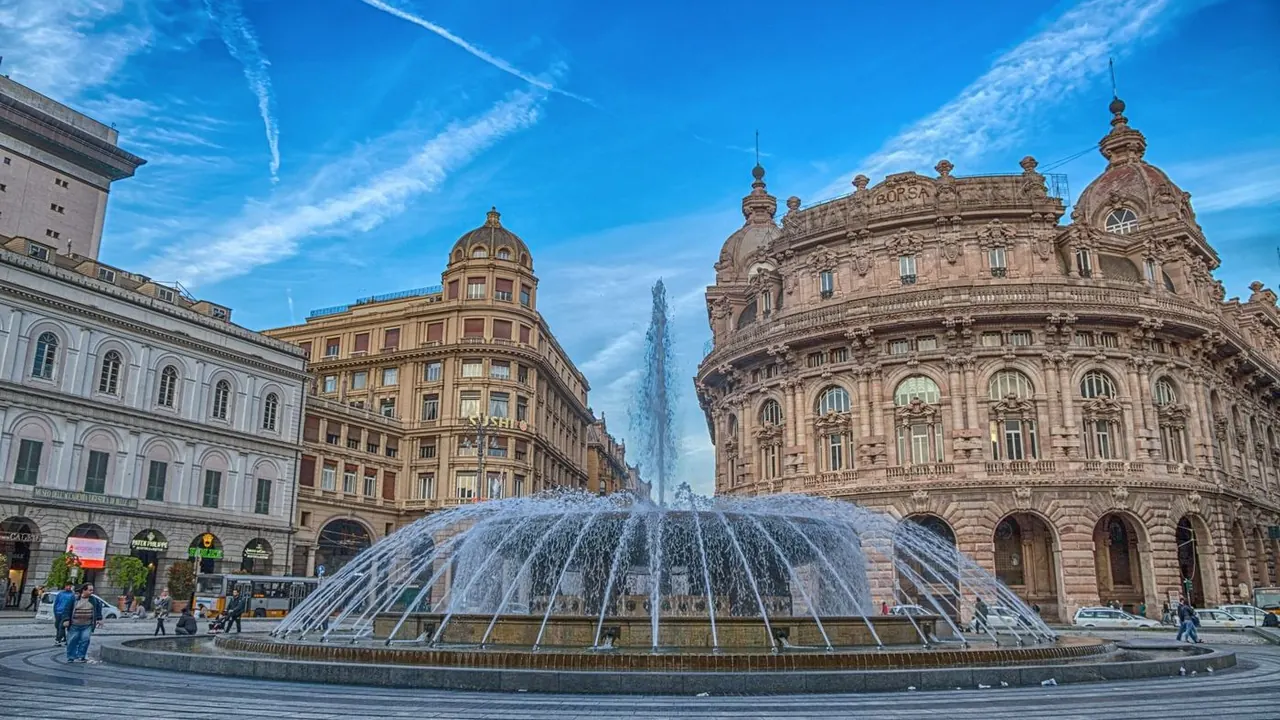
Photos: Dijon by Dennis G. Jarvis, CC BY-SA 2.0, cropped; Genoa by Faber1893, CC BY-SA 4.0, cropped.
Dijon or Genoa?
Our verdict in twelve categories, each scored against the same fixed benchmark cities, and the climate month by month, so you can choose for your trip.
Choose Dijon for
- getting around
Dijon is the better pick for a traveller who wants food and wine at the centre of the trip. The vineyards of the Côte de Nuits start at the edge of town, so village Burgundies come by the glass and the famous wine names are a short drive or cycle away. The old centre is flat and compact, so your days can run slowly: the dukes' palace in the morning, Les Halles at lunch, a cellar in the afternoon. It works well as a quiet, unhurried base, though it has no sea and less to keep children busy.
Choose Genoa for
- beaches
- nature and the outdoors
- families
Genoa gives you more to do in more directions. You get a large medieval port city with palaces, a long coast for swimming and cliff walks, and a railway line that runs past Portofino and the Cinque Terre. It suits travellers who want a city break and a stretch of the Riviera in one trip, and who don't mind steep lanes and stairs. For families, walkers and anyone who wants to swim, it is the stronger choice.
Scoreboard
Twelve categories on one fixed scale from 0 to 100. The shaded stretch is the gap between the two.
Your match
Pick a travel style or drag the sliders, and both match scores follow your weighting.
Wins on getting around with your weighting.
Wins on beaches and nature and the outdoors with your weighting.
What matters to you?
Category by category
What the scores mean for a trip.
Beaches & swimming
Dijon can't offer a beach trip. The only open-air swimming is at Lac Kir, a supervised lawn-and-sand area at a reservoir that suits a hot afternoon with children, and after that it's a municipal pool.
Genoa lets you swim on most summer afternoons without leaving the city: the pebble cove at Boccadasse, the bathing places on the rocks along Corso Italia, and the platforms below the cliffs at Nervi. Better water is a short train ride away at Camogli, Sestri Levante or the sandier beaches of Varazze. The shores are mostly pebble, and loungers fill much of the space.
Food & drink
Both cities eat very well. The difference is in what you eat and how. Dijon offers the classic French table: boeuf bourguignon, snails and Époisses cheese, served over long bistro lunches. It also has good wine by the glass and a proper fine-dining tier.
Genoa's cooking is lighter and closer to the street: focaccia at breakfast, pesto with trofie, and farinata and fried fish by the slice from old shops in the caruggi, with seafood in the harbour trattorias. Come to Genoa for grazing and the sea, and to Dijon for a long sit-down meal with Burgundy in the glass.
Culture & sights
Dijon's sights are concentrated and easy to take in: the Palace of the Dukes, the carved Valois tombs in the Musée des Beaux-Arts, the gargoyles of Notre-Dame and the lucky owl. A well-kept half-timbered centre fills the gaps, and two or three days is enough to see it.
Genoa has more, and it goes deeper. The caruggi make up one of Europe's largest medieval quarters. Above them, Via Garibaldi has a row of Rolli palaces with painted halls and works by Van Dyck and Rubens. Add the striped cathedral, the Lanterna and the marble sculpture of Staglieno, and you have enough to fill a longer stay.
Nightlife
Neither city is for a big night out, but Genoa has more going on in the evenings. People take aperitivo in the medieval squares around Piazza delle Erbe, there are waterfront bars at the Porto Antico, and in summer the crowds move out to the beach clubs along Corso Italia.
Dijon's evenings depend on its students. In term time Rue Berbisey and the market quarter fill with wine bars and pubs, but the streets go quiet around midnight once the students have left.
Nature & outdoors
Genoa has hills behind it and sea in front, so you can walk out of the city. A funicular takes you up to the ring of forts above the port. The Portofino promontory has cliff paths down to San Fruttuoso, and the boats that go out to look for whales and dolphins add something Dijon has no answer to.
Dijon's countryside is gentle. The combes just west of town have short trails and climbing cliffs, the canal towpath is flat and good for easy cycling, and the Morvan's granite hills are the wildest scenery within reach. It suits cyclists better than hikers looking for drama.
Day trips
Day trips from Dijon mostly need a car, a bike or a small tour, while from Genoa almost all of them are on the coastal railway. Dijon's days out are about wine and stone: the grand cru villages of the Côte de Nuits down to walled Beaune, Fontenay's Cistercian abbey in its wooded valley, and the ramparts of Semur-en-Auxois. Beaune and Besançon are the easy ones by train.
From Genoa the train takes you along the Riviera to Camogli, Santa Margherita for Portofino, Sestri Levante and the Cinque Terre, or inland to Milan or Turin for a museum day. Genoa's days out are about cliff villages and the sea, Dijon's about vineyards and abbeys.
Good for families
Genoa keeps children busier. The Porto Antico has one of Europe's largest aquariums, a science centre, a submarine you can walk through and a panoramic lift, and the funiculars feel like rides in themselves. The downside is the steep, dark lanes and stairs, which are hard work with a pushchair.
Dijon is the easier city to walk with small children. It is flat, safe and mostly pedestrianised, and it has a planetarium and park lawns. But once those are done, its days of tastings and fine art suit the parents more.
Getting around
Dijon is the simpler city to get around. The station, the market, the palace and the cathedral are a few flat minutes apart on foot. Trams cover the outskirts, and the TGV gets you from Paris in well under two hours. The only time you need wheels is for the wine villages away from the railway.
Genoa takes more effort. The old town is a maze, the city climbs steeply from the water, and the buses crawl through narrow streets. Funiculars, public lifts and the coastal railway make up for much of this, and the train along the Riviera is the most useful link of all.
Shopping & style
In both cities you'll mostly be shopping for things to eat. Genoa has a little more variety: the arcades of Via XX Settembre, Italian labels around Galleria Mazzini, and old-town workshops making silver filigree and coral, on top of the pesto and candied fruit.
Dijon's shopping centres on mustard, pain d'épices, cassis and Burgundy from the wine merchants. Rue de la Liberté adds a department store, French chains and some antiques in the side lanes.
Affordability
Both are mid-range, and the overall cost is similar. What differs is where the money goes. In Dijon, set lunches and wine by the glass are fair, but tastings, wine tours and good bottles add up quickly.
In Genoa, focaccia and farinata make some of the cheapest good meals in northern Italy, and the funiculars cost little. Beach days are where it gets expensive, with rented loungers and the smart Riviera resorts in summer.
Live music & performing arts
Genoa has a little more going on. The Teatro Carlo Felice on Piazza De Ferrari runs opera, ballet and symphony seasons. The city also holds Paganini concerts and has small clubs where the tradition of Genoese singer-songwriters lives on.
Dijon's Opéra is good for a city of its size, with the old Grand Théâtre and the Auditorium, known for its acoustics. But the programme follows the academic year and thins to outdoor events in summer.
Wellness & relaxation
Dijon has no bathing culture to speak of, so rest there comes from the pace of the place. There are a few hotel spas and the odd grape-based treatment in the wine villages, but mostly it means long lunches and quiet afternoons among the vines.
Genoa gives you a little more for unwinding. The thermal waters of Acqui Terme, a historic spa town in the Piedmont hills, are a little over an hour away. Closer in, Nervi's seafront promenade and villa gardens are calm in a way the busy port centre never is.
When should you go?
Pick your month. The climate figures are measured averages, not a forecast.
Dijon in July
Genoa in July
Daytime high, °C
Rainfall in the month, mm
Where the figures come from
Genoa has no rain gauge within 25 km of the centre, so its rainfall comes from a gridded climate dataset read at the city rather than from a gauge further away.
Genoa's sunshine is measured 80 km from the centre, at Capo Mele.
Temperature and rainfall are climate normals, averaged over the years shown. Dijon: 1991-2020 normals, Dijon (7 km from centre). Genoa: 1991-2020 normals, Genova / Sestri (6.7 km from centre).
Dijon has a continental climate, with clear seasons. Winters are cold and grey, with highs of about 6°C in January and little sunshine. Late spring to early autumn is the best time to visit, when the vineyards are green and summer afternoons reach 27°C or so. Rain is spread fairly evenly through the year, so no month is a washout, but none is reliably dry either. September is a good month to walk the wine villages before the weather cools.
Genoa is milder all year. Winter highs stay around 12°C, so walking the old town in January is quite comfortable. Summer is the beach season: the sea warms to about 25°C by August, and July is the sunniest and driest month. Autumn is the time to be careful. September brings heavy rain, and October is very wet, with about 212mm, so for walking the coast paths, late spring is the better choice.
Which traveller are you?
On a beach and sun trip, choose Genoa without hesitation. It has swimming coves and seafront bathing places within the city, clear water through the summer, and Riviera towns a short train ride away. Dijon is far inland and has only a lake on its western edge.
For an outdoors trip, Genoa again has the edge. You can take the funicular up to the ridge-top forts, walk the cliff paths of Portofino, hike the Cinque Terre trails and take boats out to see whales. Dijon's limestone valleys and canal towpaths are pleasant, but much gentler.
On a wine trip, Dijon is the obvious base. The Route des Grands Crus starts at the edge of the city and runs through Gevrey-Chambertin and Vougeot to Beaune. The wine bars pour village Burgundies by the glass, which Genoa's Ligurian whites can't match.
Before you go
| Measure | Dijon | Genoa |
|---|---|---|
| Official language | French | Italian |
| Currency | Euro (EUR) | Euro (EUR) |
| Sockets | CE230 V, 50 Hz | CFL230 V, 50 Hz |
| Driving side | Right | Right |
| Time zone | UTC+1, UTC+2 in summer | UTC+1, UTC+2 in summer |
| Emergency number | 112 | 112 |
| Elevation | 220 m | 20 m |
| Main airport | Lyon Saint-Exupéry Airport (LYS)178 km from centre141 non-stop destinations | Genoa Cristoforo Colombo Airport (GOA)7 km from centre25 non-stop destinations |
| Public holidays this year | 11 days | 13 days |
By the numbers
| Measure | Dijon | Genoa |
|---|---|---|
| City population | 161,830 | 558,745 |
| People per km² | 3,890 | 2,325 |
| Museums within 10 km | 8 | 51 |
| UNESCO World Heritage sites within 50 km | 1 | 1 |
| Swim season, months above 21 °C | - | 4 months |
Where else could you go?
Every comparison below shares a destination with this one, so you can follow Dijon or Genoa somewhere new.