Dominican Republic
La Romana
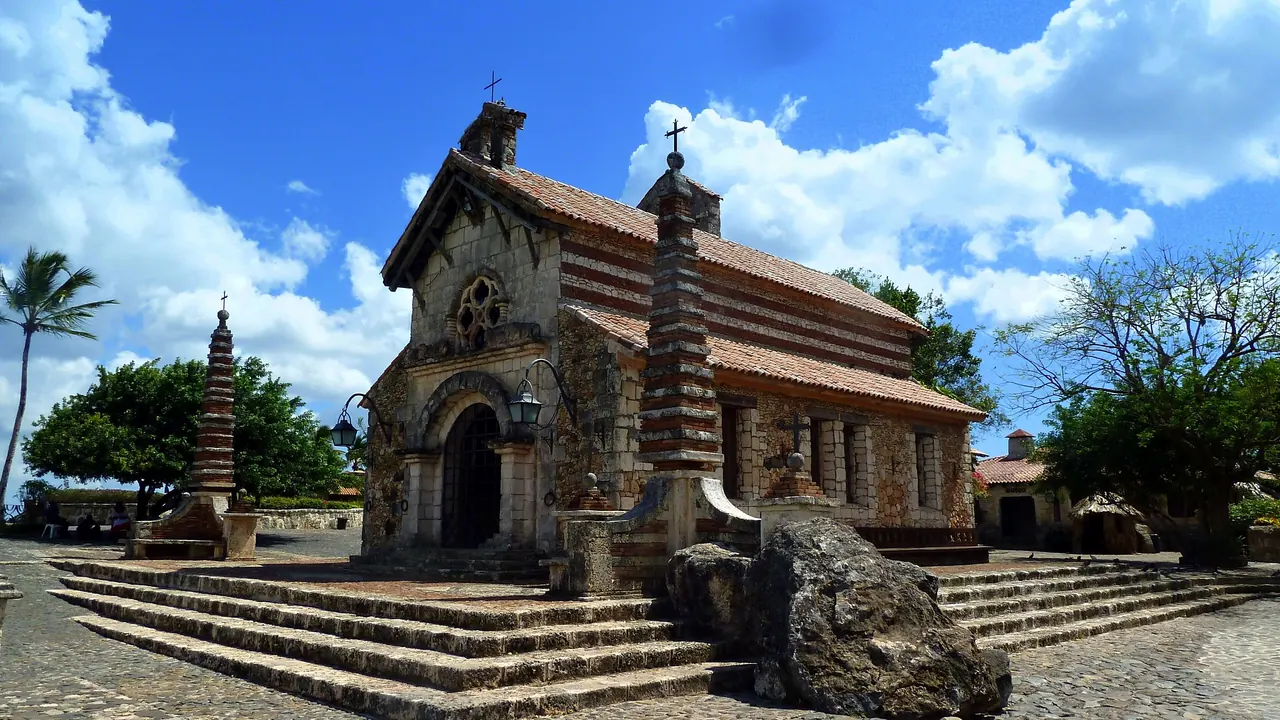
The church of San Estanislao at Altos de Chavón
- Beaches84
- Nature & outdoors62
- Families56
Match
42
Every category weighted equally
- Beach & sun50
- Culture & arts34
- Food & nightlife35
- Family trip49
- Outdoors50
- Relax & unwind47
- Shopping & style36
- On a budget43
La Romana in twelve categories
Our verdict on each, scored 0 to 100 against the same fixed benchmark cities, so a score means the same thing on every page.
Beaches & swimming. Scores 84 out of 100.
Food & drink. Scores 38 out of 100.
Culture & sights. Scores 24 out of 100.
Nightlife. Scores 30 out of 100.
Nature & outdoors. Scores 62 out of 100.
Day trips. Scores 52 out of 100.
Good for families. Scores 56 out of 100.
Getting around. Scores 24 out of 100.
Shopping & style. Scores 28 out of 100.
Affordability. Scores 50 out of 100.
Live music & performing arts. Scores 17 out of 100.
Wellness & relaxation. Scores 44 out of 100.
La Romana category by category
Beaches & swimming
84The town of La Romana sits on a working river mouth and has no beach worth planning around. The beaches start just outside it. The large gated resort east of town has its own sheltered cove, and a short drive further east, Bayahibe and Dominicus have pale sand on calm, clear water that sits around 27°C in winter and 29°C in late summer. Most visitors stay along this stretch, not in town.
The boats are the highlight. Isla Catalina, a short crossing offshore, has good snorkelling off a quiet beach. Isla Saona, inside the national park, is the classic Caribbean postcard, with palm-backed sand and shallow sandbars where starfish gather. Saona draws large boat-trip crowds, so its main beaches feel busy at midday. The reef-sheltered shore here is gentler than the surf of the north coast, which suits weak swimmers.
Food & drink
38Eating here is plain Dominican cooking: rice, beans and stewed meat at lunch, sancocho on Sundays, fried fish with tostones by the water and chicharrón from roadside stands. The town's comedores and colmados give the most local experience. Bayahibe's waterfront grills serve the day's catch simply, and the resort marina has a polished, pricier set of international restaurants.
Most visitors stay all-inclusive and rarely eat out, and that tells you how deep the scene is. Rum, cold Presidente beer and fresh juices cover the drinking. It is pleasant, not a reason to come.
Culture & sights
24The best-known sight is Altos de Chavón, a stone village built in the 1970s and 80s in the style of a 16th-century Mediterranean hill town. It sits high above the Chavón river gorge, with cobbled lanes, the church of St Stanislaus, a design school whose galleries show student work, and a small regional archaeology museum with a strong collection of Taíno pottery, tools and ceremonial objects. It is handsome and photogenic, but it is a recreation, not historic fabric.
The town itself grew up around a sugar mill. It has a modest central park, the Santa Rosa de Lima church and a baseball stadium, but little else that holds a sightseer. A morning at Chavón and an hour in the town centre cover the local sights, so this is not a place for anyone who travels mainly for museums and old streets.
Nightlife
30Going out in La Romana means the Dominican way: plastic chairs outside a colmado, beer in the cooler, merengue and bachata at full volume, and the odd discoteca filling up late at weekends. It is lively and local but not aimed at visitors. The resort marina has a handful of polished bars, and Bayahibe has a few beach bars, but both are quiet by late evening. Most travellers' nights end at the hotel's own bar and show.
Nature & outdoors
62The landscape is low and flat, dry coastal forest on old coral limestone, so the outdoors here is mostly on and under the water. Parque Nacional del Este covers the peninsula to the east and takes in Saona, with mangrove channels, frigatebirds and a shallow sandbar full of starfish. Bayahibe is one of the country's main dive centres, with reef walls, shipwrecks and an underwater museum of sunken cannons and anchors. Catalina's wall is good for snorkellers too.
On land, the Chavón river gorge can be explored by boat or kayak. There are short trails to Taíno caves inside the park, and the coast has famous seaside golf. Hikers will find little to climb, and the summer heat makes midday activity hard.
Day trips
52The trip that matters is Santo Domingo, about an hour and a half west by highway. Its Ciudad Colonial is the oldest European-founded city in the Americas, with the first cathedral, the Alcázar de Colón and cobbled streets of coral-stone houses. That is easily a full day.
Closer to La Romana, the Cueva de las Maravillas is a lit cave with Taíno rock art, on the road west. San Pedro de Macorís, home to Victorian sugar-boom buildings and baseball lore, is about forty minutes away. Higüey's soaring concrete basilica, the country's main pilgrimage site, is under an hour north-east. Saona's fishing hamlet of Mano Juan can be added to a boat trip. Beyond these, the options are mostly other resort strips.
Good for families
56For a beach vacation with children, the area works well. The water off Bayahibe and Dominicus is calm and shallow, many all-inclusive resorts are set up for families with kids' clubs and pools, and the boat trip to Saona, with its starfish sandbar, is a hit with children. The big gated resort has horses, tennis, sports and safe, quiet roads.
Outside the hotels, there is little made for children: no zoo, aquarium or theme park, and the town itself has broken pavements and busy traffic. The midday sun is strong, so shade and early starts matter. Families mostly stay put and add an excursion or two.
Getting around
24La Romana is not a place to get around on foot or by public transport. The town, the big resort, Bayahibe and Dominicus are spread along the coastal highway, with fields and scrub between them. Local guaguas (minibuses) and motoconchos (motorbike taxis) are cheap but hard to use for a visitor, and many people would not want to.
Most travellers rely on hotel transfers, taxis and organised excursions, which collect from the hotels. Inside the gated resort, guests get around by golf cart. Bayahibe village is small enough to walk. A hire car gives freedom, but local driving is assertive and the roads are poorly lit at night.
Shopping & style
28Shopping is limited and specific. La Romana is a major cigar-making town, and hand-rolled cigars are the most authentic thing to take home. Larimar, the pale blue stone found only on this island, and Dominican amber appear in jewellery shops at Altos de Chavón and the resort marina, alongside a few resort-wear boutiques. Bayahibe's stalls sell paintings, wooden carvings and souvenirs. The town centre has everyday shops and a market, not much for a visitor. There is no fashion or design scene to speak of.
Affordability
50Costs depend on how you stay. The town itself is cheap: eating in a comedor, taking a guagua and drinking at a colmado cost very little. But most visitors are not in town. Mid-range all-inclusives in Bayahibe and Dominicus are fairly priced for the Caribbean, while the large gated resort and its villas are firmly in luxury territory.
Excursions to Saona, Catalina and dive sites are priced for tourists and add up quickly, as do taxis and transfers. Budget travellers who stay local can do it cheaply. A typical resort stay costs about what a mid-range Southern European vacation would.
Live music & performing arts
17There is little formal performance here. The open-air amphitheatre at Altos de Chavón, a Greco-Roman-style bowl above the river gorge, hosts occasional concerts by major Latin and international artists. When one is on, it is a memorable setting. Otherwise, live music means merengue and bachata at a weekend party, a band at a resort, or the hotel's nightly show. There is no theatre or concert season to plan around.
Wellness & relaxation
44There is no local bathing or spa tradition. Wellness comes from the resorts. The large gated resort and several of the bigger hotels have proper spas, and beachfront massage huts are common in Bayahibe and Dominicus. The quality of hotel spas varies widely.
What the area does well is pace. Days settle into an easy rhythm of breakfast, shade, swim, lunch and siesta, and Bayahibe's village has a quiet, unhurried feel once the day boats have left. Anyone who wants yoga retreats or serious treatment programmes will find only a thin offer.
When should you go?
Pick a month to see what it is like. The climate figures are measured averages, not a forecast.
La Romana in July
Daytime high, °C
Rainfall in the month, mm
The whole year
Shaded against this city’s own year: the deepest cell is its best month for that figure and the palest its weakest.
Where the figures come from
La Romana's temperatures are measured 65 km from the centre, at Punta Cana.
La Romana has no rain gauge within 25 km of the centre, so its rainfall comes from a gridded climate dataset read at the city rather than from a gauge further away.
Temperature and rainfall are climate normals, averaged over the years shown. La Romana: 1993-2020 (rainfall 1991-2020) normals, Punta Cana (65.4 km from centre).
Before you go
| Measure | La Romana |
|---|---|
| Official language | Spanish |
| Currency | Dominican Peso (DOP) |
| Sockets | AB110 V, 60 Hz |
| Driving side | Right |
| Time zone | UTC-4 |
| Emergency number | 911 |
| Elevation | 10 m |
| Main airport | Casa De Campo International Airport (LRM)7 km from centre13 non-stop destinations |
| Public holidays this year | 13 days |
By the numbers
| Measure | La Romana |
|---|---|
| City population | 139,238 |
| People per km² | 512 |
| Museums within 10 km | 0 |
| UNESCO World Heritage sites within 50 km | 0 |
| Swim season, months above 21 °C | 12 months |
Compare La Romana with
Every comparison with a written verdict behind it.