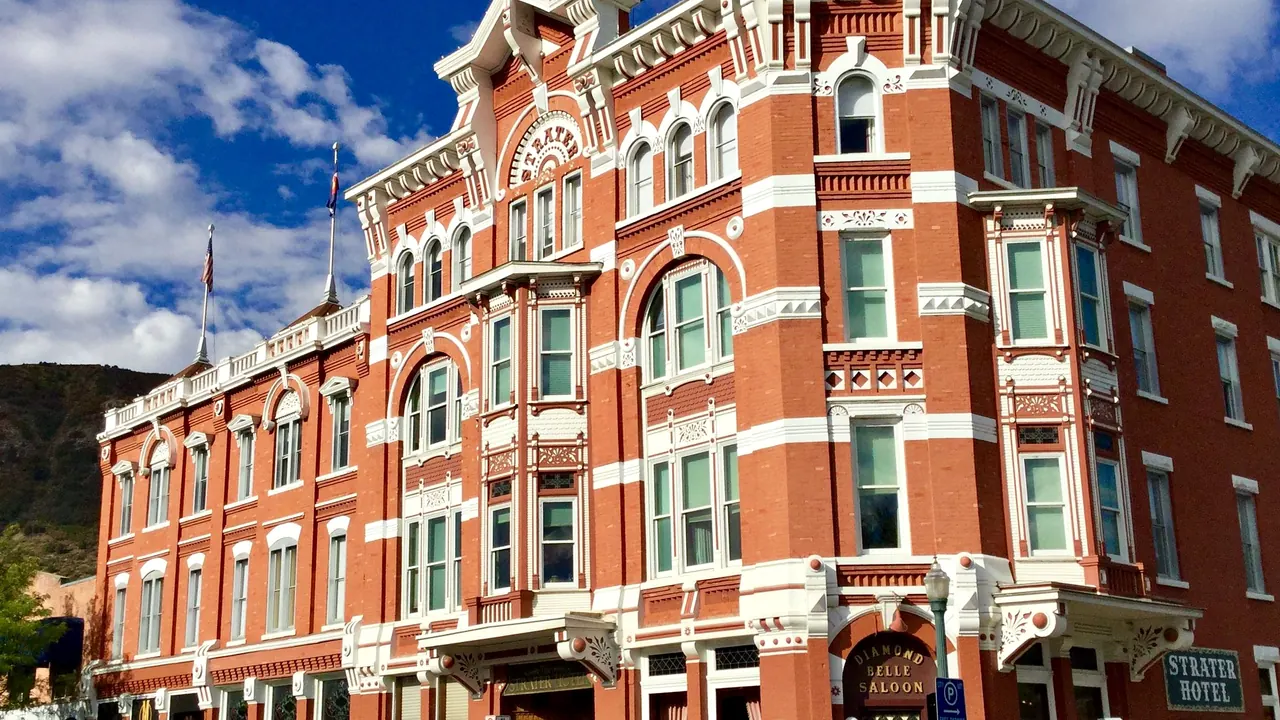

Photos: Durango, Colorado by Adeledstarr, CC BY-SA 4.0, cropped; Phoenix by Visitor7, CC BY-SA 3.0, cropped.
Durango, Colorado or Phoenix?
Our verdict in twelve categories, each scored against the same fixed benchmark cities, and the climate month by month, so you can choose for your trip.
Choose Durango, Colorado for
- nature and the outdoors
- getting around
- day trips
Durango suits a trip built around the mountains. You can ride singletrack from the edge of town, raft the Animas through the centre, hike high in the San Juans in summer and ski half an hour north in winter. Between those days there is a walkable Victorian main street, the steam train up the canyon and Mesa Verde's cliff dwellings within reach, so the evenings being early and quiet matters less.
Choose Phoenix for
- nightlife
- shopping
- live music and the arts
Pick Phoenix for winter sun with more city attached. It has the Heard Museum and Taliesin West, Sonoran Mexican cooking, the bars of Scottsdale and Tempe, proper malls and a full season of symphony, opera and touring shows, while desert trails start right in the suburbs. Expect to drive everywhere, and avoid high summer unless you plan to spend it by a resort pool.
Scoreboard
Twelve categories on one fixed scale from 0 to 100. The shaded stretch is the gap between the two.
Your match
Pick a travel style or drag the sliders, and both match scores follow your weighting.
Wins on nature and the outdoors and getting around with your weighting.
Wins on nightlife and shopping with your weighting.
What matters to you?
Category by category
What the scores mean for a trip.
Beaches & swimming
Neither city is a beach destination, and in both the water is a way to cool off. In Durango that means cold mountain water: tubing the Animas through town, a small swimming area at Lake Nighthorse and a few sandy edges at Vallecito Lake, all chilly even in July.
Phoenix has warm desert water instead, with reservoirs such as Saguaro Lake below bare cliffs and tubing on the lower Salt River. In practice, though, most of its swimming happens in resort pools with lazy rivers and slides, which are where the summer months are spent.
Food & drink
Phoenix gives you more to eat. Its Sonoran cooking, from carne asada and machaca to tortillas so thin they turn translucent and bacon-wrapped hot dogs from evening carts, is a real regional cuisine. Add wood-fired pizza, Scottsdale's resort dining and independent kitchens around Roosevelt Row, though you will drive between them.
Durango has a narrower table: green-chile plates, steakhouses and a few kitchens using Colorado lamb and trout, all within a walk along Main Avenue. Its strength is beer, with a striking number of breweries for a town of its size.
Culture & sights
Phoenix has the stronger sights, though they are museums rather than streets. The Heard Museum's Native American collections, the Musical Instrument Museum and Frank Lloyd Wright's Taliesin West are each worth a visit, and each is a separate drive.
Durango works the other way round. It has a compact downtown of brick and sandstone Victorian buildings and a working steam railway with its roundhouse museum, and an hour or two covers both. Its great ancestral Puebloan sites lie out in the surrounding country, not in town.
Nightlife
Phoenix is the place for a real night out. Old Town Scottsdale's clubs and rooftop bars fill at weekends, Tempe's Mill Avenue runs on students, and downtown has cocktail lounges and craft beer bars, all open until 2am. You pick one district and take a ride home.
Durango ends its evenings much earlier. A night out means a brewery taproom, a patio on Main Avenue or an old saloon with a piano player. There is almost no dancing, and with a crowd of outdoor people who start early, the town is quiet before midnight.
Nature & outdoors
Both cities are outdoor places, but Durango has the bigger landscape. The San Juan Mountains rise above the town. Singletrack starts at the edge of the streets, the Colorado Trail begins just north, and the Weminuche Wilderness has peaks above 4,000m. Add rafting through the centre in summer and a ski resort half an hour away in winter.
Phoenix offers desert rather than alpine country: saguaro forest in the McDowell Sonoran Preserve, steep scrambles up Camelback and the huge South Mountain park, all close to the suburbs. It is excellent from October to April, but the summer heat makes hiking dangerous after mid-morning.
Day trips
Durango has the more memorable day out in Mesa Verde, where whole villages sit in the alcoves of canyon walls. There is also the narrow-gauge steam train up the canyon to Silverton, and the Puebloan ruins at Aztec and Chimney Rock.
From Phoenix the choices are good but more spread out: hillside Jerome, Prescott's saloon street and Sedona's red rocks to the north, with Montezuma Castle on the way, and Tucson's adobe barrios and Mission San Xavier del Bac to the south. You need a car from either city, and the Grand Canyon is too far from Phoenix for a comfortable day.
Good for families
Families do about equally well in either city, in different ways. Durango is an outdoor vacation for children: the steam train, gentle rafting and tubing, the alpine coaster and ziplines in summer, and the ladders at Mesa Verde. There is nothing for a wet day, though, and the altitude can tire young children at first.
Phoenix has the indoor back-up that Durango lacks: a zoo, an aquarium, a science centre, a children's museum and water parks. The trade-off is long drives across the metro area and summer heat that keeps small children inside after early morning.
Getting around
Durango is easier to manage, at least in the centre. The walk from the depot to the top of Main Avenue takes a quarter of an hour, a riverside trail links parks for walkers and cyclists, and a trolley runs along the main corridor. Beyond town, a car is close to essential.
In Phoenix the car rules from the start. Scottsdale, Tempe, downtown and the trailheads lie far apart on a grid of wide roads, the light rail helps only along its one corridor, and summer heat makes even short walks hard work.
Shopping & style
Phoenix is the better choice for a day of shopping. Its luxury and open-air malls carry the international brands, and Old Town Scottsdale adds galleries and boutiques. Both cities sell Navajo and Pueblo silver, turquoise and rugs. Phoenix also has Hopi katsina carvings, and museum shops and reputable galleries where you can buy with confidence.
Durango's shopping is an hour or two on Main Avenue: outdoor gear, Western boots, galleries and sweet shops, with no fashion to speak of.
Affordability
Neither city is cheap, but Phoenix is a little easier on the budget. Its resort prices drop sharply in summer, chain hotels along the freeways are good value all year, and Sonoran Mexican food is cheap and good.
Durango's rooms are scarce and expensive in summer and at the peak of the ski season, so spring and late autumn are the times to save. In both cities the hire car is the real extra cost, and the trails cost nothing.
Live music & performing arts
Phoenix keeps a full big-city calendar. It has the Phoenix Symphony, Arizona Opera and Ballet Arizona, touring Broadway shows in Frank Lloyd Wright's round ASU Gammage, and bands at mid-sized venues downtown and in Tempe, mostly from autumn to spring.
Durango's stage is smaller and mainly a summer affair: a chamber and orchestral festival, a Victorian melodrama where the audience boos the villain, and cowboy music with a chuckwagon supper. The two peak in opposite seasons, and Durango has little on outside summer.
Wellness & relaxation
The two are close here, but the way you rest is different. Durango's answer is hot springs: mineral pools a few minutes north of town, terraced pools beside the San Juan River at Pagosa Springs and spring-fed pools at Ouray, all good after a ride or a day on the slopes.
Phoenix has no springs. Instead it has the classic desert resort, with full spas, several pools and golf along the foot of Camelback, treatments using sage, clay and agave, and dry winter warmth that makes a week by the pool easy.
When should you go?
Pick your month. The climate figures are measured averages, not a forecast.
Durango, Colorado in July
Phoenix in July
Daytime high, °C
Rainfall in the month, mm
Where the figures come from
Durango, Colorado has no weather station within reach, so its figures come from a gridded climate model rather than a measured record, and read a broad area rather than the city itself.
Temperature and rainfall are climate normals, averaged over the years shown. Durango, Colorado: 1991-2020 normals, TerraClimate 4 km grid at the town, no weather station within 90 km. Phoenix: 1991-2020 (sunshine 1981-2010) normals, Phoenix Sky Harbor Airport (2.8 km from centre).
Durango is at its best from June to September. The days are warm, about 30°C at the height of July, which suits tubing the river and long days on the trails, and late September brings the golden aspens. Rain is modest all year, with afternoon showers making August the wettest month. Winter highs around 5°C make December to March a ski season rather than a time for strolling the streets. Spring and late autumn are mild.
Phoenix runs the other way. From November to March the days are mild, at around 20°C, which is the best time for hiking and sitting outdoors. These are also some of its wetter months, though that means the odd shower rather than a rainy season. October and April are warmer, close to 30°C, and still pleasant early and late in the day. From June to August highs reach 41°C, and even with the long hours of sunshine, there is little to do except use the pool after mid-morning. The two fit together neatly: Phoenix for winter, Durango for summer.
Which traveller are you?
On an outdoors trip, Durango is the clear choice. The San Juan Mountains give you some of the country's best-known mountain biking, the Colorado Trail, wilderness peaks and rafting through town, and winter brings deep snow on the slopes half an hour north.
For a food and nightlife trip, Phoenix offers much more. Sonoran carne asada and evening hot-dog carts give it a real local cuisine, and Old Town Scottsdale, Mill Avenue and downtown provide clubs, rooftop bars and cocktail lounges open until 2am, where Durango goes quiet before midnight.
On a culture and arts trip, Phoenix has the depth. The Heard Museum, the Musical Instrument Museum and Taliesin West suit a museum-going traveller, and from autumn to spring there is symphony, opera, ballet and touring Broadway. Durango's steam railway and Victorian streets fill only an afternoon.
Before you go
| Measure | Durango, Colorado | Phoenix |
|---|---|---|
| Currency | US Dollar (USD) | US Dollar (USD) |
| Sockets | AB120 V, 60 Hz | AB120 V, 60 Hz |
| Driving side | Right | Right |
| Time zone | UTC-7, UTC-6 in summer | UTC-7 |
| Emergency number | 911 | 911 |
| Elevation | 1,988 m | 331 m |
| Main airport | Durango La Plata County Airport (DRO)18 km from centre4 non-stop destinations | Phoenix Sky Harbor International Airport (PHX)6 km from centre149 non-stop destinations |
| Public holidays this year | 12 days | 12 days |
By the numbers
| Measure | Durango, Colorado | Phoenix |
|---|---|---|
| City population | 19,071 | 1,608,139 |
| People per km² | 739 | 1,199 |
| Museums within 10 km | 2 | 10 |
| UNESCO World Heritage sites within 50 km | 1 | 1 |
Where else could you go?
Every comparison below shares a destination with this one, so you can follow Durango, Colorado or Phoenix somewhere new.
- Scottsdalevs Phoenix
- Telluridevs Durango, Colorado
- Sedonavs Phoenix
- Tucsonvs Phoenix
- Flagstaffvs Phoenix
- Moabvs Durango, Colorado