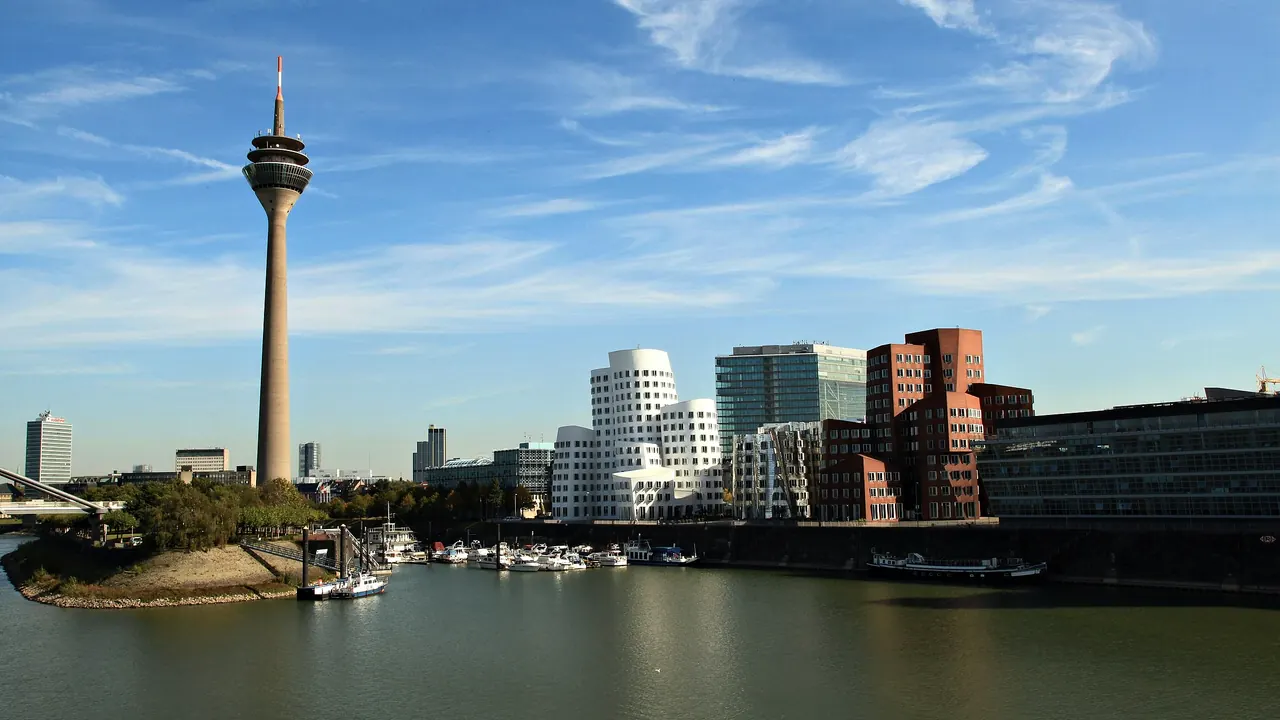
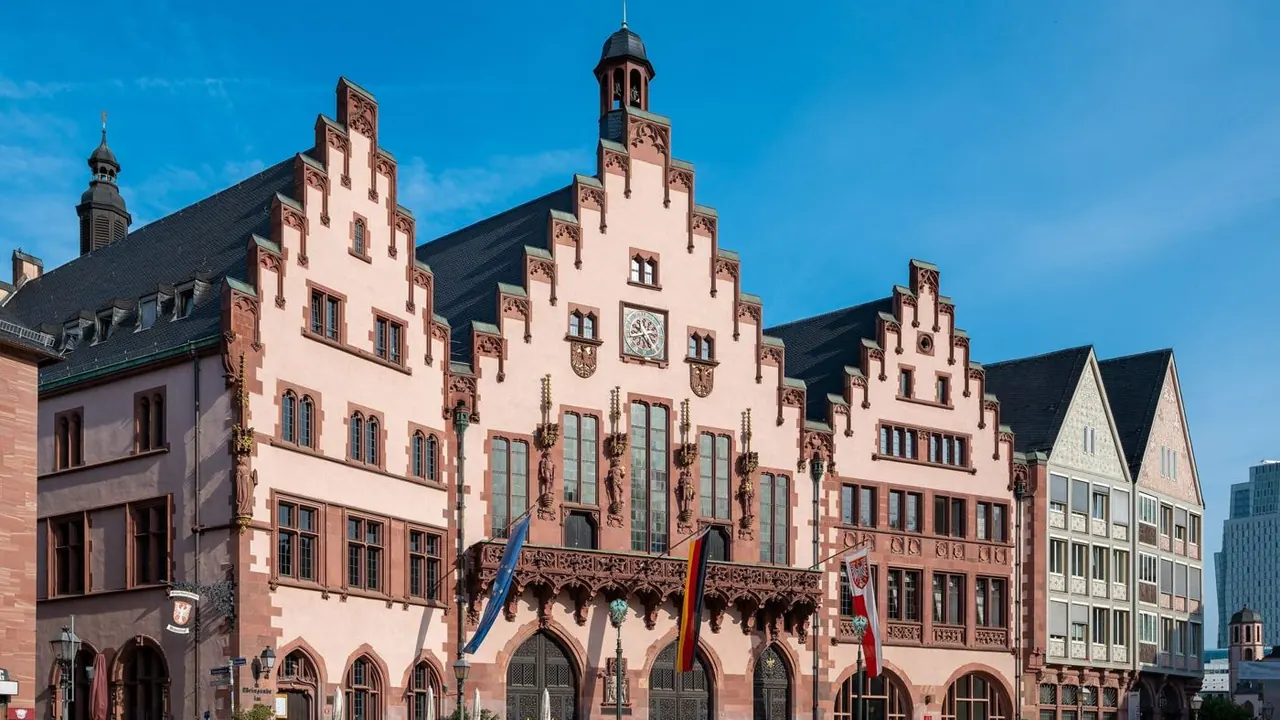
Photos: Dusseldorf by Frank Vincentz, CC BY-SA 3.0, cropped; Frankfurt by Thomas Wolf, CC BY-SA 3.0 DE, cropped.
Dusseldorf or Frankfurt?
Our verdict in twelve categories, each scored against the same fixed benchmark cities, and the climate month by month, so you can choose for your trip.
Choose Dusseldorf for
- shopping
- food and drink
- nightlife
Düsseldorf suits travellers who want their evenings to count. The Altstadt's brewhouses, the Altbier poured until you cover the glass, and the Japanese kitchens around Immermannstrasse give it the stronger table and the livelier nights. The Königsallee makes it the better pick for anyone who travels partly to shop. Its art collections, from Klee at K20 to the net under the K21 dome, reward a visitor who prefers modern art to old streets.
Choose Frankfurt for
- nature and the outdoors
- wellness
- day trips
Frankfurt is the better base for someone who wants to get out and about. The Taunus starts at the edge of the suburbs, Heidelberg and the castle-lined Rhine Gorge are about an hour away, and Wiesbaden's hot-spring baths are close by. In town, the Museumsufer, a respected opera company and the Alte Oper fill the days and evenings for a visitor more drawn to the Städel and a season of opera than to a long night in the pubs.
Scoreboard
Twelve categories on one fixed scale from 0 to 100. The shaded stretch is the gap between the two.
Your match
Pick a travel style or drag the sliders, and both match scores follow your weighting.
Too close to call, level with your weighting
Wins on shopping and food and drink with your weighting.
Wins on nature and the outdoors and wellness with your weighting.
What matters to you?
Category by category
What the scores mean for a trip.
Beaches & swimming
Neither city is a beach destination, and neither river is for swimming. Düsseldorf's Rhine has sandy stretches that look tempting, but strong currents and barge traffic make it dangerous. Frankfurt's Main banks are a place to sit with a drink, not to swim. In both cities a summer swim means a lake, and the two lakes feel quite different.
Düsseldorf's Unterbacher See is inside the city limits on the south-east side, a park-like spot where you lie on the grass between dips. Frankfurt's Langener Waldsee is a flooded gravel pit out in the woods to the south, with sand at the water's edge, a forest setting and water that turns pleasantly warm in July and August. Both cities are a long day's travel from the sea, and Düsseldorf's nearest coast is the chilly Dutch North Sea.
Food & drink
Düsseldorf is the more rewarding place to eat, because it has two strong traditions where Frankfurt has one. The Altstadt brewhouses serve sauerbraten, pork knuckle and the Halve Hahn with brown mustard, and the Japanese community around Immermannstrasse adds queues for ramen, izakaya and Japanese bakeries that are rare in Germany.
Frankfurt's own cooking centres on the apple-wine taverns of Sachsenhausen, with Grüne Soße and Handkäs mit Musik at long shared tables. The Kleinmarkthalle is a fine stop, and the Bahnhofsviertel offers cheap international food, but the local repertoire is small and nothing matches Düsseldorf's Japanese quarter.
Culture & sights
The two are close, but their strengths differ. Düsseldorf is a modern-art city, with the Klee collection at K20, the walk-on net under K21's glass dome, the Kunstpalast and galleries shaped by its art academy. Its finest historic site, the rococo Benrath Palace, lies out in the suburbs.
Frankfurt has more breadth and more history in its centre. The Museumsufer lines both banks of the Main, with the Städel as its masterpiece, and the reconstructed Römer, the cathedral, the Paulskirche and Goethe's birthplace are all a short walk apart, overlooked by Germany's only real skyline of towers.
Nightlife
Düsseldorf has the busier and more sociable night out. Hundreds of pubs and brewhouses are packed into the Altstadt, where weekend crowds drink Altbier standing in the lanes well past midnight, and Carnival turns the whole city into a party for days. Clubbing, though, is modest.
Frankfurt is quieter overall and comes alive mainly at weekends, but it has the more serious clubs. The techno and house tradition it shares with Offenbach still runs, and the Bahnhofsviertel's cocktail bars and late kiosks offer a grittier kind of night than anything in Düsseldorf.
Nature & outdoors
Frankfurt has the better outdoors. The Taunus rises just beyond its northern suburbs, with beech forest and the 880m Großer Feldberg under an hour away, and the Stadtwald is a large forest inside the city. The Rheingau vineyards and the Rhine Gorge are within easy reach.
Düsseldorf's landscape is flatter and gentler: grassy Rhine meadows with sheep on the dykes, Grafenberg forest and the wooded Neandertal. The Bergisches Land's hills are half an hour away, but nothing here compares with the Taunus on the doorstep.
Day trips
Both are excellent bases, and Frankfurt has the edge thanks to its place at the hub of the high-speed network. Heidelberg, the castle-lined Rhine Gorge and Würzburg's Residenz are all within easy reach, and closer in lie Mainz, Wiesbaden, Darmstadt and the imperial cathedrals of Speyer and Worms.
Düsseldorf's options lie in the dense Rhine-Ruhr region instead. Cologne is under half an hour away, with Bonn and the Brühl palaces beyond, and the Zollverein colliery in Essen, Aachen and Dutch Maastricht give it a more industrial and cross-border mix.
Good for families
Both cities are equally easy with children: safe, compact, and with trams that take buggies without fuss. Düsseldorf's Aquazoo Löbbecke Museum, the Rheinturm and the free Grafenberg game park are its draws, and Phantasialand and Movie Park are within about an hour. Frankfurt answers with the Senckenberg's dinosaur hall, a central zoo, the Palmengarten and skyline boat trips on the Main.
Getting around
There is almost nothing between them. Both have flat, walkable centres, integrated regional networks with confusing fare zones, and fast rail links to the airport. Frankfurt's main station connects straight to the high-speed lines, which helps for longer trips. Düsseldorf's Rhine promenade makes walking between the Altstadt, the Kö and the Japanese quarter especially pleasant.
Shopping & style
Düsseldorf is the stronger shopping city. The Königsallee, with its canal, luxury flagships and arcades, is a reason to visit in itself, and the city's fashion-fair history shows in its department stores and well-dressed crowds. Flingern's boutiques and the Japanese quarter's stationery and homeware add character.
Frankfurt is good for everyday shopping on the Zeil, with luxury houses around Goethestraße and independent shops on Berger Straße and Schweizer Straße. The Saturday flea market on the Main is fun, but nothing here draws shoppers the way the Kö does.
Affordability
The two cost much the same, and in both cases it is the hotels that do the damage, especially during trade fairs. In Frankfurt, weekends and summer can be noticeably cheaper as the business crowd leaves, and the Museumsufer pass helps. In Düsseldorf, brewhouse meals and Japanese noodle bars keep eating costs down away from the Königsallee.
Live music & performing arts
Frankfurt has the stronger stage. Its opera company is one of Germany's most respected, known for adventurous productions, and the Alte Oper hosts the radio symphony orchestra and touring ensembles. An English-language theatre and contemporary dance at Mousonturm also help visitors who do not speak German.
Düsseldorf still offers a deep programme, with the Deutsche Oper am Rhein, the domed Tonhalle and the Schauspielhaus. Its distinctive extras are political cabaret and its place in electronic music as the birthplace of Kraftwerk.
Wellness & relaxation
Frankfurt is better placed for a restful break, because classic spa towns ring the city. Bad Homburg's thermal baths sit at the foot of the Taunus, and Wiesbaden's Art Nouveau Kaiser-Friedrich-Therme, fed by hot springs, is under an hour away.
Düsseldorf relies on the sauna areas of its public pools, which are mixed and without swimwear, with thermal complexes and Aachen's springs further afield. Its slower pace and the Japanese garden in Nordpark make it pleasant enough for an easy few days.
When should you go?
Pick your month. The climate figures are measured averages, not a forecast.
Dusseldorf in July
Frankfurt in July
Daytime high, °C
Rainfall in the month, mm
Temperature and rainfall are climate normals, averaged over the years shown. Dusseldorf: 1991-2020 normals, Düsseldorf (8.3 km from centre). Frankfurt: 1991-2020 normals, Frankfurt Westend (2 km from centre).
The two share a mild central European climate, and neither is a beach destination at any time of year. Both are at their best from May to September, when afternoons reach the low to mid-twenties and the riverbanks and lakes come into their own. Frankfurt runs a degree or so warmer in high summer, around 26°C in July and August, and is noticeably sunnier, with close to 250 hours of sunshine in July. Düsseldorf is a little cooler and more often grey, and its wettest stretch falls in the height of summer, with about 77mm in August.
Spring favours Frankfurt, which is drier and brighter in April, so it is the better choice for walking in the shoulder season. November is a cool, damp turning point in both. From December to February they are cold, dark and damp, with highs of only 5°C to 7°C. That is weather for museums, concert halls and taverns rather than long days on foot, and there is little to choose between them.
Which traveller are you?
For a food and nightlife trip, Düsseldorf is the clear pick. Its Altstadt brewhouses serve hearty Rhineland dishes with the city's own mustard, the Japanese quarter adds ramen and izakaya, and afterwards the lanes of the Altstadt turn into one long open-air bar.
On an outdoors trip, Frankfurt wins. The beech forests and Roman frontier trails of the Taunus, up to the Großer Feldberg, are under an hour away by public transport, and the vineyard paths of the Rheingau give better walking than Düsseldorf's flat Rhine meadows.
For a shopping trip, choose Düsseldorf. The Königsallee, with luxury flagships along its canal, is a destination in its own right, and the fashion-fair heritage, big department stores and Japanese homeware shops give it more pull than Frankfurt's practical Zeil.
Before you go
| Measure | Dusseldorf | Frankfurt |
|---|---|---|
| Official language | German | German |
| Currency | Euro (EUR) | Euro (EUR) |
| Sockets | CF230 V, 50 Hz | CF230 V, 50 Hz |
| Driving side | Right | Right |
| Time zone | UTC+1, UTC+2 in summer | UTC+1, UTC+2 in summer |
| Emergency number | 112 | 112 |
| Elevation | 38 m | 101 m |
| Main airport | Düsseldorf Airport (DUS)7 km from centre182 non-stop destinations | Frankfurt Main Airport (FRA)13 km from centre281 non-stop destinations |
| Public holidays this year | 11 days | 10 days |
By the numbers
| Measure | Dusseldorf | Frankfurt |
|---|---|---|
| City population | 619,444 | 760,656 |
| People per km² | 2,849 | 3,063 |
| Museums within 10 km | 25 | 53 |
| UNESCO World Heritage sites within 50 km | 4 | 4 |
Where else could you go?
Every comparison below shares a destination with this one, so you can follow Dusseldorf or Frankfurt somewhere new.