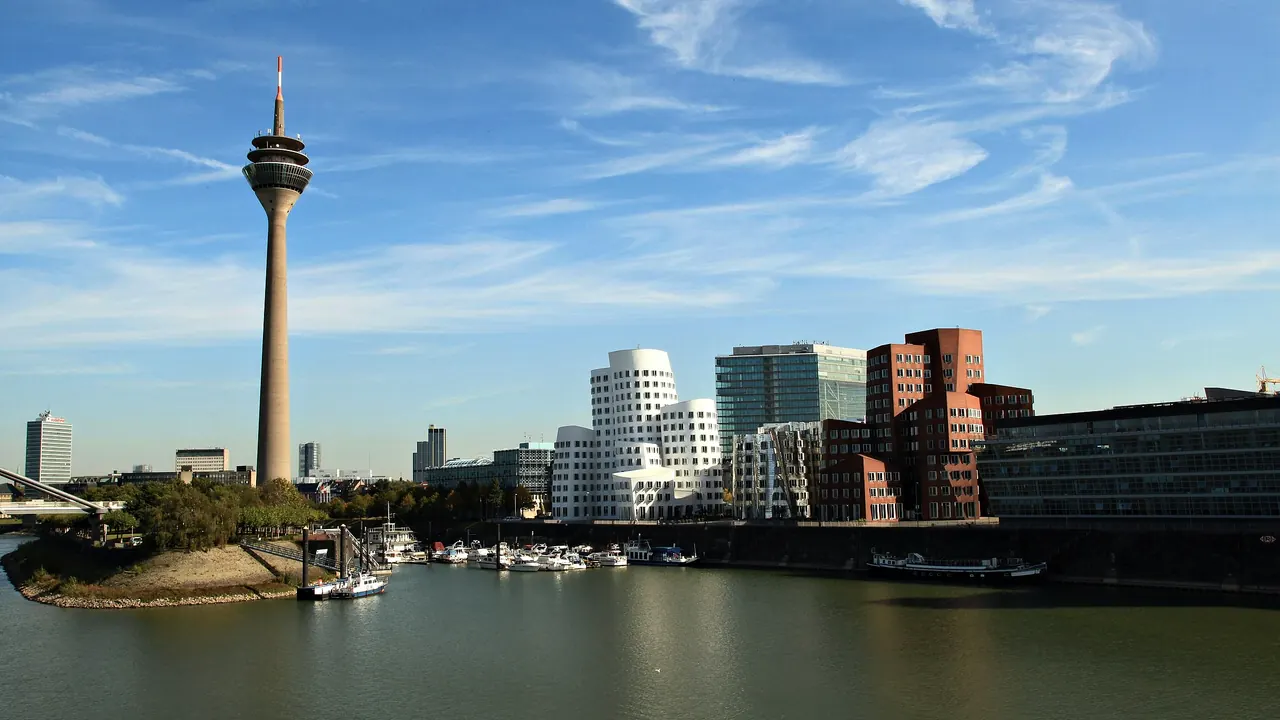
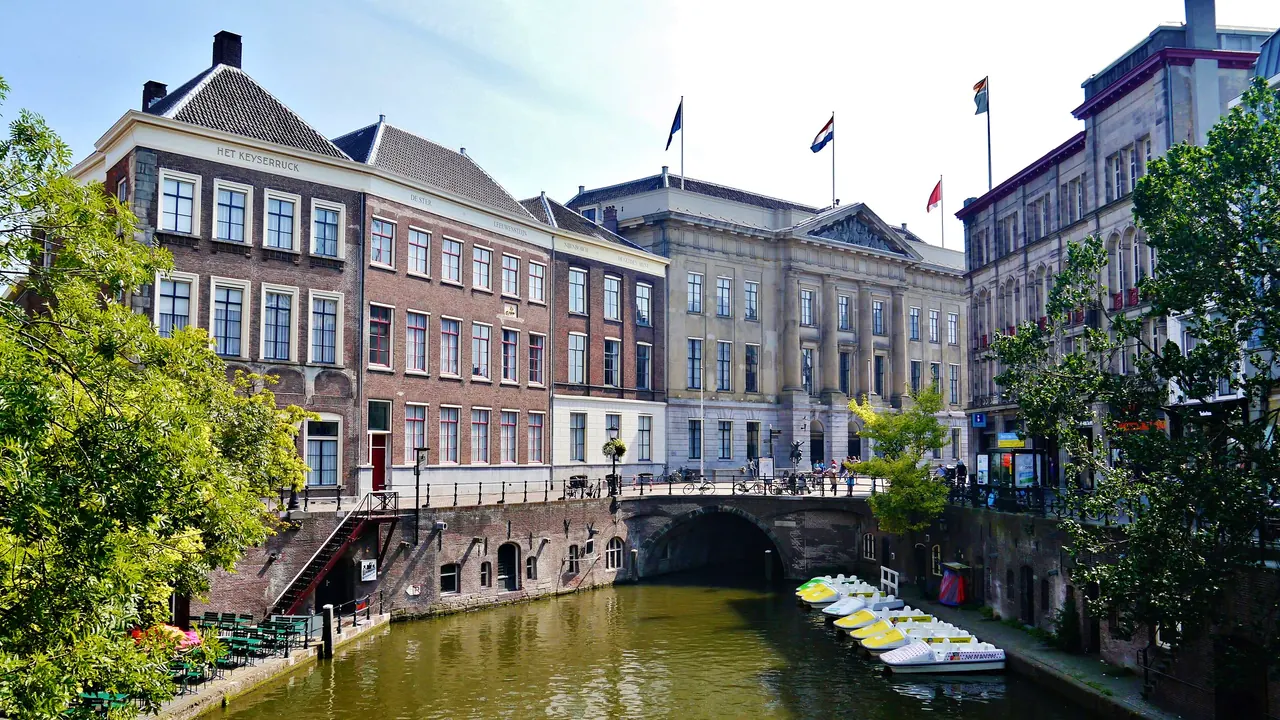
Photos: Dusseldorf by Frank Vincentz, CC BY-SA 3.0, cropped; Utrecht by Zairon, CC BY-SA 4.0, cropped.
Dusseldorf or Utrecht?
Our verdict in twelve categories, each scored against the same fixed benchmark cities, and the climate month by month, so you can choose for your trip.
Choose Dusseldorf for
- food and drink
- nightlife
- shopping
Düsseldorf suits the traveller who wants a city that eats, drinks and dresses well. The Altbier halls of the Altstadt and the Japanese quarter around Immermannstrasse give it a real food identity. The Königsallee makes it a proper shopping destination, and the weekend crowd in the old town, with Carnival on top, makes its evenings livelier. Add an opera house, serious art collections and Cologne on the doorstep, and it rewards a sociable, urban trip, while costing a little less than its neighbour across the border.
Choose Utrecht for
- getting around
- day trips
- families
Utrecht is the better pick for someone who wants to wander a medieval canal town and then see much of the Netherlands from one hotel. The Dom Tower and the two-level Oudegracht wharves give it an old fabric that Düsseldorf lost in the war. With the main station at the edge of the old town and Amsterdam, Rotterdam and Delft a short ride away, it works well as a calm, bike-friendly base, and the student-led evenings stay relaxed rather than rowdy.
Scoreboard
Twelve categories on one fixed scale from 0 to 100. The shaded stretch is the gap between the two.
Your match
Pick a travel style or drag the sliders, and both match scores follow your weighting.
Wins on food and drink and nightlife with your weighting.
Wins on getting around and day trips with your weighting.
What matters to you?
Category by category
What the scores mean for a trip.
Beaches & swimming
Neither city is a beach destination, and swimming in either means a lake on the outskirts: Unterbacher See for Düsseldorf, the Maarsseveense Plassen or the Loosdrecht lakes for Utrecht. The real difference is the sea. From Utrecht, Zandvoort or Scheveningen is roughly an hour by train, so a cool North Sea beach day is possible, while from Düsseldorf the Dutch coast is a long day's journey there and back.
Food & drink
Düsseldorf gives you far more reason to plan meals. Its brewhouse cooking, from sauerbraten to the cheese roll called Halve Hahn with the local brown mustard, is a cuisine of its own, and the Japanese community around Immermannstrasse adds a second, quite different side, with Carlsplatz market and some fine dining on top.
Utrecht has no dishes to match. What it offers is atmosphere, eating on the old cellar wharves at the canal's edge, plus cheap and varied student kitchens with Indonesian and Surinamese food. Pleasant, but rarely the point of the trip.
Culture & sights
The two are broadly level but appeal in opposite ways. Düsseldorf is about art inside buildings: Klee and classic modernism at K20, the net under the dome at K21, the Kunstpalast, and galleries shaped by its academy. Its streets, though, were largely rebuilt after the war, and the best historic site, Benrath Palace, is out in the suburbs.
Utrecht is the reverse. The Dom Tower standing apart from its choir and the unique wharves of the Oudegracht make the old centre itself the sight, while its museums, from Catharijneconvent to the Rietveld Schröder House, are fine but small.
Nightlife
Düsseldorf has the bigger night out. The Altstadt crams a few hundred pubs and brewhouses into a few streets, and on weekends it turns into a street party lasting past midnight, loud and sometimes full of stag groups. Carnival takes it to another level for days at a time.
Utrecht's evenings are gentler and more student-led, with bar terraces around the Neude and drinks at the canal edge in summer. Clubs are few, and locals wanting a big night take the train to Amsterdam.
Nature & outdoors
Both sit in flat, green country with no mountains, so neither is a reason to travel on its own. In Düsseldorf the Rhine meadows and long riverside cycle paths are the main draw, with the Neandertal and the wooded Bergisches Land for a day's walking. Utrecht leans more on cycling through polders, windmills and estates along the Vecht, with heath and forest in the Utrechtse Heuvelrug and sailing on the Loosdrecht lakes.
Day trips
Both are superb bases, but Utrecht has the edge because its trains reach a whole country's highlights. Amsterdam is under half an hour, and Rotterdam, The Hague, Delft, Leiden and Gouda are all easy runs, with Kinderdijk and the Kröller-Müller Museum further out.
From Düsseldorf the reach is regional rather than national: Cologne cathedral, Bonn and the Brühl palaces up the Rhine, the industrial heritage of Zollverein in the Ruhr, and Aachen or Maastricht in about an hour and a half.
Good for families
Both are calm, safe cities with children, so the choice rests on the attractions. Düsseldorf offers the Aquazoo, the tilted windows of the Rheinturm, wild boar in the Grafenberg game park, and Phantasialand within an hour. Utrecht answers with the national Railway Museum, the Miffy museum for toddlers and the fairy-tale Kasteel de Haar. The caution differs too: rowdy weekend nights in Düsseldorf's Altstadt, a constant flow of bikes in Utrecht.
Getting around
Utrecht is the simpler city to move about. You arrive at Utrecht Centraal on the edge of the old town, nearly everything is a short flat walk away, and a rental bike handles the rest, all on the same tap-in card as the trains.
Düsseldorf's centre is also walkable, but the Medienhafen and some museums need a tram or light rail ride, and the regional fare zones take some working out. Its advantage is that the same network carries you on to Cologne and the Ruhr.
Shopping & style
Düsseldorf is the stronger shopping city, built around the Königsallee with its luxury flagships, jewellers and arcades, and big department stores nearby on Schadowstrasse. Flingern's boutiques and the Japanese quarter's stationery and homeware shops add independent character.
Utrecht's appeal lies in small streets and markets: independent fashion and design along the Twijnstraat and Zadelstraat, and the flower market at the Janskerkhof. For luxury labels you would have to go elsewhere.
Affordability
Neither is cheap, but Düsseldorf is somewhat easier on the wallet. Its rooms are pricey for its size, and they jump sharply during trade fairs, so timing a stay around the fair calendar makes the biggest difference. Brewhouse meals and Japanese noodle lunches keep daily costs reasonable.
In Utrecht the pressure is the scarcity of hotels in the historic centre, which keeps beds dear all year. Visitors save on the ground, though, walking or cycling everywhere and eating in the student cafés.
Live music & performing arts
The two are close, but they differ in form. Düsseldorf has the classic institutions: opera and ballet at the Deutsche Oper am Rhein, the symphony in the domed Tonhalle, a leading German-language theatre, political cabaret, and a place in music history as Kraftwerk's home.
Utrecht has no opera house but concentrates its music in TivoliVredenburg, where classical, pop and experimental acts may share one evening. Its Festival Oude Muziek is a major draw for early-music lovers.
Wellness & relaxation
Neither has much of a spa culture, though Düsseldorf is slightly better placed. Saunas are a routine part of its public pools, and the hot springs of Aachen are within reach. Utrecht's wellness complexes sit out in the green belt and need a bus or a drive. For simple unwinding, Düsseldorf has the Rhine meadows and the Japanese garden in Nordpark, while Utrecht has quiet cloister gardens like the Pandhof and slow evenings by the canal.
When should you go?
Pick your month. The climate figures are measured averages, not a forecast.
Dusseldorf in July
Utrecht in July
Daytime high, °C
Rainfall in the month, mm
Temperature and rainfall are climate normals, averaged over the years shown. Dusseldorf: 1991-2020 normals, Düsseldorf (8.3 km from centre). Utrecht: 1991-2020 normals, De Bilt (4.3 km from centre).
The two climates run almost in step, so the season matters more than the city. From November to February both are cool and grey with short days. Highs barely reach double figures in November and stay in single figures through the depth of winter, which suits museums and brown cafés better than long walks. April is the driest month in both, and spring brings bright, comfortable days for walking the Rhine promenade or cycling out along the Vecht. Summer is warm without being hot. Düsseldorf peaks around 25°C in July and Utrecht is a touch cooler at 23°C, while Utrecht gets slightly more sun through spring and early summer.
Autumn is where they part. Utrecht stays wet from September onward, with around 81mm in October against about 61mm in Düsseldorf, so late September and October are kinder in the Rhineland. If you want a dip in the North Sea from Utrecht, only July to September are realistic, and even then the water reaches no more than about 19°C. Neither city gets too hot for sightseeing, so June to early September is the easy window for both.
Which traveller are you?
For a food and nightlife trip, Düsseldorf is the clear choice. Its brewhouses keep pouring Altbier until you cover the glass, the Japanese quarter adds ramen and izakaya, and the Altstadt fills with drinkers on weekend nights in a way student-led Utrecht does not.
On a shopping trip built around designer labels, Düsseldorf has the edge. The Kö is a destination in its own right, and the city's trade-fair fashion business shows in how people dress. Utrecht has the chains and plenty of browsing, but luxury labels are largely absent.
For a short city break, Utrecht is the easier fit. You step off the train straight into a compact medieval centre, the Dom Tower and Oudegracht are minutes away on foot, and two or three days cover the sights without needing trams.
Before you go
| Measure | Dusseldorf | Utrecht |
|---|---|---|
| Official language | German | Dutch |
| Currency | Euro (EUR) | Euro (EUR) |
| Sockets | CF230 V, 50 Hz | CF230 V, 50 Hz |
| Driving side | Right | Right |
| Time zone | UTC+1, UTC+2 in summer | UTC+1, UTC+2 in summer |
| Emergency number | 112 | 112 |
| Elevation | 38 m | 5 m |
| Main airport | Düsseldorf Airport (DUS)7 km from centre182 non-stop destinations | Amsterdam Airport Schiphol (AMS)34 km from centre287 non-stop destinations |
| Public holidays this year | 11 days | 11 days |
By the numbers
| Measure | Dusseldorf | Utrecht |
|---|---|---|
| City population | 619,444 | 359,370 |
| People per km² | 2,849 | 3,619 |
| Museums within 10 km | 25 | 28 |
| UNESCO World Heritage sites within 50 km | 4 | 5 |
| Swim season, months above 21 °C | - | None |
Where else could you go?
Every comparison below shares a destination with this one, so you can follow Dusseldorf or Utrecht somewhere new.