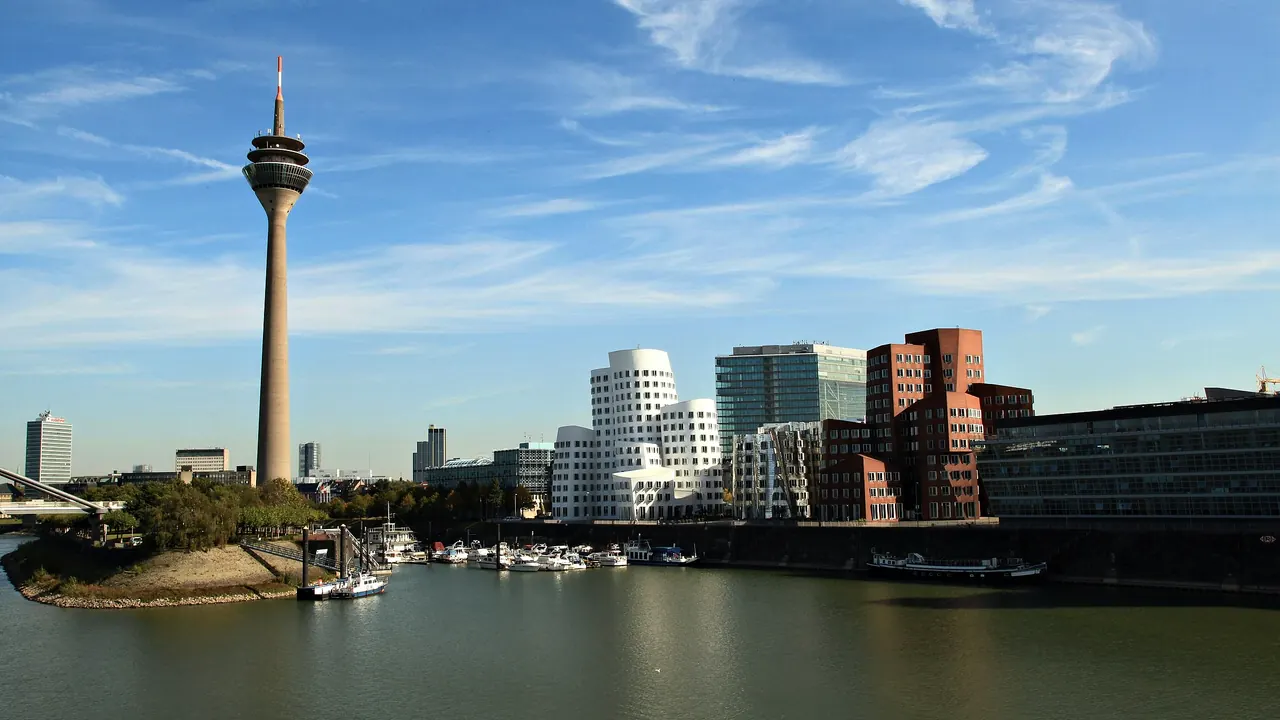
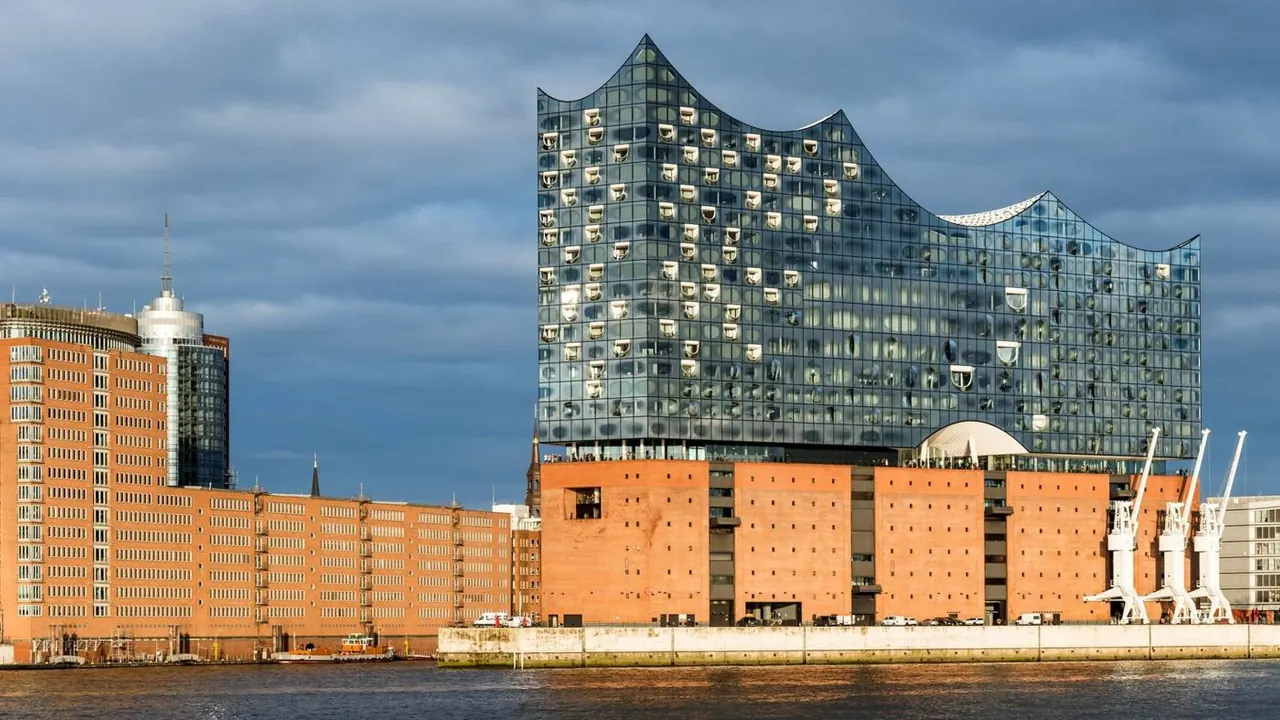
Photos: Dusseldorf by Frank Vincentz, CC BY-SA 3.0, cropped; Hamburg by Wolfgang Weiser, Pexels License.
Dusseldorf or Hamburg?
Our verdict in twelve categories, each scored against the same fixed benchmark cities, and the climate month by month, so you can choose for your trip.
Choose Dusseldorf for
- day trips
- food and drink
- prices
Düsseldorf suits a compact, well-fed trip with plenty of rail outings. Its Altstadt brewhouses and the Japanese quarter around Immermannstrasse give it the more distinctive table of the two, and its modern art collections at K20 and K21 are the cultural draw. It also sits in the dense Rhine-Ruhr region, so Cologne, Bonn, Aachen and Maastricht are all easy outings by train. Choose it if you want to eat well, look at art and spend a couple of days exploring the Rhineland.
Choose Hamburg for
- live music and the arts
- beaches
- nightlife
Hamburg is the stronger pick for evenings and for children. The Elbphilharmonie, the State Opera and the musical theatres across the harbour give it a far deeper stage programme, the Reeperbahn and the Schanzenviertel keep going until dawn, and Miniatur Wunderland and Hagenbeck make a family stay simple. The working harbour, the Speicherstadt and the Alster lakes give the city a waterside character that Düsseldorf's single riverfront can't quite match.
Scoreboard
Twelve categories on one fixed scale from 0 to 100. The shaded stretch is the gap between the two.
Your match
Pick a travel style or drag the sliders, and both match scores follow your weighting.
Wins on day trips and food and drink with your weighting.
Wins on live music and the arts and beaches with your weighting.
What matters to you?
Category by category
What the scores mean for a trip.
Beaches & swimming
Neither city is a beach destination, but Hamburg comes closer. It has real sand along the Elbe at Oevelgoenne and below Blankenese, which is good for watching ships at sunset even though the river isn't safe for swimming. The Baltic resorts of Travemuende and Timmendorfer Strand, with their wicker beach chairs, are about an hour away.
Düsseldorf's Rhine banks are just as off-limits for swimming, and the sea is a long day's travel away on the cool Dutch coast. A summer swim here means Unterbacher See or one of the gravel-pit lakes around the city.
Food & drink
Düsseldorf has the edge at the table, mostly because it has two distinct food cultures. One is the Altstadt brewhouses, with Altbier, sauerbraten and the city's sharp mustard. The other is one of Europe's largest Japanese communities around Immermannstrasse, with ramen, izakaya and Japanese bakeries you won't find on this scale in Hamburg.
Hamburg eats like the port it is: fish rolls on the Landungsbruecken piers, Labskaus, eel soup and a Franzbroetchen for breakfast. The coffee culture in Ottensen and the Schanzenviertel is strong, but overall it is good, broad eating rather than anything you would travel for.
Culture & sights
Hamburg has slightly more to see, and its sights are built around water and trade. The UNESCO-listed Speicherstadt warehouses and the Chilehaus, the Rathaus, St Michael's church and the Kunsthalle's Caspar David Friedrich paintings give it a fuller set of landmarks.
Düsseldorf is more an art city than a sightseeing one. The Klee holdings at K20, the net walk under K21's dome and the Kunstpalast are the reasons to go. For historic buildings, you head out to Benrath Palace and the ruins at Kaiserswerth.
Nightlife
Both cities have a famous party strip, but Hamburg's runs much later and offers more. The Reeperbahn mixes music clubs, cabaret and dive bars with no fixed closing time. The Schanzenviertel, Ottensen and the bars around the Alster each offer a different kind of evening, and clubs range from bunker basements to venues by the harbour.
Düsseldorf's Altstadt is more of an outdoor beer crawl, with crowds drinking Altbier standing in the lanes. It is great fun at weekends, but the club scene is modest. Its high point is Carnival, when the whole city goes out in costume.
Nature & outdoors
Both landscapes are flat and gentle, so the difference lies in what you do outdoors. Hamburg is a place to get out on the water, with sailing and paddleboarding on the Alster, canoe trips through the northern canals and Blankenese's steep lanes above the Elbe. The Altes Land orchards are white with blossom in spring.
Düsseldorf is better suited to cycling and walking in the woods. Long dyke paths run along the Rhine meadows to Kaiserswerth, the Neandertal has hiking trails, and the hills of the Bergisches Land begin within half an hour.
Day trips
Düsseldorf is the better base for day trips, because so many cities lie close together around it. Cologne Cathedral is under half an hour away by train, and Bonn, the Brühl palaces, the Zollverein colliery, Aachen and Dutch Maastricht are all easy to reach. You could fill a week without repeating yourself.
Hamburg's outings are fewer but have a consistent character: the brick Gothic towns of the Hanseatic north. Luebeck's Holstentor is under an hour away, Lueneburg's leaning gables about half an hour, and Bremen and Schwerin's lakeside castle are a little further.
Good for families
Hamburg has more to offer children. Miniatur Wunderland can absorb a whole family for hours, and Hagenbeck's moated enclosures and tropical aquarium make a full day out. Museum ships and the walk through the old Elbe tunnel add a sense of adventure.
Düsseldorf is calm and easy with a buggy, but it has fewer big attractions. The Aquazoo and the tilted windows of the Rheinturm are the main ones, along with wild boar in the Grafenberg game park. Phantasialand is about an hour away for a bigger outing.
Getting around
Both cities are easy to manage without a car, and both have airports linked to the centre by S-Bahn. Düsseldorf's centre is smaller, so you can walk from the Altstadt to the Japanese quarter, and its regional network takes you on to Cologne and the Ruhr.
Hamburg covers more ground, but its U-Bahn and S-Bahn reach every district. The harbour ferries run on the same ticket, so crossing the Elbe doubles as a sightseeing trip.
Shopping & style
Shopping is about equally good in both, and both have a luxury street at their heart. Düsseldorf's Königsallee is a single canal-side boulevard shaped by the city's fashion trade fairs, with Flingern's design shops and Japanese stationery stores adding variety.
Hamburg spreads its luxury labels along Neuer Wall and a network of covered arcades, which is useful in the rain. It also has the Alsterhaus department store on the water, vintage shops in the Karolinenviertel, the Isemarkt under the railway, and tea and coffee from the old trading houses.
Affordability
Both are prosperous cities with expensive hotels, and in both, prices jump sharply during trade fairs. Düsseldorf works out slightly kinder day to day, thanks to brewhouse meals in the Altstadt and cheap Japanese noodle lunches.
Hamburg is a little more expensive overall. Some of its best experiences are free or cheap, though: the Elbphilharmonie plaza, walks through the Speicherstadt, and harbour ferries included in the day ticket.
Live music & performing arts
This is where Hamburg pulls clearly ahead. The Elbphilharmonie's main hall, the Laeiszhalle, the State Opera and the Hamburg Ballet give it a classical programme of international standing. Germany's largest musical theatres and the small rock clubs of St Pauli, where the Beatles learned their trade, cover the rest.
Düsseldorf's programme is solid for its size, with opera and ballet at the Deutsche Oper am Rhein, concerts in the domed Tonhalle and political cabaret. Its standout claim is in music history, as the home of Kraftwerk and early electronic music.
Wellness & relaxation
A full day of pools and steam from Düsseldorf means leaving town, for one of the large thermal complexes within about an hour or for the hot springs of the old spa town of Aachen. In the city itself, the saunas are part of ordinary public pools and leisure baths, mostly mixed and without swimwear.
Hamburg keeps its best bathing inside the city, at the art nouveau Holthusenbad in Eppendorf and the big sauna landscapes where locals spend whole winter afternoons.\n\nFor quieter hours, Düsseldorf offers long walks over the Rhine meadows, the shaded Hofgarten and the Japanese garden in Nordpark, with only the Altstadt loud on weekend nights. In Hamburg the calm is mostly on the water: a slow boat around the Alster, the riverside path towards Blankenese, or an afternoon in the Japanese garden at Planten un Blomen.
When should you go?
Pick your month. The climate figures are measured averages, not a forecast.
Dusseldorf in July
Hamburg in July
Daytime high, °C
Rainfall in the month, mm
Temperature and rainfall are climate normals, averaged over the years shown. Dusseldorf: 1991-2020 normals, Düsseldorf (8.3 km from centre). Hamburg: 1991-2020 normals, Hamburg Airport (9.3 km from centre).
Both cities are at their best from May to September, and neither ever gets too hot for walking. Düsseldorf runs a couple of degrees warmer through the year and peaks around 25°C in July, against 23°C in Hamburg. That makes the Rhine meadows and the lakes on its edge a little more inviting in high summer. Hamburg makes up for it with more sunshine from April to August, and its long, bright May and June days are especially good for the harbour and the Alster.
Summer is also the wettest time in both, with July and August bringing the most rain, up to 82mm in Hamburg. Winter is grey and cold in both cities, but Hamburg is noticeably darker, with only about 36 hours of December sunshine. If you are travelling between November and February, Düsseldorf's slightly milder, brighter weather and its short distances between sights make it a little easier to manage.
Which traveller are you?
For a culture and arts trip, Hamburg is the better choice. The Elbphilharmonie, the State Opera and the Hamburg Ballet give it a much fuller programme of evening performances. The UNESCO-listed Speicherstadt and the Kunsthalle round out the days. Düsseldorf mainly appeals to visitors who specifically love modern art.
On a family trip with children, Hamburg is the easier pick. Miniatur Wunderland can fill a whole rainy morning, and Hagenbeck shows its animals in open enclosures without bars. Harbour ferries and the old Elbe tunnel turn simply getting around into part of the fun.
For a short city break, Düsseldorf works neatly. The airport is minutes from the centre, the Altstadt, the Königsallee and the art museums are all within walking distance, and between brewhouse dinners and ramen counters, two days are full of good eating without long journeys.
Before you go
| Measure | Dusseldorf | Hamburg |
|---|---|---|
| Official language | German | German |
| Currency | Euro (EUR) | Euro (EUR) |
| Sockets | CF230 V, 50 Hz | CF230 V, 50 Hz |
| Driving side | Right | Right |
| Time zone | UTC+1, UTC+2 in summer | UTC+1, UTC+2 in summer |
| Emergency number | 112 | 112 |
| Elevation | 38 m | 6 m |
| Main airport | Düsseldorf Airport (DUS)7 km from centre182 non-stop destinations | Hamburg Helmut Schmidt Airport (HAM)9 km from centre120 non-stop destinations |
| Public holidays this year | 11 days | 10 days |
By the numbers
| Measure | Dusseldorf | Hamburg |
|---|---|---|
| City population | 619,444 | 1,869,473 |
| People per km² | 2,849 | 2,476 |
| Museums within 10 km | 25 | 77 |
| UNESCO World Heritage sites within 50 km | 4 | 1 |
Where else could you go?
Every comparison below shares a destination with this one, so you can follow Dusseldorf or Hamburg somewhere new.