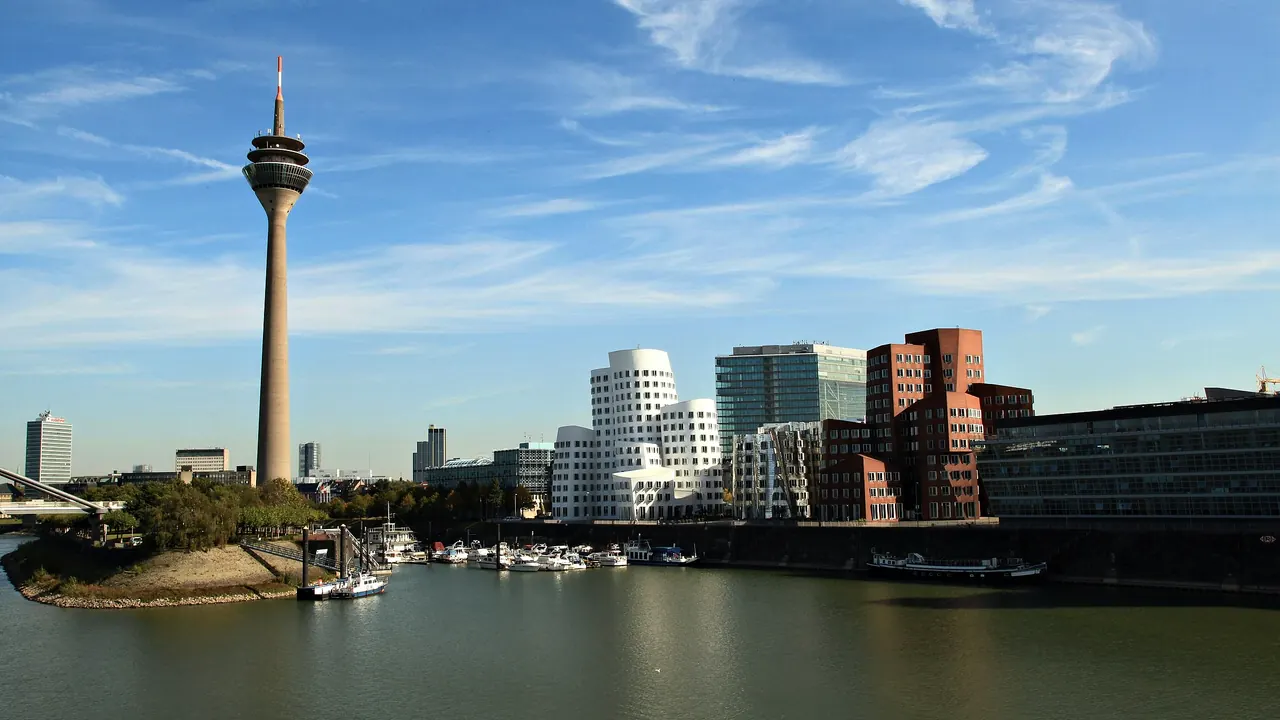
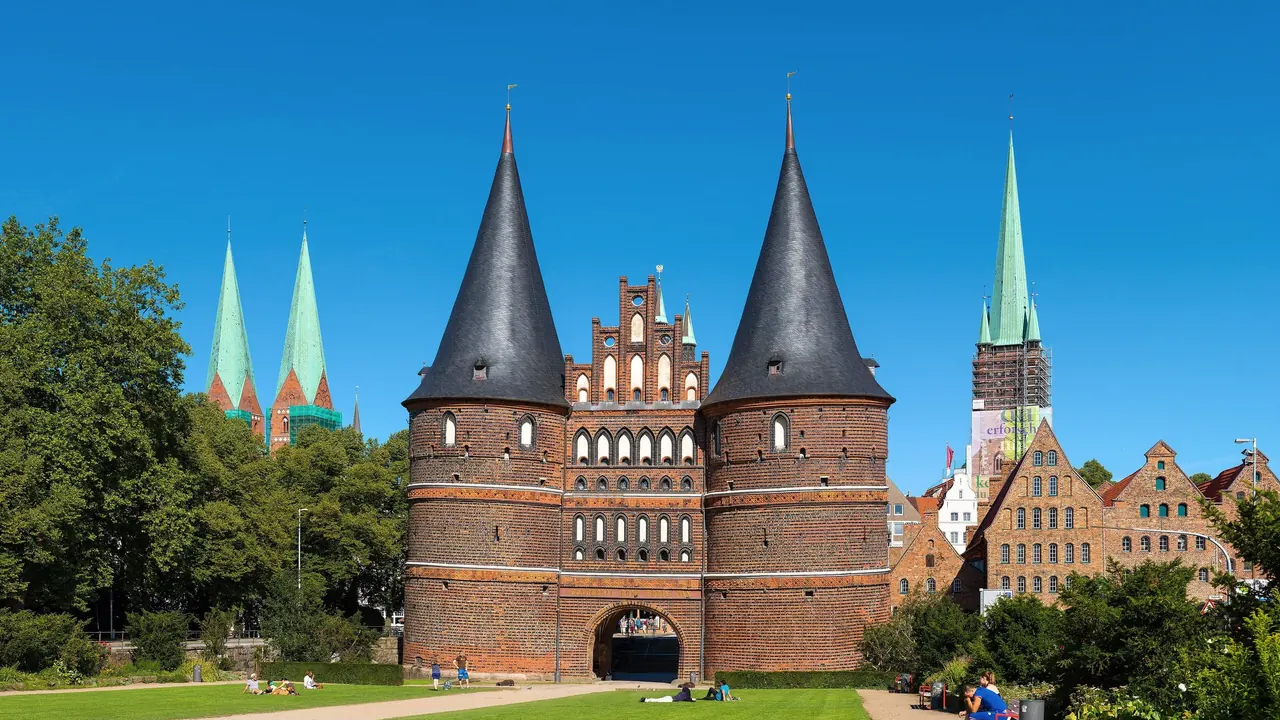
Photos: Dusseldorf by Frank Vincentz, CC BY-SA 3.0, cropped; Lubeck by Christian Wolf (www.c-w-design.de), CC BY-SA 3.0 DE, cropped.
Dusseldorf or Lubeck?
Our verdict in twelve categories, each scored against the same fixed benchmark cities, and the climate month by month, so you can choose for your trip.
Choose Dusseldorf for
- nightlife
- shopping
- food and drink
Düsseldorf suits travellers who want a city that keeps them busy from morning until late. It has the Königsallee and its department stores, the art collections at K20 and K21, Altbier in the Altstadt brewhouses and ramen around Immermannstrasse, with the opera and the Tonhalle for the evenings. It is also the stronger base for exploring the region, because Cologne, Bonn, Aachen and the Ruhr are all easy to reach by train without a car.
Choose Lubeck for
- beaches
- culture and sights
- prices
Lübeck is the better choice for a slower stay with more history. Its island old town of brick Gothic churches, stepped gables and hidden courtyards is far more intact than anything Düsseldorf has, and in summer Travemünde's sandy Baltic beach is a short train ride away. Evenings are quiet and the shopping is modest, but it costs less and is a better town to wander.
Scoreboard
Twelve categories on one fixed scale from 0 to 100. The shaded stretch is the gap between the two.
Your match
Pick a travel style or drag the sliders, and both match scores follow your weighting.
Wins on nightlife and shopping with your weighting.
Wins on beaches and culture and sights with your weighting.
What matters to you?
Category by category
What the scores mean for a trip.
Beaches & swimming
Lübeck has a real seaside within its own boundaries, which Düsseldorf cannot match. Travemünde's long sandy beach with its wicker beach chairs, and the resorts along the bay, have calm, shallow water with no tides, which suits small children. The Baltic stays cool, though, and the swimming season is short.
In Düsseldorf the Rhine looks inviting but is too dangerous to swim in, so a swim means Unterbacher See or an outdoor pool. The North Sea is a long way off, so beach days are not really part of a stay there.
Food & drink
Düsseldorf is the better place to eat, mainly because it has two strong food traditions where Lübeck has one narrower one. Brewhouse cooking in the Altstadt, with sauerbraten, Halve Hahn and the city's sharp mustard, sits alongside the Japanese quarter around Immermannstrasse, one of the largest in Europe. Carlsplatz market and a good choice of fine dining round it out.
In Lübeck food is more about a few specialities than range: marzipan from the old confectioners, herring and fish sandwiches by the harbour, Rotspon from the city's cellars and a meal in the sea captains' guild house. Beyond those, the choice narrows quickly.
Culture & sights
Lübeck is the better city for sightseeing, because its whole island old town is the attraction. It is a UNESCO-listed Hanseatic centre of brick Gothic churches, the Holstentor, the Marienkirche, and merchants' houses with courtyards behind them. With the Hansemuseum and the Buddenbrookhaus added, it fills two satisfying days.
Düsseldorf's strength is art rather than old buildings. K20, K21 and the Kunstpalast are serious collections, but wartime bombing left little of the old city standing. Apart from Benrath Palace and the ruins at Kaiserswerth, most of the sights are modern, from the Rheinturm to the Gehry buildings at the Medienhafen.
Nightlife
The gap here is wide. Düsseldorf's Altstadt packs hundreds of pubs and brewhouses into a few streets that turn into a street party at weekends. There are quieter cocktail bars in Carlstadt and the Medienhafen, and Carnival brings the whole city out for days.
Lübeck has wine bars, a few student pubs and summer evenings on Travemünde's promenade, and little goes on after midnight. People who want a proper night out take the train to Hamburg.
Nature & outdoors
Neither city has dramatic scenery, and both offer gentle country for walking and cycling. The difference is the water. Düsseldorf's outdoors follows the Rhine, with flat paths through the meadows to Kaiserswerth, the Grafenberg forest, the Neandertal, and the wooded Bergisches Land within half an hour.
Lübeck has the coast and the lakes instead: canoeing on the Wakenitz through reeds and woodland, the clifftop walk along the Brodtener Steilufer, sailing on the bay and the lake district of Holstein Switzerland.
Day trips
Düsseldorf is by far the better base. Cologne's cathedral is under half an hour away by train. Bonn, the Brühl palaces, the Zollverein colliery, Aachen, Münster, Maastricht and the Middle Rhine gorge are all within reach by fast, frequent trains.
Lübeck has a good handful of outings. Hamburg is the obvious full day, and Wismar, Schwerin's island castle and Ratzeburg on its lake are not far. After those, though, the options run out quickly.
Good for families
Both cities are safe, flat and easy with children, but they work best in different seasons. Düsseldorf works all year round, with the Aquazoo, the Rheinturm's tilted windows, the free game park, and Phantasialand and Movie Park within about an hour.
Lübeck is at its best in summer, when Travemünde's shallow beach, the playgrounds along the bay and Hansa-Park make for an easy seaside stay. In the wet or cold months there is much less for children to do.
Getting around
Both centres are easy on foot, but Düsseldorf has the edge thanks to its trams, its light rail and a fast S-Bahn link to the airport. All of it is part of a regional network that also reaches Cologne and the Ruhr, though the fare zones take some getting used to.
Lübeck is simpler. The old town island is about 2km long, the station is just across the river from the Holstentor, and a regional train reaches Travemünde in about twenty minutes. Cobbled streets and the occasional bus ride are about the only complications.
Shopping & style
Düsseldorf is a real shopping destination, centred on the Königsallee with its canal, luxury flagships and arcades. Big department stores on Schadowstrasse and in the Kö-Bogen, and independent shops in Flingern and the Japanese quarter, add to it.
Lübeck covers the basics on Breite Strasse and Königstrasse, with galleries and craft shops tucked into the side passages, and marzipan is the souvenir everyone takes home. For serious fashion, people go to Hamburg.
Affordability
Lübeck is easier on the wallet. Rooms in the old town are moderately priced, tavern meals and harbour fish kiosks are reasonable, and the old town costs nothing to explore. The one exception is the beach hotels in Travemünde, which cost more in July and August.
Düsseldorf's hotels are priced for a business city and rise steeply during trade fairs, so it is worth checking the fair calendar before booking. Brewhouse meals and Japanese noodle bars help keep day-to-day spending down.
Live music & performing arts
Düsseldorf has the fuller programme. There is opera and ballet at the Deutsche Oper am Rhein, the symphony orchestra in the domed Tonhalle, one of the leading German-language theatres, political cabaret and a summer jazz festival. As Kraftwerk's home city, it also has a place in the history of electronic music.
Lübeck's season is smaller but has its own character. It centres on Theater Lübeck, the Philharmonic and organ concerts in the Marienkirche, where Buxtehude was organist, and the Schleswig-Holstein Music Festival comes to the city in summer.
Wellness & relaxation
In Düsseldorf, relaxing usually means a German sauna. The public pools have mixed sauna areas where swimwear is not worn, which surprises some visitors. Large thermal complexes are within about an hour, and Aachen's hot springs are a little further away. Long walks through the Rhine meadows and the Japanese garden in Nordpark make a gentler alternative.
Lübeck's way to unwind is the Baltic seaside. Travemünde has been a spa resort for two centuries, and the bay has wellness hotels and an indoor seawater pool at Scharbeutz. Back in the old town, the courtyards and riverside benches are quiet all day.
When should you go?
Pick your month. The climate figures are measured averages, not a forecast.
Dusseldorf in July
Lubeck in July
Daytime high, °C
Rainfall in the month, mm
Temperature and rainfall are climate normals, averaged over the years shown. Dusseldorf: 1991-2020 normals, Düsseldorf (8.3 km from centre). Lubeck: 1991-2020 normals, Luebeck-Blankensee (6 km from centre).
Both cities have a mild, damp North German climate, so late spring to early autumn is the time to go. Düsseldorf is slightly warmer, with July highs around 25°C, and its winters are a little milder. That makes it the easier of the two for a trip built around galleries and brewhouses between November and March. In both cities rain falls fairly evenly through the year, and the wettest weeks come in high summer, up to 77mm in Düsseldorf's August.
Lübeck has the sea to plan around. The Baltic only reaches about 19°C in August, so July and August are the months for swimming, and in June it is warm enough for paddling but not much more. From May to July Lübeck gets noticeably more sunshine than Düsseldorf, but its winters are darker and colder. January highs are around 4°C and the days are short and grey, better for museums than for walks along the canals.
Which traveller are you?
On a food and nightlife trip, Düsseldorf is the clear choice. Dinner can be pork knuckle in a brewhouse one night and ramen in the Japanese quarter the next, and the Altstadt keeps the Altbier coming well past midnight. Lübeck's evenings end early.
For a beach and sun trip, Düsseldorf does not work: the Rhine is unsafe for swimming and the coast is far away. Lübeck lets you spend mornings in town and afternoons at Travemünde, where the Baltic is cool but fine for a swim in July and August.
On a culture and arts trip, Düsseldorf is the place for modern art and a full opera and theatre season. Lübeck still comes out ahead, because the whole medieval town is the sight, and it has the homes of three Nobel laureates: Mann, Grass and Brandt.
Before you go
| Measure | Dusseldorf | Lubeck |
|---|---|---|
| Official language | German | German |
| Currency | Euro (EUR) | Euro (EUR) |
| Sockets | CF230 V, 50 Hz | CF230 V, 50 Hz |
| Driving side | Right | Right |
| Time zone | UTC+1, UTC+2 in summer | UTC+1, UTC+2 in summer |
| Emergency number | 112 | 112 |
| Elevation | 38 m | 13 m |
| Main airport | Düsseldorf Airport (DUS)7 km from centre182 non-stop destinations | Hamburg Helmut Schmidt Airport (HAM)53 km from centre120 non-stop destinations |
| Public holidays this year | 11 days | 10 days |
By the numbers
| Measure | Dusseldorf | Lubeck |
|---|---|---|
| City population | 619,444 | 217,061 |
| People per km² | 2,849 | 1,013 |
| Museums within 10 km | 25 | 23 |
| UNESCO World Heritage sites within 50 km | 4 | 1 |
| Swim season, months above 21 °C | - | None |
Where else could you go?
Every comparison below shares a destination with this one, so you can follow Dusseldorf or Lubeck somewhere new.
- Colognevs Dusseldorf
- Hamburgvs Lubeck
- Maastrichtvs Dusseldorf
- Utrechtvs Dusseldorf
- Antwerpvs Dusseldorf
- Brusselsvs Dusseldorf