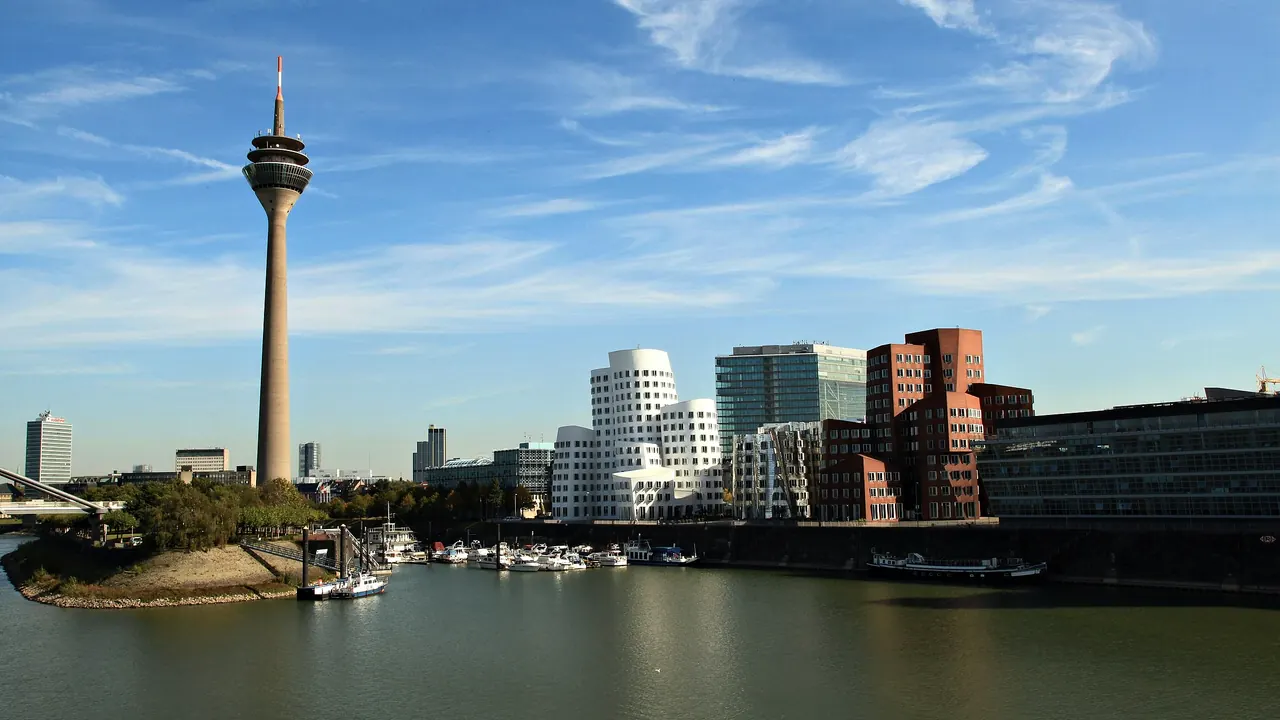
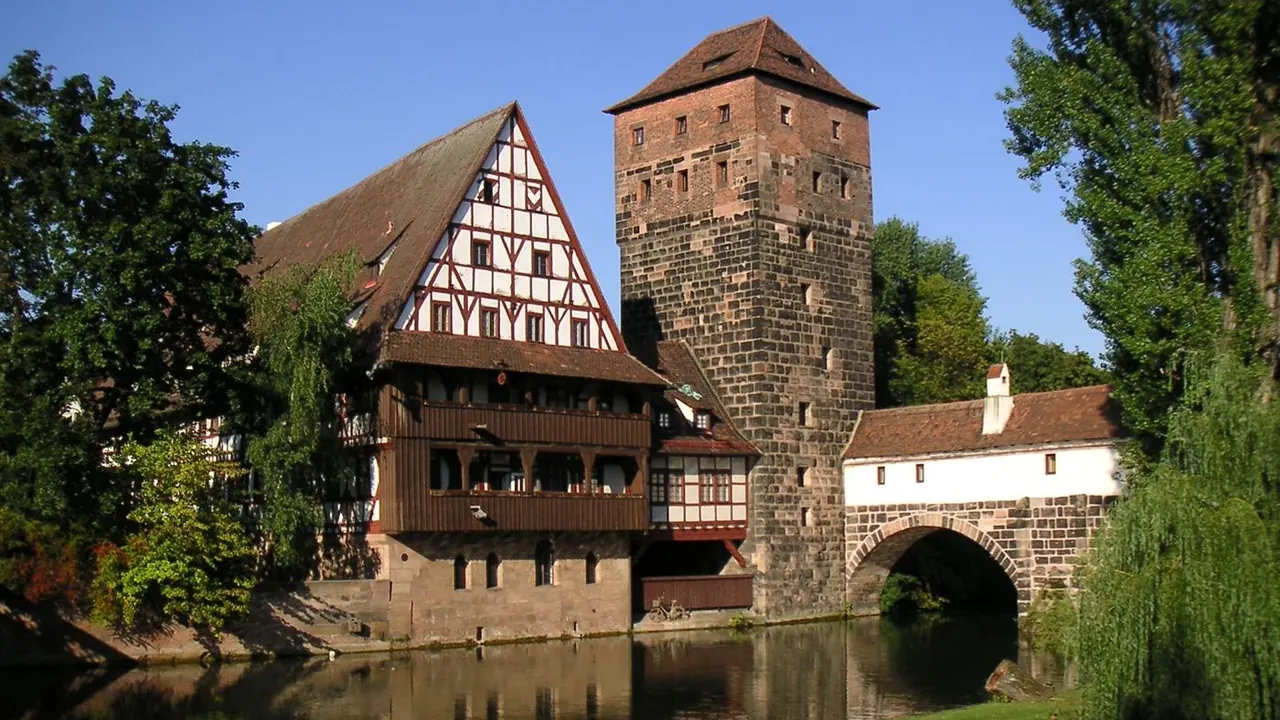
Photos: Dusseldorf by Frank Vincentz, CC BY-SA 3.0, cropped; Nuremberg by Horst Gutmann, CC BY 2.0, cropped.
Dusseldorf or Nuremberg?
Our verdict in twelve categories, each scored against the same fixed benchmark cities, and the climate month by month, so you can choose for your trip.
Choose Dusseldorf for
- shopping
- nightlife
- live music and the arts
Düsseldorf suits a sociable, polished city trip: evenings in the Altstadt brewhouses, an afternoon on the Königsallee, Japanese noodles around Immermannstrasse and a night at the opera or the Tonhalle. It is the better pick if you care more about eating, drinking, shopping and modern art than about old streets. Much of its centre was rebuilt, and its finest historic site is out in the suburbs at Benrath.
Choose Nuremberg for
- culture and sights
- nature and the outdoors
- prices
If history and a calmer pace matter more, Nuremberg is the stronger choice. The walled old town, the Kaiserburg and the Germanisches Nationalmuseum give it a depth of sights Düsseldorf can't match, and the Rally Grounds and Courtroom 600 add a sobering twentieth-century chapter. It also costs a little less and has better walking country nearby. Its evenings are spent in beer gardens rather than at street parties.
Scoreboard
Twelve categories on one fixed scale from 0 to 100. The shaded stretch is the gap between the two.
Your match
Pick a travel style or drag the sliders, and both match scores follow your weighting.
Too close to call, 2 points apart
Wins on shopping and nightlife with your weighting.
Wins on culture and sights and nature and the outdoors with your weighting.
What matters to you?
Category by category
What the scores mean for a trip.
Beaches & swimming
You won't swim much in either city, and the difference lies in where you go. In Düsseldorf the Rhine looks tempting but is dangerous, so locals swim at Unterbacher See on the city's edge, which is close enough for an evening dip. Nuremberg's equivalent is the Franconian Lake District an hour to the south, with sandy strips, sailing and water warm enough for an afternoon with children in high summer, but going there takes the whole day.
Food & drink
Düsseldorf has more range. Besides its Altstadt brewhouses with Altbier, sauerbraten and Halve Hahn, it has one of Europe's largest Japanese communities around Immermannstrasse, as well as Carlsplatz market and some fine dining.
Nuremberg sticks closely to its own food: finger-sized bratwurst grilled over beechwood, Schäufele and Lebkuchen. Its real pleasure is Franconia's small breweries and the Kellerbier served in beer gardens. Beer lovers may even prefer it, but for variety Düsseldorf goes further.
Culture & sights
Düsseldorf is a city for modern art. The Kunstsammlung's two houses, one with its large group of works by Klee and the other with a net slung high under a glass dome, and the Kunstpalast are the main reasons to go. The Altstadt was rebuilt after the war and has little old fabric, so beyond the galleries the sights are the Gehry buildings in the Medienhafen or a ride out to Benrath Palace.
Nuremberg has more to see. Its walls, the Kaiserburg, the two great Gothic churches and Dürer's house make a medieval townscape that was rebuilt but is complete, and the Germanisches Nationalmuseum alone can fill a day. The Rally Grounds and Courtroom 600 add history that few cities can show.
Nightlife
Düsseldorf is by far the bigger night out. On weekend nights the Altstadt, known as the "longest bar in the world", becomes a street party of Altbier drinkers. Carnival keeps the whole city out for days, and Carlstadt and the Medienhafen have cocktail bars for a calmer evening.
Nights in Nuremberg are smaller and spent mostly in bars. They are best in Gostenhof's alternative spots west of the walls, or on the squares and riverbanks in summer. It makes for a pleasant evening, but not a reason to book.
Nature & outdoors
Nuremberg has more interesting country on its doorstep. The Reichswald pine forest starts at the edge of town, and Franconian Switzerland, with its limestone towers, caves and climbing routes, is about an hour away. The lakes to the south add sailing and paddling.
Düsseldorf's outdoors is flatter and tamer. It has Rhine meadows with long cycle paths to Kaiserswerth, Grafenberg forest and the Neandertal, with the hills of the Bergisches Land within half an hour. It is good for a bike ride, but neither city has mountains.
Day trips
Both are excellent bases, and the difference is in the kind of places you visit. From Düsseldorf most trips are to the large cities of the Rhineland and the Ruhr. Cologne cathedral is under half an hour away, and there are also Bonn, the Brühl palaces and Zollverein's industrial heritage, with Aachen and Dutch Maastricht further out.
Nuremberg's trips lean towards well-kept old towns: Bamberg, Regensburg on the Danube, Würzburg's Residence, and walled Rothenburg and Dinkelsbühl on the Romantic Road. Bayreuth and Munich are also within reach. Choose Düsseldorf for big cities and a trip across the border, and Nuremberg for half-timbered and baroque towns.
Good for families
Both are safe, manageable cities for children, but their main attractions differ. Düsseldorf has the Aquazoo, the tilted windows of the Rheinturm, the free game park in Grafenberg and Phantasialand within an hour. Nuremberg makes the most of its toy-making past with the Toy Museum, full-size locomotives at the railway museum, a zoo set in wooded former quarries and, in Advent, a children's Christmas market. The only hard part for small legs is the cobbled climb to the castle.
Getting around
You won't need a car in either city. Düsseldorf's centre is flat and compact and is tied together by the riverside path. Its regional network runs well beyond the city to Cologne and the Ruhr, and the airport is only minutes away by train.
In Nuremberg, the sights sit inside walls about 1.5km across, with the station at the gate, so most days are spent on foot. For anything further out, trams, buses and S-Bahn trains on one ticket reach the zoo, the Rally Grounds and neighbouring Fürth.
Shopping & style
Of the two, Düsseldorf is the city for shopping. The Königsallee, with luxury flagships along its canal, sets the tone. Schadowstrasse and the Kö-Bogen cover the mainstream, and Flingern's boutiques and the stationery and homeware shops of the Japanese quarter add range.
Nuremberg's Königstraße is mostly chain stores, and its appeal lies in souvenirs: decorated Lebkuchen tins, wooden toys, tin figures and crafts from the Handwerkerhof. In Advent the Christkindlesmarkt gives it a seasonal draw that Düsseldorf lacks, but the rest of the year shopping is no reason to go.
Affordability
Nuremberg is easier on the budget, with filling tavern meals, cheap local beer and modestly priced sights. Düsseldorf's hotels are expensive for a city of its size and restaurants around the Königsallee charge to match, though brewhouse meals and noodle bars keep daily costs down. Both have the same trap: trade fairs push room prices sharply up, and in Nuremberg so does the Advent market, so check the dates before booking.
Live music & performing arts
Düsseldorf has the deeper programme through the year. The Deutsche Oper am Rhein, the Tonhalle in its domed former planetarium and the Schauspielhaus give it opera, symphony concerts and leading theatre. Political cabaret, small jazz venues and its place in history as the birthplace of Kraftwerk add more.
Nuremberg's Staatstheater stages opera, ballet and drama well in its Art Nouveau house, but its best moments are seasonal. In summer there are open-air orchestra concerts in the Luitpoldhain and the free Bardentreffen folk weekend in the old town's squares.
Wellness & relaxation
Neither city has springs of its own, and both rely on the German sauna habit, where saunas are mostly mixed and swimwear is not worn. Nuremberg is a little more convenient, with a large thermal spa in Fürth a short U-Bahn ride away and saline pools you can float in at Bad Windsheim. Düsseldorf's big thermal complexes are up to an hour out, with Aachen's hot springs further still. To unwind, Düsseldorf has the Rhine meadows and the Japanese garden in the Nordpark, while Nuremberg has beer gardens on the Pegnitz.
When should you go?
Pick your month. The climate figures are measured averages, not a forecast.
Dusseldorf in July
Nuremberg in July
Daytime high, °C
Rainfall in the month, mm
Temperature and rainfall are climate normals, averaged over the years shown. Dusseldorf: 1991-2020 normals, Düsseldorf (8.3 km from centre). Nuremberg: 1991-2020 normals, Nuernberg (5.5 km from centre).
The two cities share the same summer peak, with highs around 25°C in July and August, and May to September is the comfortable stretch for walking either one. Düsseldorf has the milder winter, with January highs of about 6°C against 4°C in Nuremberg, which makes it a little easier for a cold-season break. Nuremberg's summers are noticeably sunnier.
Rain is the other difference. Düsseldorf gets a steady share in every month and has no real dry season, with the wettest weather in late summer and again in December. Nuremberg is drier overall. February and April see only about 33mm, and May to August are its wettest months. That makes spring, and April in particular, the better time for Nuremberg.
Which traveller are you?
For a food and nightlife trip, Düsseldorf is the clear choice. You can eat well at both ends of the scale, from brewhouse plates to Japanese noodles, and go out every night, with crowds on the streets well past midnight at weekends.
On a shopping trip, Düsseldorf is worth a day or two of serious browsing, from luxury labels to department stores and small design shops. Nuremberg suits a quick hunt for gingerbread and wooden toys, and only really comes into its own in Advent.
For an outdoors trip, Nuremberg gives you proper days out: a forest walk or bike ride straight from town and, within an hour, hiking between villages or a day of climbing. Düsseldorf offers pleasant riverside cycling and gentle walks, but little more.
Before you go
| Measure | Dusseldorf | Nuremberg |
|---|---|---|
| Official language | German | German |
| Currency | Euro (EUR) | Euro (EUR) |
| Sockets | CF230 V, 50 Hz | CF230 V, 50 Hz |
| Driving side | Right | Right |
| Time zone | UTC+1, UTC+2 in summer | UTC+1, UTC+2 in summer |
| Emergency number | 112 | 112 |
| Elevation | 38 m | 209 m |
| Main airport | Düsseldorf Airport (DUS)7 km from centre182 non-stop destinations | Nuremberg Airport (NUE)5 km from centre56 non-stop destinations |
| Public holidays this year | 11 days | 12 days |
By the numbers
| Measure | Dusseldorf | Nuremberg |
|---|---|---|
| City population | 619,444 | 531,159 |
| People per km² | 2,849 | 2,848 |
| Museums within 10 km | 25 | 50 |
| UNESCO World Heritage sites within 50 km | 4 | 1 |
Where else could you go?
Every comparison below shares a destination with this one, so you can follow Dusseldorf or Nuremberg somewhere new.