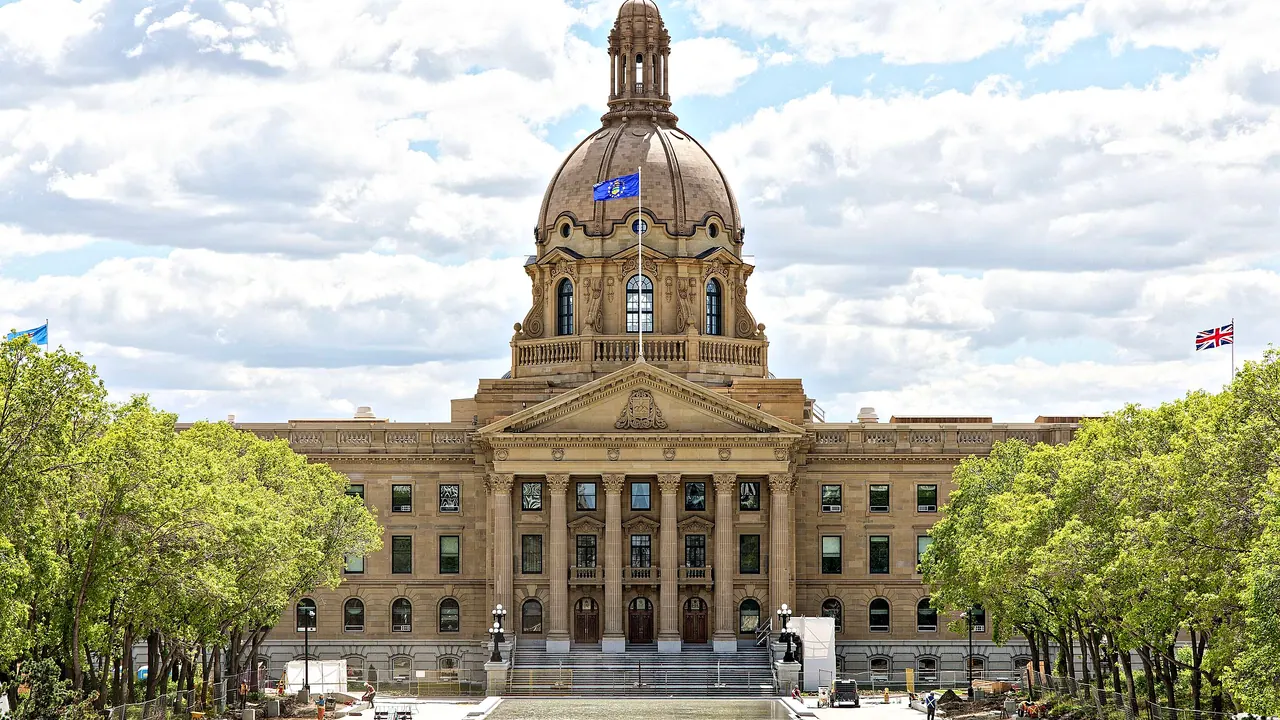
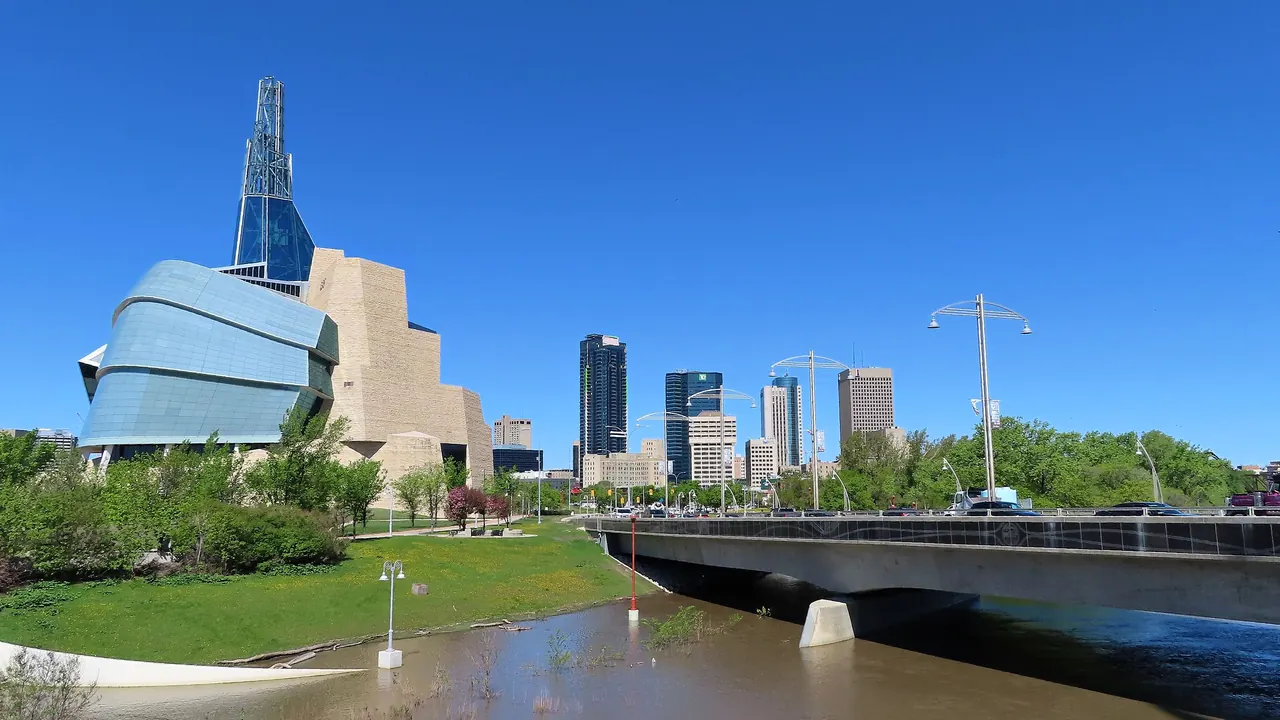
Photos: Edmonton by D. Benjamin Miller, CC0; Winnipeg by Dennis Sylvester Hurd, CC BY 2.0, cropped.
Edmonton or Winnipeg?
Our verdict in twelve categories, each scored against the same fixed benchmark cities, and the climate month by month, so you can choose for your trip.
Choose Edmonton for
- shopping
- nightlife
- food and drink
Edmonton suits travellers who want a livelier evening and more to do indoors. Whyte Avenue gives it a real strip of bars and small clubs, West Edmonton Mall puts serious shopping, a wave pool and roller coasters under one roof, and the river valley runs a long ribbon of trails through the middle of the city. An LRT line helps a little with getting about.
Choose Winnipeg for
- beaches
- culture and sights
- wellness
Winnipeg is the better pick if you'd rather spend your days in museums and old streets. The Canadian Museum for Human Rights, the Inuit art at the Winnipeg Art Gallery and the warehouse blocks of the Exchange District give it more to see. It also has a proper sandy beach at Grand Beach within driving distance, and a Nordic spa that many visitors come specially for.
Scoreboard
Twelve categories on one fixed scale from 0 to 100. The shaded stretch is the gap between the two.
Your match
Pick a travel style or drag the sliders, and both match scores follow your weighting.
Too close to call, 1 point apart
Wins on shopping and nightlife with your weighting.
Wins on beaches and culture and sights with your weighting.
What matters to you?
Category by category
What the scores mean for a trip.
Beaches & swimming
Neither city is a beach destination, but Winnipeg has the better beach within reach. Grand Beach on Lake Winnipeg has fine white sand backed by dunes, a little over an hour's drive away, and Gimli and Winnipeg Beach add old resort piers and boardwalks.
Edmonton's nearest lakes, Pigeon and Wabamun, are smaller and plainer, and Sylvan Lake is a longer drive. In both places the water reaches about 20°C in midsummer and algae can spoil it late in the season. In Edmonton, the mall's indoor wave pool is often the more practical swim.
Food & drink
The two eat much alike, both shaped by Ukrainian settlers, so perogies, cabbage rolls and kielbasa are easy to find in either. Edmonton leans on Alberta beef and its steakhouses, and its better eating is spread along Whyte Avenue, 124 Street and the downtown core, with craft breweries and the Old Strathcona Farmers' Market.
Winnipeg has more homegrown oddities: Mennonite farmer sausage, honey dill sauce, dense local rye bread and all-hours diners. The Forks Market by the rivers is the easiest place to graze. Neither city is worth planning a trip around for the food.
Culture & sights
Winnipeg has the more rewarding sights. The Canadian Museum for Human Rights is a national institution whose galleries spiral up to a tower above the rivers, the Winnipeg Art Gallery holds an Inuit collection without equal anywhere, and the Exchange District is a real piece of grain-boom townscape. St Boniface adds a French quarter and the ruined cathedral facade.
Edmonton's attractions are regional. The Royal Alberta Museum, with its strong First Nations galleries, is the best of them, and the Art Gallery of Alberta is worth seeing for its building alone. Fort Edmonton Park brings the fur-trade years to life, but two days covers the city.
Nightlife
Edmonton is the better city for a night out. Whyte Avenue is a long strip of pubs, dive bars and small clubs, busy with students at weekends. Downtown fills up around hockey games and concerts, and 124 Street suits a quieter glass of wine.
Winnipeg's going out is gentler: craft-beer and cocktail bars in the Exchange District warehouses, younger pubs in Osborne Village, and only a handful of clubs. It's at its best on summer evenings on the patios. In the deep cold, a night out usually means one warm bar rather than several.
Nature & outdoors
These two are evenly matched outdoors, but the landscapes differ. Edmonton's North Saskatchewan River Valley is the bigger asset inside the city: more than 150km of trails through forested ravines, with beavers and coyotes. Elk Island's bison and the Beaver Hills dark skies, good for the northern lights, are under an hour away.
Winnipeg's city green space is smaller, in Assiniboine Forest, the riverbanks and the bison at FortWhyte Alive. In return, it has Whiteshell's granite, pine and lake country about an hour and a half away, close enough for a canoeing trip in a way the Rockies are not from Edmonton. Its frozen-river skating trails are a winter speciality, and its summer mosquitoes are fierce.
Day trips
Both lists are short and every outing needs a car, but Winnipeg's has a little more variety. Lower Fort Garry is a stone fur-trade post with costumed interpreters about forty minutes north. Gimli pairs an Icelandic fishing harbour with the lakeshore, and Steinbach's Mennonite village has a working windmill.
Edmonton offers the Ukrainian Cultural Heritage Village, with its onion-domed churches, and the vintage machines of the Reynolds-Alberta Museum. The Alberta sights most visitors really want, Drumheller's badlands and the mountains at Jasper and Banff, need an overnight stay.
Good for families
Both cities work well with children, and the difference is where the highlights are. Edmonton's trump card is West Edmonton Mall, with its waterpark, roller coasters, ice rink and sea lions all indoors, which matters a great deal through a prairie winter. Fort Edmonton Park's steam train and the science centre's planetarium fill more days.
Winnipeg's best family day is outdoors at Assiniboine Park Zoo, where polar bears swim overhead in an underwater tunnel. The children's museum at The Forks and the bison at FortWhyte round it out. In winter, though, Winnipeg has nothing to match Edmonton's indoor playground.
Getting around
Getting around is much the same: a walkable core, then distances that push most visitors into a hire car. Edmonton has the advantage of rail. Its LRT links downtown with the university and the southern suburbs, and the High Level Bridge and the funicular connect the centre to Old Strathcona and the valley.
Winnipeg runs on buses alone, with one busway south towards the university, but its downtown, Exchange District and The Forks sit closer together. Both cities have enclosed walkways downtown, pedways in Edmonton and skywalks in Winnipeg, for the coldest days.
Shopping & style
Edmonton is the clear choice for shopping, mainly because of West Edmonton Mall, one of the largest on the continent. Whyte Avenue's vintage and outdoor-gear shops and 124 Street's boutiques and galleries add more individual browsing.
Winnipeg's retail mostly serves residents. The worthwhile stops are the independent clothing and design shops in the Exchange District warehouses and the craft stalls at The Forks. Both cities are good places to buy Indigenous art, and Winnipeg's Inuit galleries are especially strong. Neither has luxury fashion.
Affordability
Costs are much the same, with hotels moderate by Canadian standards and eating and drinking at ordinary North American levels once tax and tip go on. What changes is where the money goes. Edmonton's car hire and parking are kind to the budget, and many of its summer festivals and river-valley trails are free.
In Winnipeg, downtown rooms are good value, but taxis or a rental car for anything beyond the centre add up quickly.
Live music & performing arts
The two are equally strong on stage, but they shine in different ways. Edmonton is at its best in summer, when the Fringe, the largest in North America, fills Old Strathcona every August and the Folk Music Festival takes over the slopes of Gallagher Park. The Citadel and the Winspear Centre carry the rest of the year.
Winnipeg's strength is its companies. The Royal Winnipeg Ballet, the oldest in the country, shares the Centennial Concert Hall with the symphony and the opera, and St Boniface has French-language theatre. Its own Fringe and the folk festival at Birds Hill Park, with its campers, keep summer busy too.
Wellness & relaxation
Edmonton spreads its wellness thinly. It has several smaller Nordic-style spas, some out on the northwestern fringe and most needing a car, plus hotel spas and public leisure centres. None of them draws visitors the way Winnipeg's spa does. A walk in the river valley or an hour in the Muttart Conservatory's greenhouses is about as restful as a day in Edmonton gets.
Winnipeg puts its effort into one large Nordic spa, set among trees beside a park near the university, and that one place is enough to make the trip. Its outdoor hot pools, saunas and cold plunges are at their best when the air drops to around -20°C. With the city's light traffic and a slow summer afternoon in Assiniboine Park's English garden, Winnipeg is the easier place to unwind, though neither city is built around rest.
When should you go?
Pick your month. The climate figures are measured averages, not a forecast.
Edmonton in July
Winnipeg in July
Daytime high, °C
Rainfall in the month, mm
Temperature and rainfall are climate normals, averaged over the years shown. Edmonton: 1991-2020 normals, University Of Alberta Metabolic Centre (2.5 km from centre). Winnipeg: 1991-2020 normals, Winnipeg The Forks (0.9 km from centre).
The warm season is short in both cities, and June to early September is the time to go. Winnipeg runs a little warmer in high summer, with July highs around 27°C against Edmonton's 25°C, and the lakes near both cities are only worth swimming in during July and August. September is still pleasant for walking in both, and a touch milder in Winnipeg.
Winter is long and hard in both from November to March, but Winnipeg's is clearly colder. January highs sit around -10°C there and -5°C in Edmonton, so walking the streets in Winnipeg means hurrying between skywalks and warm bars. Rain also falls differently. Edmonton is dry for most of the year apart from a wet July of about 104mm, while Winnipeg's rain is spread more evenly from May to August.
Which traveller are you?
On a culture and arts trip, Winnipeg is the stronger choice. It has a national museum in a landmark building, the world's largest public collection of contemporary Inuit art and the terracotta warehouses of the Exchange District, and the Royal Winnipeg Ballet adds to the stage.
For a shopping trip, Edmonton wins clearly. West Edmonton Mall is a destination in its own right, with hundreds of stores alongside its rides. Whyte Avenue adds vintage clothes, records and outdoor gear, and 124 Street has galleries and small boutiques.
On a food and nightlife trip, Edmonton gives you more to do after dinner. Whyte Avenue's pubs and clubs stay busy at weekends, and the arena district fills on game nights. Winnipeg's evenings are quieter and mostly over by the early hours.
Before you go
| Measure | Edmonton | Winnipeg |
|---|---|---|
| Official language | French, English | French, English |
| Currency | Canadian Dollar (CAD) | Canadian Dollar (CAD) |
| Sockets | AB120 V, 60 Hz | AB120 V, 60 Hz |
| Driving side | Right | Right |
| Time zone | UTC-7, UTC-6 in summer | UTC-6, UTC-5 in summer |
| Emergency number | 911 | 911 |
| Elevation | 645 m | 238 m |
| Main airport | Edmonton International Airport (YEG)25 km from centre52 non-stop destinations | Winnipeg / James Armstrong Richardson International Airport (YWG)7 km from centre41 non-stop destinations |
| Public holidays this year | 13 days | 10 days |
By the numbers
| Measure | Edmonton | Winnipeg |
|---|---|---|
| City population | 1,010,899 | 749,607 |
| People per km² | 1,316 | 1,670 |
| Museums within 10 km | 13 | 30 |
| UNESCO World Heritage sites within 50 km | 0 | 0 |
Where else could you go?
Every comparison below shares a destination with this one, so you can follow Edmonton or Winnipeg somewhere new.