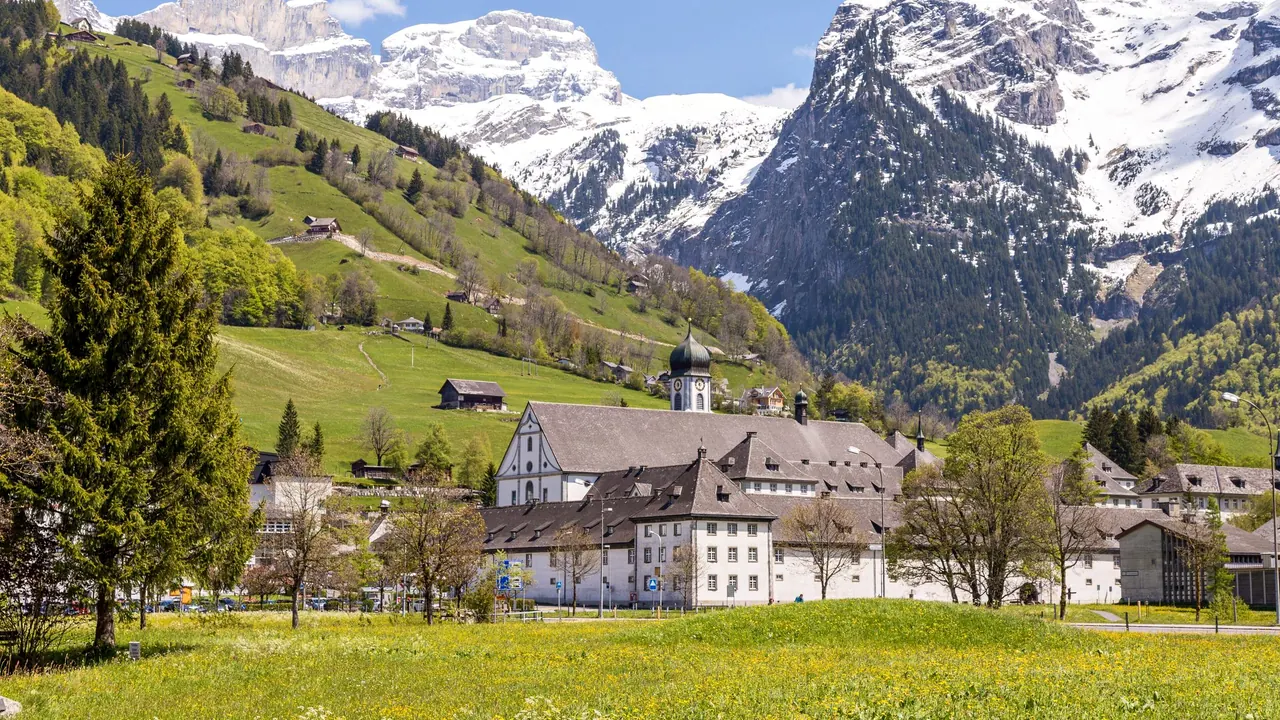
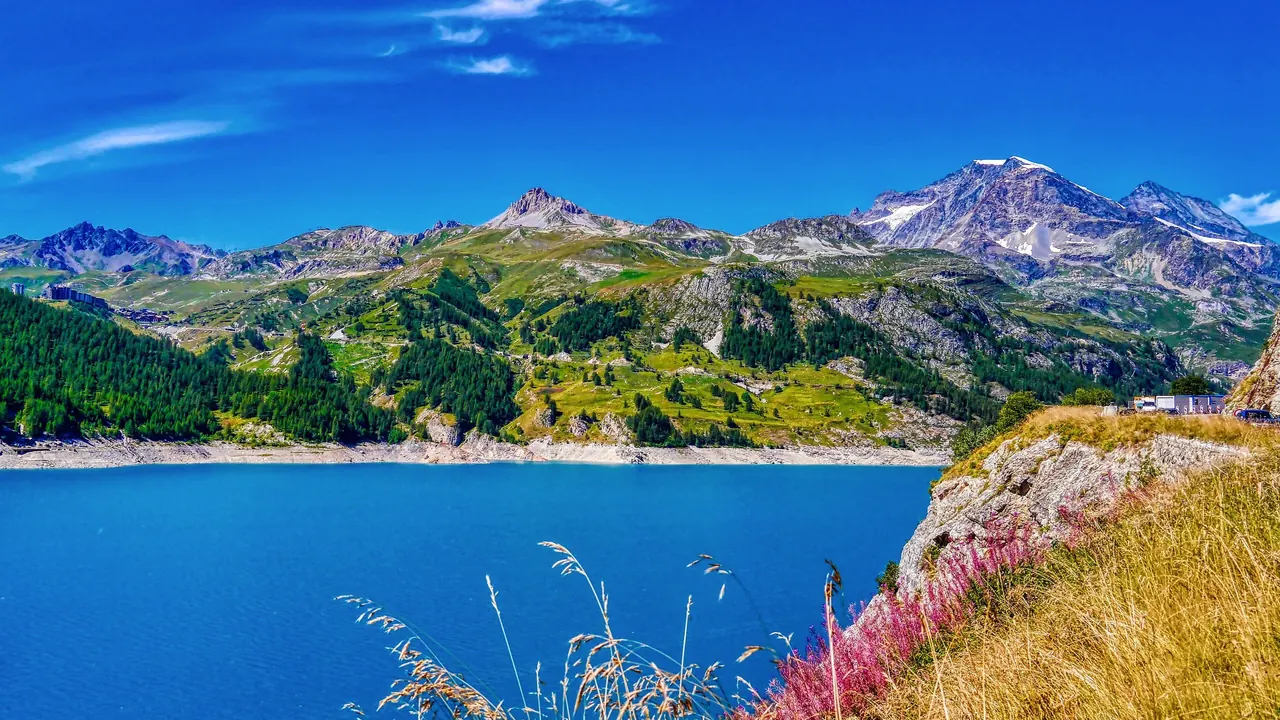
Photos: Engelberg by JoachimKohler-HB, CC BY-SA 4.0, cropped; Tignes by Zairon, CC BY-SA 4.0, cropped.
Engelberg or Tignes?
Our verdict in twelve categories, each scored against the same fixed benchmark cities, and the climate month by month, so you can choose for your trip.
Choose Engelberg for
- day trips
- getting around
- families
Engelberg suits travellers who want high mountains without giving up easy connections. The train climbs from Lucerne, the village is compact and walkable, and the lake, the old towns of central Switzerland and even Zurich are within reach on a day off the slopes. Families do well here, with Brunni's play lake and a glacier that anyone can visit, and the Benedictine abbey gives the village a historic centre that Tignes lacks.
Choose Tignes for
- nightlife
- food and drink
- prices
Pick Tignes for a week built around the snow and the evenings after it. Its lifts join with Val d'Isère's to form one of the largest ski areas in the Alps, high enough for a season that opens in autumn on the glacier, and the après-ski in Val Claret and Le Lac goes on far later than anything in Engelberg. It is harder to reach and offers little beyond the mountains, but it is somewhat easier on the budget, especially in summer.
Scoreboard
Twelve categories on one fixed scale from 0 to 100. The shaded stretch is the gap between the two.
Your match
Pick a travel style or drag the sliders, and both match scores follow your weighting.
Wins on day trips and getting around with your weighting.
Wins on nightlife and food and drink with your weighting.
What matters to you?
Category by category
What the scores mean for a trip.
Beaches & swimming
Neither resort is a place for swimming, but the options differ. Engelberg's mountain lakes are too cold for bathing, so a swim means the sports-centre pool or the hour's train ride down to Lake Lucerne. Its lidos and lakeside meadows offer clear water that is pleasantly mild in midsummer.
Tignes has a bathing spot on its doorstep, a supervised area with a small sandy shore on the Lac de Tignes in July and August. The water is snowmelt and stays near 16°C, though, so most visitors use the indoor lagoon pool with slides instead.
Food & drink
Both run on melted cheese, but Tignes offers a little more choice. Engelberg means hotel dining rooms, panelled village restaurants and mountain huts serving rösti and Älplermagronen, and the monastery's show dairy is the one stop that feels special.
In Le Lac and Val Claret the menus stretch to pizzerias, crêperies and a few kitchens cooking modern Alpine food, and the delicatessens sell Beaufort, Reblochon and Savoie wines. Menus still repeat, and many places close out of season.
Culture & sights
Engelberg has the only real sight of the two: the Benedictine abbey founded in 1120, with its bright baroque church and one of Switzerland's largest organs. Add the valley museum and the Belle Époque hotels from the days of the grand Alpine resorts, and you have an hour or two of sightseeing.
Tignes was rebuilt from scratch high above its old site after the Chevril dam flooded the original village in 1952, so its buildings are mostly functional apartment blocks. Its main heritage is the story of that drowned village, remembered in the giant mural on the dam wall. Apart from a few chapels in Les Brévières and Les Boisses, there is little to visit.
Nightlife
Tignes is the place to go out. In the ski season, après-ski moves from music on the mountain terraces to the bars of Val Claret and Le Lac, and the small clubs stay open until well after midnight, full of a loud crowd of British, Scandinavian and French skiers.
Engelberg has a shorter version of the same thing: busy bars at the foot of the slopes in the late afternoon, plus a couple of late bars and a small club at weekends in high season. In summer both go quiet, and an evening in Engelberg usually ends on a hotel terrace.
Nature & outdoors
Both sit under glaciers and both are outstanding. The difference is in the kind of mountain experience. On Titlis, cable cars bring permanent snow within reach of non-skiers, with the rotating gondola, the suspension bridge and the ice cave. Its steep north faces draw freeriders, and the Four Lakes walk over the Jochpass is a summer classic.
Tignes sits higher, around a lake at 2,100m, and is built on a bigger scale. Its lifts join with Val d'Isère's to form one of the largest ski areas in the Alps, and the Grande Motte glacier opens the season in autumn. In summer the Vanoise National Park, France's oldest, has trails where you see ibex and marmots.
Day trips
Engelberg is much better placed for days away. The valley railway reaches Lucerne in under an hour, with paddle steamers to Weggis and Vitznau, and Stans, Schwyz, the abbey at Einsiedeln and Zurich are all within a couple of hours.
From Tignes the long, winding road down turns most outings into a drive. Val d'Isère is close by bus, Conflans and Beaufort make a pleasant day by car, and Aosta in Italy is about two hours away when the Little St Bernard Pass is open in summer.
Good for families
Engelberg is the easier base for a family. The village is safe, with short walks to the lifts, and both mountains have play areas: rafts and stepping stones on Brunni's Härzlisee and boats at the Trübsee. Lucerne's transport museum is close for a wet day.
Tignes is strong in winter, with children's ski classes, beginner slopes beside Le Lac and Val Claret, ski-in, ski-out apartments and the aquatic centre with slides. Away from the snow there is less for children to do, and the whole resort sits at an altitude that tires small children, something Engelberg asks of them only at its glacier station.
Getting around
Engelberg is easier to reach and to get around. The train climbs from Lucerne in under an hour, the village is compact and flat, and the cable cars leave from its edge, so you don't need a car for anything.
Tignes is simple once you are there, a string of villages linked by free shuttles and lifts, though the paths can be icy and uphill. The nearest station is at Bourg-Saint-Maurice, about forty minutes below by bus or taxi, and anything outside the valley needs a car or a transfer.
Shopping & style
Shopping is an afterthought in both. Engelberg's main street has a few watch and jewellery shops for tour groups alongside the gear and rental shops, and the best things to buy are monastery cheese and Swiss chocolate. Tignes sticks to ski hire, sportswear and supermarkets, and the things to take home are Beaufort, cured sausage and mountain honey.
Affordability
Neither is cheap, but Engelberg is the harder of the two on a budget. Hotel, restaurant and drink prices sit far above European norms, and the Titlis cable car is a large cost on its own. A Swiss travel pass and supermarket picnics help only a little.
Tignes is expensive in the peak ski weeks, but self-catering apartments make up much of the resort, early and late season weeks are noticeably cheaper, and summer brings lower prices for places to stay and free activities around the lake. Eating out stays expensive in both.
Live music & performing arts
Neither has much of a stage life, and what there is differs in kind. In Engelberg it means organ recitals and concerts in the baroque abbey church and a small classical festival in summer, with Lucerne's concert halls less than an hour away. In Tignes live music means bands in the après-ski bars, DJs on the terraces and the occasional free outdoor concert at resort events.
Wellness & relaxation
For winding down the two are close, but the mood differs. Engelberg began as a health resort, and its quiet valley suits a slow stay, especially in early summer or midweek in winter, with hotel spas and the sports-centre pool.
Tignes has a busier rhythm, with early lifts and late bars, though its aquatic centre has a hammam and massage, and the thermal waters of Brides-les-Bains are about an hour down the valley. Neither has a bathing tradition of its own.
When should you go?
Pick your month. The climate figures are measured averages, not a forecast.
Engelberg in July
Tignes in July
Daytime high, °C
Rainfall in the month, mm
Where the figures come from
Engelberg has no weather station within reach, so its figures come from a gridded climate model rather than a measured record, and read a broad area rather than one spot.
Tignes has no weather station within reach, so its figures come from a gridded climate model rather than a measured record, and read a broad area rather than one spot.
Temperature and rainfall are climate normals, averaged over the years shown. Engelberg: 2001-2020 normals, NASA POWER reanalysis grid, no weather station within 90 km. Tignes: 2001-2020 normals, NASA POWER reanalysis grid, no weather station within 90 km.
Neither place has a beach season, so the choice is between snow and walking. Engelberg sits lower and milder, with summer highs around 21°C from June to August, but these are also its wettest months, at about 150mm each, so a summer stay should allow for some rain days. Winter in the valley stays just above freezing, with daytime highs of 1°C or 2°C from December to February.
Tignes is colder all year. Daytime highs stay below freezing from December to February, which keeps the snow reliable, and only July reaches about 18°C. It is drier than Engelberg in every month, so July and August are the settled window for hiking up to its lakes. Spring and late autumn are cool in both places, and both resorts go quiet between the seasons.
Which traveller are you?
For a food and nightlife trip, Tignes is the better choice. In winter, going out is a central part of the week, and a young crowd keeps the evenings going late. Engelberg's nights out are shorter and mostly stop outside high season. Dinner choices are also a little wider in Tignes.
On a family trip with children, Engelberg is the easier choice. Distances are short, the village sits lower, and there is plenty for children to do on both mountains in summer as well as winter, with good rainy-day options down the valley. Tignes works well mainly for a ski week.
On a tight budget, neither resort is cheap, but Tignes gives you more ways to cut costs if you choose your week carefully and cook for yourself. In Engelberg, Swiss prices reach every meal, drink and lift ride, so there is not much room to save.
Before you go
| Measure | Engelberg | Tignes |
|---|---|---|
| Official language | French, German, Italian, Romansh | French |
| Currency | Swiss Franc (CHF) | Euro (EUR) |
| Sockets | CJ230 V, 50 Hz | CE230 V, 50 Hz |
| Driving side | Right | Right |
| Time zone | UTC+1, UTC+2 in summer | UTC+1, UTC+2 in summer |
| Emergency number | 112 | 112 |
| Elevation | 1,015 m | 1,440 m |
| Main airport | Zürich Airport (ZRH)72 km from centre226 non-stop destinations | Geneva International Airport (GVA)105 km from centre150 non-stop destinations |
| Public holidays this year | 13 days | 11 days |
By the numbers
| Measure | Engelberg | Tignes |
|---|---|---|
| Population | 4,181 | 1,919 |
| People per km² | 56 | 24 |
| Museums within 10 km | 0 | 0 |
| UNESCO World Heritage sites within 50 km | 2 | 0 |
Where else could you go?
Every comparison below shares a destination with this one, so you can follow Engelberg or Tignes somewhere new.
- Val d'Isèrevs Tignes
- Les Arcsvs Tignes
- La Rosièrevs Tignes
- La Plagnevs Tignes
- Val Cenisvs Tignes
- Courchevelvs Tignes