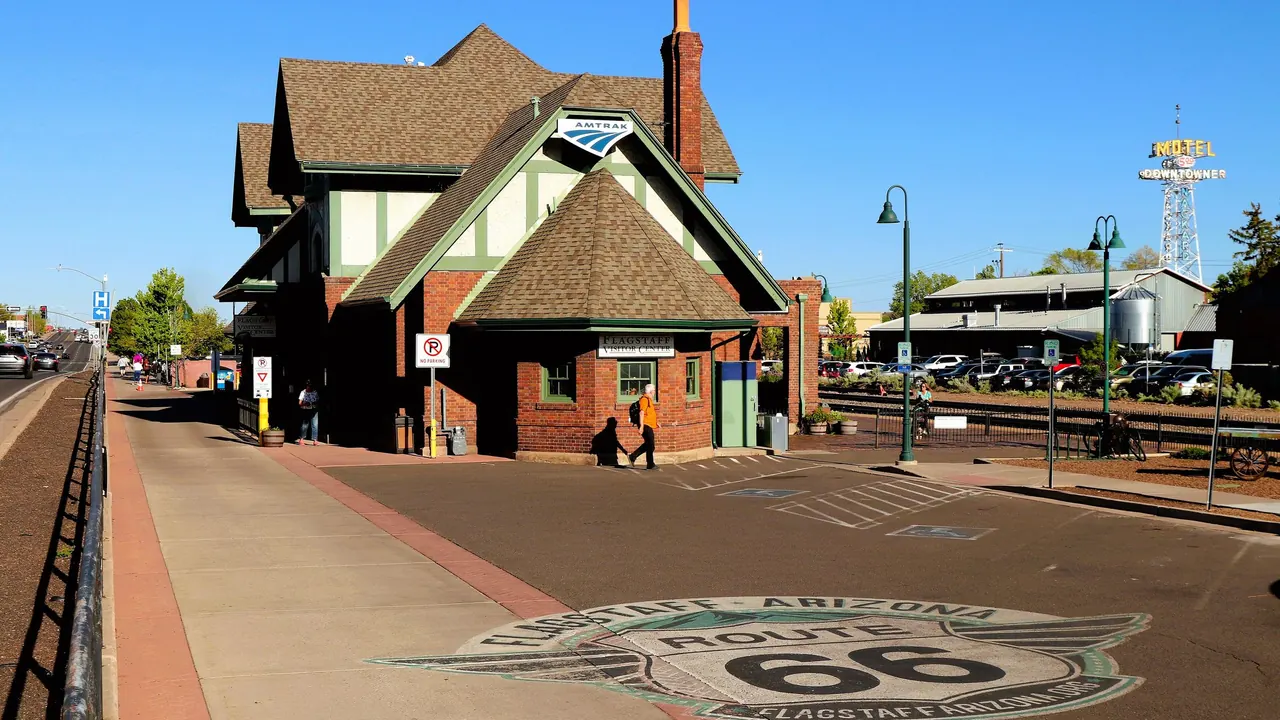
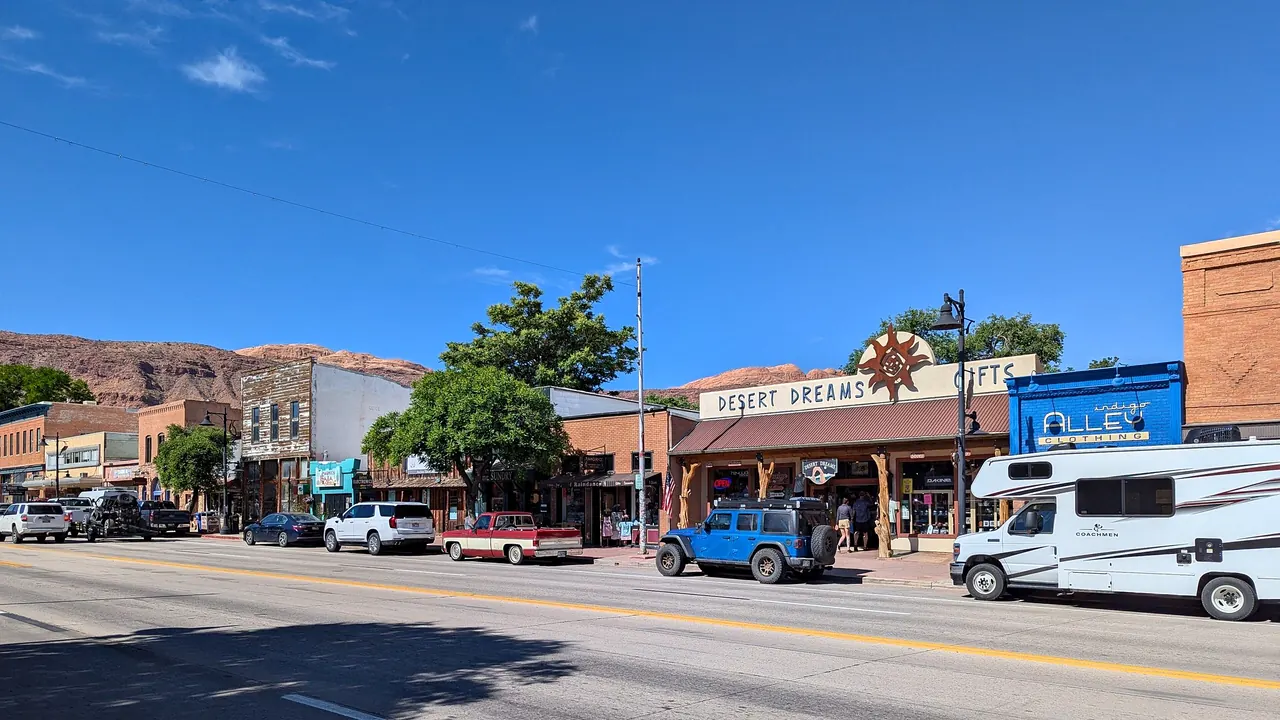
Photos: Flagstaff by Thank You (25 Millions) views, CC BY 2.0, cropped; Moab by G. Edward Johnson, CC BY 4.0, cropped.
Flagstaff or Moab?
Our verdict in twelve categories, each scored against the same fixed benchmark cities, and the climate month by month, so you can choose for your trip.
Choose Flagstaff for
- day trips
- culture and sights
- nightlife
Flagstaff suits a rounded mountain vacation. It is the handier base for both the Grand Canyon and Sedona, and it adds what Moab lacks: an observatory and a serious museum, a brewery scene for the evenings, a wider spread of day trips and an easier time with young children. It is also the cooler escape in high summer.
Choose Moab for
- nature and the outdoors
For a trip that is all about the outdoors, Moab is the sharper pick. Arches begins at the edge of town, Canyonlands is close by, and slickrock biking, rafting and canyoneering can fill every day. The town itself offers little else, so go in spring or autumn and plan to be outside from dawn.
Scoreboard
Twelve categories on one fixed scale from 0 to 100. The shaded stretch is the gap between the two.
Your match
Pick a travel style or drag the sliders, and both match scores follow your weighting.
Wins on day trips and culture and sights with your weighting.
Wins on nature and the outdoors with your weighting.
What matters to you?
Category by category
What the scores mean for a trip.
Beaches & swimming
Neither town is a beach vacation, and both are equally far from one. The difference is in how you cool off. Near Flagstaff it means the creek pools of Oak Creek Canyon, with Slide Rock busy on summer weekends. Moab has Mill Creek's shallow pools, Ken's Lake and sandbars on a fast, silty Colorado, and in both towns the motel pool does most of the work.
Food & drink
Flagstaff gives you more choice. It has a proper cluster of craft breweries across downtown and the Southside, Mexican and New Mexican cooking, regional touches such as Navajo tacos and green chile, and a few more ambitious restaurants downtown.
Moab's food is fuel for the trail: big portions on Main Street, early coffee and a thinner choice in winter. Utah's alcohol rules also make a beer with dinner a more formal business than across the state line in Arizona. Neither town is worth visiting for its food, but evenings at the table are easier in Flagstaff.
Culture & sights
Flagstaff has real sights for a small town. There is the Lowell Observatory, where Pluto was discovered, the Museum of Northern Arizona with its Hopi, Navajo and Zuni collections, the Riordan Mansion and the railroad-era downtown on Route 66. Together they are worth a day or two.
In Moab, the culture is on the rock rather than in buildings. The petroglyph panels along Potash Road and Kane Creek and the dinosaur trackways are striking. The town itself, with its small museum and uranium-era Main Street, fills a morning at most.
Nightlife
Flagstaff has a real evening circuit: taprooms, cocktail bars and old Route 66 saloons within a short walk of each other across downtown and the Southside, with students keeping it livelier in term time. There are hardly any clubs, but you can move from place to place.
In Moab, a couple of brewpubs on Main Street hold riders and rafters until the town goes quiet around eleven. The better night out there is under the stars.
Nature & outdoors
Both are outstanding outdoor bases, and the difference is in the landscape. Flagstaff is mountain and forest. It has the volcanic San Francisco Peaks with their aspen and ski area, vast ponderosa pine woods and the lava fields of Sunset Crater, and Sedona's red rock and the Grand Canyon's South Rim are within driving range.
Moab is bare stone and rivers. Arches begins minutes from town and Canyonlands and Dead Horse Point are under an hour away. The Slickrock Trail, rafting on the Colorado and canyoneering make it a place for doing things as much as looking. Choose Flagstaff for snow, shade and the canyon, and Moab for slickrock and desert adventure.
Day trips
Flagstaff has the far wider choice of outings. You can reach Sedona's galleries, the hillside mining town of Jerome, the cliff dwellings at Montezuma Castle, the historic railway from Williams to the Grand Canyon and the Hopi mesas, home to some of North America's oldest inhabited villages.
From Moab, most outings simply lead to more scenery, and the towns within reach, such as Bluff and Green River, are small. The best cultural outing, to Edge of the Cedars and Hovenweep, takes up a whole long day of driving.
Good for families
Flagstaff is the gentler choice with children. The observatory's telescope evenings, the dinosaur displays at the museum, rope courses in summer and sledding in winter give plenty of variety, though the altitude tires little ones for the first day or two.
Moab rewards older, active children with easy arch walks, Junior Ranger programmes and calm raft floats. Summer heat, unfenced drops and the lack of anything built for small children make it much harder with toddlers.
Getting around
Neither works well without a car, but Flagstaff gives you more options. It has a walkable downtown, a paved urban trail network, local buses and long-distance trains at the downtown station. The mountain, Sedona and the canyon still need a car or a tour.
In Moab, Main Street is walkable and a bike path reaches the Arches entrance, but that is about all. The parks lie along long desert roads, many trailheads are on dirt tracks, and a high-clearance vehicle opens up far more ground.
Shopping & style
Flagstaff is the better place to buy Native American craft. Navajo rugs, Hopi kachina carvings, pottery and turquoise jewellery are sold in downtown galleries, the museum shop and roadside trading posts, and the town also has bookshops and a regional mall.
Moab's Main Street is practical: bike and climbing shops, rock shops selling geodes and fossils, and a few galleries. It is good for a spare tyre, but not for an afternoon of browsing.
Affordability
Flagstaff is the cheaper base. Chain motels on old Route 66 keep a basic stay within reach, and the town is much cheaper than Sedona or the canyon rim, though rooms cost more on summer weekends.
Moab's limited rooms charge resort rates in spring and autumn, and guided rafting or jeep tours add up quickly. The savings there are in public campgrounds, free dispersed camping and a park entry that covers a week of free hiking, and winter costs far less. Both towns need a hire car.
Live music & performing arts
Flagstaff has a modest calendar that runs all year. There are concerts by the Flagstaff Symphony Orchestra and the university's music school, touring bands at the restored Orpheum Theater, community theatre, and outdoor concerts in the pines in summer.
Moab essentially has one event, the Moab Music Festival at the end of summer. Its chamber concerts in canyon grottoes reached by boat are memorable, but the rest of the year offers little more than a weekend band in a brewpub.
Wellness & relaxation
Neither is a spa destination, but Flagstaff is the more restful stay. It is a slow mountain town with cool evenings and pine-scented air, and Sedona's resort spas and yoga studios are about an hour's drive away when you want treatments.
Moab's days mean early starts and long efforts in the heat, and its few massage studios mostly serve sore cyclists. Its calm comes from quiet desert evenings and red cliffs at sunset, or from a cabin up in the La Sal Mountains.
When should you go?
Pick your month. The climate figures are measured averages, not a forecast.
Flagstaff in July
Moab in July
Daytime high, °C
Rainfall in the month, mm
Where the figures come from
Flagstaff has no rain gauge within 25 km of the centre, so its rainfall comes from a gridded climate dataset read at the city rather than from a gauge further away.
Moab's temperatures are measured 27 km from the centre, at Moab / Crescent Junction.
Moab's station stands 162 m above the city centre, so the centre is likely a little warmer than the figures say.
Moab has no rain gauge within 25 km of the centre, so its rainfall comes from a gridded climate dataset read at the city rather than from a gauge further away.
Temperature and rainfall are climate normals, averaged over the years shown. Flagstaff: 1991-2020 normals, Flagstaff / Fort Tuthill (7.4 km from centre). Moab: 2006-2020 (rainfall 1991-2020) normals, Moab / Crescent Junction (27 km from centre).
Flagstaff is at its most comfortable from May to October. Early summer is dry and warm. July and August reach about 27°C but bring afternoon monsoon storms, with up to 64mm of rain in August. September and October are mild and good for walking. From November to March it is cold, with snow that suits sledding and skiing more than sightseeing.
Moab is at its best in spring and autumn, when April, May, September and October are warm and dry for hiking. High summer is the reverse of Flagstaff's, with highs around 35°C that make midday on the trails risky, and winter days near 2°C are quiet and cold. Moab stays dry all year, never much above 25mm in a month, so the choice between the two is about heat rather than rain: Flagstaff for July, Moab for April or October.
Which traveller are you?
For an outdoors trip, both towns are superb, so choose by terrain. Flagstaff suits hikers after mountain forest and snow, and it is the pick for summer. Moab is for riders, rafters and canyoneers after bare desert rock in spring or autumn.
On a family trip with children, Flagstaff is the safer bet, especially with little ones, because it offers more variety and cool summers. Moab suits older, adventurous children who are happy to spend whole days outside on rock and river.
On a culture and arts trip, Flagstaff is the clear choice. It has enough sights and concerts for a couple of days, with Native American history within a day's drive. In Moab, culture comes second to the trails.
Before you go
| Measure | Flagstaff | Moab |
|---|---|---|
| Currency | US Dollar (USD) | US Dollar (USD) |
| Sockets | AB120 V, 60 Hz | AB120 V, 60 Hz |
| Driving side | Right | Right |
| Time zone | UTC-7 | UTC-7, UTC-6 in summer |
| Emergency number | 911 | 911 |
| Elevation | 2,106 m | 1,227 m |
| Main airport | Flagstaff Pulliam Airport (FLG)7 km from centre2 non-stop destinations | Canyonlands Regional Airport (CNY)27 km from centre2 non-stop destinations |
| Public holidays this year | 12 days | 12 days |
By the numbers
| Measure | Flagstaff | Moab |
|---|---|---|
| City population | 76,831 | 5,366 |
| People per km² | 464 | 501 |
| Museums within 10 km | 1 | 1 |
| UNESCO World Heritage sites within 50 km | 0 | 0 |
Where else could you go?
Every comparison below shares a destination with this one, so you can follow Flagstaff or Moab somewhere new.
- Sedonavs Flagstaff
- Telluridevs Moab
- Scottsdalevs Flagstaff
- Phoenixvs Flagstaff
- Aspenvs Moab
- Deer Valleyvs Moab