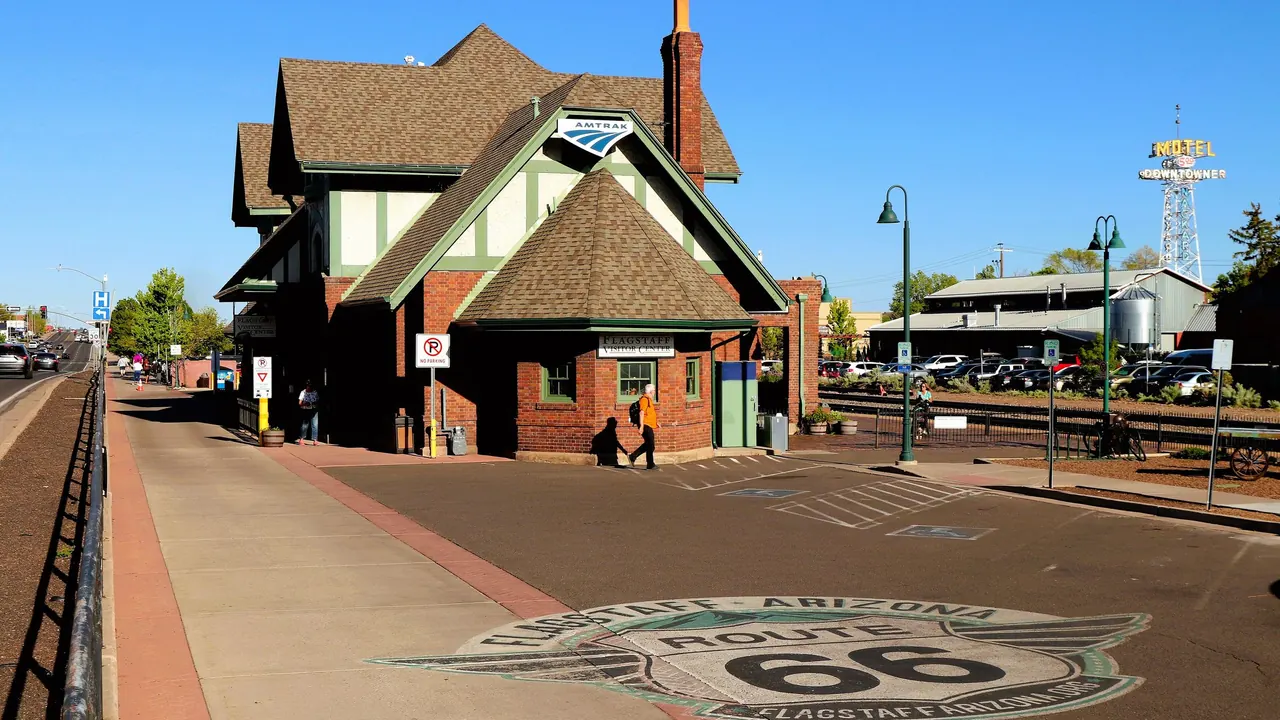
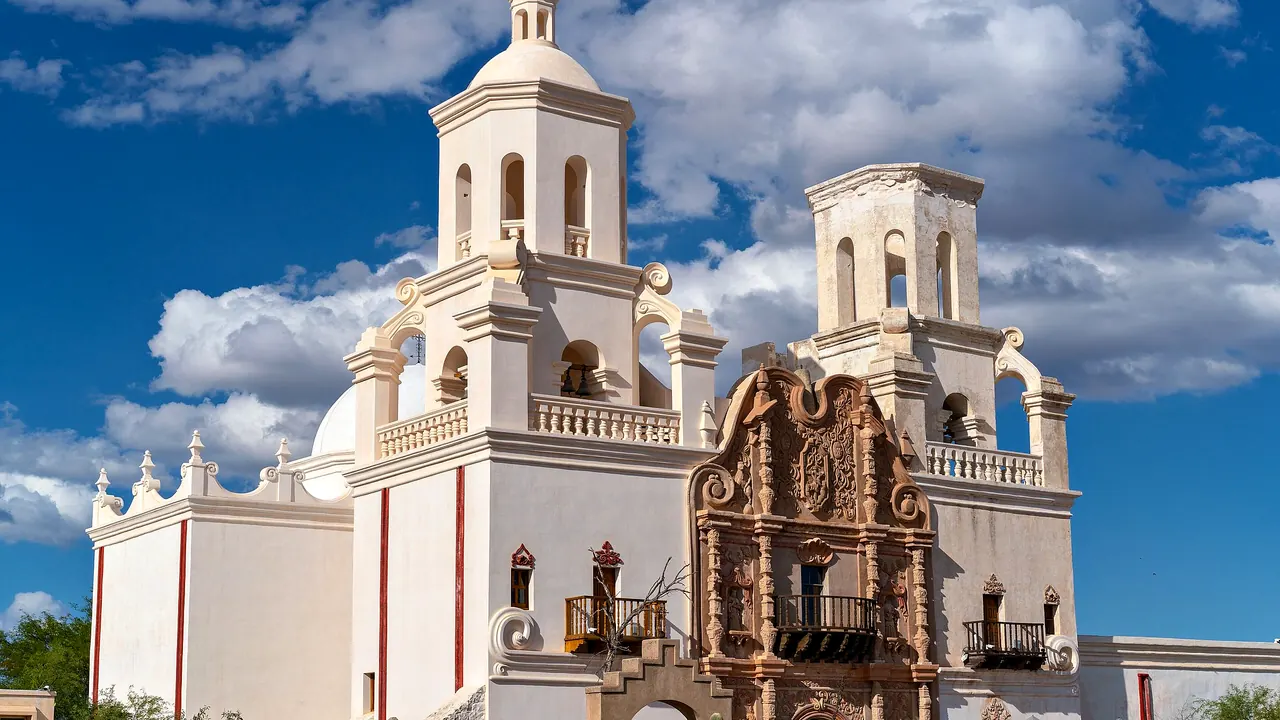
Photos: Flagstaff by Thank You (25 Millions) views, CC BY 2.0, cropped; Tucson by Steve and Kimberly Rader, CC BY-SA 4.0, cropped.
Flagstaff or Tucson?
Our verdict in twelve categories, each scored against the same fixed benchmark cities, and the climate month by month, so you can choose for your trip.
Choose Flagstaff for
- nature and the outdoors
- getting around
- beaches
Flagstaff is the pick for a trip built around the outdoors and cooler air. It works as a mountain base for the Grand Canyon, the San Francisco Peaks and Sedona's red rock, and it has some of the darkest night skies anywhere. Its pine-forest summers stay mild while the desert below bakes. Evenings mean a brewery patio and an early night, which suits people who want to be on a trail by dawn.
Choose Tucson for
- wellness
- food and drink
- shopping
Travellers who want more from the town itself should lean towards Tucson. It has its own regional cuisine in Sonoran Mexican cooking and a broader set of sights, from San Xavier del Bac to the aircraft museum. Its evenings on Fourth Avenue and Congress Street are livelier, and its desert spa resorts have been around for a long time. It is a winter-sun city, at its best when Flagstaff is under snow, and it is a little easier on the budget.
Scoreboard
Twelve categories on one fixed scale from 0 to 100. The shaded stretch is the gap between the two.
Your match
Pick a travel style or drag the sliders, and both match scores follow your weighting.
Wins on nature and the outdoors and getting around with your weighting.
Wins on wellness and food and drink with your weighting.
What matters to you?
Category by category
What the scores mean for a trip.
Beaches & swimming
Neither city is a beach destination, so the difference is in what swimming means. From Flagstaff, the best option is a drive down into Oak Creek Canyon. Slide Rock and the creek pools there offer cold, slippery natural swimming that gets crowded on hot summer days.
Tucson has the hotel or resort pool, which is where everyone ends up in the long hot season. Shallow pools also appear in Sabino Canyon after rain. The nearest sea, the Gulf of California, is a four-hour drive into Mexico.
Food & drink
Tucson eats better by some way, because it has a cuisine of its own. Mesquite-grilled carne asada, paper-thin flour tortillas and the bacon-wrapped Sonoran hot dog turn up across the south side and along South 12th Avenue. Desert ingredients such as tepary beans and prickly pear give the menus a local flavour.
Flagstaff's case rests mostly on beer, with a cluster of breweries downtown and in the Southside, plus diners, coffee houses and a little frybread and green chile. It feeds a hiker well, but nobody plans meals there the way they might in Tucson's barrios.
Culture & sights
Tucson has more to see, including the finest single building in either city: Mission San Xavier del Bac, with its painted and gilded interior. The adobe row houses of Barrio Viejo, the Arizona State Museum and the huge aircraft collection at Pima fill two or three days.
Flagstaff's list is shorter but distinctive. It centres on the Lowell Observatory, where Pluto was discovered, and the Museum of Northern Arizona's Hopi, Navajo and Zuni collections. A day or two covers it, and its themes are astronomy and Native art rather than Spanish colonial history.
Nightlife
Tucson offers a little more for an evening out. The dive bars and patios of Fourth Avenue are a short walk from the rooftops and few dance floors on Congress Street, and in term time drinking outside on warm nights is a large part of the appeal.
Going out in Flagstaff means walking between brewery taprooms, cocktail bars and old Route 66 saloons downtown and in the Southside, with almost no clubs and an early finish. Both towns depend on their students, and neither suits anyone looking for serious clubbing.
Nature & outdoors
Both are excellent outdoor bases, but Flagstaff has the edge in variety and in the length of its season. The San Francisco Peaks, the great ponderosa forest, the lava flows of Sunset Crater and the Grand Canyon all lie close by, and the dark skies are a draw of their own.
Tucson has its own strengths: saguaro forests in the national park on both sides of the city, canyon trails at Sabino, serious road cycling and world-class birding. Mount Lemmon climbs from cactus to pine forest. The catch is the summer heat, which pushes outings to dawn, while Flagstaff's altitude keeps its trails usable through the warm months.
Day trips
The two are broadly matched, and both need a car. Flagstaff's outings are about landscape and ancient sites: Sedona's red rock, the Sinagua ruins at Walnut Canyon and Wupatki, the cliff dwellings of the Verde Valley, the railway to the Grand Canyon and the Hopi mesas.
Tucson's trips lean towards frontier and mining history. Its options include Tombstone, Victorian Bisbee, the artists' village of Tubac with Tumacácori next door, and the wineries around Sonoita, with Biosphere 2 and Phoenix to the north.
Good for families
For children the two are about even, and the choice comes down to the season. Flagstaff suits summer and winter, with telescope evenings at Lowell, dinosaurs at the museum, rope courses in the pines and sledding on the mountain. Families have to manage the altitude and the long drives, though.
Tucson suits October to April, when the Arizona-Sonora Desert Museum, the zoo, the planetarium and the giant aircraft are easy to enjoy. In summer the heat sends families to the pools or up Mount Lemmon.
Getting around
Both cities need a car for anything beyond the centre, so the difference is small and mostly one of kind. Flagstaff's compact downtown and Southside are easy to walk, and a paved trail network makes cycling realistic, though winter snow can make the mountain roads hard going.
Tucson has the Sun Link streetcar linking downtown, Fourth Avenue and the university. Beyond that the city sprawls, buses are slow and the summer heat discourages walking. In its favour, traffic is light and parking is easy.
Shopping & style
Neither is a shopping destination, but Tucson offers more. Native American jewellery, Tohono O'odham baskets and Mexican folk art fill galleries in the old town and in Tubac, and Fourth Avenue has vintage shops. The winter gem and mineral show also draws collectors from around the world.
Flagstaff's best buys are Navajo rugs, Hopi kachina carvings and silver and turquoise jewellery from downtown galleries and trading posts, plus outdoor gear. In both places, buying from established dealers or directly from the artists is the safe way to get authentic work.
Affordability
Tucson is the easier city on a budget. Its mid-range rooms cost less than in the bigger Southwest cities, taquerías and hot dog stands make cheap eating simple, and summer brings real bargains for anyone who can bear the heat.
Flagstaff is moderately priced, but rooms rise sharply on summer weekends when the town fills up as the main base for the Grand Canyon, and park and monument fees add up. Both cities add the cost of a hire car and tipping, and Tucson's winter high season, especially during the gem show, narrows the gap.
Live music & performing arts
Tucson has the fuller programme. It has a symphony orchestra, Arizona Opera and the Arizona Theatre Company, and touring Broadway shows play Centennial Hall. The restored Fox and Rialto host concerts, and mariachi runs deep in the city. Most of the season runs from autumn to spring.
Flagstaff's offer is smaller: its symphony and university concerts, touring bands at the Orpheum and community theatre. Its liveliest stretch is summer, with outdoor concerts in the pines and music festivals, just as Tucson's season is winding down.
Wellness & relaxation
The gap is wide here. Tucson is one of the original homes of the American destination spa. Long-established wellness resorts in the Catalina foothills and out towards Oracle offer fitness, massage and meditation, and many large resorts have full spas with mountain views.
Flagstaff has only a handful of day spas, and its restorative side is the setting itself: cool evenings, pine air and bright stars. Visitors who want treatments drive an hour down to Sedona. Neither city has thermal baths or bathhouses.
When should you go?
Pick your month. The climate figures are measured averages, not a forecast.
Flagstaff in July
Tucson in July
Daytime high, °C
Rainfall in the month, mm
Where the figures come from
Flagstaff has no rain gauge within 25 km of the centre, so its rainfall comes from a gridded climate dataset read at the city rather than from a gauge further away.
Temperature and rainfall are climate normals, averaged over the years shown. Flagstaff: 1991-2020 normals, Flagstaff / Fort Tuthill (7.4 km from centre). Tucson: 1991-2020 normals, Tucson International Airport (10.1 km from centre).
The two cities run on opposite calendars. Flagstaff sits high up, so it is a summer and early autumn destination. June is warm and nearly dry at 26°C, and September and October bring crisp walking weather. July and August add afternoon thunderstorms, and August is the wettest month at 64mm, so hikes on the peaks are best started early. From December to February daytime highs stay in single figures and the town lies under snow, which is good for sledding but cold for strolling around downtown. March is only a little milder and still wet.
Tucson is the reverse. From November to March, highs of about 19°C to 25°C make it comfortable to walk the old barrios and hike all day, and spring stays dry. By June the heat reaches 39°C, too hot for sightseeing except early in the morning, and the July and August monsoon brings short, heavy storms. Neither city has a beach season, but for a summer in Arizona, Flagstaff is far more comfortable.
Which traveller are you?
On an outdoors trip, Flagstaff wins clearly. Volcanic peaks, a vast ponderosa forest, the Arizona Trail and the Grand Canyon's South Rim are all close. The altitude also keeps summer hiking comfortable, while Tucson's desert trails become punishing after spring.
For a relaxing and wellness trip, Tucson is far better equipped. Its foothills destination spas and resort pools facing the mountains are made for a slow, sunny winter break. Flagstaff offers little beyond quiet pine air and sends people who want a spa down to Sedona.
On a food and nightlife trip, Tucson again comes out ahead. Sonoran Mexican cooking from the south-side stands and barrio kitchens gives meals a real identity. Fourth Avenue and Congress Street also offer more choice than Flagstaff's brewery taprooms and Route 66 saloons.
Before you go
| Measure | Flagstaff | Tucson |
|---|---|---|
| Currency | US Dollar (USD) | US Dollar (USD) |
| Sockets | AB120 V, 60 Hz | AB120 V, 60 Hz |
| Driving side | Right | Right |
| Time zone | UTC-7 | UTC-7 |
| Emergency number | 911 | 911 |
| Elevation | 2,106 m | 728 m |
| Main airport | Flagstaff Pulliam Airport (FLG)7 km from centre2 non-stop destinations | Tucson International Airport (TUS)12 km from centre18 non-stop destinations |
| Public holidays this year | 12 days | 12 days |
By the numbers
| Measure | Flagstaff | Tucson |
|---|---|---|
| City population | 76,831 | 542,629 |
| People per km² | 464 | 923 |
| Museums within 10 km | 1 | 10 |
| UNESCO World Heritage sites within 50 km | 0 | 0 |
Where else could you go?
Every comparison below shares a destination with this one, so you can follow Flagstaff or Tucson somewhere new.