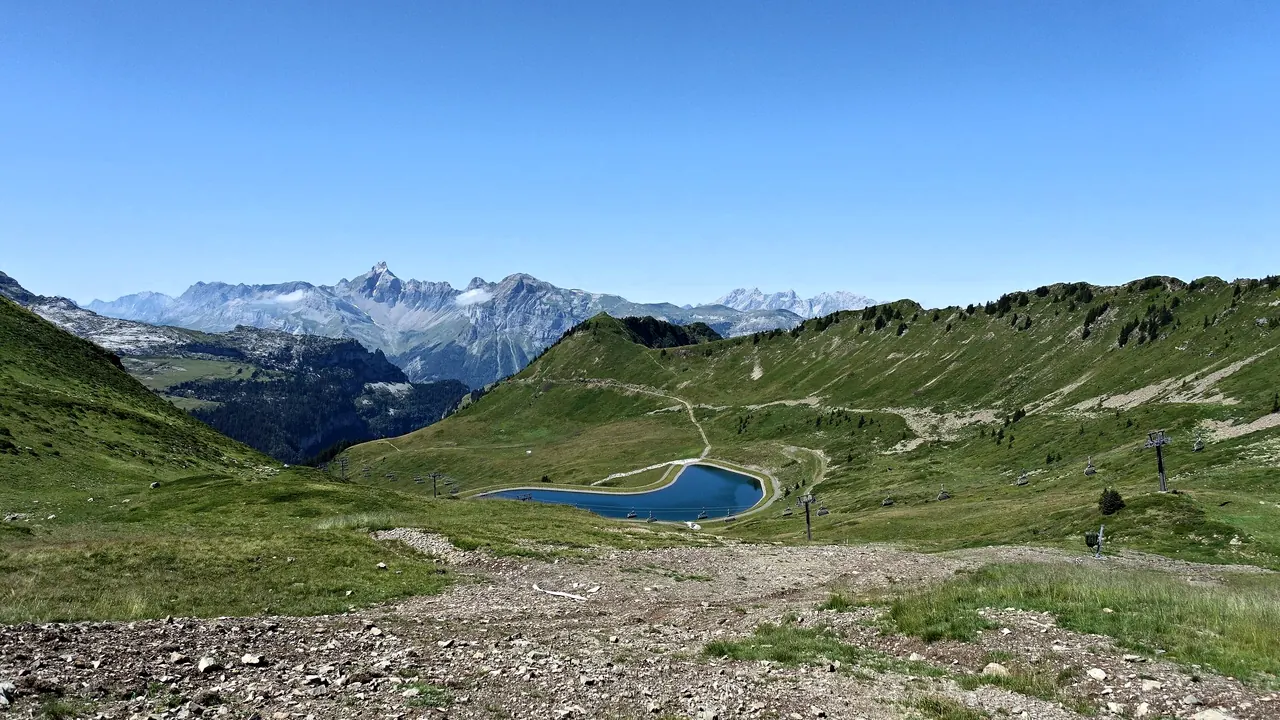
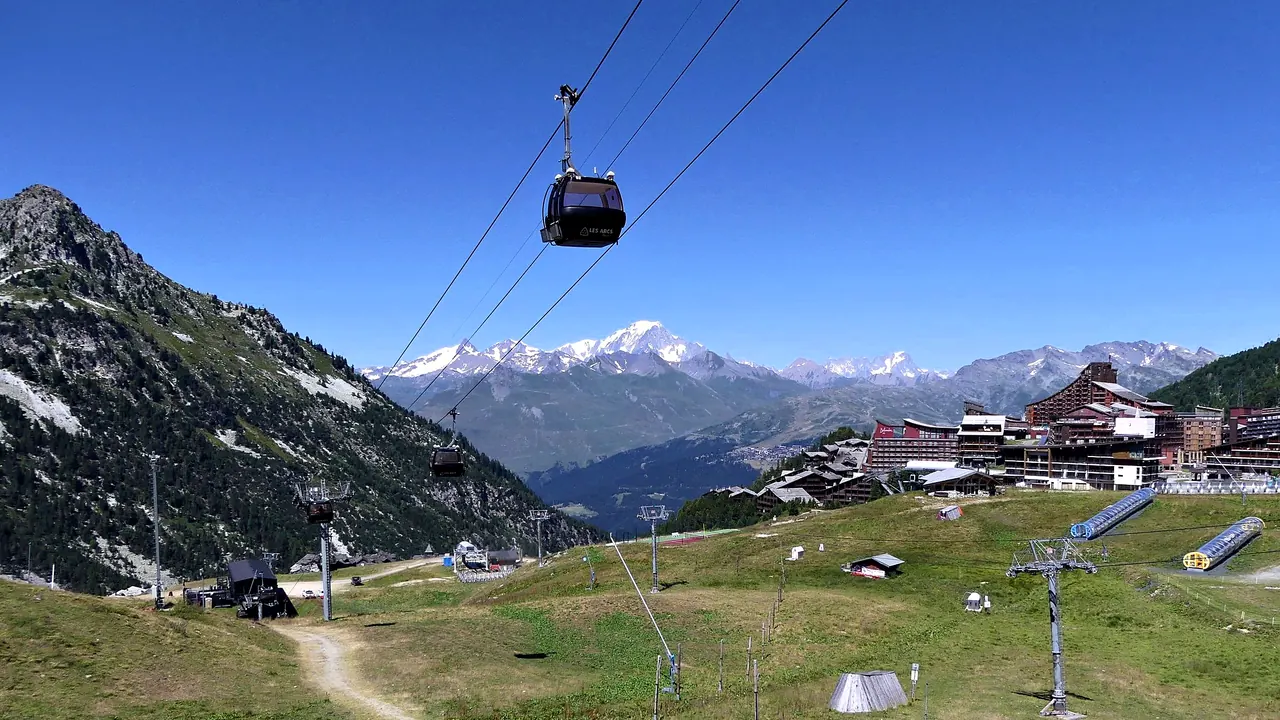
Photos: Flaine by Guilhem Vellut, CC BY 2.0, cropped; Les Arcs by Florian Pépellin, CC BY-SA 4.0, cropped.
Flaine or Les Arcs?
Our verdict in twelve categories, each scored against the same fixed benchmark cities, and the climate month by month, so you can choose for your trip.
Choose Flaine for
- day trips
- prices
- culture and sights
Flaine suits a ski week where the budget matters and the wider region is part of the plan. It is the cheaper of the two, Geneva, Chamonix and Annecy are all close enough for a day out, and Marcel Breuer's concrete resort, with sculptures by Picasso and Dubuffet in the open air, gives you more to look at between runs than most ski stations. The Grand Massif skiing is very good, even if it is lower and smaller.
Choose Les Arcs for
- live music and the arts
- getting around
- food and drink
Les Arcs is the better choice when the mountain is the whole point. Paradiski is one of the largest ski areas in the Alps, and its runs start much higher. In summer you get the Vanoise National Park, rafting on the Isère and a chamber music festival in July. It costs more, but a funicular climbs to the resort from the railway station at Bourg-Saint-Maurice, so you can arrive by train. Families also find more to do there off the slopes.
Scoreboard
Twelve categories on one fixed scale from 0 to 100. The shaded stretch is the gap between the two.
Your match
Pick a travel style or drag the sliders, and both match scores follow your weighting.
Wins on day trips and prices with your weighting.
Wins on live music and the arts and getting around with your weighting.
What matters to you?
Category by category
What the scores mean for a trip.
Beaches & swimming
Neither resort is a place to swim, and in summer the only real difference is how you get into the water. Flaine's small lake is for picnics rather than bathing. Lake Geneva and Lake Annecy are a long drive down the valley, though still closer than they are from the Tarentaise.
Les Arcs is roughly two hours from Lake Annecy or Lac du Bourget, but some of its residences have heated outdoor pools and the valley below has small leisure lakes for a paddle.
Food & drink
Both resorts serve the Savoyard repertoire of fondue, raclette and tartiflette, and in both many visitors cook in their apartments. Les Arcs gives you more choice. Beaufort comes from the surrounding valleys, old farm buildings have been turned into mountain huts for long terrace lunches, and a handful of more ambitious kitchens cook refined alpine dishes. The Beaufort cooperative and the markets in Bourg-Saint-Maurice sit right at the foot of the resort.
In Flaine the choice is narrower and shrinks once the ski season ends, so a careful dinner or a market morning means driving down to the valley towns or Annecy. What it does well is the cheese counter, stocked with Reblochon, Abondance and Tomme de Savoie.
Culture & sights
Flaine has more to show of the modernist architecture that is the main sight in both resorts. Breuer designed it as a single whole, with a building cantilevered over the cliff and a small modernist chapel, and you can walk round monumental works by Picasso, Dubuffet and Vasarely in an hour or two.
In Les Arcs, Charlotte Perriand's stepped blocks and compact interiors in the two older villages carry France's label for remarkable twentieth-century architecture. Arc 1950, built later, is only a pastiche of a traditional alpine village, and the older heritage is down in the baroque chapels of the Tarentaise.
Nightlife
Les Arcs is the livelier of the two after the lifts close, though neither is a party resort. Flaine's evenings centre on a handful of bars around the Forum, with a DJ at weekends at most, and its families and serious skiers mostly head home after dinner.
In Les Arcs, the terrace bars at the foot of the slopes have DJs and table-dancing at the liveliest spots, and Arc 1800 adds a late bar or two and a small club. Out of season, both go very quiet.
Nature & outdoors
Les Arcs goes higher and links into a far bigger ski area, with runs starting from the Aiguille Rouge at over 3,200m. Flaine's Grand Massif tops out at about 2,500m, but it has a view of Mont Blanc, a long wooded run down to Sixt and north-facing snow that holds well. In summer the fissured karst of the Désert de Platé makes for unusual hiking, though the lifts run for a shorter season.
The double-decker cable car from Les Arcs to La Plagne forms Paradiski, and its descents run all the way to the valley floor. In summer there are paths into the Vanoise National Park, home to ibex and chamois, and rafting and kayaking on the Isère.
Day trips
Flaine is the better base for days out. Geneva and Chamonix are each about an hour away and Annecy a little more. Closer in are the stone village of Samoëns, the abbey at Sixt-Fer-à-Cheval and lakeside Yvoire, as long as you have a car and patience for the winding road down.
From Les Arcs, most outings go to other mountain places, such as Bourg-Saint-Maurice, the Beaufortain cheese villages and Val d'Isère, with Annecy and Chambéry about two hours away. The summer opening of the Little St Bernard Pass to Aosta is the one real draw.
Good for families
Both were built for family ski weeks, with car-free centres, apartments on the snow and ski schools close by. Les Arcs gives children more to do off the skis, with themed fun slopes, swimming pools and ice skating, and in summer lakeside play areas and mountain-bike lessons.
Flaine has wide, gentle runs where children improve quickly, plus sledging and snowshoeing. Beyond the snow it has little, especially in summer, and the long drive up can tire small children.
Getting around
Les Arcs is easier to reach. Long-distance trains stop at Bourg-Saint-Maurice, a funicular climbs to Arc 1600 in a few minutes, and free shuttles link the villages. Those villages are spread along a winding road, though, and you cannot walk between them.
Flaine is the more compact place once you are there. Forum, Forêt and Front de Neige are joined by lifts and a shuttle, so the car can stay parked all week. Getting up means driving the mountain road or taking a transfer from Geneva airport, as the nearest station is down at Cluses.
Shopping & style
Nobody chooses either resort for shopping, though Les Arcs has a little more, with outdoor clothing and equipment as well as ski rental, and Beaufort, charcuterie and génépi in Bourg-Saint-Maurice. Flaine stops at ski shops, delis and a few souvenir counters in the Forum. Its advantage is that Annecy and Geneva, with real shops, are a shorter drive away.
Affordability
Neither is cheap, but Flaine is the easier one on the wallet. In both resorts the lift pass, hire and lessons make up most of the bill. In Les Arcs the pass covers a much bigger linked area and costs more for it, and mountain meals add up quickly.
Both are mostly self-catering apartments rather than luxury hotels, so cooking for yourself saves money in either. In both, January, late March and summer cost noticeably less than the French school vacation weeks.
Live music & performing arts
Les Arcs has the one real musical event of the two, a summer classical festival held since the 1970s, when chamber concerts and a music academy fill its halls and chapels for a few weeks in July. Flaine has no theatre, concert hall or festival, and for an evening of music you go to Annecy or Geneva. In winter both offer little more than bands at après-ski.
Wellness & relaxation
The two are broadly level. In both, wellness means the pools, saunas and steam rooms in residences and hotels, though Les Arcs has several proper spas aimed at tired skiers. For thermal water, Les Arcs is about an hour from Brides-les-Bains and Salins-les-Thermes, while from Flaine you go down to the spa towns of the Chablais and Lake Geneva. Flaine's own appeal is its car-free quiet, and Les Arcs is calmest in summer and the shoulder weeks.
When should you go?
Pick your month. The climate figures are measured averages, not a forecast.
Flaine in July
Les Arcs in July
Daytime high, °C
Rainfall in the month, mm
Where the figures come from
Flaine has no weather station within reach, so its figures come from a gridded climate model rather than a measured record, and read a broad area rather than one spot.
Les Arcs's temperatures are measured 43 km from the centre, at Grand St. Bernard / Grand Saint Bernard.
Les Arcs's station stands 199 m above the city centre, so the centre is likely a little warmer than the figures say.
Les Arcs has no rain gauge within 25 km of the centre, so its rainfall comes from a gridded climate dataset read at the destination rather than from a gauge further away.
Temperature and rainfall are climate normals, averaged over the years shown. Flaine: 2001-2020 normals, NASA POWER reanalysis grid, no weather station within 90 km. Les Arcs: 1991-2020 normals, Grand St. Bernard / Grand Saint Bernard (43.4 km from centre).
Neither resort ever gets warm enough for a beach trip. Their seasons run on snow in winter and walking in summer. Flaine is the milder of the two. Its daytime highs stay below freezing from December to February and reach about 18°C in July and August, and its rain is spread fairly evenly through the year. That makes June to September comfortable for hiking on the Désert de Platé.
The climate figures for Les Arcs run several degrees colder. Highs stay below freezing from November right through March and reach only about 12°C in midsummer, so the cold lasts well into spring and summer days are fresh rather than warm. It is also the wetter of the two, at its wettest in November with 193mm, while July and August are drier and the sunniest months, with around 211 hours of sun in July. December is very dark.
Which traveller are you?
On a trip on a tight budget, Flaine is the better pick. A week there costs less overall, the apartments are modest and cheap to cook in, and in summer, when the lift pass stops being the main cost, it gets cheaper still.
For an outdoors trip, Les Arcs wins. Paradiski's long descents from over 3,200m and the glacier views give it the bigger winter. In summer it adds the Vanoise National Park and its wildlife, a bike park and rafting on the Isère.
For a culture and arts trip, Flaine has more to see. You can walk through Breuer's planned modernist resort past works by Picasso, Dubuffet and Vasarely, and Annecy and Geneva are close. Music lovers coming in July should look at Les Arcs and its festival instead.
Before you go
| Measure | Flaine | Les Arcs |
|---|---|---|
| Official language | French | French |
| Currency | Euro (EUR) | Euro (EUR) |
| Sockets | CE230 V, 50 Hz | CE230 V, 50 Hz |
| Driving side | Right | Right |
| Time zone | UTC+1, UTC+2 in summer | UTC+1, UTC+2 in summer |
| Emergency number | 112 | 112 |
| Elevation | 1,600 m | 2,273 m |
| Main airport | Geneva International Airport (GVA)52 km from centre150 non-stop destinations | Geneva International Airport (GVA)92 km from centre150 non-stop destinations |
| Public holidays this year | 11 days | 11 days |
By the numbers
| Measure | Flaine | Les Arcs |
|---|---|---|
| Museums within 10 km | 0 | 0 |
| UNESCO World Heritage sites within 50 km | 2 | 0 |
Where else could you go?
Every comparison below shares a destination with this one, so you can follow Flaine or Les Arcs somewhere new.
- La Rosièrevs Les Arcs
- Samoënsvs Flaine
- La Plagnevs Les Arcs
- Saint-Gervais-les-Bainsvs Flaine
- Tignesvs Les Arcs
- Chamonixvs Flaine