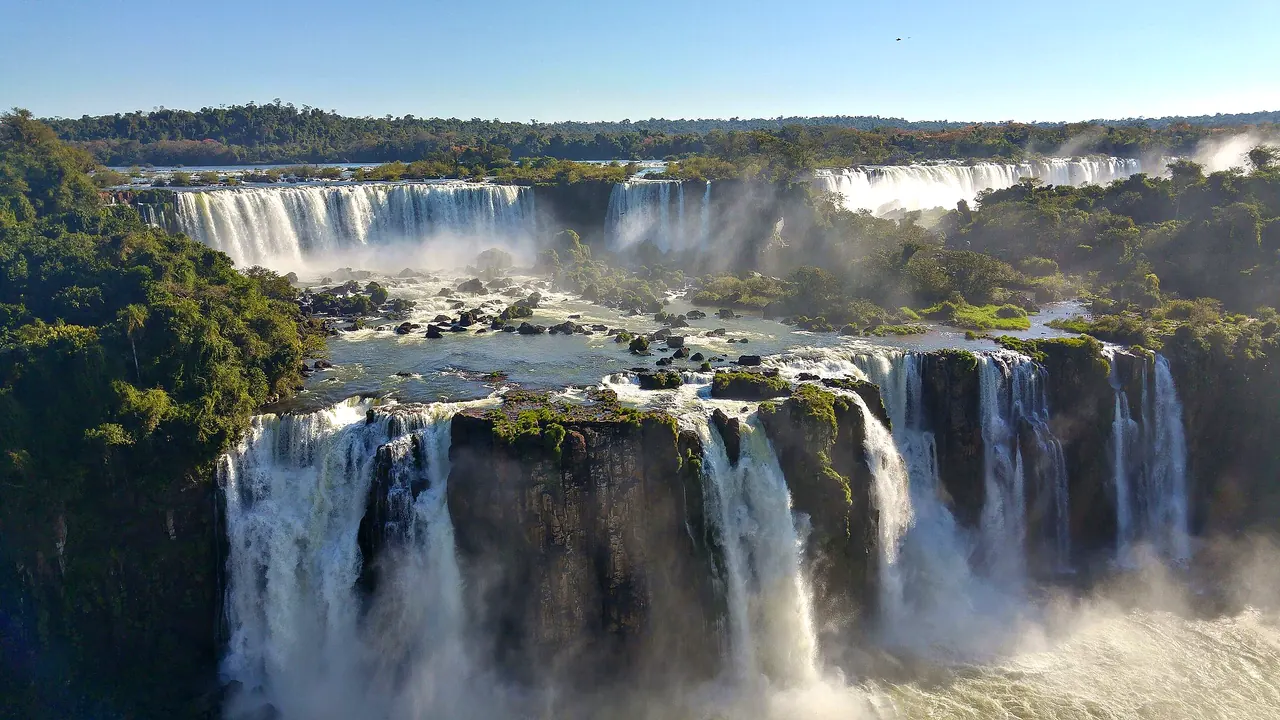
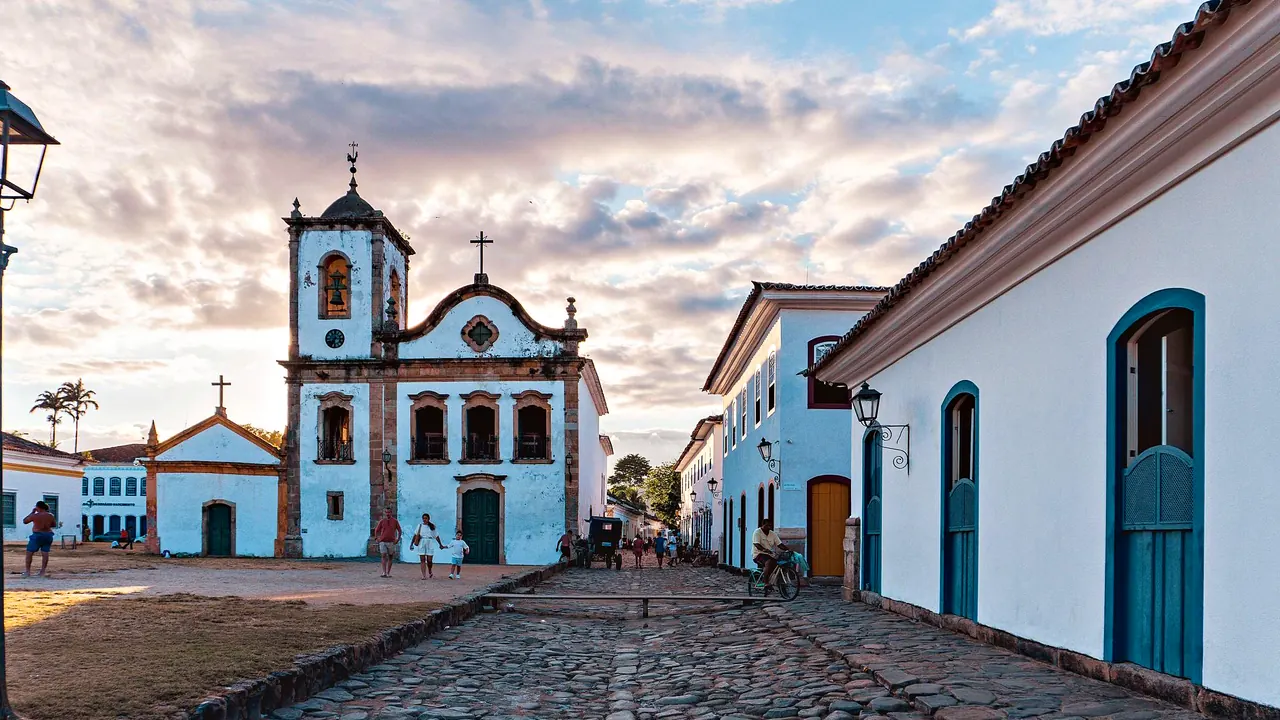
Photos: Foz do Iguacu by Gabriel Resende Veiga, CC BY-SA 4.0, cropped; Paraty by Gabriel Zachi, Pexels License.
Foz do Iguacu or Paraty?
Our verdict in twelve categories, each scored against the same fixed benchmark cities, and the climate month by month, so you can choose for your trip.
Choose Foz do Iguacu for
- families
- prices
- nature and the outdoors
Foz do Iguaçu is the choice when the whole trip turns on one great natural sight. You can see the falls from both the Brazilian and Argentine banks, take a boat into the spray and spend an afternoon at the bird park, which makes for a few easy, absorbing days, especially with children, and day-to-day costs are lower. The town itself is plain and modern, evenings are quiet and you will spend a fair amount of time in cars.
Choose Paraty for
- beaches
- culture and sights
- wellness
Paraty suits a slower coastal stay, where a beautiful colonial town comes with boat days on a warm bay. It is well ahead for beaches, for historic atmosphere and for unwinding in a garden pousada, and its rainforest, waterfalls and the Mamanguá inlet give it plenty of nature of its own. It is best for couples and for travellers who would rather stay in one place than tour.
Scoreboard
Twelve categories on one fixed scale from 0 to 100. The shaded stretch is the gap between the two.
Your match
Pick a travel style or drag the sliders, and both match scores follow your weighting.
Wins on families and prices with your weighting.
Wins on beaches and culture and sights with your weighting.
What matters to you?
Category by category
What the scores mean for a trip.
Beaches & swimming
Foz do Iguaçu has no coast. The nearest you get to a beach is the sandy lake shores on the Itaipu reservoir, half an hour or more away by car, so most visitors swim in the hotel pool between visits to the falls.
Paraty is a real beach destination, though the beaches in town are the weakest part of it. Boat trips go out to forested islands and coves with calm, warm water, and Trindade adds wider open-sea beaches and a clear rock pool. Wilder bays such as Praia do Sono are reached on foot through the forest or by boat.
Food & drink
Neither town is a place to travel for the food, and they differ more in kind than in quality. Foz eats like a border city: rodízio at the churrascarias, Lebanese esfihas and kibbeh from its large Arab community, and Argentine parrillas with Malbec across the bridge in Puerto Iguazú.
Paraty cooks from the sea, with grilled fish, shrimp and the local banana-tinted fish stew, served in candlelit townhouses in the old town. Its other draw is cachaça, which you can taste at small distilleries in the hills outside town.
Culture & sights
Paraty is the stronger choice here because the town itself is the sight. Its grid of colonial houses, built on the gold trade and listed by UNESCO, is a pleasure to wander, with Santa Rita church on the waterfront and the fort on the hill as the landmarks.
Foz has no historic core. What it offers is unusual rather than old: a tour inside the huge Itaipu dam, a white-domed mosque, a Buddhist temple looking towards Paraguay, and the point where three countries meet across the rivers.
Nightlife
Neither town offers much of a night out, and in both an evening usually means a long dinner. Foz has a short strip of bars with a local student crowd, a few clubs open late at weekends and casinos over the borders. Paraty has no clubs but more atmosphere: live guitar in old-town bars, streets that stay lively on summer weekends, and beach parties for backpackers at Trindade.
Nature & outdoors
Both are superb for nature, and Foz has a slight edge because few sights anywhere match the falls themselves: hundreds of cascades spread across rainforest in two national parks, with boats running into the spray and coatis, toucans and butterflies all around.
Paraty is more varied than spectacular. You can hike the old Gold Trail or slide down a waterfall in the Serra da Bocaina, then kayak, paddleboard or snorkel among the islands of the bay, and the fjord-like Saco do Mamanguá has a steep climb to a viewpoint.
Day trips
The day trips are a modest extra in both towns. From Foz, the novelty is crossing borders: you visit Puerto Iguazú along with the Argentine side of the falls, and go to Ciudad del Este to shop. The Jesuit missions are too far for a day.
From Paraty, the obvious outing is the beaches of Trindade, and you can also visit the potters of Cunha in the hills or the larger beach town of Ubatuba. Ilha Grande deserves a night or two of its own.
Good for families
Foz do Iguaçu is the easier place to bring children. The main walkway at the falls is short, with a lift at the end, the noise and the wildlife keep children interested, and the Parque das Aves lets them walk among macaws and flamingos. Resort hotels with pools make a comfortable base.
In Paraty children enjoy the boat days, the rock pools and the waterfall slide, but there is nothing built for them, and the old town's huge cobbles are hard work with a pushchair.
Getting around
Paraty is slightly easier to manage. Its car-free centre takes ten minutes to cross, though the rounded stones slow you down. Boats leave from the quay for the bay, buses run to Trindade, and you need a taxi or a tour only for the waterfalls, the distilleries and Mamanguá.
In Foz the sights lie outside town. The falls are about 20km away on a direct bus route, Itaipu is on the other side of town, and visiting the Argentine side usually means a taxi or a transfer through two sets of border posts.
Shopping & style
Shopping is a minor part of either trip, and the two offer different things. Foz is about bargains: the crowded discount galleries of Ciudad del Este across the bridge, duty-free shops at the border and gemstone souvenirs. Paraty is about browsing: galleries, linen boutiques, indigenous basketry and bottles of local cachaça in colonial shopfronts, which makes for a nicer evening stroll.
Affordability
Foz do Iguaçu is cheaper to stay in. Mid-range hotels, buffet lunches, churrascaria dinners and buses all cost little, and what adds up is the park entry fees, boat rides and tours at the falls.
Paraty charges resort prices for pousadas and restaurants in the historic centre, and room rates climb steeply on long weekends and at festivals. Shared schooner trips, beach kiosks and staying just outside the old town keep the costs reasonable.
Live music & performing arts
For a show in Foz, the main option is a folk-dance dinner staged for tour groups, running from samba to Argentine tango and Paraguayan harp music. Beyond a small municipal theatre and the odd concert, there is no orchestra and no music scene to speak of.
Paraty has more to offer, though most of it is informal. Samba and bossa nova are played in the old-town bars in the evenings, the town has a long tradition of puppet theatre, and its festivals bring concerts and street performance. Outside festival time, though, there is little formal programme to attend.
Wellness & relaxation
Paraty is better for switching off. Out of season the car-free old town is quiet, the best pousadas have gardens, hammocks and pools, and small retreats in the forest and along the bay offer real seclusion.
In Foz, relaxing means a rest day at one of the larger resort hotels on the road to the falls, which have spas and pools, between busy days of sightseeing among the crowds.
When should you go?
Pick your month. The climate figures are measured averages, not a forecast.
Foz do Iguacu in July
Paraty in July
Daytime high, °C
Rainfall in the month, mm
Where the figures come from
Paraty has no weather station within reach, so its figures come from a gridded climate model rather than a measured record, and read a broad area rather than the city itself.
Temperature and rainfall are climate normals, averaged over the years shown. Foz do Iguacu: 1992-2020 (sunshine 1991-2020, rainfall 1991-2020) normals, Foz Do Iguacu Aeroporto (2.6 km from centre). Paraty: 1991-2020 normals, TerraClimate 4 km grid at the town, no weather station within 90 km.
Foz do Iguaçu has a hot, sticky summer and a mild, drier winter. From October to March daytime highs sit between 30°C and 33°C under heavy humidity, and October to January is the wettest stretch, though this is also when the river is fullest and the falls are at their most powerful. June to August are the comfortable months for long days on the walkways, with highs in the low to mid twenties and July the driest month, though the midwinter days are the least sunny. With no sea, the timing is about the falls, not about swimming.
Paraty is never quite as hot, but its summer is much wetter: January to March each bring more than 300mm of rain, mostly in afternoon downpours. The sea is warmest in those months at 27°C and stays pleasant for swimming into May, then cools to about 21°C by August. May to September is drier and better for walking the old town and hiking, so for a trip that takes in both cities, the southern winter suits each of them best.
Which traveller are you?
For a beach and sun trip, Paraty is the only real option. Schooners take you to warm, calm coves in the bay, and Trindade has open-sea beaches and the still rock pool at Cachadaço. Foz is far inland, with lake beaches and hotel pools.
On a family trip with children, Foz do Iguaçu works better. The short, gentle walkway at the falls, the coatis on the paths and the walk-through aviaries at the bird park hold children's attention, while Paraty's uneven paving defeats pushchairs and it has no attractions built for children.
On a culture and arts trip, Paraty has more to offer. Its whole UNESCO-listed centre of whitewashed colonial houses and baroque churches is worth a day of slow walking. Foz has the Itaipu dam and two striking religious buildings, but no old town at all.
Before you go
| Measure | Foz do Iguacu | Paraty |
|---|---|---|
| Official language | Portuguese | Portuguese |
| Currency | Brazilian Real (BRL) | Brazilian Real (BRL) |
| Sockets | CN60 Hz | CN60 Hz |
| Driving side | Right | Right |
| Time zone | UTC-3 | UTC-3 |
| Emergency number | Police 190, ambulance 192, fire 193 | Police 190, ambulance 192, fire 193 |
| Elevation | 164 m | 5 m |
| Main airport | Cataratas International Airport (IGU)12 km from centre10 non-stop destinations | Rio de Janeiro Galeão – Tom Jobim International Airport (GIG)157 km from centre54 non-stop destinations |
| Public holidays this year | 14 days | 14 days |
By the numbers
| Measure | Foz do Iguacu | Paraty |
|---|---|---|
| City population | 285,415 | 47,668 |
| People per km² | 462 | 51 |
| Museums within 10 km | 1 | 2 |
| UNESCO World Heritage sites within 50 km | 1 | 1 |
| Swim season, months above 21 °C | - | 12 months |
Where else could you go?
Every comparison below shares a destination with this one, so you can follow Foz do Iguacu or Paraty somewhere new.
- Puerto Iguazuvs Foz do Iguacu
- Rio de Janeirovs Paraty
- Sao Paulovs Paraty
- Buziosvs Paraty
- Florianopolisvs Paraty
- Florianopolisvs Foz do Iguacu